The submorphemic Aristotle
John Bjarne Grover
Abstract: The paper presents an alternative reading of some of Aristotle's fundamental concepts in his Categories, Physics and Metaphysics for showing that there exists a level of theoretic abstraction in his philosophy which approximates my fundamental theorems of logic and linguistics. This makes it possible to construct a reading of Aristotle which turns his philosophy into a formal description of a submorphemic level of language, and the study outlines how this can be defined via probabilistically based features. It would have been the prominent role of Aristotle for the history of philosophy which thereby lends credibility to this conjectured submorphemic signification in language. Since my fundamental theorem of logic measures truth as flux of information from eternity into history, and hence it models the human faculty of faith, this explains also the role of Aristotle for christian theology, which furthermore supports the conjectured description of the submorphemic level of language and prechristian philosophy.
The study is in two parts: Part 1 outlines the theoretic basis and part 2 discusses examples of interpretation of central concepts from Aristotle's works.
Text sources for the examples are from the internet references at the end of the file, slightly adjusted in a few places on basis of the Loeb editions.
Contents overview:
Part 1:
1. The background of this interpretation of Aristotle
2. Aristotle reinterpreted
3. The οὐσίαι - the 'substances'
4. The word συμβαίνειν in Aristotle's Categories (6 examples)
5. The generalized subfeatures
6. στοιχεῖον = 'summation sign' in Aristotle's Physics (23 examples)
7. The 23 occurrences of στοιχείον in Physics relative to Distinctive feature theory
8. Conclusion to part 1
Part 2:
9. Do Aristotle's concepts apply to the entropy equation?
10. αἴτια = the plus/minus sign (Physics 5 examples)
11. ἀρχαί = initial subscripts (Physics 5 examples)
12. ἐνυπάρχειν = subscripts (Physics 17 examples)
13. ὕλη = logarithm (Physics 5 examples)
14. μορφή = base of logarithm? (Metaphysics 5 examples)
15. σχῆμα = the equation sign (Metaphysics 9 examples)
16. ἰδέα = the flux of information (Metaphysics 2 examples)
17. εἶδος = nesting loops (Metaphysics 4 examples)
18. τὸ τί ἦν εἶναι = the numerators (Metaphysics 8 examples)
19. ὑποκείμενον = the denominator (Metaphysics 8 examples)
20. Some concluding remarks
The background of this interpretation of Aristotle
It was in Budapest in 1991 when I worked on my MA thesis about probabilistic grammar and tried to find a formal definition for syntactic dependency in language that I found the following definition - which I later have come to recognize as the fundamental theorem of logic:
For a reader unaquainted with probability and information theory, I can refer to my MA thesis pages 23-30 for an easy introduction to the basic concepts needed for understanding this formula. 'Entropy' is a concept for the measure of information (in the technical sense which is described in my MA thesis) that goes through a stream. The more unpredictable an event is, the more technical information is there in it: If you get surprised by an event, it has more technical information than if you could guess it in advance. Information in a series of events such as alphabetic letters in a text is dependent not only on the average surprise value of a letter but also on the surprise value in the context it appears in: The letter 'q' is rather rare in english, and hence the probability p(q) of 'q' is a small value, say, it could be p(q) = 0,01 which means 'once every 100th letter', which is less than the average among 25 letters which is 0,04. However, if you measure the surprise value of 'q' in the immediate context before 'u', you can perhaps find that it is much higher since 'question', 'queue', 'quiet', 'quick' and many others gives an overrepresentation of 'q' before 'u' which gives it less information value because its frequency before 'u' is higher. In particular if you ask what is the probability that after a 'q' there follows a 'u', the probability would be high and the surprise value low - which means small information value. This is called 'dependent probability': The dependent probability that a 'b' will occur in the context of an 'a' is called p(b|a) = 'the probability of b given a'. See my MA thesis pages 26 for the technical information value for this p(b|a) as
I = – log p(b|a).
Logarithm is the principle of exponency: 2 * 2 * 2 = 8 which also can be written 23 (two in the power of three) and then one says that the base is 2 while the exponent is 3. Then 2 * 2 * 2 * 2 * 2 = 23+2 = 25 = 32 which means that for logarithms one adds in the exponent what otherwise must be multiplied in the base. Logarithms can be fractions and not only integer numbers, but then it is more difficult to visualize by 2 * 2 with only a fraction of one of the 2's. The following discussion shows how Aristotle's concept of ὕλη (normally translated as 'matter' or 'woodland') can be seen as equivalent to the 'logarithm' in the fundamental theorem of logic. (That is not because of a naive idea of english 'log', but it is true that trees spread out 'logarithmically'). The MA thesis describes in a simple way why logarithms are used and why it is a negative value (that is because logarithms are negative between 0 and 1, and probabilities are in the standard theory always between 0 and 1 and are therefore negative, for which reason the information value, which is not negative, needs a negation sign for making it positive). Now consider a syntactic combination of NOUN + VERB for an elementary SENTENCE construction. In the category called NOUN - here called the category 'A' - there can be a number of nouns such as 'house, man, tree...' which is called 'a1, a2, a3, ...ai'. These will have absolute probabilities called 'p(a1), p(a2), p(a3), ... p(ai)'. The absolute probability of this category A will then be the sum of all these probabilities from elements 1,2,3...i written ∑i p(ai). The summation sign ∑i means that one adds together all the elements called 'i' which means those which count from a1 up to ai. The ∑j p(bj) sums and counts all the b1 up to bj for the category 'B'. The information value of the category 'A' (say, NOUN = 'house, man, tree...') will then be I(A) = ∑i - log p(ai) = - ∑i log p(ai), the sum of the information in all the elements that are considered part of the category. Likewise, the information value of a category B in the context of a category A, for example VERB in the context of NOUN, will then be I(B|A) = - ∑i log p(B|ai). The formulaic expression of counting the probabilities of all elements in A in the context of the probabilities of all elements in B is - ∑i∑j p(ai|bj), which means running first through all probabilities of elements b indexed by 'j' in the context of a1, next running through all probabilities of element b indexed by 'j' in the context of a2 up to running through all probabilities of elements indexed by 'j' in the context of ai - which means a total of i*j - this is in effect a multiplication matrix written ∑i∑j. This means that ∑i∑j means two nesting loops: If there are three elements a1, a2, a3 in a category A and the same b1, b2, b3 in category B, the combined summation signs ∑i∑j (which also can be written ∑i,j) means that one must sum up 9 values altogether when running through the two nesting loops of ∑i∑j for the combined aibj - hence ∑i∑j p(aibj) = p(a1b1)+p(a1b2)+p(a1b3)+p(a2b1)+p(a2b2)+p(a2b3)+p(a3b1)+p(a3b2)+p(a3b3). Entropy is a measure on the information flux through a category (or a 'stream'). It really measures the way that the probabilities vary. For example, if there are four elements in a category and these are completely equiprobable, i.e. they occur with maximal regularity and predictability, the information value of each of them (with logarithms on base 10) will be I(A) = - ∑i log p(ai) = 4 * log(0,25) = 4 * 0,602059991328 = 2,408239965312. If three of them has probabilitiy 0,3 = 3*0,3 = 0,9 and the fourth has probability 0,1 for the total of 0,9 + 0,1 = 1,0, the information value in this category will be 3 * 0,52287874528 + 1,0 = 1,56863623584 +1,0 = 2,56863623584 - which is bigger than for the equiprobable distribution. Hence distributions with equiprobability have a smaller information value than distributions of non-equiprobability, which means that higher variability of the occurrences increases the information value (which is natural since complete equiprobability such as in an even pulse means that it is very easy to guess the next occurrence). This is what entropy (called 'H' - the greek big 'eta' for 'E' = 'entropy') measures - the flux of information through a category. When this is measured against other categories, the probabilities are weighted for their relative probability, such that the entropy H of a category A = a1, a2... an is computed as
H(A) = - ∑i p(ai)/p(A) log p(ai)/p(A)
Since each probability here is weighted against its relative occurrence, it can be calculated against other entropies of other categories computed in a similar way. The entropy of a compound aibj, when for example A = noun roots and B = grammatical morphs which can be attached to it, or A = noun and B = verb, is consequently the simple
H(AB) = - ∑i∑j p(aibj)/p(AB) log p(aibj)/p(AB)
Conditional entropy is the measure on probability distribution in a category B when it occurs dependently relative to a category A, such as morphs relative to roots. Conditional entropy behaves much like conditional information value. A certain morph category B can occur in many contexts in a corpus but the entropy measure of B in the context of the root category A will not be the same as the entropy of the category B (or A) considered independently. The conditional entropy of B relative to A is computed by stopping at all A in the corpus and then counting how many times a B follows in the neighbourhood of A. The probability of the compound p(AB) globally in the corpus is normally defined as the probability of A = p(A) multiplied with the probability of B in the context of A = p(B|A). That is, p(AB) = p(A) p(B|A). One can count the number of AB's in a corpus and compute their probability, and one can count the number of B's in the neighbourhood of A's and compute the relative probability independently - and then counting discrete symbols in a finite corpus will prove that the mathematical relation H(A) + H(B|A) = H(AB) is valid. That is when the symbols are discrete and the corpus is finite.
This is the one out of the laws which apply to this - the addition and commutative laws of conditional entropies. The addition law is this H(A) + H(B|A) = H(AB) - which means that the entropy of category A plus the conditional entropy of category B in the context of A equals the entropy of the compound AB. The commutative law says that H(A) + H(B|A) = H(B) + H(A|B), which means that the addition law applies equally when the dependencies of the relation are imposed on either A or B. Now since
H(B|A) = - ∑i p(ai) ∑j p(bj|ai)/p(B|ai) log p(bj|ai)/p(B|ai)
and
H(A) = - ∑ p(ai)/p(A) log p(ai)/p(A)
and since ∑j p(bj|ai)/p(B|ai) = 1.0 for all ai, this can be inserted into the expression for H(A), which then gives
H(B|A) + H(A) = - ∑i∑j p(ai)p(bj|ai)/p(A)p(B|ai) log p(bj|ai)/p(B|ai) - ∑i∑j p(ai)p(bj|ai)/p(A)p(B|ai) log p(ai)/p(A) = - ∑i∑j p(aibj)/p(A)p(B|ai) log p(aibj)/p(A)p(B|ai)
while the entropy of the compound AB is given by
H(AB) = - ∑i∑j p(aibj)/p(AB) log p(aibj)/p(AB) = - ∑i∑j p(aibj)/p(A)p(B|A) log p(aibj)/p(A)p(B|A)
This tells that H(A) + H(B|A) = H(AB) means that
The two sides differ in the denominator only - in the dependency relation of the element on the lefthand side with the category on the righthand side. The equation tells the entropy as the flux of information from eternity into history through the combination of elements ai and bj belonging to categories A and B. It turns out that the equation is valid only for the case of complete (dependent) equiprobability of the ai - which then is identical with the dependent probability of the category A. Since this equiprobability never happens in language, there are two ways to rescue the equation nevertheless (this is not standard theory - this is my own):
1) The semantic solution is to define something called 'semantics' onto the situation for lifting the principle of 'equiprobability' from referring to 'equiprobability of occurrence' onto referring to 'equiprobability of meaning' - that is, the probability that the meaning of a sign is the same every time it occurs. Since this clearly is not the same, it is assigned the status of being the same nevertheless by way of the principle of semantics which thereby will claim that the occurrence is 'equiprobable' if one takes meaning into account. Hence the principle of equiprobability can be rescued nevertheless and the historic humans can live in fancied harmony with eternity - even if clearly the solution looks like a piece of philosophical humbug for calming the confused humans down. The equation can thereby be taken to be an account of how or why meaning arises in language: It is a smart trick for bringing the historic humans in harmony with the eternity. Alternatively, one could say that it is for bringing physics in harmony with metaphysics - or simply the body in harmony with the genetics. It can be assumed to be the basis for how or why humans have thoughts which can be formalized.
2) The syntactic solution for rescueing the equation (such that the value is the same on both sides of the equation sign) is to define a theoretic and temporary 'reduced/distorted reality' which allows for the sum of probabilities in a distribution to differ from the unity 1,0 which it per definition has or should have. If this means that the summation is done over only a part of the corpus (while the remaining part is temporarily 'sacrificed to the gods'), and the part of the whole need not be the same on either side of the equation sign, then one can see this solution as a principled account of how or why categories arise in language.
In effect, the combination can be seen as a principled account of how or why language (with semantics + syntax) arises.
Solution 1) can also be seen to be a definition of the need for Euclid's fifth axiom (the parallel axiom) and solution 2) a definition of the need for Euclid's fifth common notion (telling that the whole is bigger than the part). The need for the parallel axiom has always been disputed - this led to János Bolyai's non-euclidean geometry - and here one can seen the basis for disputing his fifth common notion as well, which is my idea.
After having completed my MA degree in the spring 1992 I started working in the autumn 1992 on a project of the history of linguistics relative to the history of information technology (which concerns also this idea of human thoughts that can be formalized) and came to the conclusion that the theories of a formal description of language came to develop stepwise through the levels of linguistic constituents (phoneme, morpheme, phrase) in parallel with levels of information technology. It was possible to see the formal description of the word level as being established around the time of Christ and the phrase level around a millenium later - assuming the printing technology to have its root around the year 1000 - and the sentence level is reached around 2000 with the computer technology. This should suggest that a submorphemic level could have defined the millenium from 1000 BC to the birth of Christ. This would be controversial, though. I therefore started reading Plato and Aristotle in search of this submorphemic level of theories of language. I read most of Aristotle's relevant works and soon found - on basis of studies of the greek source of his works - that it probably would be possible to see the outlines of this theory if one imposes a rather radical re-interpretation of his fundamental concepts - which would alter the standard understanding of their philosophical meaning. I concluded on basis of my studies of primarily his Metaphysics, Physics and Categories that such a radical reinterpretation probably would be possible - in which case one could arrive at a theory of a pre-christian theory of a submorphemic signification related to the elemental theories (on the greek 'stoikheion') which were standard in those days and which look a little odd today - that the philosophers believed that the world was composed of the basic elements water, air, earth and fire. They could not really mean that - more or less heated mud with air bubbles? Clearly it must have been something more sophisticated - but I could not find a solution for how it should be understood.
In 1993-94 I wrote the book 'Submorphemic signification' - on that single issue whether there exists an empirical basis for assuming that such a level of submorphemic meaning exists in language (beyond the trivial onomatopoetics and mama-papa level). I concluded in the book that such a level probably exists. It was at that time and it maybe still is considered controversial that a level of active signification below the morpheme should exist in normal human language - but I found that there were reasons for considering this theory seriously.
I put the speculations aside and included my 1992-1993 study 'The history of linguistics and information technology' (written at the 'Centre for technology and human value' in Oslo) - later expanded with a parallel history of logical paradoxes - as book 2 in my 1997 PhD dissertation 'A waist of time' which landed on the observation that from the historic viewpoint of parallel developments in these three fields of knowledge (history of formal description of language, levels of information technology, logical paradoxes), it could be concluded that a logical paradox is the same as a grammatical category. It could mean that a category must contain more than complete equiprobability - and hence the logical paradox is that the two sides of the above entropy equation are not the same.
Although I discovered the above-mentioned equation as a formalism for the information flux from eternity into history in 1991 (it has been on my homepage since 2007), the articulation of the two 'repair methods' for solving the problem is more recent. I have defined two fundamental theorems:
1) The fundamental theorem of linguistics tells that 'two and only two items can be the same across different realities'. This really means that the human reality is limited and there are transcendent phenomena that we cannot perceive or even understand but that contribute to giving shape to our reality. The theorem means that two metaphysical items appear to us as 'the same' because we cannot perceive the factual difference between them, and it is this flaw in our perception (and cognition about and categorization of it) that gives rise to ontological referents (the physical world) and thereby also metaphysical redundancies which also give rise to what we understand as causalities. It is this conflation which makes two different 'items' (from two potentially different metaphysical realities) in our understanding of them collapse into one single ontological referent onto which a 'linguistic' item is semiotically attached in a clumsy human attempt to preserve the originally transcendent difference between them. The theorem is rather radical in this sense of it: It says that ontological reality - the existence of the physical world - arises from this collapse by the conflation of originally different metaphysical 'items'. Why, as tells the theorem, two and only two such items? Why cannot three items be 'the same' in this sense of it? Because then it would be a matter of categorization and not of metaphysical 'conflation' into 'identity' sufficient for the ontological existence of this 'item' or 'items'. It would be this attachment of two different metaphysical realities to each other (by way of this conflation of two items, one from each of the realities, by the human mind which thereby attaches their spiritual existence into one ontologically physical referent) which lends to them a certain 'inertia', a dependency relation (like those A's and B's discussed above), an inertia which is recognized by humans as 'gravity'. It means that cosmic gravity is a result of human deficiencies in the understanding of the metaphysical world. Mystic inquiry tries to dissolve these conflations (misunderstood identities) in order to recognize and re-establish the original integrity of the metaphysical items or realities in which they are found: An example could be these probably 'ex nihilo' formations - by their 'ex nihilo' status (here assumed to be extraordinarily crossing the border from metaphysics to physics) they are telling in the physics of what is in the metaphysics:
|
|
|
|
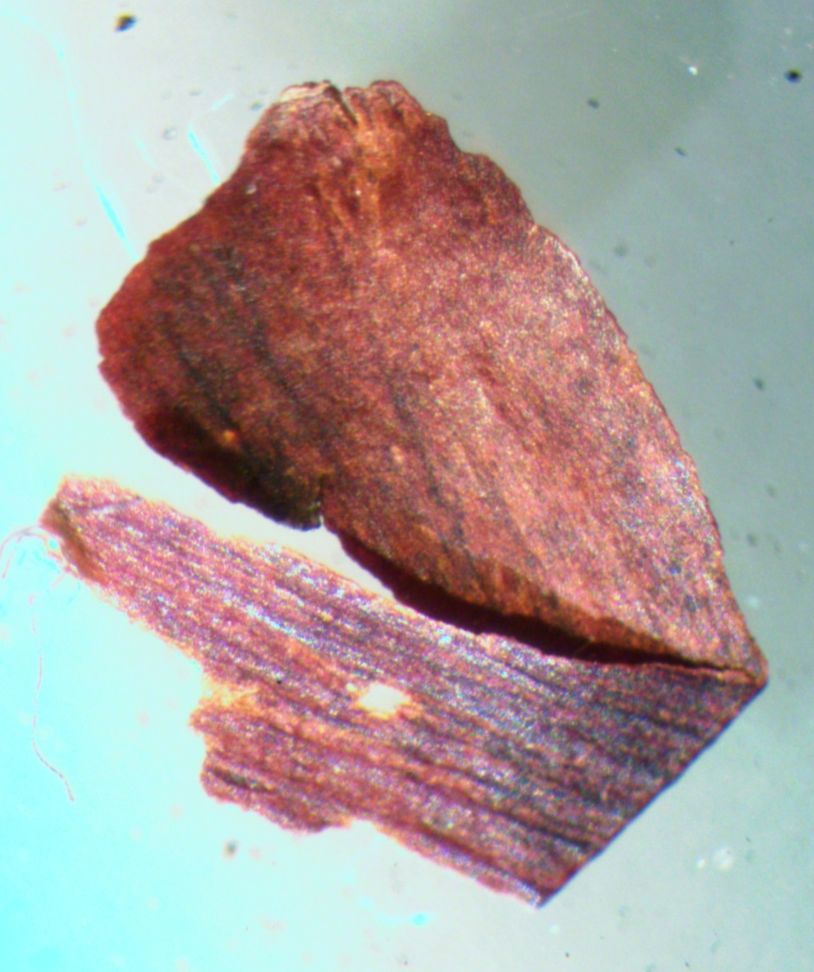
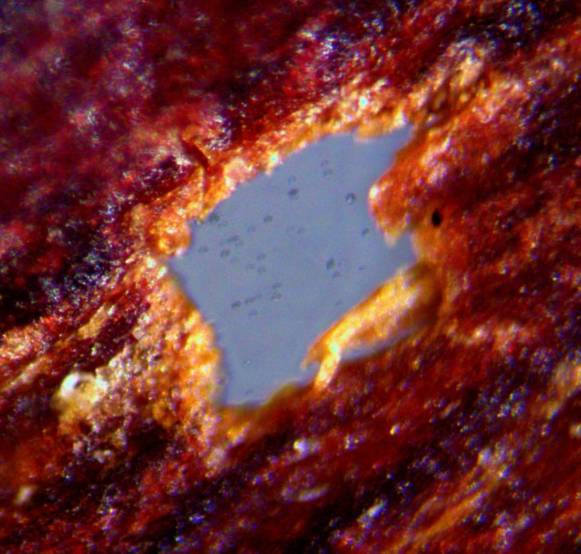
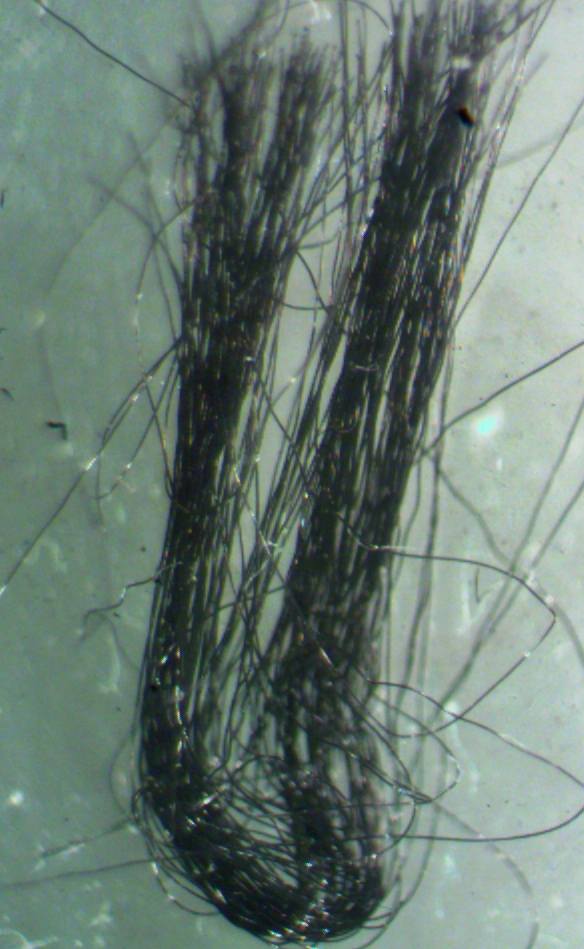
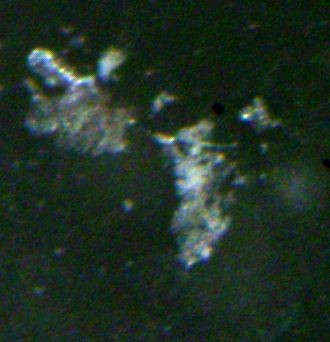
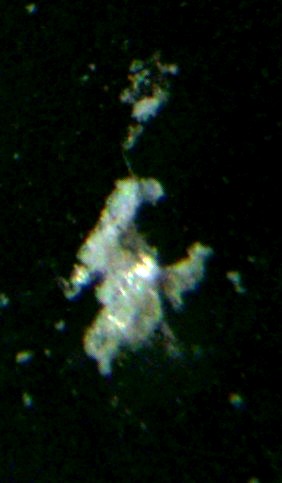
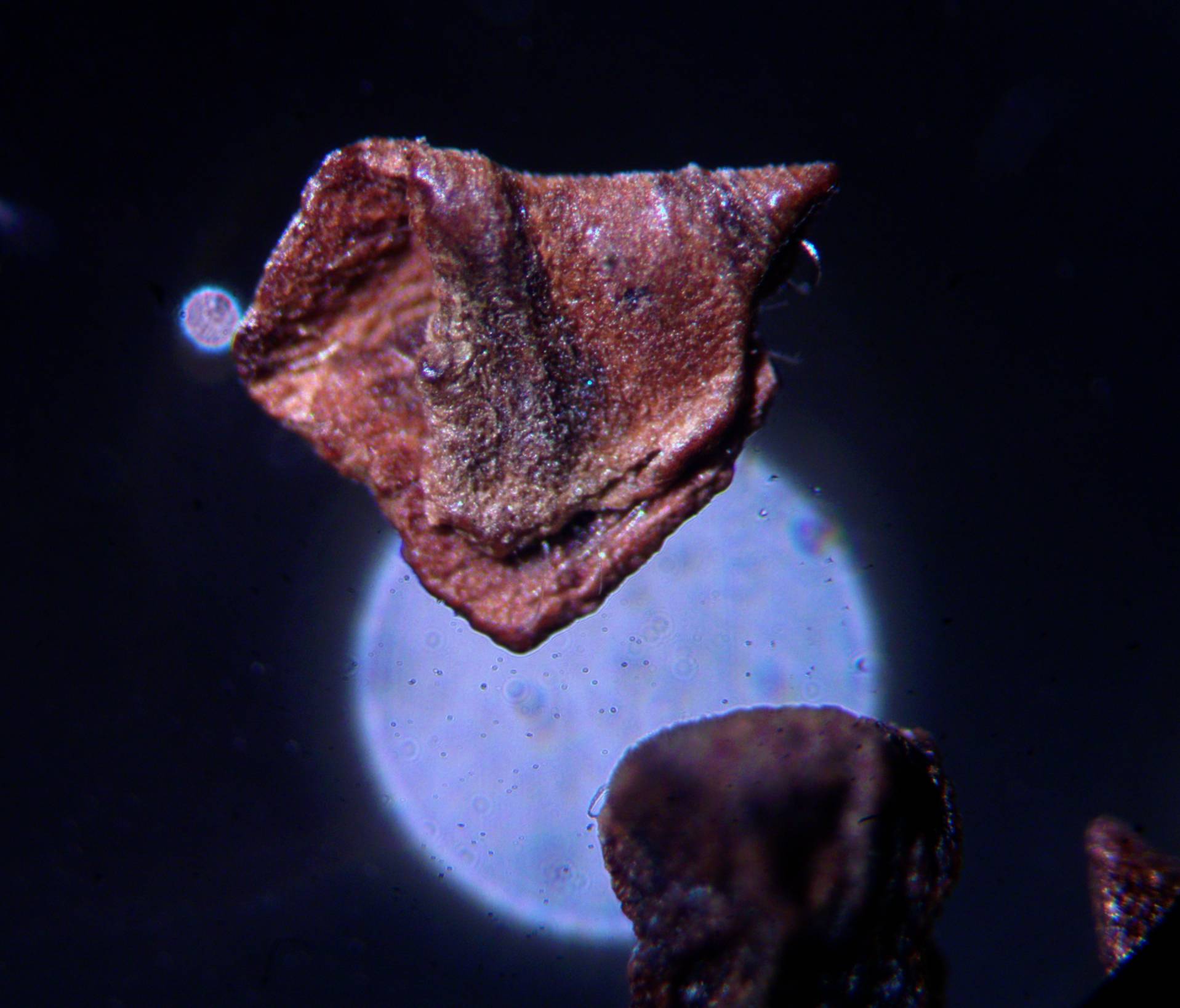
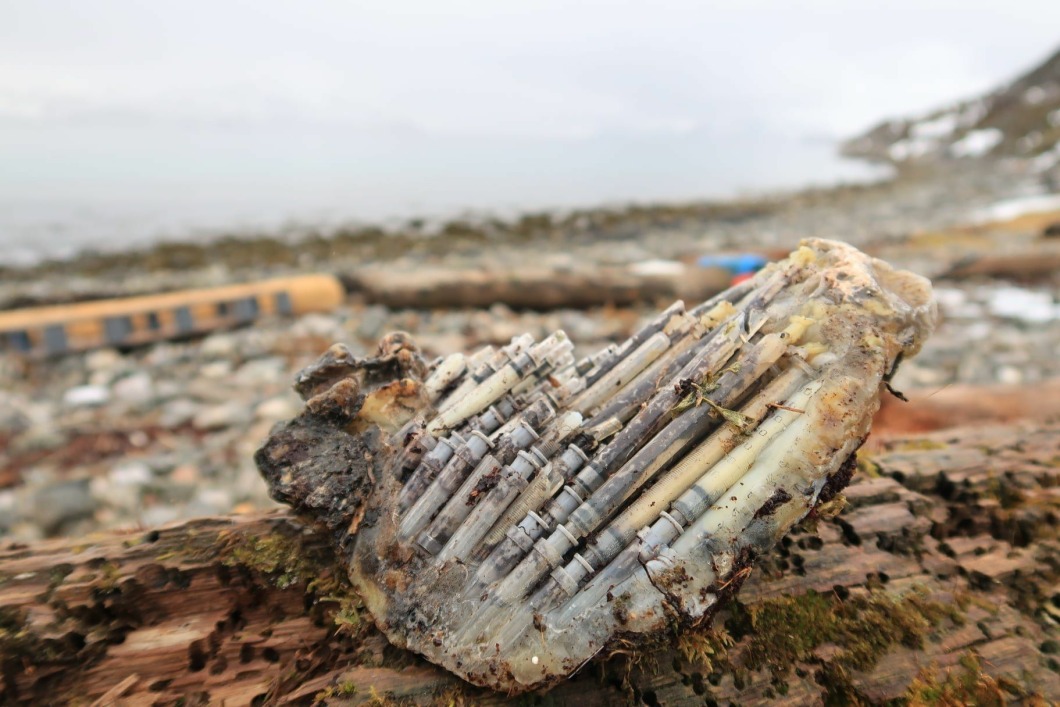
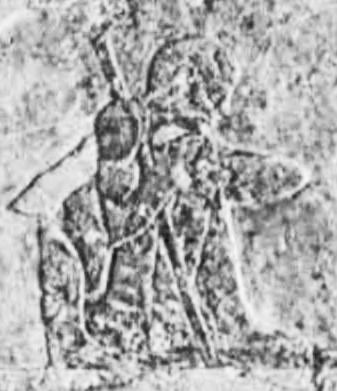
The piece that I found glued onto the inner sole of my shoe (I dont know where it came from) and the one which I found at the foot end of my bed some time later look 'the same' (as seen with the not all too precise look of the human eye and understanding) but my 'mystic inquiry' can be seen to have re-established the original integrity in them by observing the original differences, which indeed one must conclude that they are characterized by - there are indeed important differences between them, such as in their 'substance', for example, even if, from another viewpoint, they can be said to be 'the same'. This status of the 'substance' is a central theme of Aristotle, as discussed below. The detail from the latter 'stigma' piece can be seen to be a 'stigma' which in its inner outlines also shows some similarities with the outer outlines of the other two - as if 'recursion' should have been a noticeable aspect. It could tell that every human has the stigma in the semiotic constitution and by understanding it one can understand more or the human limitations. The crucifixion of Jesus was of course a grandiose error which told that they had understood something but not enough. Another example: One sunday I stepped into tram #1 in Vienna and in the empty carriage there was a black folded textile on a tramseat - I took it up and it was humid even if the day was sunny. I gave it to the driver for the lost-and-found. The next sunday around the same times the same happened again - but now there was a woman sitting on a chair behind the black textile which even this time was humid even if the day was sunny. I asked if it were hers and she said it was not. I gave it to the driver once again. I have later understood that it could have been a format of a 'scapular' - one front and one back side with a 'cognitive week' inbetween. It is probable that these two examples tell of 'ex nihilo' formation of matter and that the two 'similars' really are metaphysical but glide over the border to ontological reality and hence constitute an 'extra element' in the distribution of the physical world. A third example: One day in 2013 there was a strong impulse going through the spiritual space and I wondered what it was. Some time later, a week or two maybe, there was another very strong impulse which I recognized as 'the same' - and early next morning pope Benedict announced his immediate decision of resignation - which clearly made the two 'impulses' different after all, even if they appeared to be similar. However, these did not take on a physical format but appeared in consciousness. The example could be telling of the character of human thought or even consciousness. Here is a schematic exposition of this fundamental theorem of linguistics - the examples will be the 'sameness' of the two 'x's:
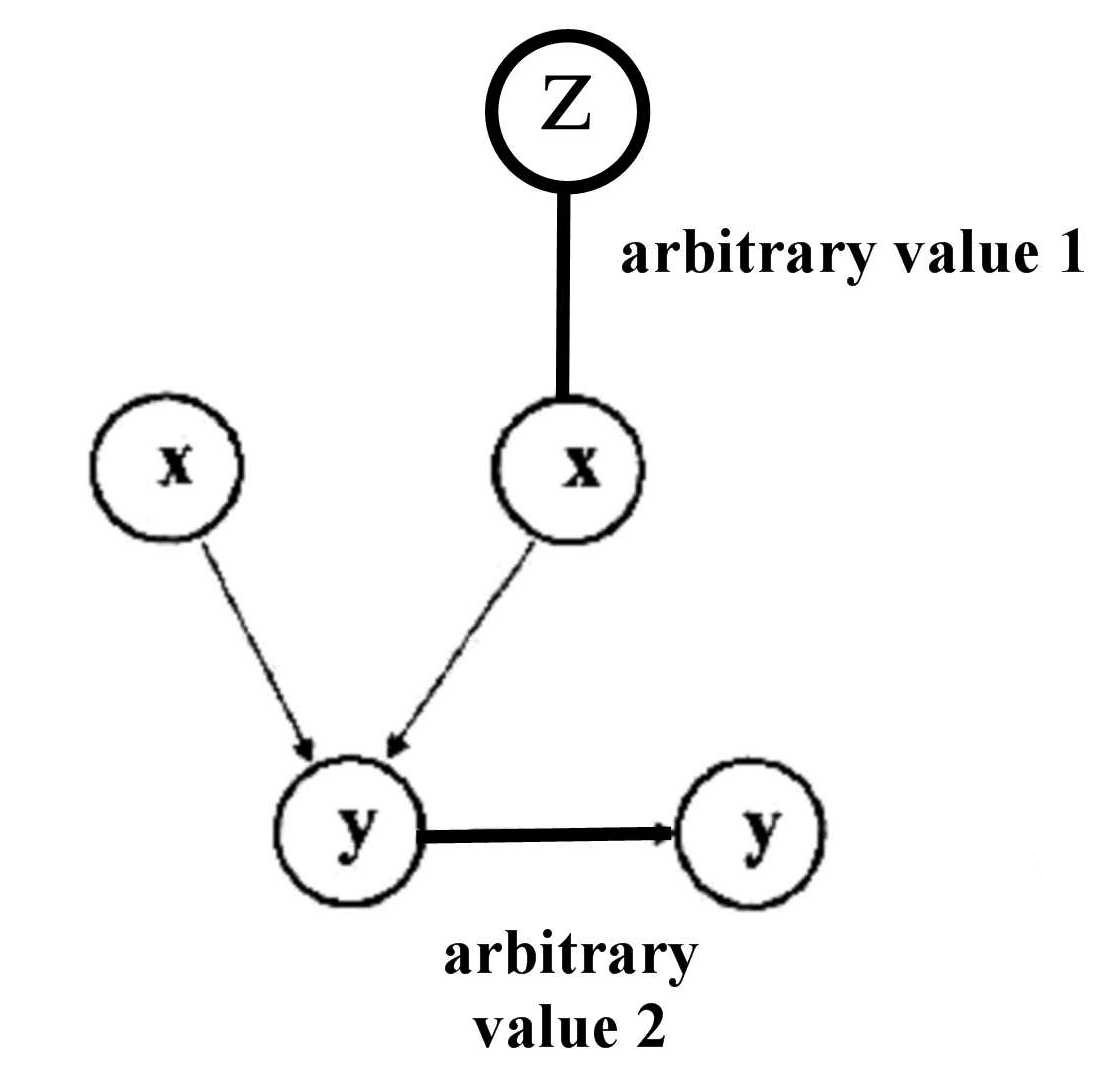
The two 'x' are the two metaphysical items from potentially different metaphysical realities, while the 'z' is the difference between them which lies beyond our understanding - the relation between 'z' and 'x' is a relation of what I call the transcendent arbitrarity. The lefthand 'y' is the ontological physical referent and the righthand 'y' is the sensorial perceptible linguistic label attached to it in a relation of immanent arbitrarity. This definition of a transcendent arbitrarity is my own.
2) The fundamental theorem of logic is the same as the above-mentioned formula for the influx of information from eternity into history. The status of 'ex nihilo' substance and the sudden surplus of information value (often of high surprise value) which this adds to the sum of probabilities could relate to this. The progress therein for logical theory is that it allows for an elimination of NEGATION as the last logical operator - by reducing TRUE and FALSE to TRUTH in the sense of 'more or less influx of information from eternity into history'. It means that TRUTH is what humans perceive when they get a glimpse of eternity via the re-established original integrity of the metaphysical realities. It means that TRUTH is what can be acquired in mystic inquiry - it is not an empty zero in a tautologically closed system. Therefore this TRUTH can be recognized as relevant to the human faculty of faith - in contrast to the TRUE/FALSE of classic logic within a closed tautological system which pertains to the human faculty of reason. (It is when the classic negation is moved from the faculty of reason over onto the faculty of faith that humans get nervous about the potential doom at the end of life - when life is considered a closed tautological system).
The question is how these two fundamental theorems relate to each other. There is a 'fundamental' relation exemplified as in the following scheme from this article:
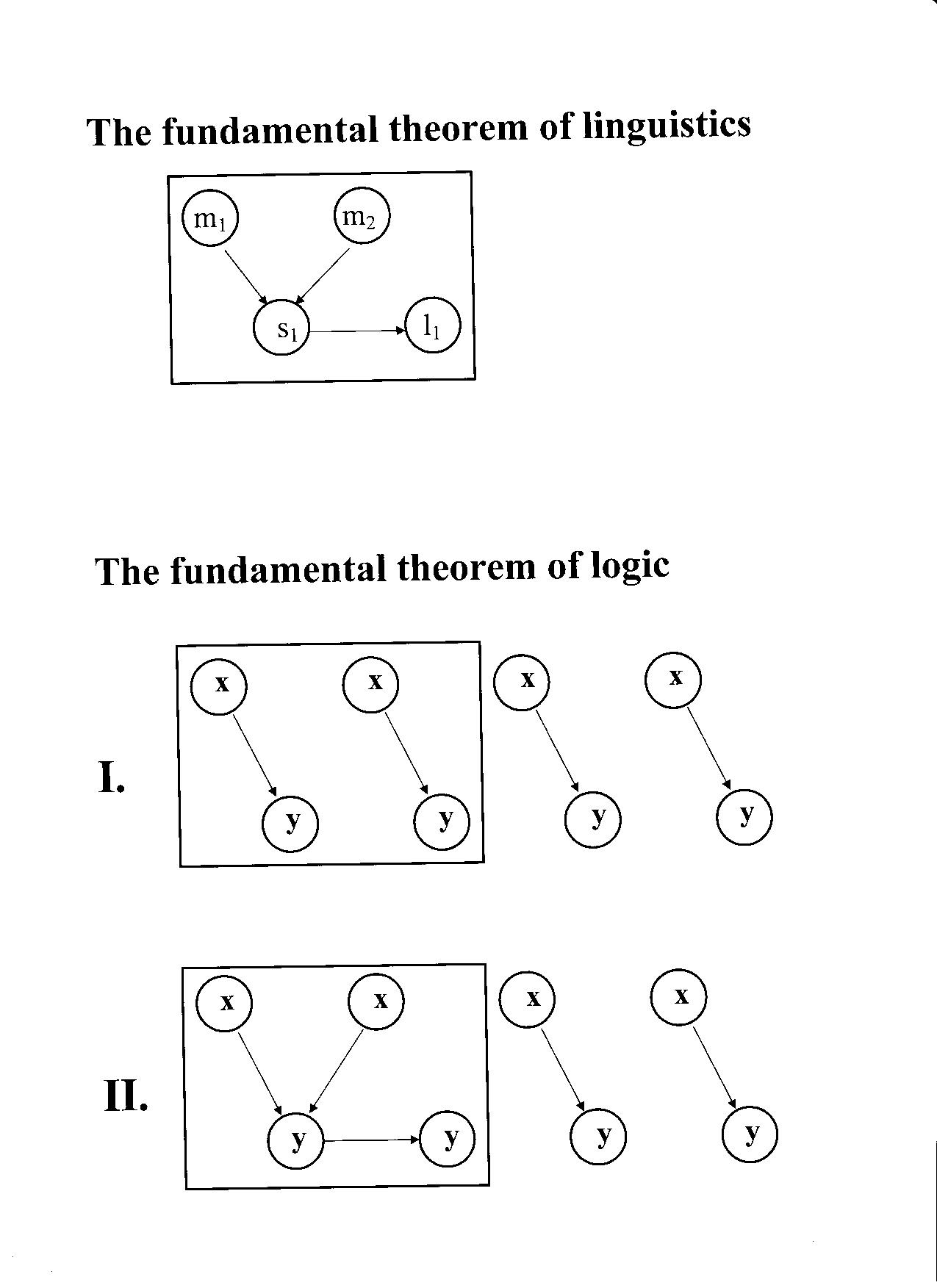
In step 1) of the theorem of logic the relations between x's and y's are 'equiprobable' and a deviation from this (which is what leads to the need for establishing semantics and the categories of syntax) in 2) leads to an isomorphy with the fundamental theorem of linguistics. It is likely that this isomorphy is what attaches logic to linguistics and its syntactic rules by the fundamental distibutional redundancies.
With these phenomena under reasonable control such as described here one can then return to Aristotle in search of what the postulated and mysterious 'submorphemic signification' of his philosophy could be about. As I show in the following, it turns out that this postulated and mysterious 'submorphemic signification' can be found in his philosophy - but only via a rather radical re-interpretation of his fundamental concepts. It seems that this reinterpretation is not only possible - indeed it seems that it could be highly necessary in order to bring the reception of Aristotle out of a confusion of highly intuitive ideas such as 'the underlying substance' and things like that. It is particularly the probably essential role of Aristotle for christian theology which could make this an important study.
It is here assumed that the prechristian philosophy really was concerned with an elemental theory which was profoundly different in its character and fundamental reality conception compared with what tradition has assigned to Aristotle. It means that in order to find the postulated 'submorphemic signification' in his philosophy, one must be inclined to accept a rather radical revision of some of his concepts.
An example: Tradition takes Aristotle's τὸ τί ἦν εἶναι = 'the what was to be' = 'to be that which was' as something called 'essence', a philosophical concept of more or less clear sense. This could be typical of the reality which tradition assigns to the prechristian philosophy. I translate it 'the numerator' in the above entropy equation in that particular sense of enumerating occurrences (in the historic reality) which has already had a stable existence when the count of the corpus started - it is those occurrences which do not take form 'ex nihilo' during the counting. Therefore τὸ τί ἦν εἶναι can be recognized as the numerator, the counter. This is one element in the above entropy equation.
To tell the story in a nutshell: The entire philosophy of Aristotle can be sensibly cast into such interpretational conception that it comes down to a representation of the various elements of the equation of the fundamental theorem of logic.
My theory is that this is the real character of Aristotle's philosophy - but clearly these formulaic aspects of it has not been understood by the history of philosophy - briefly, it is not likely that philosophy has understood the internal coherence of his ideas to such a degree that they can be tightly packed into a formula - an abstraction which also explains how language arises and functions. The reception of Aristotle has been in terms of concepts that are understood on an intuitive basis by human thought. The history after Aristotle presented Euclid (around 300 BC) who adopted the mathematical (geometrical) formalisms of his time in such a way that he probably took over these aspects of Aristotle's philosophical elements but gave parts of them the formulaic twist (which philosophy had not understood well enough) - but which thereby (via Euclid's formalisms by the faculty of reason) also left a good part of the original Aristotle out of account - what can be understood as his philosophy on the 'faculty of faith' - and these leftovers from Aristotle is what came to be the basis for the christian faith - which thereby let the full Aristotle 'resurrect' in a system of religious thought which came to be more or less misunderstood by Euclid's faculty of reason. This makes sense also relative to medieval theology (and also to the strange theory that tells that all of Aristotle's works in greek language should have gone lost but survived in arabic translations from which they later were translated back to greek again). When Aristotle in effect could be given a 'formulaic' abstract form (which at that time was not possible but which is possible today), the fact that Euclid's 'philosophy' is on a strictly formulaic and somewhat reductionist form meant that Aristotle's formalistic format of the faculty of faith was transplanted over onto Euclid and his faculty of reason and thereby the very fundamental misunderstanding arose which came to constitute the later breach of Henry VIII and Luther from the catholic church interpreting Aristotle. The italian renaissance was probably a renaissance of just these aspects of Aristotle - against which Henry VIII and Luther may have felt that Euclid was 'the true basis' (here by scripture and its alphabetic symbol manipulations which can be given a probabilistic twist) since he was formulaic in form (like scripture is) - while the actual fact would have been that this is what Aristotle was and Euclid so to speak 'couped' it from Aristotle - somewhat like Hitler couped Lenin's revolition. This fictional and fancied conflict between protestantism and catholicism has been the essential european history for more than 500 years - and the interpretation of Aristotle which I present here could come to solve these essential disputes and their rooting in Henry VIII and Luther. They would have felt that they were 'right' because the alphabet is probabilistic or at least can be formalistically described as such - and hence they could have felt justified in the sense that they (probabilistically) represented 'the lost Aristotle' while in actual fact they only continued Euclid's 'coup' - since protestantism protested against the catholicism which was essentially grown out of the medieval basis in aristotelian thought. Hence the conflict came to look like a paradox between the 'syntactic' catholicism and the 'semantic' protestantism, most clearly differing in the dogma of transubstantiation. The key to understanding the whole story is therefore in the concept of the presence of a submorphemic signification in the philosophy of Aristotle. The historic conflict with protestantism would thereby be about the same as the resistance in modern linguistic theory against an active submorphemic signification in natural language - and the conflict could be tentatively solved by finding out of this submorphemic signification. It was not easy to find this - but I think I have found out where it is located, as I will show in the following.
Jesus fulfilled the scriptures. But did he fulfill Aristotle's scriptures? Is this even the source of antisemitism?
Aristotle's 'Metaphysics' explores the role of the 'z' - the transcendent arbitrarity - for the 'x's.
His 'Physics' explores the elements 'y' in the isomorphy of logic and linguistics - the immanent arbitrarity.
His 'Categories' explores the convergence (συμβαίνει) onto categories by the two solutions (to the problems inherent in the non-equiprobability) presented above.
The key for understanding this story is given in the procedure of recognizing Aristotle's basic concepts as simple as the elements of the fundamental theorem of logic, such as the following examples:
ὑποκείμενον = the denominators in the entropy equation
τὸ τί ἦν εἶναι = the numerators
εἴρηται = dependency relations (via ἐιρέρος = slavery, bondage)
ἐνυπάρχειν = the subscripts i, j in the ai and the bj
στοιχεῖον = the summation signs ∑ in the entropy formula - there are four of them (στοιχεῖον is the 'element' that is summed up thus)
ἀρχαί = the indexes, the subscripts i, j in the στοιχεῖον = the summation signs ∑i∑j in the entropy formula
τὰ αἴτια = the negative sign in front of the entropy formula (what is subtracted from the total reality leaving the human reality is what creates the causalities)
ἡ ὕλη = the logarithm sign LOG (ὕλη = woodland/matter, and trees grow 'logarithmically')
λέγεται = it is distributed (probably normally not 'it is said')
συμβαίνει = concept for the convergence onto certain categories when running through the indexes
φύσις = what has been 'blown up' or 'expanded' from the transcendent 'z' - here the relation between genetic DNA and the form of the body and psyche
μορφή = base of logarithm - this is so far highly speculative but I refer to my study of Rembrandt
σχῆμα = the equation sign
ἰδέα = the flux of information
εἶδος = the nesting loops of the subscripts
In general, it is normally possible to recognize a systematic concept of Aristotle's in the form of an element in the formula or its interpretation.
For example, the Physics starts with the following line:
Ἐπειδὴ τὸ εἰδέναι καὶ τὸ ἐπίστασθαι συμβαίνει περὶ πάσας τὰς μεθόδους, ὧν εἰσὶν ἀρχαὶ ἢ αἴτια ἢ στοιχεῖα
Since the vision (what is seen) and the knowing 'go together' (= 'converge') in all (accumulative) 'following-after', such as in the indexation, the negation signs, the summation signs
which tells of the bottom connection line between the two 'y's of the linguistic theorem - the immanent arbitrarity relation - relative to the elements of the logical theorem.
(Loeb translation: "In all sciences that are concerned with principles or causes or elements, it is acquaintance with these that constitutes knowledge or understanding").
The Metaphysics starts:
πάντες ἄνθρωποι τοῦ εἰδέναι ὀρέγονται φύσει.
All humans expand the 'blow-up' into the vision (what is seen)
(Loeb translation: "All humans naturally desire knowledge").
which tells of how the transcendent 'z' is or turns into a 'blow-up' which is expanded into the visible world - that is, it tells of the transcendent arbitrarity
Hence the Metaphysics is about the transcendent arbitrarity, the Physics about the immanent arbitrarity. That it συμβαίνει means that it 'converges' onto a categorization which allows for the equation to obtain via the indexations, negations (causes) and summations. Since the indexation applies to the p(aibj) in the logical formula, it amounts to a matrix of multiplications of the series of the a's with the b's - hence the first line of the Physics even reads 'multiplication, subtraction and addition' - typically themes which Euclid later took up.
The word οὐσία = 'substance' is used 471 times in the Metaphysics, 54 times in the Physics and 64 times in the Categories. It clearly is the topic of the Metaphysics. What does it mean? It means, in my interpretation, that if a piece of matter takes shape 'ex nihilo' in front of your eyes, what is its substance really? Does it suddenly exist even if it did not exist a moment ago? For the discussion of the fundamental theorem of logic it really means that if a non-semantic solution to the equation be sought, it must be in the form of a solution wherein one sums the probabilities up to something else than 1,0 - the total sum of probabilities must be bigger or smaller than unity. But that can really only come about if you start counting the occurrences in a corpus and reach e.g. the result of 9 occurrences, while during your count an extra occurrence has taken place which means that the factual number of occurrences is 10 while you have only counted 9. This means that the sum of probabilities which you have in your mind is 0,9 while it really or factually is 1,0 - or, alternatively, if you have counted up to 1,0 the sum really or factually is 1,1. The question is what sort of status you shall assign to the 'ex nihilo' formation - if it 'exists' in the same way as the other occurrences. Alternatively, should you count over again? But what if the same happens again while you count the second time? This was probably the sub-idea of Cantor's diagonal proof. Some people may feel that 'ex nihilo' does not exist at all - if you claim that it does, then you must be a liar - and if the cretan who claims that 'all cretans lie' also lie, it means that he does not etc - it is a paradox.
This may be the real theme of Aristotle's Metaphysics - the question of the status of the οὐσίαι = the 'substances'. It means in fact what is the status of the non-semantic solution to the fundamental theorem of logic. According to my interpretation, this problem is the factual contents of Wittgenstein's 'Tractatus logico-philosophics' - it can be seen to be the basic problem of logic.
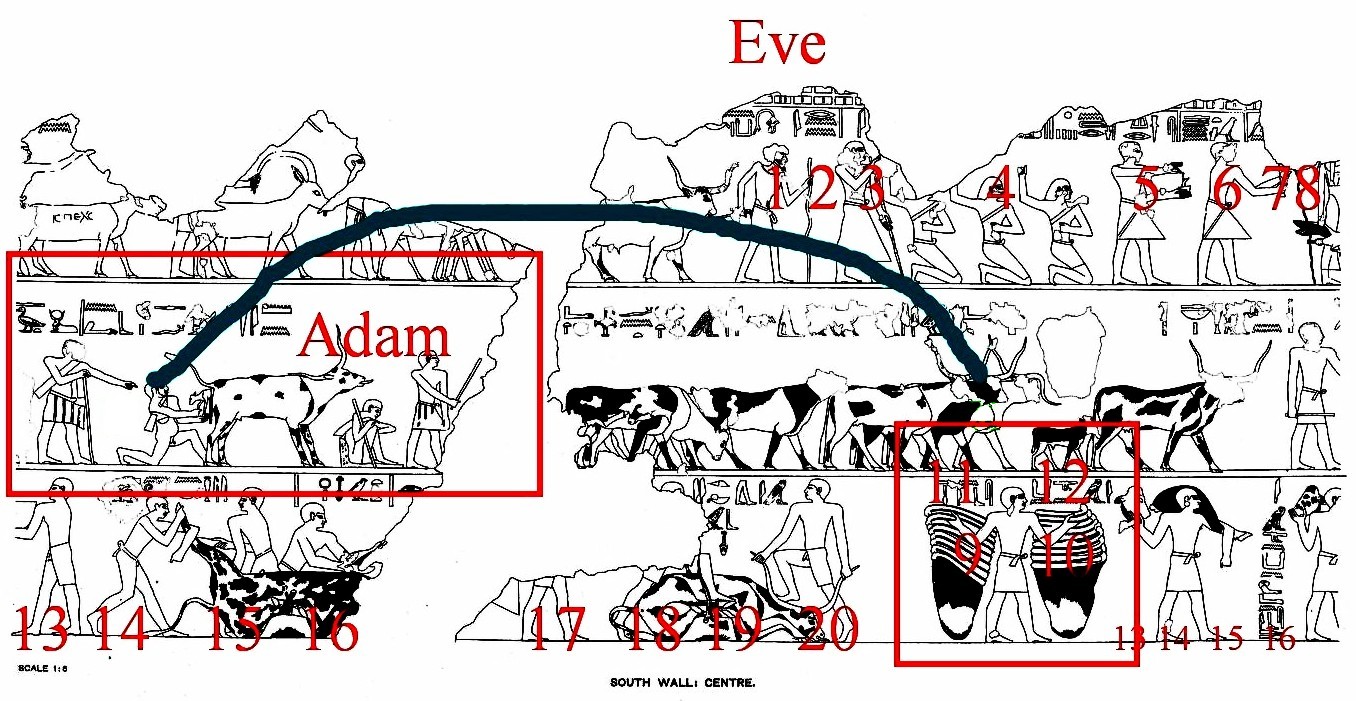
Does 'ex nihilo' matter exist? I have twice experienced a proof that it does: I have pulled a book out of the bookshelf and opened it, read a page and turned the next, and when it turns around there is a clot of humid jelly on the underside of the turning page, while there is no mark left after it on the counterpage. It is a proof that the clot must have taken form in the moment when the page was lifted in the turning - otherwise it would necessarily have been flat (from the condition of the closed book) or there must have been a humid mark left on the counterpage. Another example: I was sitting before the rubber mat on my desk (it has a centimetre grid) when suddenly it occurred to me that a small beetle took form on the coordinate point 75 horizontally 25 vertically - it wagged its tail and bent one of its two antennae and then it died, it seemed. See also this discussion of some apparent 'ex nihilo's relative to ancient egyptian hieroglyps.
Those who are desperate about preventing such ex nihilo formations getting out of control, such as Goethe's 'sorcerer's apprentice', will perhaps claim that either am I lying when I say so or I am mentally unstable and have been 'absent-minded' or even suffer from a split personality. That would, though, probably mean that you do not trust yourself if you claim so. Generally the world is as nice as you are.
It is likely that the status of the substance of 'ex nihilo' matter is the essence of philosophy. What is existence really? Bertrand Russell's famous example is that it is fully possible that the whole world was created 5 minutes ago - including our memories etc. It is full possible that all matter in the world is of an 'ex nihilo' origin.
There are also different variants of the problem including perception - and in modern times that also concerns the phenomenon of 'cognitive surveillance' which now probably has reached a high level of sophistication 100 years after the invention of EEG: It is probable that modern high-technological surveillance can 'read thoughts' even to the extent of looking out through your eyes and listening through your ears. This also means that high secrets no longer exist - for example, some decades ago a high secrets of state could be stored in a microfish format and be read through an optic microscope, and that was a safe storage and forwarding of the secret, while today surveillance only reads it through the eyes of the one who uses the microscope - or even his or her thoughts. My story of the 5 military helicopters coming low over the water up the Danube is then telling: If cognitive surveillance could document these by seeing the same as I saw (by 'looking out through my eyes'), while general surveillance of the same area did not see anything, this reemphasizes the status of this 'mystic' vision. There are even normally some bridges there which seemed to be absent just when this happened. What is the status of their 'substance'? My vision was clearly religious-mystic and not psychiatric - and it may raise the question whether the world exists at all. That is an old philosophical question.
It really is about the socalled human 'faculty of faith'. If you believe that everybody try to cheat you, at the end of your life you can certainly turn around and look back at it and conclude that 'yes, indeed, that was very true'. If you believe that people are good at heart, you can probably also come to conclude so. If you believe that the bridges of the Danube are on-and-off, that can also function well. My entropy formula describes this 'faculty of faith' mathematically - and that is probably also the reason why Aristotle's abstractions approximates this formula. Of course he did not sit there peeping at such a formula as a 'business secret' - but the formula describes mathematically what he wanted to tell linguistically.
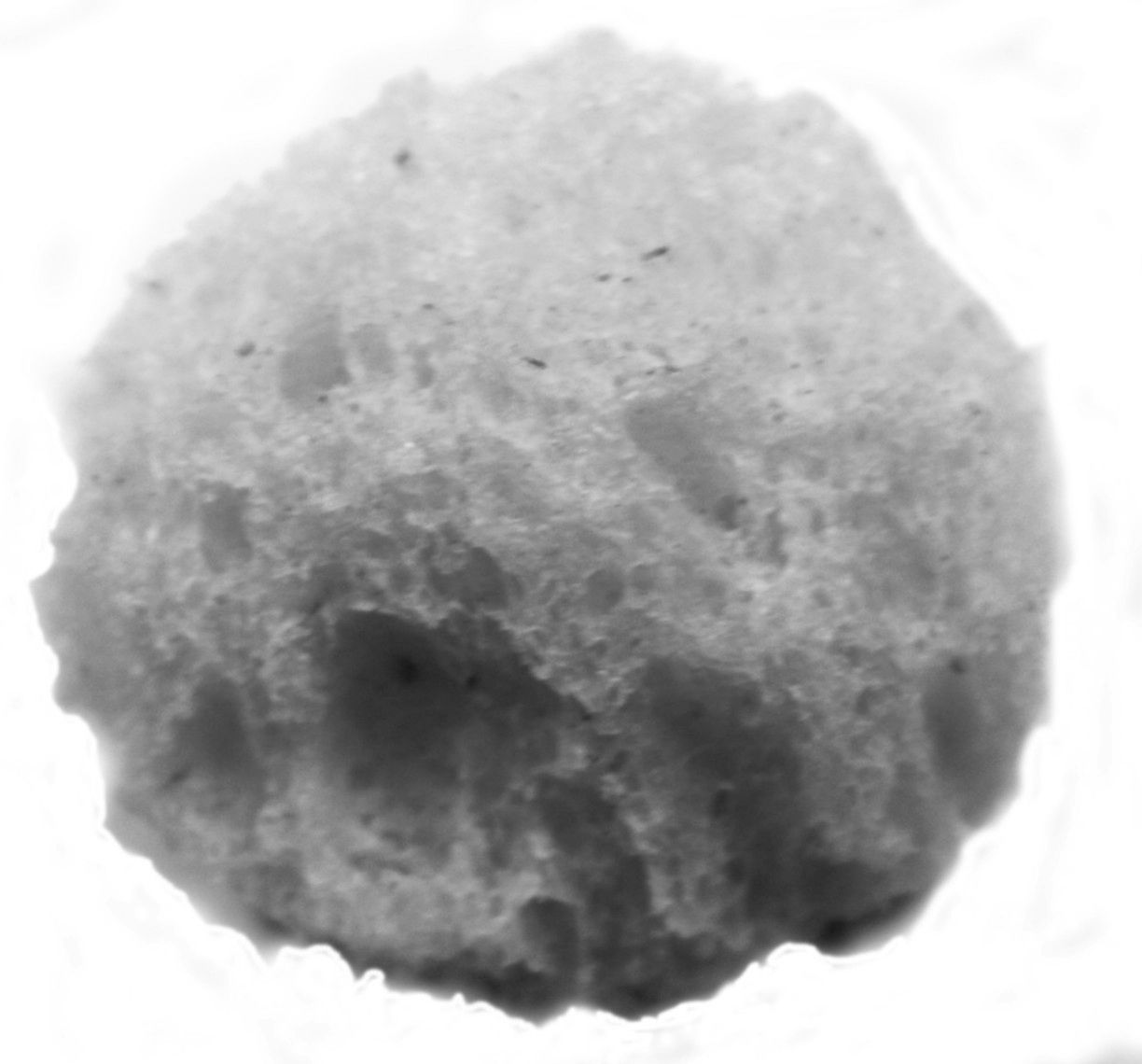
It was in january 2014 that I completed the second part of 'Der Dornenstrauch' - I had written 75 poems of 12 lines each when I reduced these to 64 poems by dividing poems 65-75 into couplets which I appended to the 64 first - for a sort of 'sonnet' variant. It was while I was doing this that the 'magic images' took form. When I some months later while writing the third part had written 77,3 poems of 14 lines each and 'met the wall', I could not find any other solution than reducing even these to 64 poems in a similar fashion - and it was in the process of reorganizing them in that way that I found what I have called a 'lapis philosophorum' - a socalled 'white stone' of length appr. 2,718 cm - it seemed to have taken form 'ex nihilo' in the drain filter to my kitchenbench. When I finally completed the book with part 4 in april 2015 and wrote the last word on 24 april 2015, and started to reduce the 18 poems into 16, it was very few hours after the 18th poem was completed that the white stone called Mount Everest trembled in a giant earthquake of Nepal (magnitude around 8.0) at 06:11:26 UTC. At the foot of Mount Everest there is the socalled 'base camp' from which one can see the much smaller mountain 'Khumbutse' - which is quite similar ('isomorphic') to the white stone I found in my kitchenbench at the completion of part 3:
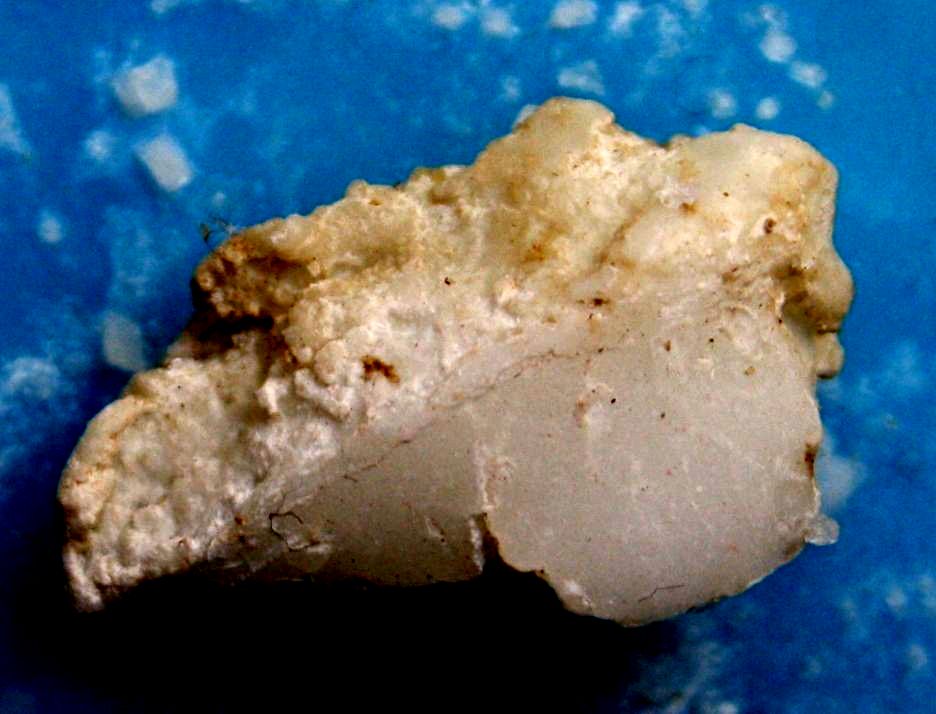 My 'lapis philosophorum' of october 2014 |
 Khumbutse mountain at Mount Everest (source) |
 Khumbutse mountain annotated (source) |
 With 'ming' sign from the time of Moses (source) |
See Exodus 16:17 which can be translated as follows: "And they created a Base Camp, the constructions/sons of Israel, and they collected the cause of becoming great/mighty and the cause of becoming small/naked/polished". This verse is the parallel text to my TEQ #464:
TEQ #464
Exodus 16:17
ויעשו כן בני ישראל וילקטו המרבה והממעיט׃
Pickin' our clothes through
handrobber sewn that minges with sting,
and filers feel too good.
Nameless Jerusalem
01.04.99
This poem has a peculiar echo in Shijing #114. 命 = 'ming' = 'God's will' - see the 'oracle script' style of the sign from the time of Moses - it can be recognized as the 'naked person' from my white stone onto the cliff wall of Khumbutse. It is that mystic Jerusalem. Mystic inquiry can be conceived as the attempt to re-establish the integrity of the two metaphysical 'x's to their original format before they were conflated into 'the same' which gave cause to the collapse of these two 'x's into one single ontological referent 'y' with an (immanent) arbitrary signifier. Here the two causes would be the great and the small white stone.
This tells why a mountain can be awe-inspiring. It is not only a big mass of stone.
So the question is what is the status of 'ex nihilo' matter? More specifically - since the substantial 'magic' seemed to happen in connection with the reduction of 77,3 poems to 64 or 18 poems to 16 - would this be the same phenomenon as the sum of probabilities being bigger or smaller than unity? They seemed to be 1,0 but it turned out that some matter had taken shape 'ex nihilo' during the count and therefore they were 'really' only 0,9 - or, if vice versa, factually 1,1. Does Mount Everest really exist? Are there mystic connections between the parts of 'Der Dornenstrauch' that interpret historic time relative to eternity in a way that is not only semantic but also 'syntactic'? See e.g. DDS II:62 and DDS III:62. The corresponding part of part 4 will be the last poem DDS IV:18 from 'der Ring' to the end of stanza 2. See also TEQ #680 with parallel text Exodus 19:18 - "...and the whole mountain trembled violently". 'Wood Gumpa' arguably resembles 'Khumbutse' ('gump-wood-se'). It should be obvious, though, that these matters cannot be about 'causalities' - rather one could take the white stone of 2014 to be telling of these forms. I have often thought of my TEQ as being about 'the form of time'. Would it have been my stone which made the earthquake? Rather the other way round.
See also the below discussion of some samples of Aristotle's use of the word μορφή as tentatively associated with the mathematical concept of the base of the logarithm - which possibly can be seen to be related also to the idea of this Base Camp (of Exodus 16:17). I notice the following:

The length of the white stone is e = 2,718... cm. When was the centimetre introduced as international standard? That was probably around the mid 19th century and it is of course possible that the white stone were known and gave the impulse to the standard unit of length at that time. Would this have been the reason also for the modern term of 'morphe-me' - cp. the 'base' camp? The term 'morpheme' is not so old and derives from french morphème on basis of the greek μορφή. It must be emphasized that the white stone I found in my kitchenbench drainhole at the time of the completion of 'Der Dornenstrauch' part 3 shows forms which can be recognized also in some cases of art - I have even speculated if it used to be standard education in art academies - but it is of course equally probable that it is an aspect of the human semiotic constitution. See e.g. this comparison on background of this.
I refer again to the first line of Aristotle's Metaphysics: πάντες ἄνθρωποι τοῦ εἰδέναι ὀρέγονται φύσει = 'all humans expand the 'blow-up' (expansion, extension) into the vision (what is seen)' - that is, both the Khumbutse mountain and my white stone could be 'blow-ups' from the semiotic constitution wherein the connection between them is found in the transcendent arbitrarity. It could also be about a relation a/b = b/c - that Everest relates to Khumbutse such as Khumbutse relates to my white stone. The quote continues: σημεῖον δ᾽ ἡ τῶν αἰσθήσεων ἀγάπησις = 'Semeion/signification' is in the 'agape' of the 'aesthesis' - that is, it is by the 'mystic agape' that the poetic-esthetic logic allows for the semiosis. I notice also the ancient egyptian tombs in the rocks - here by the chinese 命 = 'ming' = 'God's will' on the rock wall of Khumbutse. The 'blow-up' is here conceived as Aristotle's concept of φύσις (as what has been 'expanded' or 'extended') - see the comment to μορφή example 4.
I refer also to these phenomena. If a military weapon exists which can make such quakes (as Turkey/Syria in 2023), it could have been about organized persecution of my poetry - otherwise one could speculate that my synchronic poetry could have captured a 'seismic logic' that is part of the human semiotic constitution after some million years of techtonic plate movements - in combination with a similar logic in placenames.
Some time before the earthquakes of 2023, Jacinda Ardern of New Zealand had announced her surprise resignation - 'no later than the 7th of february 2024' (at 00:28). Chris Hipkins became the next PM and took over before this announced time point - and his name arguably could invoke associations to the map showing the location of the earthquakes.
See also this story.
See this story of how bookspines and bookshelves of mine collected dust in peculiar ways - as if the dust knew what the books were about (semantics). The dust settled on mainly bookspines of linguistic and mathematical subjects - cp. the story of Aristotle and Euclid. This was at the time when the ex nihilo material formations were rather dense around me. The dust also settled on the bookshelves which in norwegian are called 'hylle', pronounced just like Aristotle's ὕλη - which means 1) woodland and 2) matter. Can one understand that the dust settled there for the concept of 'logarithm'? That is what seems to make sense also relative to the entropy formula. The 'exponency' on the 'book-spine-ency' is a little interesting. I reproduce again some of the vertical planks of my 'hylle':
Dust on bookshelf sample 1
Dust on bookshelf sample 2
Dust on bookshelf sample 3
Dust on bookshelf sample 4
Clearly the holes in the wood could be telling of 'equiprobability'. See example 1 under the discussion of ὕλη below: It is possible to read this example as being about the two solutions by deviation from equiprobability (such as from the holes in the shelves): Either the semantic way, which is the dust selecting books of certain content, or the syntactic way by summing probabilities to more or less than one, which could be the dust on the shelves.
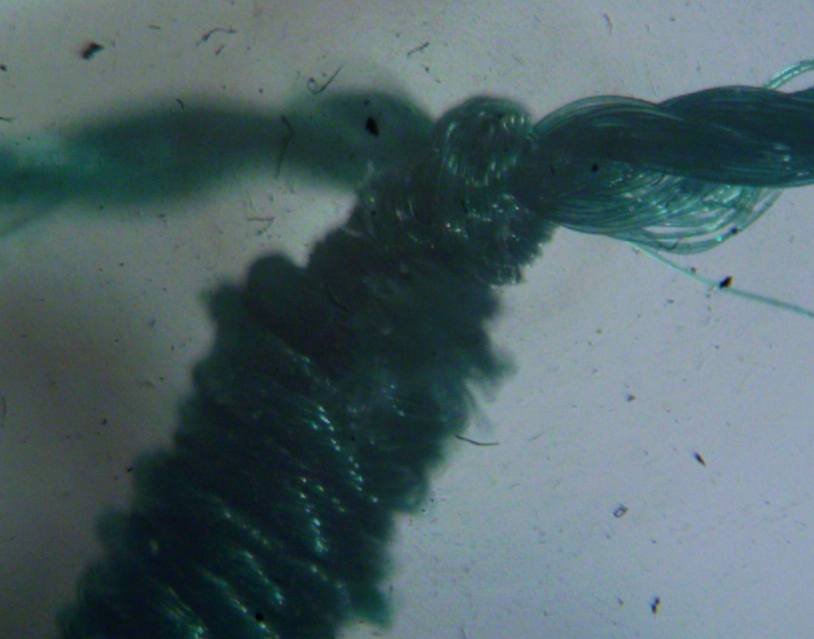
Inspired by this ὕλη/hylle and the quasi 'ex nihilo' character of the dust, I could ask myself whether there were other occurrences from those days which could be telling of other of Aristotle's central concepts in a similar way. I stop by these objects from october or rather november 2021 which I could be inclined to understand as related to the central concept of ὑποκείμενον. I then take the ὑπο- to tell of the green knot and κείμαι of the metal brush which even was quite extraordinary as it seemed to semi-levitate on the microscope glass: It lay on the glass and then rose up to balance on its U-curve end with the 'brush' pointing up - quite contrary to the laws of gravitation. It may have been that there was a thin fibre on which it balanced, but if that were the case it would have been a miracle of balance anyhow. ὑποκείμενον can be seen as composed of ὑπό (for the green knot) for which the article interestingly tells of the proto-indo-european origins including the sanskrit derivation उपम (upamá) = 'uppermost, highest, most excellent, eminent, best, nearest, next, first, equal, similar, resembling, like' - which could be telling of this story of Mount Everest, Khumbutse and my white stone: The article also tells that "the genitive is from the PIE ablative of origin or cause. The dative is from the PIE locative and metaphor of all infinitives coming from locatives. The accusative is from the pre-PIE directional and the PIE accusative of direct object". I notice also the alleged hittite 'u-up-zi' = "to rise (of the sun)" from PIE *h₁ewp-. :
The rest of the word is κεῖμαι which derives from PIE *ḱey- which finds reflexes also in κῑνέω = to set in motion, move, remove etc - cp. the trembling mountain - and κίω = 'to go'.
Would it have been my DDS and white stone that made the earthquake? Rather the other way round. Hence the ὑποκείμενον could be seen as the denominator - like ὕλη being the logarithm.
A peculiar form of (probably) 'ex nihilo' formation is constituted by the three stickers which developed a few years ago: The 'ROYAL LAND' and 'Filósofo' stickers as well as the 'Götterfrucht' label which occurred a number of times, normally in the context of my hand. The three stickers were all self-adhesive on the back side. Norwegian for 'sticker' is 'klistremerke'. I notice ancient greek κλύζω which includes 'to coat with wax' - see the below discussion of 'a small robe' (λώπιον is diminutive of λώπη) and 'a robe' (ἱμάτιον) for the norwegian form 'loppe-marked' = 'flea market'. κλυστήρ = 'syringe, clyster'. 'Klyse' is also norwegian for 'clot of spit' and hence 'klyse-tear' could refer also to the jelly clot under the turning page that serves as a proof that ex nihilo formations do exist and are no humbug.
('Götterfrucht' could also refer to 'gutter-fear' - the fear of landing in the gutter or ditch by 'klistremerke').
There is also the form μηρυκάζω = 'to chew the cud, to ruminate' which could add to this self-adhesive-ness. κλίσις = inclination - a peculiar trait of the 'filósofo' label is that it constantly curls up and refuses to be made flat - I press it down on the glass to which it sticks by its selfadhesiveness - but it soon curls up again to this form.
For the 'ROYAL LAND': ῥοῦς = 'small tree, stream' while λῆν = infinitive of λᾶω = to see, seize, want. φιλόσοφος = loving art. γηίτης = husbandman, φρύγω = to roast, to fry.
This 'ex nihilo' has shown itself to be related to the concept of 'philosopher' and clearly could apply to the 'Filósofo' sticker.
This 'magic image' from the days of the end of DDS part 2 seems to show a woman in a flannel dress running in panic from the autumn dark park where she has been with her boyfriend (who is about to climb over the fence in the background). The had perhaps seen these archetypes in the humid air between the big oaks and chestnut trees. 'She in the park' in norwegian is 'henne i parken' which sounds like ἐνυπάρχειν. She seems to run past a cardinal and a longbearded ordinal hanging over his shoulder - they are out walking in the late evening - and the boyfriend who follows behind her with an electric torch is climbing over the fence but has got his testicles in some pressure against the plank - as one can see from the electric torch - and so the 'subscript counting' could apply to the ἐνυπάρχειν. It is a cluster of natural associations which converge on this concept.
The archetypes would then be ὑπάρχον = 'i parken' = 'in the park'.
τὸ καθόλου likewise could apply to the cardinal with the ordinal - in particular if the latter shold be the pope himself. I have understood τὸ καθόλου as the division bar between the numerator τὸ τί ἦν εἶναι and the denominator ὑποκείμενον - hence the division bar could be the plank in the background while the numerator naturally is a number type.
This image could apply to 'συμβαίνειν'. The man with the 'beatles-hair' has crept under the hedge for kissing her as she is sleeping in the hammock under the half moon. The two white fields are her calves in parallel - cp. the below example 1.
Is there a reflex of the numerator τὸ τί ἦν εἶναι? It is not impossible that the two stigma pieces (stigma 1 and stigma 2) are a form of '2 to 1 being' - indeed that seems to be their true character in the form of the two metaphysical items of the fundamental theorem of linguistics. If this also is supposed to mean a 'numerator' it could suggest that a number also is the result of such a collapse of two originally independent metaphysical items. If, on the other hand, one should take it that 'stigma' is a form of στοιχεῖον, the two pieces could relate also to the two holes that both could be 'isomorphic' with the outlines of the piece itself and hence provide for a 'recursive' variant (turned 90 degrees, like a turning swastika). If so, there could be 4 such στοιχεῖα - one for each of the summation signs ∑ in the entropy equation.
Having just completed 'Stillhetens åndedrag' in 2016, which included a similar reduction from 105-106 poems to 64, I went around for three days with a strange pebble in my shoe - when I tried to jack it out with a finger it was gone but it was soon back again when I continued walking. After three days I decided to investigate the shoe more clearly and found a 3 cm long archaic-looking nail aslant inside the sole in such a way that when the foot was pressed down on the inner sole it touched the tip of the nail, otherwise this was hidden under the surface. It strange character and position suggests that it could have been an 'ex nihilo' phenomenon.
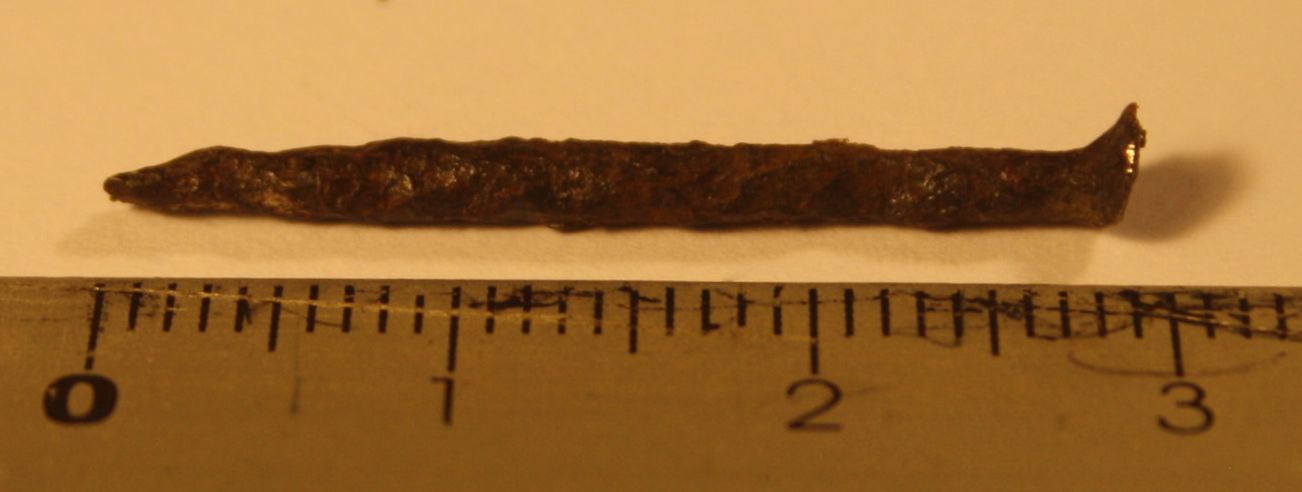


(This happened just at the time when Shimon Peres died in Israel). If one should follow the same logic as with the ὕλη/hylle, one could see in this probably ex nihilo nail a norwegian correlate to 'stoikheion' = 'sto i kjeian' = 'stood in the chain' = the elemental theory.
See also the below discussion of ἐνυπάρχον example 8 with the two stigma pieces: "...such as the wood expansion of the inclining/bed or the bronze of the sculpture". It is a fact that I found the 'bronze' in the shoe when I was about to put the shoe on 'for going out walking', which in norwegian language could be called 'skulle på tur' which is phonetically close to 'skulptur' = 'sculpture'. The form ἀνδριάς can probably mean both a 2-dimensional 'image of a man' such as the shoulder/arm/hand shape as well as the 3-dimensional 'sculpture' in which case that would have applied to my foot when I was about to go out walking.
This immediate association of a surface form of language with a deeper form of another language is normally considered a quite primitive sort of signification which perhaps can be associated with somewhat 'criminal' ways of thinking. It is possible that terrorists can carry out their work only under the pretext of being justified by something that is of utmost importance for our society to come to an understanding of. In this case it could be about the need for finding out what happened with Aristotle's theory and the aftereffects which it left on christianity and the split with protestantism at the time of Luther and Henry VIII - a split which perhaps could be traced to a fate of 'formalistic' aristotelic thought after Euclid 'couped' the abstractions for a new 'technological' era. Christ is not an information technology but it is true that the last cuneiform tablets seem to have been written around his time. If, therefore, this way of thinking like 'stoikheion' = 'sto i kjeian' = 'stood in the chain' or 'skulle på tur' for 'skulptur' is typical of criminal or terrorist signification, it can be what lends to their work a shade of historic justification and quasi legitimacy in spite of its generally hostile character. Why could norwegian be such a language? Could the linguistic phenomenon attract pretext-hungry groups or certain political inclinations? If England were instrumental in establishing the state of Norway in 1814, and later pretended that this were the reason why they battled Napoleon in 1815, it could have been about couping the real reason for such a norwegian state while the factual reason (which thereby came to be suppressed) would have been in the language and its explanatory value relative to Aristotle. The example of 'a robe' = greek λώπη) and 'a robe' = greek (ἱμάτιον) for the norwegian form 'loppe-marked' = 'flea market' could be telling: The probably 'ex nihilo' traveller in my bed thereby tells of greek λώπη and norwegian 'loppe' in a way which could be quite special for the submorphemic reality. 'Robe' could be norwegian 'kåpe' or 'kappe' while the horse running in darkness into a lightbeam (discussed below under ἀρχαί example 1) could be a 'she-horse' = norwegian 'hoppe' (the word hoppe means 1) she-horse and 2) to jump e.g. like a flea) - hence the norwegian language contains the paradigm 'hoppe-loppe-kåpe' for this 'robe' in an alphabetic context of, say, 'Heimskringla' and 'Pope' - which could suggest how the norwegian language could be considered a little special relative to Aristotle's submorphemic greek). Likewise, if 'Heimskringla' (one of the reasons for the state in 1814) should have been a fraudulent construction on basis of the norwegian language relative to hebrew ('nåde' etc), it would likewise have been for couping the factual reason ('skulle på tur', kåpe/λώπη etc). This would furthermore have been the reason for the norwegian language conflict and the role of the poet Hans-Henrik Holm - see e.g. this study.
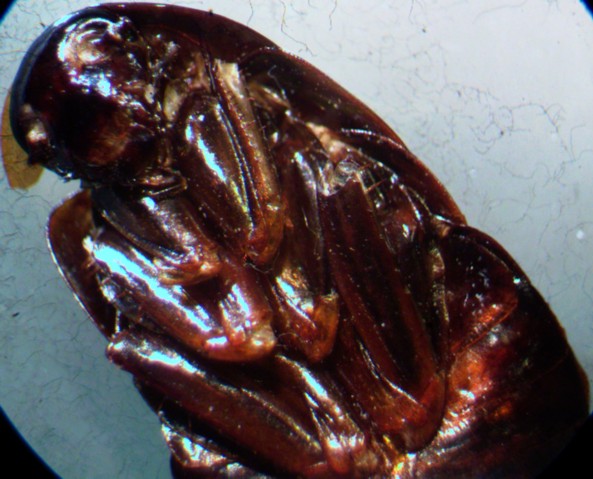
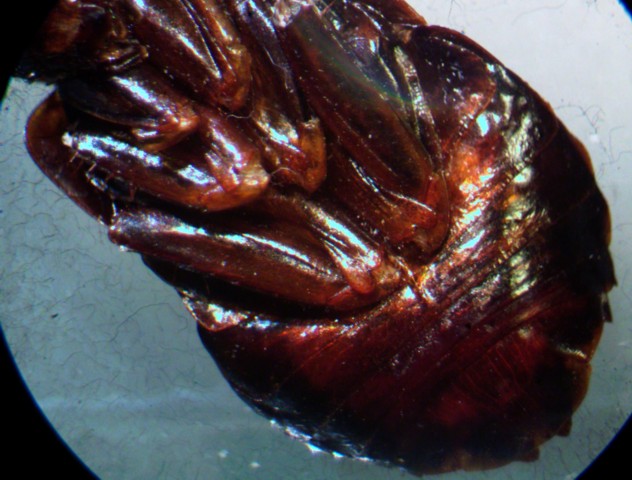
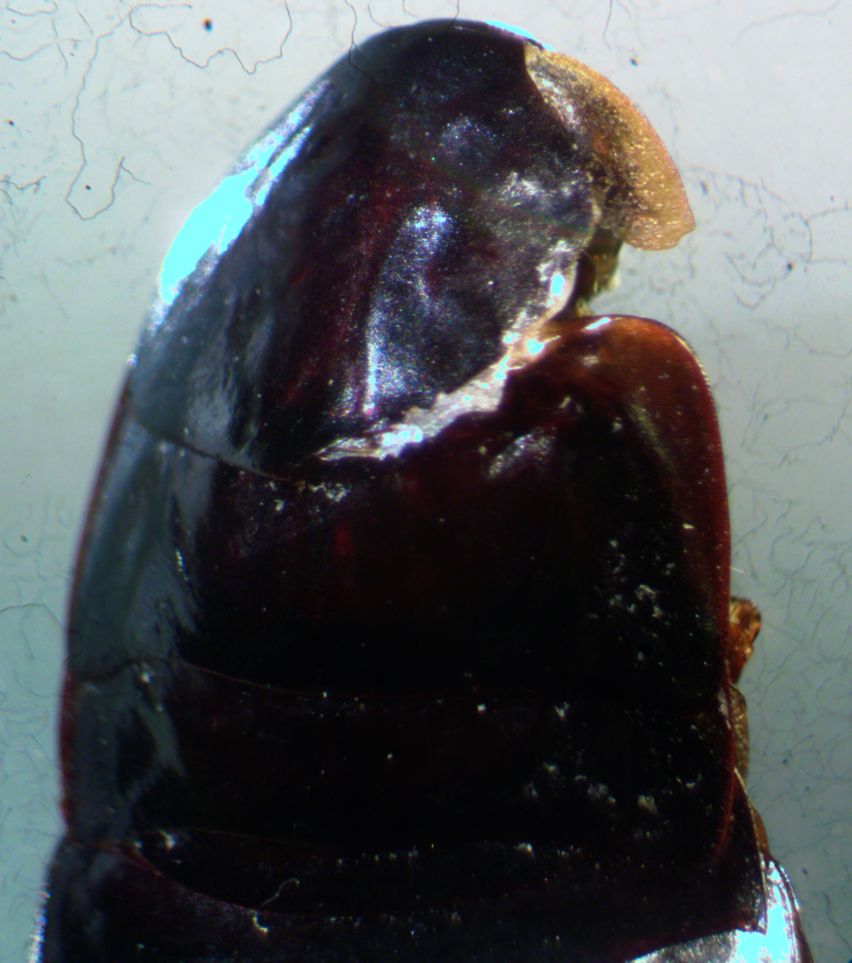
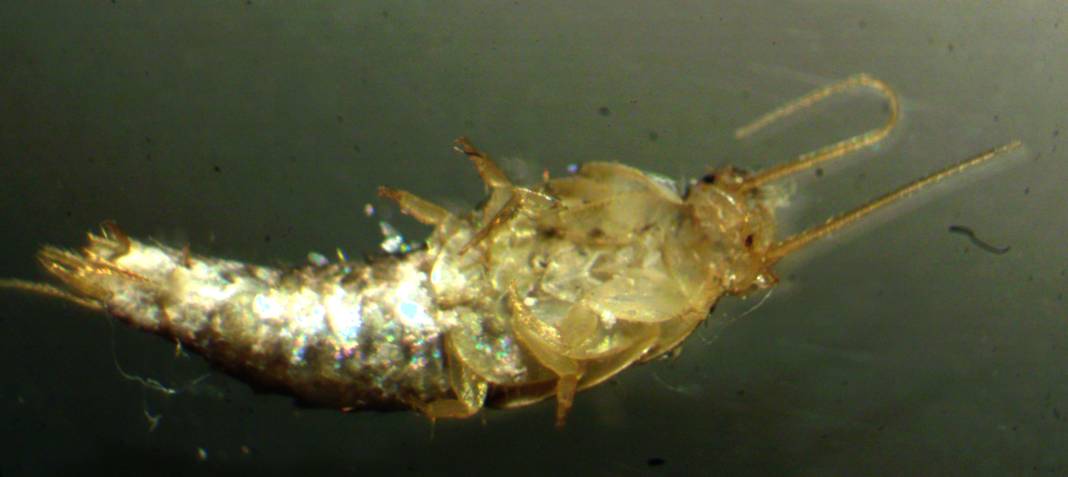
This piece of probably 'ex nihilo' matter suddenly lay in my bed one morning in 2015. Following a similar logic she could be called ἀντικειμένη or Aristotle's ἀντικείμενα (neuter plural), a quantum phenomenon described in his Metaphysics as follows:
[1018α-20] ἀντικείμενα λέγεται ἀντίφασις καὶ τἀναντία καὶ τὰ πρός τι καὶ στέρησις καὶ ἕξις καὶ ἐξ ὧν καὶ εἰς ἃ ἔσχατα αἱ γενέσεις καὶ φθοραί: καὶ ὅσα μὴ ἐνδέχεται ἅμα παρεῖναι τῷ ἀμφοῖν δεκτικῷ, ταῦτα ἀντικεῖσθαι λέγεται ἢ αὐτὰ ἢ ἐξ ὧν ἐστίν.
"Opposites are distributed on (are called) opposite-appearance and the opposite things and beside and privation and state of mind and 'from his' and in the end of the universe and decay; and as far as she does not undertake this she is at the same time present at both 'receptions' - such is distributed (is called) the opposite of herself or from what she is".
[1016a] λέγεται δ᾽ ἓν καὶ ὧν τὸ γένος ἓν [25] διαφέρον ταῖς ἀντικειμέναις διαφοραῖς—καὶ ταῦτα λέγεται πάντα ἓν ὅτι τὸ γένος ἓν τὸ ὑποκείμενον ταῖς διαφοραῖς (οἷον ἵππος ἄνθρωπος κύων ἕν τι ὅτι πάντα ζῷα), καὶ τρόπον δὴ παραπλήσιον ὥσπερ ἡ ὕλη μία.
"It is said/distributed (over) one and over the class of one of those things that differentiate between the opposite differences - and that is said/distributed about/over all the one that the class of one is the denominator [ὑποκείμενον] for the differences (such as man, horse, dog are one thing in that they are all animals/images), and in the manner are nearly the same just like the logarithm [ὕλη] one".
This is likely to refer to the 'magic image' (discussed in this article - see e.g. the high relevance of Rilke's first Duino elegy) which developed from the smeared-out heated wet-mud (with bubbles?) on a microscope glass - which shows the combined form of dog (facing leftwards), man (the singer with a black eye) and horse (the horsehead). These are one image but three forms in one - but not in a way which many images can show three things in one: It is in the same way as the ὕλη is one. Likewise he often refers to λευκός (white), ἄνθρωπος (man), ἵππος (horse) in which case he may have intended to point to the black region over one of the eyes of the singer - which for a normal human is white and not black: Wherefrom comes that white of lateralized humans?
I notice the three similar ancient greek words:
|
ἀΐδιος αἰδοῖος ἀοιδός |
= eternal = shame-faced = singer |
Likewise he often talks of man as δίπους = twolegged (biped) in contrast to the fourlegged animals - but this again could be in reference of another 'magic image' - the beatleshaired moonlight kisser of the woman with the two white calves - the image I have associated with Aristotle's concept of συμβαίνειν.
The discussion of these qua animals [ζῷον] is therefore likely to be not a coincidental example because ζῷον = 'animal' can also mean 'image', for which reason each of the three animals in the image can also refer to the whole image - which is what provides for a recursive trinity function. (See also the beginning of Aristotle's Categories).
The examples discussed here serve to support the idea that the central concepts which Aristotle uses for describing the οὐσία = 'substance' are of the kind which associates with 'ex nihilo' phenomena and therefore it is questionable if they are of the same status as 'normal matter' - if they are included in the probability count or not.
In the following I bring some examples of these interpretations of the philosophical concepts from Aristotle's work - for showing their relevance relative to the entropy equation and the two possible solutions there are. I start with συμβαίνει = 'to go together' for 'convergence' as it is used in the Categories and interpret these relative to a subfeatural level for a submorphemic grammar, before I consider the word στοιχεῖον in Aristotle's Physics for a similar comparison against distinctive feature theory - after which I discuss a number of central concepts of Aristotle for their relevance for the entropy equation.
The word συμβαίνειν in Aristotle's Categories
The point of departure is the problem that the equation makes sense only for complete equiprobability and how do we handle the case when it deviates from this - which it (nearly) always does? One solution is the humbug of semantics - that pretends to preserve equiprobability in the sense of the same meaning on every occurrence. Another and more interesting one is the solution of the sum of probabilities being more or less than unity (1,0) - depending on the substances (οὐσίαι) - then it could be brought into balance under certain circumstances. But clearly if any distribution is allowed, not much is gained. Hence one could think of a solution wherein a distribution below or above unity converges on a limited number of classes or categories: If these are in accordance with the wellknown grammatical categories of human language, or classic categories of reality conception, then one could assume that if these allow for balance in the equation, it would have high explanatory value for the non-equiprobable solutions without the need for humbug semantics (swindle, lies etc). This naturally could be the theme of Aristotle's 'Categories'.
More specifically, if you take a set of probabilities that are ordered (alphabetically, by size, order of occurrence or whatever) and stacked the one upon the other in what looks like a spectrum, if, in order to obtain a balance between the two sides of the equation, you compress the distribution to a value smaller than 1,0 (say, 0,8) such that the entropy value (when a virtual or 'ex nihilo' 'x' = 0,2 is added) is altered to be the same as what it is when this is expanded, if you take these two ordered distributions which constitute spectra and compare them, they will exhibit more or less interference (maybe what Aristotle calls "how much the white is distributed relative to how much it displays" in example 1 below) - and if this interference is in accordance with the acoustic definitions of some distinctive features (of, say, Jakobson/Halle), such as for example a clear formant structure, then one can assume that it also will be in harmony with the human physiology and thereby be a criterion for a distribution relevant to the human knowledge. If so, this would be what is called Aristotle's account of submorphemic signification. It would be what would amount to the reality of submorphemic signification before Christ.
The essential concept for this theory will be the phenomenon of 'convergence' which harmonizes with what our modern time could call 'recursion': That a part of the distribution refers partly to itself, partly to the totality. The distribution will then converge on itself and expand again to the whole - and it will contest the necessity of Euclid's fifth common notion telling that the whole is bigger than the part.
If the theory is right that συμβαίνω = 'to go together' is the concept (in the present interpretation) for 'convergence' on a small number of grammatical classes or categories when the sum of probabilities deviates from unity, then one can expect the discussions around the occurrences of the word συμβαίνω (and variants) in Aristotle's 'Categories' to be telling of such ideas. That is easily tested - by searching for occurrences of the form συμβ- in the text. I could not find the conjugation scheme for συμβαίνω on the web but it is just to use the βαίνω = 'to go' and put 'συμ-' = 'συν-' = 'together' in front of it: For example, συμβαίνει is present tense 3rd person singular active indicative (see the inflection scheme) while συμβεβηκός will be perfect tense 3rd person active participle neuter and συμβήσεται will be future tense 3rd person middle indicative. συμβεβηκότων is a little more cumbersome - it is a perfect tense active masculine or neuter participle which is inflected like an adjective and it is plural genitive masculine or neuter of this. I have searched for the form συμβ and extracted the following 6 examples - containing the total 11 of occurrences in the 'Categories':
Text:
Κυρίως δὲ ποσὰ ταῦτα μόνα λέγεται τὰ εἰρημένα, τὰ δὲ ἄλλα πάντα κατὰ συμβεβηκός• εἰς ταῦτα γὰρ [5b] ἀποβλέποντες καὶ τἆλλα ποσὰ λέγομεν, οἷον πολὺ τὸ λευκὸν λέγεται τῷ τὴν ἐπιφάνειαν πολλὴν εἶναι, καὶ ἡ πρᾶξις μακρὰ τῷ γε τὸν χρόνον πολὺν εἶναι, καὶ ἡ κίνησις πολλή. οὐ γὰρ καθ' αὑτὸ ἕκαστον τούτων ποσὸν λέγεται. οἷον ἐὰν ἀποδιδῷ τις πόση τις ἡ πρᾶξίς ἐστι, τῷ χρόνῳ ὁριεῖ ἐνιαυσαίαν ἢ οὕτω πως ἀποδιδούς. καὶ τὸ λευκὸν ποσόν τι ἀποδιδοὺς τῇ ἐπιφανείᾳ ὁριεῖ• ὅση γὰρ ἂν ἡ ἐπιφάνεια ᾖ, τοσοῦτον καὶ τὸ λευκὸν φήσειεν ἂν εἶναι. ὥστε μόνα κυρίως καὶ καθ' αὑτὰ ποσὰ λέγεται τὰ εἰρημένα, τῶν δὲ ἄλλων οὐδὲν αὐτὸ καθ' αὑτό, ἀλλ' εἰ ἄρα, κατὰ συμβεβηκός.
Translation:
Κυρίως = etymologically 'spreading out', these dependency relations are distributed partly by the rest of the totality according to the convergence [συμβεβηκός]; for looking apart from these and distributing the remaining, such as how much the white is distributed relative to how much it displays, or how the 'big praxis' is relative to the many (intervals of) time (points?), or the increase (?) of movement (acceleration?). For not each of these is distributed relative to itself in such ways. For if it were to assign how much the praxis is, at what time it would divide year by year or however you assign it. And the amount of white which you assign to the 'forthcoming' defines/delimits it: For as much as the 'forthcoming' would be, that much the white would also be said to be. Hence it would be only 'spreading out' and according to itself that much as the dependency relations are distributed, while the rest would not be according to itself, but if so should be nevertheless, it would be according to the convergence [συμβεβηκός].
Comment:
This excerpt seems clearly to suggest the idea of an interference structure between a spectrum of probabilities and its compressed or 'out-spread' (expanded) version. (Cp. also the sleeping woman surprised by a kisser in the moonlight - her white and 'converged' calves for συμβαίνειν). The dependency relations would probably be the dependent probabilities in the denominators. It is seen that I translate τὰ εἰρημένα with 'dependency relations' that are 'distributed' [λέγεται] with respect to the desired 'convergence' [συμβεβηκός]. For the intervals and increase of time points and 'movement', see my MA thesis pages 50-52 for related considerations. When Aristotle talks of 'forthcoming' elements, it is likely that he refers to aspects that are not counted as being of the same substance and therefore can lead to summations of ambiguous status - hence allowing for the sum of probabilities to be bigger or smaller than unity. It is precisely under such conditions that 'convergence' towards a semiotically acceptable form can be assumed.
For showing the rather radical reinterpretation that these ideas constitute relative to the traditional conception of these concepts of Aristotle I reproduce the relevant excerpt in the translation of Cooke (published in the Loeb series pages 40-41) here - for a comparison with my interpretation. It is my idea that 1) Aristotle had not access to the mathematical tools needed for these formalisms, but they constituted an abstract matrix in his thought nevertheless, and 2) as long as philosophy tried to understand Aristotle without access to a formulation of these abstractions, they had to interpret him along the lines of traditional philosophical concepts - hence the strong traditional standards. The present study tries to show that these formalisms can be seen to be the intended reference framework for Aristotle's basic concepts - and then it is suddenly much easier to interpret the whole system even if it can look quite radically different from the standard interpretation.
Text:
ἔτι δὲ εἰ ἔσται τὸ μέγα καὶ τὸ μικρὸν ἐναντία, συμβήσεται τὸ αὐτὸ ἅμα τὰ ἐναντία ἐπιδέχεσθαι καὶ αὐτὰ ἑαυτοῖς εἶναι ἐναντία. συμβαίνει γάρ ποτε ἅμα τὸ αὐτὸ μέγα τε καὶ μικρὸν εἶναι• ἔστι γὰρ πρὸς μὲν τοῦτο μικρόν, πρὸς ἕτερον δὲ τὸ αὐτὸ τοῦτο μέγα. ὥστε τὸ αὐτὸ καὶ μέγα καὶ μικρὸν κατὰ τὸν αὐτὸν χρόνον εἶναι συμβαίνει• ὥστε ἅμα τὰ ἐναντία ἐπιδέχεσθαι. ἀλλ' οὐδὲν δοκεῖ [6a] ἅμα τὰ ἐναντία ἐπιδέχεσθαι, οἷον ἐπὶ τῆς οὐσίας• δεκτικὴ μὲν τῶν ἐναντίων δοκεῖ εἶναι, ἀλλ' οὔτι γε ἅμα νοσεῖ καὶ ὑγιαίνει. ἀλλ' οὐδὲ λευκὸν καὶ μέλαν ἐστὶν ἅμα. ἀλλ' οὐδὲ τῶν ἄλλων οὐδέν ἐστιν ὃ ἅμα τὰ ἐναντία ἐπιδέχεται. καὶ αὐτὰ δ' ἑαυτοῖς συμβαίνει ἐναντία εἶναι. εἰ γάρ ἐστι τὸ μέγα τῷ μικρῷ ἐναντίον, τὸ δ' αὐτό ἐστιν ἅμα μέγα καὶ μικρόν, αὐτὸ ἑαυτῷ εἴη ἂν ἐναντίον. ἀλλὰ τῶν ἀδυνάτων ἐστὶν αὐτὸ ἑαυτῷ εἶναί τι ἐναντίον. οὐκ ἔστιν ἄρα τὸ μέγα τῷ μικρῷ ἐναντίον, οὐδὲ τὸ πολὺ τῷ ὀλίγῳ. ὥστε εἰ καὶ μὴ τῶν πρός τι ταῦτά τις ἐρεῖ ἀλλὰ τοῦ ποσοῦ, οὐδὲν ἐναντίον ἕξει.
Translation:
If the big and the small were to be opposites, 'the same' would both take upon itself to converge [συμβήσεται] the opposite and itself be the opposite. For the convergence [συμβαίνει] is that the same is both big and small: For it will be small relative to this thing, and big relative to the other. Thus it is itself both big and small while converging [συμβαίνει] according to its own time (at the same time): thus it takes upon itself (to be) both opposites. But nothing takes upon itself its opposite, such as upon the substance/reality: it seems to accept to be among the opposites, but not because it is both sick and well. But it cannot be both white and black at the same time. But neither of the others is anything that converges [συμβαίνει] onto opposites. For if the big is the opposite of the small, 'the same' is both big and small, it would be against itself. For it cannot be both itself and its opposite. Therefore the big is not the opposite of the small, nor the much the opposite of the little. So that even if it does not speak of these things but of the amount, it is not the opposite of anything.
Comment:
For the convergence [συμβαίνει] is that the same is both big and small: That suggests that the convergence is onto the state wherein both the compressed as well as the expanded distribution are 'the same', only opposite in plus and minus. The image of the sleeping woman surprised by a kisser shows her calves big relative to the rest of her body - could be because of subjective attention to a certain smaller region of her body. It is likely that Aristotle intends to point to one criterion for a convergence onto semiotically acceptable categories.
Example 3 – Categories 7a-26
Text:
λέγω δὲ ὅτι οὐδὲ τῶν ὁμολογουμένως πρὸς ἀντιστρέφοντα λεγομένων, καὶ ὀνομάτων αὐτοῖς κειμένων, οὐδὲν ἀντιστρέφει, ἐὰν πρός τι τῶν συμβεβηκότων ἀποδιδῶται καὶ μὴ πρὸς αὐτὸ ὃ λέγεται, οἷον ὁ δοῦλος ἐὰν μὴ δεσπότου ἀποδοθῇ ἀλλ' ἀνθρώπου ἢ δίποδος ἢ ὁτουοῦν τῶν τοιούτων, οὐκ ἀντιστρέφει• οὐ γὰρ οἰκεία ἡ ἀπόδοσίς ἐστιν. ἔτι δ' ἐὰν μὲν τι οἰκείως ἀποδεδομένον ᾖ πρὸς ὃ λέγεται, πάντων περιαιρουμένων τῶν ἄλλων ὅσα συμβεβηκότα ἐστί, καταλειπομένου δὲ μόνου τούτου πρὸς ὃ ἀπεδόθη οἰκείως, ἀεὶ πρὸς αὐτὸ ῥηθήσεται, οἷον ὁ δοῦλος ἐαν πρὸς δεσπότην λέγεται, περιαιρουμένων τῶν ἄλλων ἁπάντων ὅσα συμβεβηκότα ἐστὶ τῷ δεσπότῃ, οἷον τὸ δίποδι εἶναι καὶ τὸ ἐπιστήμης δεκτικῷ και τὸ ἀνθρώπῳ, καταλειπομένου δὲ μόνου τοῦ δεσπότην εἶναι, ἀεὶ ὁ δοῦλος πρὸς αὐτὸ ῥηθήσεται• ὁ γὰρ δοῦλος δεσπότου δοῦλος [7b] λέγεται.
Translation:
But I say that among the agreements that are not attached to what is chosen to be turned away, and among the denominators' [κειμένων] names for those, none of them turn away, if it is assigned to what is distributed and not to that which itself is distributed, such as the slave distributed relative to a master, being stripped of everything else such as converges [συμβεβηκότα] towards the master considered to be a 'bi-ped' and by the knowledge of accepting the 'man', only leaving the master to be behind, if the slave will say something to him(self): For the slave is distributed as a master's slave.
Comment:
This fragment is a little difficult but seems to concern the dependent probabilities in the denominator - assuming that the category A in the expression p(B|A) on the righthand side means 'the slave of the man' while p(B|ai) means the dependent probability of only one feature or aspect of the man in the sense of 'the slave of a bi-ped' (as example of such features - if you add all of them up through the summation ∑ they will meet all the descriptions needed for the category A = 'man' and not e.g. 'monkey' or 'kangaroo'). Hence the references to 'biped' and 'slave/master' lends meaning to the understanding of κειμένων (= 'lying on a flat surface') as being reference of the 'denominators' (here assumed to normally be the form ὑποκειμένων, though). 'The slave is distributed as a master's slave' means that this slave = 'B' subsists (is distributed) in a necessary dependency relation to a master who is an 'A'. Notice the sleeping woman's 'bi-ped' condition.
What sort of category type should this be? It would presumable be a category type that tries to bring the equation in balance by deviations from one in the sum of dependent probabilities.
Example 4 – Categories 9b-23
Text:
εἴτε γὰρ ἐν τῇ κατὰ φύσιν συστάσει ὠχρότης ἢ μελανία γεγένηται, ποιότης λέγονται (ποιοὶ γὰρ κατὰ ταύτας λεγόμεθα), εἴτε διὰ νόσον μακρὰν ἢ διὰ καῦμα τὸ αὐτὸ συμβέβηκεν ὠχρότης ἢ μελανία, καὶ μὴ ῥᾳδίως ἀποκαθίστανται ἢ καὶ διὰ βίου παραμένουσι, ποιότητες καὶ αὐταὶ λέγονται• ὁμοίως γὰρ ποιοὶ κατὰ ταύτας λεγόμεθα.
Translation:
Whether the [genetically?] engineered paleness and ink-darkness are 'standing together' in the 'blow-up' qua distributed qualities (for we are distributed according to these), or whether paleness or ink-darkness have converged [συμβέβηκεν] due to sickness or [sun]burn/fever that has not been immediately healed but remains for life, these are distributed qualities: For we are similarly distributed according to these.
Comment:
The 'blow-up' is from the transcendent arbitrarity - here probably in the form of genetic predisposition ('engineered') for a physical quality.
Sickness or fever - the fever is probably a [non-genetic] feature or quality of the sickness like [genetic] bi-ped of a man (the same convergence).
Distributed qualities = distributed features/properties/aspects/qualities.
The question seems to be whether the distinctive featural opposition derives from the transcendent or the immanent arbitrarity in this category type
Example 5 – Categories 13b-10
Text:
ὅλως δὲ τῶν κατὰ μηδεμίαν συμπλοκὴν λεγομένων οὐδὲν οὔτε ἀληθὲς οὔτε ψεῦδός ἐστιν• πάντα δὲ τὰ εἰρημένα ἄνευ συμπλοκῆς λέγεται. οὐ μὴν ἀλλὰ μάλιστα ἂν δόξειε τὸ τοιοῦτο συμβαίνειν ἐπὶ τῶν κατὰ συμπλοκὴν ἐναντίων λεγομένων• τὸ γὰρ ὑγιαίνειν Σωκράτην τῷ νοσεῖν Σωκράτην ἐναντίον ἐστίν.
Translation:
All that is distributed without any interweaving [συμπλοκὴν] is neither true nor false; but everything that is dependent (probability) without interweaving is distributed. Even more so, this convergence [συμβαίνειν] would rather be expected of the distributions that are according to what is intervowen from opposites: For the healthy Sokrates is the opposite of a sick Sokrates.
Comment:
This idea that truth or non-truth is a property that belongs only to intervowen distributions makes sense for the entropy equation in the sense that it concerns the relation between A = a1, a2... ai and B =
b1, b2 ... bj - two sets that are intervowen in the summations ∑i and ∑j.
Text:
τοῦτο δὲ οὐκ ἀληθές ἐστι• σχεδὸν γὰρ κατὰ πάντα τὰ πάθη ἢ τὰ πλεῖστα ἀλλοιοῦσθαι συμβέβηκεν ἡμῖν οὐδεμιᾶς τῶν ἄλλων κινήσεων κοινωνοῦσιν• οὔτε γὰρ αὔξεσθαι ἀναγκαῖον τὸ κατὰ πάθος κινούμενον οὔτε μειοῦσθαι, ὡσαύτως δὲ καὶ ἐπὶ τῶν ἄλλων, ὥσθ' ἑτέρα ἂν εἴη παρὰ τὰς ἄλλας κινήσεις ἡ ἀλλοίωσις• εἰ γὰρ ἦν ἡ αὐτή, ἔδει τὸ ἀλλοιούμενον εὐθὺς καὶ αὔξεσθαι ἢ μειοῦσθαι ἤ τινα τῶν ἄλλων ἀκολουθεῖν κινήσεων• ἀλλ' οὐκ ἀνάγκη.
Translation:
But this is not true; for in almost all occurrences (τὰ πάθη) or in most changes it has converged [συμβέβηκεν] (for) us (onto?) none of the other inflections' share in them; for it is not necessary for the thing inflected according to occurrence to increase or to decrease, and likewise also in the case of the others, so that the change in the other inflections would be different: For if it were the same, it would be necessary for the change immediately to increase or decrease or follow some other movements: But that is not necessary.
Comment:
"...the thing inflected according to occurrence" = the impetus comes from the dependency in occurrence. This means that the general probability of a category B could be e.g. very low considered independently but if it is considered in the context of another category A it could be very high: If A nearly always is followed by B the p(B|A) would then be high even if p(B) is low. Hence the discussion concerns the only difference between the left- and the righthand side of the equation - the p(B|ai) on the lefthand side versus the p(B|A) on the righthand side.
Now considering these 6 excerpts from the viewpoint of my tentative definition of acoustic features in part 5 of my 1997 PhD dissertation 'A waist of time', I could try and interpret the above 6 excerpts by the following identification:
Example 1 = vertical dependency = frequency spectrum of the FFT
Example 2 = VOCALIC feature
Example 3 = GRAVE feature
Example 4 = DIFFUSE feature
Example 5 = CONSONANTAL feature
Example 6 = horizontal dependency = time dimension in FFT
It is likely that this is a subfeatural level of signification - with a sort of generalized 'hyperfeatures' - which could provide for the significational constituents for a grammar over the submorphemic units in the στοιχεῖον theory, while one could speculate that the 'grammatical hyperfeatures' in examples 1 and 6 could be constituted by e.g. the prime, retrograde, inversion and retrograde inversion of Schönberg's 12-tone theories. A most radical (albeit here rather intuitive) theory could tell that this level of 'grammatical hyperfeatures' would find its formulation in the idea of an isomorphy between time and frequency - including the phrasal segmentation which this necessarily would lead to - which hence could provide for the idea of symmetries in the information flux. It is probably known that the cuneiform script exhibits symmetries in its distribution of the four main graphemes. This level of subfeatural signification could be seen as an aspect of parts 3 and 4 of my PhD dissertation - see the below discussion of σχῆμα and ἰδέα. It would correspond to the episteme of 2000-1000 BC - which should be the period when the phonemic alphabet likely took form.
It can be argued that isomorphy between time and frequency is perhaps the only really good reason one could find for the idea of segmentations into phrases and units of different sizes in the linguistic code. If so, it can be assumed that this isomorphy between time and frequency necessarily has to exist in language - hence also the phenomenon of symmetries.
Assuming that the description of the sentence in our time has reached a sophistication and explicit description that it now can be considered as turning into a new 'unit of signification' that applies to the level of 'language', and assuming that 1000 years ago the phrase had reached a similar degree of sophistication in description that it could be considered a lower level of 'unit of signification', and that the word was reached at the time of Christ, it is here postulated that the prechristian millenium was the age of submorphemic signification with Aristotle and that the millenium even before that - 2000-1000 BC - would have been an age of 'subfeatural signification'. This takes us back to the millenium 3000-2000 BC at the end of which egyptian culture seems to have reached a level of sophistication in description of knowledge which can be seen as clearly formulated in their frequent depictions commonly called the 'fishing and fowling' motive - which I call 'the sunflower matrix' - in the lower row of a 3.3 MB resolution here (source Blackman 1914):
The illustration is from the tomb of Senbi (son of 'Ukh-Hotp') and his wife Meres who lived about 2000 BC. See this article and this on the 'sunflower matrix' which clearly shows my fundamental theorem of linguistics to the left (the two and only two fishes on the spear) and my fundamental theorem of logic to the right - Senbi with his hand wriggling loose a hieroglyph from the wall - that is the semantic and/or syntactic solution to the theorem including the expansion or reduction of the sum of probabilities beyond or below 1,0.
It is likely that the sunflower matrix tells of how acoustic elements turn into subfeatures which provide for the constituents in the sentence level sign which now can be constructed by modern computer methods. If one assumes that one millenium is one quadrant in a coordinate system, four millenia will make for a 360 degrees circle to come round today where Senbi and wife were 4000 years ago - and hence the sunflower matrix tells of the two fundamental theorems on either side of the hippopotamus bridge. There are quite a number of similarities of this with the revolvable 'magic image' - I first consider it mirrored horizontally:


One sees how the 'wrench' (with the fleeing rat underneath) at the end of the wolf corresponds to the two fishes penetrated by the spear or 'two items' that can be the same across different realities in the fundamental theorem of linguistics - cp. also the two 'stigma' pieces I found around 2014. Christian crucifixion symbolism will be a play with these two fishes penetrated by one spear. There is also a 'fox' wandering up a slanting line which must be the forelegs of the wolf. Compressing the egyptian image horizontally from 1,0 to 0,6 makes it match the mirrored magic image rather well:

The top rightmost bird holds a rod in the beak which seems to be the mouse in the mouth of the wolf. The rod resembles what Senbi wriggles loose from the hieroglyphs - only inverted or turned around. The crested bird is approximately at the scroll before the breasts of the wolf.
Hence assuming a compression 2/3 horizontally it could be the three ducklings which Senbi holds in his hand (against the 2 fish on the other side) and there seem to be quite relevant similarities between the two images. This could be a substantial contribution to the idea that the 'spectrum' of ordered and stacked probabilities must be compressed or expanded for meeting the requirement for an optimal categorization which the human semiotic constitution accepts.
I refer also to The mystery object found in Rekvika in Troms county in the north of Norway - how it seems to be composed of elements resembling the papyrus reeds of the ancient egyptian matrix.
Does this mean that the surface appearance of the sunflower matrix will be mirrored by a complete revolution (after 4000 years)? Like isomorphic time and frequency forms? I dont know if the microscope glass could have been upside down when I photographed it - otherwise that could be an interesting observation. It was probably not upside down.
It is also possible to match the two images compressed but unmirrored - which perhaps is even better?

It is noticed that my 'magic image' is made from the ex nihilo black spot I found in the bathtub - I even saw it take shape while I looked into the tub, so I know it is ex nihilo - I rubbed it off with a spatula and smeared it onto a microscope glass and then it was of a substance which could be called 'wet mud' maybe even with some bubbles in it - and when this dried up (through 'heat') it left the image which I could photograph through the microscope. Hence it came 'ex nihilo' into being - thereby it crossed the border to the countable probabilities - and went through the four basic elements earth, water, air and fire - called στοιχεῖα (plural of the singular form στοιχεῖον) in ancient greek - before it took on the form which can be recognized as some distinct object in the human reality.

|


|
This could mean that it would take 4000 years to make one such logical 'string-hook' (say, a chomskyan context-free phrase structure 'hook') which could constitute one level up in information technology. It is the slanting line along which the egyptian fox is ascending (lower right) - cp. also the ex nihilo fox which looks like a 'folded stone' - a paradox which could resemble the stringhook of the egyptian fox - or the lateralized humans. Even more - it could be how the intersection between paradigm and syntagm is formed by interaction of the vertical and horizontal dependencies via the general format of the four acoustic subfeatures based on the difference and relatedness of the articulatory and the acoustic distinctive features.
For the general phenomenon of compression of an ancient egyptian correlate, see also this comment.
στοιχεῖον = 'summation sign' in Aristotle's Physics
The elemental στοιχεῖον theory was dominating the entire prechristian era of greek philosophy. It told that the world was made of the four elements water, earth, air, fire. Clearly they meant that not literally. My theory here is that these four elements are equivalent to the four summation signs ∑ in the entropy formula.
There are 23 occurrences of the word στοιχεῖον in Aristotle's Physics. I go through the 23 occurrences here - for checking if they could conform to the theory of the summation signs in the formula. The word is normally translated 'element' in the sense of the classic elemental theory of water, air, earth and fire being the four elements that constitute reality. However, in the present study I conceive of it as the term and concept referring to the four summation signs in the entropy formula of my fundamental theorem of logic. There is a natural reason for this in the original sense of the word στοῖχος which properly means 'a row in an ascending series'.
A word which occurs often in the context of στοιχεῖον in this treatise of Aristotle is ἄπειρος which can mean either 'un-trialed' ('inexperienced') or 'in-finite'. It seems sensible to conceive of this as a term for that solution of summing the probabilities up to more or less than one: ἄπειρος can then mean e.g. the full ordered stack of probabilities (summed up to one) but compressed down to a smaller value for getting the equation in balance, or expanded beyond one for similar balance reasons. The counterpoint to ἄπειρος is πεπερασμένος from περαίνω = to finish, to bring to an end, to limit, to effect, to reach, to come to an end, to penetrate.
The 3 first occurrences are in the very beginning of the work, which starts as follows:
Examples 1-2 – Physics beginning of book 1
Text:
Ἐπειδὴ τὸ εἰδέναι καὶ τὸ ἐπίστασθαι συμβαίνει περὶ πάσας τὰς μεθόδους, ὧν εἰσὶν ἀρχαὶ ἢ αἴτια ἢ στοιχεῖα, ἐκ τοῦ ταῦτα γνωρίζειν (τότε γὰρ οἰόμεθα γιγνώσκειν ἕκαστον, ὅταν τὰ αἴτια γνωρίσωμεν τὰ πρῶτα καὶ τὰς ἀρχὰς τὰς πρώτας καὶ μέχρι τῶν στοιχείων), δῆλον ὅτι καὶ τῆς περὶ φύσεως ἐπιστήμης πειρατέον διορίσασθαι πρῶτον τὰ περὶ τὰς ἀρχάς.
Translation:
Since the vision and the knowledge converge [συμβαίνει] throughout all our inquiry, which is about the subscripts [ἀρχαὶ], the negation signs [αἴτια] and the summation signs [στοιχεῖα], from this knowledge (and then we anticipate or conjecture the knowledge each time as if we were to know the initial negations [plus/minus signs] and the initial subscripts as far as the summation signs are concerned), the knowledge is computable [obvious] since it is 'blown up' [= 'expanded' from the transcendent arbitrarity] for tentatively delimiting the first subscripts.
Comment:
This seems to mean that the first subscripts (i, j) are 'delimited' (constrained) from being counted to the end, and this delimitation is based on an initial conjecture or pre-knowledge for making the reduced or compressed summation match the expanded one: Clearly there is a parallel to this in the transcendent and immanent arbitrarities themselves - and that could be a part of the 'innate' anticipation. The knowledge is computable therefore.
Notice that if the sum of probabilities can be expanded beyond unity, then the initial negation sign will turn positive - hence the mention of this as 'anticipated' or 'conjectured' could indicate that the systematic compression and expansion includes variation in this value.
"Since the vision and the knowledge converge" = the connection line (of immanent arbitrarity) between the two 'y's at the bottom of the nucleus of the fundamental theorem of linguistics
"This inquiry is consequently about 1) the subscripts, 2) the negation and 3) the summation signs" - traditional translation calls these 1) the principles, 2) the reasons and 3) the elements -
τῆς περὶ φύσεως - this I interpret as 'blown up' or 'expanded' (into physical being and form) from the transcendent arbitrarity in the 'z': There was in ancient Greece a widespread discussion of φύσις vs. θέσις - that is likely to mean simply a discussion of what in my terminology is called 'immanent vs transcendent arbitrarity'. The modern version of it could be the dispute between structuralism and generativism in linguistics.
The first chapter continues:
Text:
πέφυκε δὲ ἐκ τῶν γνωριμωτέρων ἡμῖν ἡ ὁδὸς καὶ σαφεστέρων ἐπὶ τὰ σαφέστερα τῇ φύσει καὶ γνωριμώτερα• οὐ γὰρ ταὐτὰ ἡμῖν τε γνώριμα καὶ ἁπλῶς. διόπερ ἀνάγκη τὸν τρόπον τοῦτον προάγειν ἐκ τῶν ἀσαφεστέρων μὲν τῇ φύσει ἡμῖν δὲ σαφεστέρων ἐπὶ τὰ σαφέστερα τῇ φύσει καὶ γνωριμώτερα.
Translation:
It has been extended from what is more familiar and clear to us onto what is more clear by 'expansion' and better known; for these are not even known to us and are singular/simple. Therefore it is necessary to proceed in this way from what is more un-clear to us in 'expansion' although more clear by way of what is clearer by 'expansion' and more familiar.
Comment:
This seems to invoke the idea of innate knowledge contained in the transcendent arbitrarity - and we have to use this innate knowledge for finding the path forwards in our inquiry. Compare with the 'magic image' above in relation to the sunflower matrix of ancient Egypt: It can be seen as 'expanded from' an amorphous elemental mass - as if this magic image were 'expanded' from a transcendent arbitrarity of apparently amorphous character into the immanent arbitrarity - it is hard for a human mind to find out of why it took on just this form of the 'magic image' unless one ascribes to it a guiding or controlling intention (beyond the human historic reality) which perhaps could be contained in Aristotle's concept of 'entelechy'.
Example 3 – Physics 184a-22
Text:
ἔστι δ' ἡμῖν τὸ πρῶτον δῆλα καὶ σαφῆ τὰ συγκεχυμένα μᾶλλον• ὕστερον δ' ἐκ τούτων γίγνεται γνώριμα τὰ στοιχεῖα καὶ αἱ ἀρχαὶ διαιροῦσι ταῦτα.
Translation:
It is for us first to compute (δῆλος = 'obvious') and clarify the confounded matters better: thereafter the summations [τὰ στοιχεῖα] develop the knowledge from these and the subscripts [αἱ ἀρχαὶ] divide them.
Comment:
This clearly suggests how the confounded matters - that is the mud smeared on the glass or even before it took on form - is the first stage and the 'magic image' of the historic reality is clarified by the summation signs and the subscripts to what is to be counted.
Example 4 – Physics 184b-22
Text:
ὁμοίως δὲ ζητοῦσι καὶ οἱ τὰ ὄντα ζητοῦντες πόσα• ἐξ ὧν γὰρ τὰ ὄντα ἐστὶ πρώτων, ζητοῦσι ταῦτα πότερον ἓν ἢ πολλά, καὶ εἰ πολλά, πεπερασμένα ἢ ἄπειρα, ὥστε τὴν ἀρχὴν καὶ τὸ στοιχεῖον ζητοῦσι πότερον ἓν ἢ πολλά.
Translation:
Similarly, [human] beings inquire by inquiring 'how many'; for since [human] beings by this are first [= 'first in the entropy formula'?], they inquire this - whether there is one or many, and if many, if the count is brought [carried through] to the end or not, so that they seek by the subscripts and the summation sign whether they are one or many.
Comment:
Again, the story of the magic image tells that the conception of στοιχεῖον as 'summation sign' makes sense. 'Brought to the end' could refer to count and summation of probabilities up to 1.0 or something else.
Example 5 – Physics 187a-24
Text:
διαφέρουσι δὲ ἀλλήλων τῷ τὸν μὲν περίοδον ποιεῖν τούτων, τὸν δ' ἅπαξ, καὶ τὸν μὲν ἄπειρα, τά τε ὁμοιομερῆ καὶ τἀναντία, τὸν δὲ τὰ καλούμενα στοιχεῖα μόνον.
Translation:
They differ from each other in whether they are cyclic [or: if they have a regular pulse], the one with the single cycle, the other with the 'not run through' cycle, the ones with the similar/same cycle and the opposite cycle, but the ones with the so-called summations [στοιχεῖα] only.
Comment:
Clearly if ∑i∑j are to sum over p(aibj), there will be two intertwined (nesting) cycles of addition. One or both or none of the two cycles could be 'not run through' if the syntactic (rather than semantic) solution is adopted of summing the probabilities up to a value differing from unity - and hence the στοιχεῖα could appear as reasonably conceived as the summation (signs).
Example 6 – 188b-26
Text:
μέχρι μὲν οὖν ἐπὶ τοσοῦτον σχεδὸν συνηκολουθήκασι καὶ τῶν ἄλλων οἱ πλεῖστοι, καθάπερ εἴπομεν πρότερον• πάντες γὰρ τὰ στοιχεῖα καὶ τὰς ὑπ' αὐτῶν καλουμένας ἀρχάς, καίπερ ἄνευ λόγου τιθέντες, ὅμως τἀναντία λέγουσιν, ὥσπερ ὑπ' αὐτῆς τῆς ἀληθείας ἀναγκασθέντες.
Translation:
Until, therefore, the majority of the others also followed in almost the same way, as we said before; for all the summations [τὰ στοιχεῖα] and those which are called subscripts [ἀρχάς] they have determined without logos [λόγοs], yet they distribute conversely, as if by this truth itself.
Comment:
'The majority of the others' could be about convergence onto certain classes in the interpretation of the 'probability spectra'. 'Logos' seems to be conceived by Aristotle as closely related to the 'dynamis' which seems to be affiliated with the transcendent 'z' of the linguistic nucleus.
Example 7 – Physics 189b-17
Text:
τὸ μὲν οὖν τρία φάσκειν τὰ στοιχεῖα εἶναι ἔκ τε τούτων καὶ ἐκ τοιούτων ἄλλων ἐπισκοποῦσι δόξειεν ἂν ἔχειν τινὰ λόγον, ὥσπερ εἴπομεν, τὸ δὲ πλείω τριῶν οὐκέτι• πρὸς μὲν γὰρ τὸ πάσχειν ἱκανὸν τὸ ἕν, εἰ δὲ τεττάρων ὄντων δύο ἔσονται ἐναντιώσεις, δεήσει χωρὶς ἑκατέρᾳ ὑπάρχειν ἑτέραν τινὰ μεταξὺ φύσιν• εἰ δ' ἐξ ἀλλήλων δύνανται γεννᾶν δύο οὖσαι, περίεργος ἂν ἡ ἑτέρα τῶν ἐναντιώσεων εἴη.
Translation:
If the summations [τὰ στοιχεῖα] are said/thought to be three, they will be expected/considered (?) to be from these and from such others, if they have any logos, such as we distribute [εἴπομεν], but more than three they are not: for, on the one hand, it is enough with one for being acted upon [πάσχειν], and if there were four they would be in two contraries (couples), they would be attached inbetween mutual subscript/indexation each to the other during the 'expansion'; if, on the other hand, they could generate each other being two, the other one of these contradictions would be 'over-careful' (= 'overdetermined'?).
Comment:
It could mean that the fourth element is the fire = 'heat' that works on it for drying it only after it has been smeared on the glass. One could think of air and fire as being less essential. Aristotle's account of the two pairs of στοιχεῖα makes sense for the summation signs in the formula.
Example 8 – Physics 189b-28
Text:
ὅτι μὲν οὖν οὔτε ἓν τὸ στοιχεῖον οὔτε πλείω δυοῖν ἢ τριῶν, φανερόν• τούτων δὲ πότερον, καθάπερ εἴπομεν, ἀπορίαν ἔχει πολλήν.
Translation:
Therefore, neither is the summation [τὸ στοιχεῖον] one, nor is more than two or three evident/known; but which of these, such as we distribute [εἴπομεν], is very uncertain.
Comment:
This seems to suggest that it is hard to tell which of the summation signs is the fourth, the fire. (It is perhaps not entirely evident if this be about one summation (or two or three) or whether the summation of probabilities runs up to one - or even two or three: If more than three is not known, then it is hardly about the number of summations in the entropy formula since four is the standard there, and hence the comment could be about a summation of probabilities up to two or even three, but more than this is not known - that could mean e.g. that sums of probabilities up to three could be compressed down to one, for a rather dense spectral interference).
Text:
ἅπαντα δὲ τὰ νῦν εἰρημένα αἴτια εἰς τέτταρας πίπτει τρόπους τοὺς φανερωτάτους.
τὰ μὲν γὰρ στοιχεῖα τῶν συλλαβῶν καὶ ἡ ὕλη τῶν σκευαστῶν καὶ τὸ πῦρ καὶ τὰ τοιαῦτα τῶν σωμάτων καὶ τὰ μέρη τοῦ ὅλου καὶ αἱ ὑποθέσεις τοῦ συμπεράσματος ὡς τὸ ἐξ οὗ αἴτιά ἐστιν, τούτων δὲ τὰ μὲν ὡς τὸ ὑποκείμενον, οἷον τὰ μέρη, τὰ δὲ ὡς τὸ τί ἦν εἶναι, τό τε ὅλον καὶ ἡ σύνθεσις καὶ τὸ εἶδος•
Translation:
But overall the now mentioned/distributed [εἰρημένα] plus/minus signs [αἴτια] fall into four most obvious classes. For the summations [τὰ στοιχεῖα] of 'what-is-brought-together' [OR: of syllables], and the logarithm [ἡ ὕλη] of the artificial/prepared, and fire and that sort of bodies, and the parts of the whole, and the hypotheses of the conclusion [OR: the underlying towards the end], such as that from which the negation sign [plus/minus] [αἴτια] derives, of these [is] on the one hand like the denominator [τὸ ὑποκείμενον], such as the parts, on the other hand such as the numerator [τὸ τί ἦν εἶναι], the whole and the synthesis and the nesting loops [εἶδος].
Comment:
ἡ ὕλη τῶν σκευαστῶν = the woodland/matter of what is prepared/artificial/disguised - this could refer to the situation with the helicopters and the question of what sort of reality/substance that would be. However, in the sense of 'logarithm of the prepared', it could refer to the denominator in the last ratio in the entropy formula.
τὰ μέρη τοῦ ὅλου = the parts of the whole is clearly relevant to the matter of summation to less than unity.
Examples 10-12 – Physics 203a-16
Text:
οἱ δὲ περὶ φύσεως πάντες [ἀεὶ] ὑποτιθέασιν ἑτέραν τινὰ φύσιν τῷ ἀπείρῳ τῶν λεγομένων στοιχείων, οἷον ὕδωρ ἢ ἀέρα ἢ τὸ μεταξὺ τούτων. τῶν δὲ πεπερασμένα ποιούντων στοιχεῖα οὐθεὶς ἄπειρα ποιεῖ• ὅσοι δ' ἄπειρα ποιοῦσι τὰ στοιχεῖα, καθάπερ Ἀναξαγόρας καὶ Δημόκριτος, ὁ μὲν ἐκ τῶν ὁμοιομερῶν, ὁ δ' ἐκ τῆς πανσπερμίας τῶν σχημάτων, τῇ ἁφῇ συνεχὲς τὸ ἄπειρον εἶναι φασίν.
Translation:
Those concerned about the 'blow-up', all of them propose another 'blow-up' than the 'not-run-through' distributed summation [στοιχείων], such as water or air or something like that. But those who make 'brought-to-an-end' summations [στοιχεῖα] do not make countless [summations]; those who make the summations [τὰ στοιχεῖα] countless, such as Anaxagoras and Democritus, the first from the similars, the second from the forms from all sorts of seeds, say that the countless is continuously/contiguously in touch (OR: 'to be kindling').
Example 13 – Physics 204a-15
Text:
εἰ δὲ κατὰ συμβεβηκὸς ἔστιν τὸ ἄπειρον, οὐκ ἂν εἴη στοιχεῖον τῶν ὄντων, ᾗ ἄπειρον, ὥσπερ οὐδὲ τὸ ἀόρατον τῆς διαλέκτου, καίτοι ἡ φωνή ἐστιν ἀόρατος.
Translation:
But if the countless [τὸ ἄπειρον] is according to the convergence [συμβεβηκὸς], it would not be a summation [στοιχεῖον] of beings, insofar as the countless is concerned, just as neither is the invisible [ἀόρατος] of 'what-goes-through-the-distribution' [δια-λέκ-του], although the voice [ἡ φωνή] is invisible.
Comment:
δῐᾰ́λεκτος means of course 'discourse, conversation' but it has its origin in this which here would correspond to 'through-the-distribution'. The point is anyhow that counting visible things cannot be countless - at least not in the sense of 'infinite' - here as far as categorial convergence in the summation to more or less than unity is concerned
Example 14 – Physics 204b-13
Text:
σύνθετον μὲν οὖν οὐκ ἔσται τὸ ἄπειρον σῶμα, εἰ πεπερασμένα τῷ πλήθει τὰ στοιχεῖα.
Translation:
Hence the countless/infinite body cannot be composite [σύνθετον = put together] if the summations [τὰ στοιχεῖα] are finite [driven through to the end] in number/magnitude.
Example 15 – Physics 204b-23
Text:
ἀλλὰ μὴν οὐδὲ ἓν καὶ ἁπλοῦν εἶναι σῶμα ἄπειρον ἐνδέχεται, οὔτε ὡς λέγουσί τινες τὸ παρὰ τὰ στοιχεῖα, ἐξ οὗ ταῦτα γεννῶσιν, οὔθ' ἁπλῶς.
Translation:
But neither can a countless/infinite body be one and singular, nor, as some distribute the subject of the summations [τὰ στοιχεῖα], can it be from what these generate, nor can it be singular[ly]
Example 16 – Physics 204b-30
Text:
ἀδύνατον δ' εἶναι τοιοῦτον, οὐχ ὅτι ἄπειρον (περὶ τούτου μὲν γὰρ κοινόν τι λεκτέον ἐπὶ παντὸς ὁμοίως, καὶ ἀέρος καὶ ὕδατος καὶ ὁτουοῦν), ἀλλ' ὅτι οὐκ ἔστιν τοιοῦτον σῶμα αἰσθητὸν παρὰ τὰ καλούμενα στοιχεῖα• ἅπαντα γὰρ ἐξ οὗ ἐστι, καὶ διαλύεται εἰς τοῦτο, ὥστε ἦν ἂν ἐνταῦθα παρὰ ἀέρα καὶ πῦρ καὶ γῆν καὶ ὕδωρ• φαίνεται δ' οὐδέν.
Translation:
For this is a frail existence [OR: it cannot be like this], not because it is infinite/countless (for in this respect it is common to distribute over everything alike, both air and water and the like), but because there is no such perceptible body/thing beyond the so-called summations [τὰ καλούμενα στοιχεῖα]; for everything is from where it is, and dissolve into it, such as if it were here beyond air and fire and earth and water; it seems to be nothing.
Examples 17-18 – Physics 205a-1
Text:
οὐδὲ δὴ πῦρ οὐδ' ἄλλο τι [205a] τῶν στοιχείων οὐδὲν ἄπειρον ἐνδέχεται εἶναι. ὅλως γὰρ καὶ χωρὶς τοῦ ἄπειρον εἶναί τι αὐτῶν, ἀδύνατον τὸ πᾶν, κἂν ᾖ πεπερασμένον, ἢ εἶναι ἢ γίγνεσθαι ἕν τι αὐτῶν, ὥσπερ Ἡράκλειτός φησιν ἅπαντα γίγνεσθαί ποτε πῦρ (ὁ δ' αὐτὸς λόγος καὶ ἐπὶ τοῦ ἑνός, οἷον ποιοῦσι παρὰ τὰ στοιχεῖα οἱ φυσικοί)• πάντα γὰρ μεταβάλλει ἐξ ἐναντίου εἰς ἐναντίον, οἷον ἐκ θερμοῦ εἰς ψυχρόν.
Translation:
Neither fire nor anything else [205a] of the summations [τῶν στοιχείων] can take upon itself to be uncountable/infinite [ἄπειρον]. In short, even without the uncountable/infinite being one of these, the all is 'frail' [ἀδύνατον] and it would be 'not-driven-through-to-the-end' either to be or to become one of them, such as Heraclitus said, that everything turns into fire (the same logos and about the one, such as the proponents of innateness [οἱ φυσικοί] relate about the summations [τὰ στοιχεῖα]); for everything changes from opposite to opposite, such as from hot to cold.
Example 19 – Physics 205a-30
Text:
εἰ δ' ἄπειρα καὶ ἁπλᾶ, καὶ οἱ τόποι ἄπειροι, καὶ ἔσται ἄπειρα τὰ στοιχεῖα• εἰ δὲ τοῦτ' ἀδύνατον καὶ πεπερασμένοι οἱ τόποι, καὶ τὸ ὅλον [πεπεράνθαι ἀναγκαῖον]• ἀδύνατον γὰρ μὴ ἀπαρτίζειν τὸν τόπον καὶ τὸ σῶμα• οὔτε γὰρ ὁ τόπος ὁ πᾶς μείζων ἢ ὅσον ἐνδέχεται τὸ σῶμα εἶναι (ἅμα δ' οὐδ' ἄπειρον ἔσται τὸ σῶμα ἔτι), οὔτε τὸ σῶμα μεῖζον ἢ ὁ τόπος• ἢ γὰρ κενὸν [205b] ἔσται τι ἢ σῶμα οὐδαμοῦ πεφυκὸς εἶναι.
Translation:
If it is 'not-driven-through' (or 'uncountable') and singular, then the places are 'not-driven-through'/uncountable and the summations are 'not-driven-through'/uncountable; but if this is 'frail' and the places are finite, then the whole [is necessarily finite]; for it is 'frail' not to complete place and body; for neither is the place bigger than the body can be (if the body is not yet uncountable), nor is the body bigger than the place; for either there will be some vacuum [205b] or the body cannot be 'expanded'/'blown-up' [πεφυκὸς].
Examples 20-22 – Physics 209a-14
Text:
τί γὰρ ἄν ποτε καὶ θείημεν εἶναι τὸν τόπον; οὔτε γὰρ στοιχεῖον οὔτ' ἐκ στοιχείων οἷόν τε εἶναι τοιαύτην ἔχοντα φύσιν, οὔτε τῶν σωματικῶν οὔτε τῶν ἀσωμάτων• μέγεθος μὲν γὰρ ἔχει, σῶμα δ' οὐδέν• ἔστι δὲ τὰ μὲν τῶν αἰσθητῶν στοιχεῖα σώματα, ἐκ δὲ τῶν νοητῶν οὐδὲν γίγνεται μέγεθος.
Translation:
For what if we were to assign to place anything such? For neither the summation [στοιχεῖον] nor out of summations [ἐκ στοιχείων] has such 'expansion/blow-up' [φύσιν] to be of this kind, neither of the corporeal nor of the incorporeal: for although it has magnitude, it has no body; but the summations of perceptibles [τὰ μὲν τῶν αἰσθητῶν στοιχεῖα] are bodies, and nothing (out) of the thinkable can gain magnitude.
Example 23 – Physics 254b-15
Text:
τό τε γὰρ αὐτὸ ὑφ' αὑτοῦ κινούμενον φύσει κινεῖται, οἷον ἕκαστον τῶν ζῴων (κινεῖται γὰρ τὸ ζῷον αὐτὸ ὑφ' αὑτοῦ, ὅσων δ' ἡ ἀρχὴ ἐν αὐτοῖς τῆς κινήσεως, ταῦτα φύσει φαμὲν κινεῖσθαι• διὸ τὸ μὲν ζῷον ὅλον φύσει αὐτὸ ἑαυτὸ κινεῖ, τὸ μέντοι σῶμα ἐνδέχεται καὶ φύσει καὶ παρὰ φύσιν κινεῖσθαι• διαφέρει γὰρ ὁποίαν τε ἂν κίνησιν κινούμενον τύχῃ καὶ ἐκ ποίου στοιχείου συνεστηκός), καὶ τῶν ὑπ' ἄλλου κινουμένων τὰ μὲν φύσει κινεῖται τὰ δὲ παρὰ φύσιν, παρὰ φύσιν μὲν οἷον τὰ γεηρὰ ἄνω καὶ τὸ πῦρ κάτω, ἔτι δὲ τὰ μόρια τῶν ζῴων πολλάκις κινεῖται παρὰ φύσιν, παρὰ τὰς θέσεις καὶ τοὺς τρόπους τῆς κινήσεως.
Translation:
For when it is moved by itself it moves by 'expansion/blow-up' [φύσει], which each of the living beings (for the living being moves by itself, to the extent that the subscript [ἀρχὴ] of movement is in them, this we say to move by nature/'expansion'; because the whole living being moves itself by nature/'expansion', while the body takes upon itself to move both by nature/'expansion' and towards nature/'expansion': for it differs as to whether it would arbitrarily move the movement and by what summation it would combine them), and among those movements by other things, the nature/'expansion' moves the things by the nature/'expansion', by nature/'expansion' moves the hawk/age up and the fire down, and still the genitals of the living beings (animals) [OR: the minute details of an image] move many times by the nature/'expansion', by the position and the ways of movement.
The 23 occurrences of στοιχείον in Physics relative to Distinctive feature theory
It is concluded from the above discussion that there are reasons to recognize the στοιχείον theory as relevantly represented in the entropy equation. Below I also discuss several of the other central concepts in Aristotle's philosophy - for the eventual conclusion that there are good reasons to see Aristotle's philosophy as steering towards an abstraction which approximates this equation. Since the equation can be seen as a fundamental theorem of logic, this makes sense for Aristotle's philosophical program generally. When it comes to Aristotle's submorphemic theories in terms of his use of the word στοιχείον, there are reasons to recognize this as 'distributed' along the lines of an inherent distinctive feature theory. There are the articulatorily oriented features of Chomsky/Halle and the acoustically oriented features of Jakobson/Halle. I first present this summarily in the form of the distinctive feature theory in this 'Wikipedia' article, from which I quote the following - adding only a few enumerations for referring to the 23 occurrences of the word στοιχείον in Aristotle's Physics:
Articulatorily oriented features (Chomsky/Halle)
Major class features: The features that represent the major classes of sounds. Enumeration is explained below.
1. [+/− syllabic] Syllabic segments may function as the nucleus of a syllable, while their counterparts, the [−syll] segments, may not. Except in the case of syllabic consonants, [+syllabic] designates all vowels, while [−syllabic] designates all consonants (including glides).
2. [+/− consonantal] Consonantal segments are produced with an audible constriction in the vocal tract, such as obstruents, nasals, liquids, and trills. Vowels, glides and laryngeal segments are not consonantal.
3. [+/− approximant] Approximant segments include vowels, glides, and liquids while excluding nasals and obstruents.
4. [+/− sonorant] This feature describes the type of oral constriction that can occur in the vocal tract. [+son] designates the vowels and sonorant consonants (namely glides, liquids, and nasals) that are produced without an imbalance of air pressure in the vocal tract that might cause turbulence. [−son] describes the obstruents, articulated with a noticeable turbulence caused by an imbalance of air pressure in the vocal tract.
Laryngeal features: The features that specify the glottal states of sounds.
[+/− voice] This feature indicates whether vibration of the vocal folds occurs with the articulation of the segment.
[+/− spread glottis] Used to indicate the aspiration of a segment, this feature denotes the openness of the glottis. For [+sg], the vocal folds are spread apart widely enough for friction to occur; for [−sg], there is not the same friction-inducing spreading.
[+/− constricted glottis] The constricted glottis feature denotes the degree of closure of the glottis. [+cg] implies that the vocal folds are held closely together, enough so that air cannot pass through momentarily, while [−cg] implies the opposite. [+cg] sounds include glottalized, ejective and implosive consonants, as well as the glottal stop.
Manner features: The features that specify the manner of articulation.
19. [+/− continuant] This feature describes the passage of air through the vocal tract. [+cont] segments are produced without any significant obstruction in the tract, allowing air to pass through in a continuous stream. [−cont] segments, on the other hand, have such an obstruction, and so occlude the air flow at some point of articulation.
20. [+/− nasal] This feature describes the position of the velum. [+nas] segments are produced by lowering the velum so that air can pass through the nasal tract. [−nas] segments conversely are produced with a raised velum, blocking the passage of air from the nasal tract and shunting it to the oral tract.
21. [+/− strident] The strident feature applies to obstruents only and refers to a type of friction that is noisier than usual. This is caused by high energy white noise.
22. [+/− lateral] This feature designates the shape and positioning of the tongue with respect to the oral tract. [+lat] segments are produced as the center of the tongue rises to contact the roof of the mouth, thereby blocking air from flowing centrally through the oral tract and instead forcing more lateral flow along the lowered side(s) of the tongue.
23. [+/− delayed release] This feature distinguishes stops from affricates. Affricates are designated [+del rel]
Place features: The features that specify the place of articulation.
[ LABIAL ] Labial segments are articulated with the lips. As consonants, these include bilabial and labiodental consonants.
[+/− round]: [+round] are produced with lip rounding, while [−round] are not.
[ CORONAL ] Coronal sounds are articulated with the tip and/or blade of the tongue. These include a large number of consonants, which can be made with the tip, blade or underside of the tongue (apical, laminal, or subapical consonant, respectively), making contact with the upper lip (linguolabial), between the teeth (interdental), with the back of the teeth (dental), with the alveolar ridge (alveolar), behind the alveolar ridge (postalveolar), or on or in front of the hard palate ((pre)palatal). With postalveolar sibilants, additional tongue shapes need to be distinguished, i.e. "domed" or slightly palatalized ("hushing" or "palato-alveolar"), palatalized (alveolopalatal), and "closed" ("hissing-hushing").
[+/− anterior]: Anterior segments are articulated with the tip or blade of the tongue at or in front of the alveolar ridge. Dental consonants are [+ant], postalveolar and retroflex ones are [−ant].
[+/− distributed]: For [+dist] segments the tongue is extended for some distance in the mouth. In other words, laminal dental and postalveolar consonants are marked as [+dist], while apical alveolar and retroflex consonants are [−dist].
[ DORSAL ] Dorsal sounds are articulated by raising the dorsum of the tongue. All vowels are dorsal sounds. Dorsal consonants include palatal, velar and uvular consonants.
[+/− high]: [+high] segments raise the dorsum close to the palate. [−high] segments do not.
[+/− low]: [+low] segments bunch the dorsum to a position low in the mouth.
[+/− back]: [+back] segments are produced with the tongue dorsum bunched and retracted slightly to the back of the mouth. [−back] segments are bunched and extended slightly forward.
[+/− tense]: This feature (mainly) applies to the position of the root of the tongue when articulating vowels. [+tense] vowels have an advanced tongue root. In fact, this feature is often referred to as advanced tongue root (ATR), although there is a debate on whether tense and ATR are the same or different features.
[ RADICAL ] Radical sounds are articulated with the root of the tongue. These include epiglottal consonants.
[+/− advanced tongue root]: [+ATR] segments advance the root of the tongue.
[+/− retracted tongue root]: [+RTR] segments bunch the root of the tongue towards the pharyngeal wall and activate the pharyngeal constrictor muscles
[ GLOTTAL ] Purely glottal sounds do not involve the tongue at all. These are the glottal consonants.
Vowels are distinguished by
[+/− back] (back vowels)
[+/− high] (close vowels)
[+/− low] (low vowels)
[+/− tense] (tense vowels)
However, laryngoscopic studies suggest these features
[+/− front] (front vowels)
[+/− raised] (raised vowels)
[+/− retracted] (retracted vowels)
[+/− round] (round vowels)
Acoustically oriented features (Jakobson/Halle)
This system is given by Jakobson & Halle (1971, 3.6, 3.7). Enumeration is explained below.
Sonority
5. [+/− vocalic] vocalic, non-vocalic
6. [+/− consonantal] consonantal, non-consonantal
7. [+/− nasal] nasal, oral
8. [+/−compact] forward-flanged: velar and palatal consonant, wide vowel[clarification needed]
9. [+/−diffuse] backward-flanged: labial and coronal, narrow vowel[clarification needed]
10. [+/− abrupt]
11. [+/− strident] strident, mellow
12. [+/− checked]
Protensity
13. [+/− tense]
Tonality
14. [+/− grave] peripheral consonant, back vowel
15. [+/− acute]
16. [+/− medial] coronal or palatal consonant, front vowel
17. [+/− flat] narrowed slit, wider slit
18. [+/− sharp] widened slit, narrower slit
Now for my theory:
Aristotle uses the word 'stoikheion' 23 times in his Physics.
He seems to use the word 'legetai' which normally means 'it is said' in the sense 'it is distributed' - which is a part of the reason why this correlation between the distinctive features and the 23 correlations can make sense.
The acoustically oriented features of Jakobson/Halle can apparently be matched (in that order) against occurrences 5-18 - although it must be emphasized that Jakobson/Halle's (1980) original version collapses [+/-diffuse] and [+/-compact] into one and inserts a [+/- voice] between [+/-checked] and [+/-tense]. There are some reasons to believe that the original order is more in line with Aristotle's samples than the one suggested in the Wikipedia article. Here is the original order:
8. [+/−compact/diffuse] forward-flanged (velar and palatal consonant, wide vowel) vs. backward-flanged (labial and coronal, narrow vowel)
9. [+/− abrupt]
10. [+/− strident] strident, mellow
11. [+/− checked]
12. [+/− voice]
Examples 1-4 = Major class features.
Examples 19-23 = Manner features.
The rest of the articulatorily oriented features (on Place of articulation - notice that occurrences 19-20 also discuss Place) could be distributed over the 23 occurrences for a second time - for the principle of a match of articulation against acoustics - leaving a small set of categories for the interference between acoustics and articulation which are described in Aristotle's Categories - for those 6 occurrences of συμβαίνειν = 'convergence' - here convergence of the articulation with the audition of acoustics.
This would have made Aristotle the precursor of Jesus who fulfilled the scriptures of Moses.
It would also solve the problem of the schism in christianity with Henry VIII and Luther.
Is this featural interpretation of the 23 stoikheia of Physics possible? Could be it is if the interpretations of the concepts are adjusted according to this intended goal.
Characteristic for this theory is that it will combine the acoustic properties (spectral) with the distributions of probabilities of occurrence of words or sounds - these probabilities will be ordered and stacked from 0 to 1 and be compressed and expanded around 1 for making the interferences that make up the acoustic characteristics of the distinctive features. The distribution will probably pertain to words: That would make for a joint theory of word and phoneme level - bridging across the double articulation of language. It is likely that my TEQ function 14 will be about this.
Notice also the same phenomenon for the VOCALIC in occurrence 5: The word περίοδος could mean either 1) the cyclicity obtained by the compression of the ordered and stacked probabilties or 2) the periodicity in the time-dimension of the vocalic subfeature.
There are some chances to test the hypothesis right away - without consulting probabilities and spectra: This is in the form of the four generalized (sub)features I tentatively defined in my PhD dissertation. For example, this VOCALIC in occurrence 5 should have some sort of reflex in excerpt #2 from Categories. It does exhibit some relevances. Likewise, the feature GRAVE (including its opposite ACUTE), which finds a correlate in Aristotle's Categories example #3, should share some characteristics with the discussion of examples 14-15 (GRAVE+ACUTE) in the Physics.
It is also normal to define GRAVE and ACUTE as strict opposites - which indeed they are also here in these two occurrences.
I notice that 'what is chosen to be turned away' in excerpt 3 from the Categories would be about occurrence 13 in Physics - the 'protensity feature'.
The COMPACT and DIFFUSE sonority features (by 'stoikheion' occurrences 8 and 9 in Physics) should make sense for excerpt 4 from Categories: Occurrence 9 has a very high explanatory value for the overall general theory in this study - and that makes sense for the role of the feature DIFFUSE in my definition. The mention of 1 vs 2 and 3 in occurrence 8 is likewise characteristic of my definition of DIFFUSE.
Likewise occurrence #6 CONSONANTAL should make sense for excerpt #5 from Categories. I notice that 'what is intervowen from opposites' makes sense for 'they distribute conversely'.
Hence it looks promising - not the least for the program of verifying the existence of a formalized description of a submorphemic signification in language in the millenium before Christ. It started with the presocratics and culminated in Aristotle.
However, there exists yet another method for testing the relevance of Aristotle against the distinctive feature theory - and that is to test them against the 'sunflower matrix' combined with my magic image or its mirrored form
I notice the phonetic voice bar which the egyptians so generously have added in the lower part and hence it is possible that the sunflower matrix should be taken to be a key to both phonetic and logical features. The continuous heavy bar in the lower part of the sunflower matrix makes sense also for example 12 above.
I refer to this article for the idea that the magic image can be rotated in four 'quadrants' - and each of these can be matched against relevant lines of Rilke's first Duino elegy. That could provide for a lot of relevant semantic material which could be matched against the ancient egyptian 'spectrogram' and my (sub)featural definitions as well as Aristotle's definitions - and, of course and most importantly, against empirical probability distributions both temporally and 'spectrally' in the stacked and ordered entropy valuations matched against semiotically acceptable categories. There is in addition also the other 'magic image' which in four rotations matches Rilke's fourth elegy - which also is the theme of my PhD dissertation book 3 relative to an exhibition of sculpture in Bergen. Hence there could be much material in these sources for searching for the semantic-logical correlates to the phonetic features.
The study has reached the conclusion that a submorphemic grammar probably can be set up on basis the entropy equation calling for semantic or syntactic solutions by subfeatural units in temporal distribution that can be probabilistically modelled in such a way that the (dependent and independent) probabilities can be ordered and stacked in a spectrum from 0 to 1 and compressed and expanded due to the role of the appearance of 'alternative substances' for converging on semiotically acceptable categories - via interferences between ordinary and compressed/expanded spectra producing interferences which can be compared with classic acoustic spectra for distinctive feature evaluation. In this way a joint account can be established, representing symmetries and isomorphies between time and frequency which will output segments for hierarchical levels of language. These spectra will perhaps resemble the ancient egyptian sunflower matrix (see this file) - between representations of my fundamental theorems of linguistics and logic - or the mystery object found on the beach of Rekvika in Troms in northern Norway (source) - or generally a cuneiform-shaped representation. It is concluded that Aristotle's philosophy probably approximated an abstraction of this solution on a submorphemic level and therefore his philosophical concepts can be used for narrowing down the number of possible grammars that can be set up on basis of this model of submorphemic signification.
Part 2:
Do Aristotle's concepts apply to the entropy equation?
The rest of this article excerpts and discusses occurrences of Aristotle's central philosophical concepts of relevance for the present theory - from the viewpoint whether the sometimes rather radical reinterpretation which this can entail makes sense relative to the theory of the entropy equation - interpreting a flux of information from eternity into the human reality in history - as a postulated abstraction in Aristotle's philosophy.
I present in the following some (rather unsystematically selected) contexts and translations of αἴτια, ἀρχαί, ἐνυπάρχειν, ὕλη, μορφή, σχῆμα, ἰδέα, εἶδος, τὸ τί ἦν εἶναι and ὑποκείμενον.
Many important concepts of Aristotle's I have not considered here since I have concentrated on the relevance of the entropy equation. Concepts that could need a more detailed study (see e.g. the 30 or so concepts of Metaphysics book 5) include ἐνέργεια, δύναμις, λόγος, γένος, φύσις, θέσις, ἐντελέχεια etc. I have translated as precise as I could from the viewpoint of the relevance of my submorphemic theory but my limited knowledge of greek cannot always guarantee high exactitude.
Probabilities are traditionally (and by definition) between 0 and 1, which means that the logarithm of these will be negative. The minus signs in front of the summation signs serve to turn these negative values positive. However, if τὰ αἴτια (Aristotle uses both the neuter adjective plural form τὰ αἴτια, such as in example 1, singular τὸ αἴτιος, as well as the feminine singular noun ἡ αἰτία, such as the accusative τὴν αἰτίαν in example 2), which normally means 'the reason[s]', is supposed to mean the negative signs in the front of the entropy formula, there is, on the one hand, the general idea that the reason why there are reasons is that the human reality is limited and redundant - it is because there are 'minuses' - things subtracted - from the assumed total reality that causalities and reasons arise: If there had not been minuses from the total reality there would not have been 'reasons' either, is the logic. The word here is really the adjective αἴτιος in neuter plural form - hence 'those things about the causes'. On the other hand, there is the special idea that for making the entropy formula balance without the use of semantics there can be the need for compressing and expanding probability distributions which also means that the sum of probabilities can come to expand beyond 1 and then the logarithm turns positive. This is the reason why τὰ αἴτια in the sense of the plus/minus sign in front of the entropy formula can be a variable worth the attention in the philosophical investigation.
Does this make sense for the occurrences of the word in the text of e.g. the Physics? I excerpt a few samples at random.
Example 1 – Physics 207b-35
Text:
ἐπεὶ δὲ τὰ αἴτια διῄρηται τετραχῶς, φανερὸν ὅτι ὡς ὕλη τὸ ἄπειρον αἴτιόν ἐστι, καὶ ὅτι [208a] τὸ μὲν εἶναι αὐτῷ στέρησις, τὸ δὲ καθ' αὑτὸ ὑποκείμενον τὸ συνεχὲς καὶ αἰσθητόν.
Translation:
Since the plus/minus signs are divided into four parts, it appears that just as the logarithm [ὕλη] is the 'ἄπειρον' (countless, infinite) plus/minus sign, and that on the one hand being (existence) in itself is a privation, on the other hand according to the denominator [ὑποκείμενον] it is continuous and perceptible.
Comment:
This tells in fact precisely this: The general idea is that the human reality is in itself a privation with important parts negated, on the other hand there is the special idea that the logarithms are normally between 0 and 1. There are four summation signs in the formula which means also four summations to one or above/below - which is why the plus/minus sign is a variable.
Example 2 – Physics 252a-24
Text:
ἀλλὰ καὶ τοῦτο δεῖ τὸν λέγοντα μὴ φάναι μόνον, ἀλλὰ καὶ τὴν αἰτίαν αὐτοῦ λέγειν, καὶ μὴ τίθεσθαι μηδὲν μηδ' ἀξιοῦν ἀξίωμ' ἄλογον, ἀλλ' ἢ ἐπαγωγὴν ἢ ἀπόδειξιν φέρειν• αὐτὰ μὲν γὰρ οὐκ αἴτια τὰ ὑποτεθέντα, οὐδὲ τοῦτ' ἦν τὸ φιλότητι ἢ νείκει εἶναι, ἀλλὰ τῆς μὲν τὸ συνάγειν, τοῦ δὲ τὸ διακρίνειν.
Translation:
But even in this it is necessary to not only account for the distribution, but also to specify the plus/minus sign [αἰτίαν] itself, and to not make the worthy thought to be worthy (OR: to make the axiom axiomatic) illogically (alogos), but rather to bring in (infer) what is either to bring in (inference) or to bring out (be concluding - a proof): for these are not the plus/minus signs of the denominator [ὑποτεθέντα], nor were it for the love or quarrel but one of them for the 'bringing together' (unification) and the other for the 'bringing apart' (separation).
Comment:
"μὴ τίθεσθαι μηδὲν μηδ' ἀξιοῦν ἀξίωμ' ἄλογον" is 3 μη (= 'not') or even 4 negations in close succession so it is hard to tell if it ends up as plus or minus, which also seems to be theme. The 'bringing together' is likely to be the compression of the probability distribution when it is scaled down, the 'bringing apart' would then be the expansion of the resulting distribution to what could exceed unity.
Example 3 – Physics 197a-20
Text:
ὥστ' ἐπεὶ ἀόριστα τὰ οὕτως αἴτια, καὶ ἡ τύχη ἀόριστον.
Translation:
Just like these plus/minus signs are 'ἀόριστος' (= 'beyond the horizon', 'infinite'), such as also the arbitrarity (OR: 'chance') is 'ἀόριστος'.
Comment:
ὥστ' ἐπεὶ ἀόριστα in the Loeb edition is ὥστ' ἐπειδὴ ἀόριστα. Hence if the logarithm of 1 is 0, it is the turning point from minus to plus and hence what the αἴτια are about as far as their valuation is concerned. One could think of this turning point as the horizon - beyond which there is 'another valuation' of guesswork or imposition of expectations.
The τύχη is often translated 'luck' and contains the element of 'coincidence' - I translate it 'arbitrarity'. It is interesting to observe that Aristotle conceives this plus/minus valuation as closely akin to the concept of τύχη which in this interpretation seems to be conceived as equivalent to 1) 'the act of a god' = 'transcendent arbitrarity' as well as 2) 'the act of a human being' = 'immanent arbitrarity'
Example 4 – Physics 195a-3
Text:
τὰ μὲν οὖν αἴτια σχεδὸν τοσαυταχῶς λέγεται, συμβαίνει δὲ πολλαχῶς λεγομένων τῶν αἰτίων καὶ πολλὰ τοῦ αὐτοῦ αἴτια εἶναι, οὐ κατὰ συμβεβηκός, οἷον τοῦ ἀνδριάντος καὶ ἡ ἀνδριαντοποιικὴ καὶ ὁ χαλκός, οὐ καθ' ἕτερόν τι ἀλλ' ᾗ ἀνδριάς, ἀλλ' οὐ τὸν αὐτὸν τρόπον, ἀλλὰ τὸ μὲν ὡς ὕλη τὸ δ' ὡς ὅθεν ἡ κίνησις. ἔστιν δέ τινα καὶ ἀλλήλων αἴτια, οἷον τὸ πονεῖν τῆς εὐεξίας καὶ αὕτη τοῦ πονεῖν• ἀλλ' οὐ τὸν αὐτὸν τρόπον, ἀλλὰ τὸ μὲν ὡς τέλος τὸ δ' ὡς ἀρχὴ κινήσεως. ἔτι δὲ τὸ αὐτὸ τῶν ἐναντίων ἐστίν• ὃ γὰρ παρὸν αἴτιον τοῦδε, τοῦτο καὶ ἀπὸν αἰτιώμεθα ἐνίοτε τοῦ ἐναντίου, οἷον τὴν ἀπουσίαν τοῦ κυβερνήτου τῆς τοῦ πλοίου ἀνατροπῆς, οὗ ἦν ἡ παρουσία αἰτία τῆς σωτηρίας.
Translation:
Since on the one hand the plus/minus signs are distributed rather evenly, while on the other hand the plus/minus distributions converge in many ways and there are many plus/minus signs for the same thing, not according to convergence such as the sculpture and the sculptor and the bronze, and not according to some other image or in some other way, but as logarithm and hence the movement. There are also some 'reciprocal/mutual' plus/minus signs, such as the toil [πονεῖν] of good health [εὐεξία] and of the toil itself: but not in the same way, but on the one hand as the aim/end and on the other as the subscript/origin of movement. But the same is true of the opposites; for what is present is a plus/minus of something, and this goes sometimes away when we plus/minus-evaluate the opposite, such as the absence of the captain of a capsizing ship, where his presence would have been the plus/minus of their salvation.
Comment:
Hence it seems to concern the beginning and end of movement, which could concern the relation between dynamis and energeia.
σχεδὸν τοσαυταχῶς λέγεται = distributed rather evenly - could concern the issue of equiprobability if not evenly around zero (plus and minus) - or both? The example of the captain and the ship is likely to tell of just such a plus/minus phenomenon: His presence is plus and his absence is minus (or vice versa).
Example 5 – Physics 258b-24
Text:
τὸ μὲν γὰρ αὐτὸ ἑαυτὸ κινοῦν ἅπαν ἔχειν ἀνάγκη μέγεθος, εἰ μηδὲν κινεῖται ἀμερές, τὸ δὲ κινοῦν οὐδεμία ἀνάγκη ἐκ τῶν εἰρημένων. τοῦ δὴ τὰ μὲν γίγνεσθαι τὰ δὲ φθείρεσθαι, καὶ τοῦτ' εἶναι συνεχῶς, οὐδὲν αἴτιον τῶν ἀκινήτων μὲν μὴ ἀεὶ δ' ὄντων, οὐδ' αὖ τωνδὶ μὲν ταδί [κινούντων], τούτων δ' ἕτερα. τοῦ γὰρ ἀεὶ καὶ συνεχοῦς οὔτε ἕκαστον αὐτῶν οὔτε πάντα αἴτια• τὸ μὲν γὰρ οὕτως ἔχειν ἀΐδιον καὶ ἐξ ἀνάγκης, τὰ δὲ πάντα ἄπειρα, καὶ οὐχ ἅμα πάντα ὄντα.
Translation:
For the thing itself moves/changes whenever it has a need for magnitude, if it does not move unrestrictedly [ἀμερές] the movement can nevertheless be (felt as) necessary due to the dependent probabilities [ἐκ τῶν εἰρημένων]. For by the creation and destruction, and all is constant/continuous, no plus/minus is of the immovables nor of the perpetually moving, nor again of those with that [moving] nor [with] the other ones. For in this way it has everlastingness and necessity, which both/all of them are 'unrestricted' [ἄπειρα], and they are not simultaneously being all of them.
Comment:
This example is more diffuse and into more specialized philosophical treatment. The philosophy in this could be that probabilities (ordered and stacked for in the summation to be compressed below or expanded beyond unity) apply only to expectation of what can change - and therefore plus/minus valuation does not apply to immovables etc.
These examples consider the theory that ἀρχή (plural ἀρχαί) refers to the 'subscript' in the formula: In its plain form ἀρχή it refers to the subscripts of the initial summation signs ∑i∑j, in the forms ὑπάρχειν or ἐνυπάρχειν it refers to the subscripts inside the formula.
Text:
ἐθορυβοῦντο δὲ καὶ οἱ ὕστεροι τῶν ἀρχαίων ὅπως μὴ ἅμα γένηται αὐτοῖς τὸ αὐτὸ ἓν καὶ πολλά. διὸ οἱ μὲν τὸ ἐστὶν ἀφεῖλον, ὥσπερ Λυκόφρων, οἱ δὲ τὴν λέξιν μετερρύθμιζον, ὅτι ὁ ἄνθρωπος οὐ λευκός ἐστιν ἀλλὰ λελεύκωται, οὐδὲ βαδίζων ἐστὶν ἀλλὰ βαδίζει, ἵνα μή ποτε τὸ ἐστὶ προσάπτοντες πολλὰ εἶναι ποιῶσι τὸ ἕν, ὡς μοναχῶς λεγομένου τοῦ ἑνὸς ἢ τοῦ ὄντος.
Translation:
The latter of the subscripts was 'tumultuous', in such a manner that not simultaneously it would develop for themselves the same one and many. But some of these are deprived of the being, such as Lykophron, while others are equiprobable in their linguistic forms, such that a man is not white but has been whitened, he is not striding but strides, in order that they should not be 'attaching towards' many being made into one, such as one single of the distributed one or of the being.
Comment:
The human striding and white could once again refer to the 'magic image' of the 'beatles-haired' moonlight kisser of the woman with the white calves. The theme is likely to be the subscript of the summation sign ∑ - and then it could be about the issue whether it should be ∑i or ∑j - that is, whether it concerns the p(A) or the p(B|ai). This would concern the question whether the count is plain or 'tumultuous' = ἐθορυβοῦντο as far as οἱ ὕστεροι τῶν ἀρχαίων = the latter/later of the subscripts/elders are concerned. ὕστερος could refer to both those coming after in place as well as those coming after in time.
ὥσπερ Λυκόφρων = such as Lukophron: This is likely to be Aristotle's play on the λύκος of the φρων = mind derived from φρήν which has its synonymous variant in the θυμός which seems to be associated with the upper part of the chest: It is seen that this complex contained in the name of Λυκόφρων corresponds closely to the 'trinitarian' (here ἅμα [...] τὸ αὐτὸ ἓν καὶ πολλά = 'the same one and many') magic image (in the cover illustration to my Der Dornenstrauch). It is seen that the image shows three essential themes: 1) A 'wolf' facing leftwards with a mouse sleeping peacefully in its mouth and with a scroll held by a human hand between its female breasts, 2) a face of a male singer with one eye in darkness, and 3) the head of a horse running diagonally out leftwards - as if it were running in darkness and suddenly came into a sharp beam of light. Now the λύκος means partly just this 'wolf', partly it can mean the 'curb bit' of the 'bridle' of the horsehead, which then is in the lower line of the image, partly it can mean the blackness of the jackdaw - which here would mean the black darkness of the male singer's eye - that is, between the head and the tail of the wolf. The rotational point-symmetry in this image is notable: The mouse sleeping in the mouth of the wolf has its rotational symmetric form in the rat in the righthand side (just underneath the wrench) - not only is a rat a sort of 'opposite' of a mouse but it also fleeing instead of sleeping peacefully. The wrench in the behind of the wolf is the rotation-symmetric opposite of the book scroll held out between the two human-female breasts of the front of the wolf, and the Venus-in-marble constituted by the wolf's tail is the opposite of the Venus-in-sprawl on the other side - one glimpses her behind between her parted legs as if by a secret camera surveying her Venus-erotical activities - under the female breasts of what could have been belonging to another comparable body, as if the upper and lower parts of her body were apart (like in that famous trick of a 'sawed lady'). If so, then the blackness of the jackdaw between the wolf's head and tail would have its counterpart in the bridle in the lower part of the horsehead. All this would have been contained in the name Λυκόφρων and it is likely that it is this or these 'trinitarian' aspects of the human semiotic constitution which Aristotle refers to.
The form προσάπτοντες = nom. plur. of the participle προσάπτων from προσάπτω = 'attaching to' (a form composed of πρός which tells of the direction of the horsehead as it runs into the lightbeam and ἅπτω = to kindle, set on fire, fasten fire to (cp. the lightbeam), to fasten to, bind fast (like that bridle), to join to (like the three themes of the trinitarian character of the image). It is that form which exhibits the paradox of Heraclitus in Diels-Kranz fragment 26 =
ἄνθρωπος ἐν εὐφρόνῃ φάος ἅπτεται ἑαυτῷ [ἀποθανὼν] ἀποσβεσθεὶς ὄψεις, ζῶν δὲ ἅπτεται τεθνεῶτος εὔδων, [ἀποσβεσθεὶς ὄψεις], ἐγρηγορὼς ἅπτεται εὕδοντος
which uses the form ἅπτω thrice: 1) for the ἄνθρωπος = man who ἅπτεται = kindle a φάος = light ἐν εὐφρόνῃ = in good spirits (say, singing in good company) even if he is by himself = ἑαυτῷ [ἀποθανὼν = dying] with ἀποσβεσθεὶς ὄψεις = extinguished inner vision, 2) ζῶν = living he ἅπτεται = touches τεθνεῶτος = the dead while εὔδων = sleeping and 3) while ἐγρηγορὼς = awake he ἅπτεται = touches the εὕδοντος = asleep: See the etymology to this in latin sudus in the sense of 'bright, clear' - as for the horsehead (or a sleeper?) running into the strong lightbeam.
ζῶν is the participle 'living' from ζῶ = 'to live', same origin as ζῷον = animal, beast, (art) form, image - which seems to be that wolf and also being used for this artistic phenomenon of a 'trinitarian' image which also invokes recursively the wolf and the whole image itself. Indeed this particular phenomenon on a heraclitean background seems to be the essence of Aristotle's ideas of recursion for the philosophical background of what came to develop into the 'trinity' of christian theology. Hence kindle, touch and join seems to be the three senses of this 'hapt-' used in this heraclitean fragment referred to by Aristotle a few lines before the present discussion of the ἀρχαί: ἀλλὰ μὴν εἰ τῷ λόγῳ ἓν τὰ ὄντα πάντα ὡς λώπιον καὶ ἱμάτιον, τὸν Ἡρακλείτου λόγον συμβαίνει λέγειν αὐτοῖς = "but on the one hand for the logos the One being All like 'a small robe' (λώπιον is diminutive of λώπη) and 'a robe' (ἱμάτιον), the Heraclitean logos 'converges' [συμβαίνει] as it 'distributes' [λέγειν] onto itself". Here the idea is probably that the small robe is a part of the whole robe (cp. Euclid's fifth common notion) while still the same and yet these synonyms while nearly the same in meaning are very different in form. The heraclitean ζῶν of ζῷον is likely to be just that phenomenon relative to the whole magic image. Interestingly, this phonetic form can be recognized also in my own two poems at the end of DDS part II - in DDS II:64 and the following DDS II:Nachrede - which both of them likewise can be seen to have a similar trinitarian theme. I wrote the two poems in late 2013 and re-organized DDS II:64 in january 2014 according to the principles told on this page: See also the following discussion of part III when the after-organization of the 77,3 poems into 64 culminated in the formation of the 'white stone' - the progress of this described in more detail on this and the following pages and indeed the magic images arose just at the time when I was completing the form of part II: I think it was on 12 january 2014 that the 4-5 black spots appeared in the bathtub which gave rise to the images and I completed the reorganized form of the 66 poems of part II 2-3 days later, which means that I was just in the middle of this reorganization for the final form to part II when the spots occurred in the bathtub which gave rise to the images. Indeed the matter which I smeared out on the microscope glass was like a sort of grey mud - which could be identified as composed of just three of the four basis 'stoikheia' of classic greek philosophy: The earth, the water and maybe also the air (it is true that it gave a slightly 'bubbly' impression as I smeared it over the microscope glass) but not fire in that form. However, since the mud had to dry up before the images took form, one could add even fire to this inventory and thereby suggest that the magic images are of an 'elemental' or 'stoikheion' format - what I call 'submorphemic' knowledge. This accounts for the high explanatory value in those magic images relative to Aristotle's account of what later developed into the christian trinity.
Hence, it can be concluded, my line 'und Sohn ist seines Vaters Sohn und Sohn' is indeed relevant to Aristotle's discussion of ζῷον on background of the presocratic Heraclitus' paradoxical ζῶν.
This therefore is very likely to be the historic background of the christian theological 'trinity'. Clearly even the homophony of this with the german word 'Sohn' could have been an essential part of Hitler's coup of Lenin's revolution when he dressed up as a Jesus born from the Fatima Madonna - and thereby couped also the german people's sense of linguistic diachrony, taking them far astray into a wilderness of hitlerish violence philosophy. It is possible to explain this rationally and then it is of utmost importance to get the diachronic sense back onto its original rails - which is just the purpose with my 'Der Dornenstrauch' (2009-2015). The western problem could be the homophony in ζῷον and Sohn which serves in nazi philosophy to replace Jesus with Hitler - and this could have stuck deep into the german intuitions on the diachrony of language.
(See also my translation of Heraclitus with its fragment 26 on page 1295).
The modern Lykophron could be an postwar phenomenon in the form of 'Sohn'/ζῷον in the sense of a 'knitbrow' - a '[g]lückenhaftes' forehead - a real 'Panne' or 'panne' (see the norwegian - would this 'pancake' even have been the background of the Kennedy assassination? - the 'pancake' was the first word I learnt to read in fact just about that time). When Aristotle says that "some of these are deprived of the being, such as Lykophron" - he probably refers to the originally black part of the forehead which is 'whitened' out by the phenomenon of 'equiprobability' "in their linguistic forms, such that a man is not white but has been whitened, he is not striding but strides, in order that they should not be 'attaching towards' many being made into one, such as one single of the distributed one or of the being" - whereby he refers to aspects of this man, the horsehead and the wolf that concern the phenomenon of the problem of equiprobability in my fundamental theorem of logic.
I therefore quote also the rest of this chapter 2 from book 1 - the remaining lines following immediately after the above:
Example 2 – Physics 185b-33
Text:
πολλὰ δὲ τὰ ὄντα ἢ λόγῳ (οἷον ἄλλο τὸ λευκῷ εἶναι καὶ μουσικῷ, τὸ δ' αὐτὸ ἄμφω• πολλὰ ἄρα τὸ ἕν) ἢ διαιρέσει, ὥσπερ τὸ ὅλον καὶ τὰ μέρη. ἐνταῦθα [186a] δὲ ἤδη ἠπόρουν, καὶ ὡμολόγουν τὸ ἓν πολλὰ εἶναι - ὥσπερ οὐκ ἐνδεχόμενον ταὐτὸν ἕν τε καὶ πολλὰ εἶναι, μὴ τἀντικείμενα δέ• ἔστι γὰρ τὸ ἓν καὶ δυνάμει καὶ ἐντελεχείᾳ.
Translation:
The many, on the other hand, is the being relative to the logos (such as either the 'white' [man] for the 'musical' [man] or both - hence the many are one) or to the difference [διαίρεσις], just like the whole and the part. Hence they were already astray, and they agreed (in linguistic terms) [ὁμολογέω] that the one is many - such as to not take upon itself one being many, not the 'anti-denominators' (ἀντικείμενα): for the One is both dynamis as well as entelechy.
Comment:
Hence the discussion of this one-many problem concerns both the dynamis as a variant of the trinity and the entelechy in the 'guided' form of the 'ex nihilo' formation of matter since the ontological referent (y) derives from at least two metaphysical items (the x's). Hence the conclusion to this chapter 2 in book 1 of the Physics could be about the difference between the transcendent and the immanent arbitrarity, as I call it. The 'logos' as one third of the trinity is then the transcendent arbitrarity contained in the 'difference' of the dynamis of 'z' - which really is the same as the difference between the two metaphysical items. "Hence they were already astray" even if they agreed in linguistic terms.
ὥσπερ τὸ ὅλον καὶ τὰ μέρη = just like the whole and the part: This phrase in this book of Aristotle could thereby even (in principle) have been the background of Euclid's inclusion of this idea among the 'common notions' - albeit what Euclid says thereby is that the whole is always bigger than the part, quite contrary to what Aristotle apparently intends to say: Therefore the 5th common notion could have been a very essential part of the euclidean 'coup' of aristotelian thought - like Hitler couped Lenin's revolution by the trick of proposing the Fatima revelations as the immediate impetus for the russian revolution and thereby dressing up in Jesus-like clothings when he wrote his 'Mein Kampf' in Landsberg Gefängnis where he was after the Beer Hall Putsch. The christian dogma of the trinity can be seen as an attempt to get Aristotle up again after the 'coup attempt' of Euclid when he claimed that it is completely self-evident and can be assigned axiomatic status that the whole is bigger than the part. It is this 'common notion' which blocks for the 'syntactic' solution (by sum of probabilities being bigger or smaller than one) since if the sum can be smaller than one the whole can be smaller than the part - it is the efficient block of this which prevents the syntactic solution and then there is only the semantic solution left (the 'humbug' of pretending that the lost equiprobability in occurrence can be rescued by the principle telling that the probability that a sign 'means' the same every time it occurs is 'the same' every time it occurs). This problem can be spotted in the conflict between catholicism and protestantism as far as the transubstantiation is concerned: Protestants insist on a 'semantic' interpretation (like Euclid) - telling that the eucharist only 'means' the body of Christ when it glides down the gullet - while the catholic stance is 'syntactic' (like Aristotle) - telling that it really is the body of Christ.
Example 3 – Physics 186a-4
Text:
Τόν τε δὴ τρόπον τοῦτον ἐπιοῦσιν ἀδύνατον φαίνεται τὰ ὄντα ἓν εἶναι, καὶ ἐξ ὧν ἐπιδεικνύουσι, λύειν οὐ χαλεπόν. ἀμφότεροι γὰρ ἐριστικῶς συλλογίζονται, καὶ Μέλισσος καὶ Παρμενίδης [καὶ γὰρ ψευδῆ λαμβάνουσι καὶ ἀσυλλόγιστοί εἰσιν αὐτῶν οἱ λόγοι• μᾶλλον δ' ὁ Μελίσσου φορτικὸς καὶ οὐκ ἔχων ἀπορίαν, ἀλλ' ἑνὸς ἀτόπου δοθέντος τἆλλα συμβαίνει• τοῦτο δ' οὐθὲν χαλεπόν]. ὅτι μὲν οὖν παραλογίζεται Μέλισσος, δῆλον• οἴεται γὰρ εἰληφέναι, εἰ τὸ γενόμενον ἔχει ἀρχὴν ἅπαν, ὅτι καὶ τὸ μὴ γενόμενον οὐκ ἔχει.
Translation:
In this leftover [ἐπιοῦσιν from
ἔπειμι] way/manner the being seems impossibly to be one, and from what it is pointing to, (it seems) to unbend [λύειν] or be difficult [χαλεπός].
For both quarrelsomely [ἐριστικῶς] calculate, both Melissus and Parmenides
[for the logoses take lies and are a-syllogistic: Melissus is rather tiresome and does not show restraint, but given of an unnormal one/unity the others converge: this is not difficult].
That Melissus is out of his mind [παρα-λογίζεται] is computable [δῆλος]: It can be conjectured [οἴομαι] to have taken/got (place), if the created has all subscripts, that also the not created has not.
Comment:
To this it can be observed that the reference to the two names Μέλισσος and Παρμενίδης seems to have explanatory value - and the names can be analyzed as follows:
Παρμενίδης
παρα- = beside, contrary to
μενος = strength, force, inclination of mind etc
ἴδη = 1) timber-tree, the wooded hill, 2) the sheen of metal
Μέλισσος
μέλισσα = honey, bee, a pure being
But this is precisly another of the magic images from 12 january 2014: It is the cover illustration to my synchronic german poetry book SNEEFT COEIL:

(See also this article). It is seen that the lefthand part of it (which is the back page) seems to show a girl playing at a large upright piano (windable) which also helps her turning the pages - it turns around and reaches for the page to be turned. She seems to have won a cup in some competition and there are animals listening with piety. The piano can therefore be said to be 'Para-men-ide-s' while the righthand side is honey-coloured - at least the dreamer on his toy horse (horsehead like that first magic image?) on a wooden stick (cp also the wooden horse of the Iliad), going for the stars. If one holds the image bent towards oneself in the lower end, so that one sees it like an airplane coming in for landing, one can see clearly the jew with his shtreimel (which could have the function of 'pure mind'):


It is seen that the honey-coloured melissa is 'out of his mind': The honey-coloured dreamer is extending out of his hat on the righthand side ('Melissus is rather tiresome and does not show restraint'). This therefore seems 'computable' on basis of the 'submorphemic logic' in the names παρα-'Μενίδης' = 'Μέλισσος' - because this is an image that has developed from the 'stoikheia' when the bubbly mud dried out and the lefthand part of it (the Parmenides part) is 'the same image' as the righthand part of it (the Melissus). The greek ν looks like a λ upside down etc. Hence it can be computed (by some submorphemic logic) that Melissus was out of his mind etc. Could be the question even of one or two ∑ signs can be seen to be present?
The sum of all this is the same discussion as in example 1 - that it is not certain what is meant by p(A) and p(B|ai) - if these two image halves count as one or two. Are they the metaphysical items - the 'x's? Hence the question is how to count the subscripts, what they refer to - that is how to understand the ἀρχή. It is seen that 'the end of a rope or stick' is one of the senses - and this conforms well with the function of this in 'dogs paradox' - the end of the rope was a 'subscript' under the fence going to the tree (like that upright piano) in the magic image. It is seen that there are also some dotted lines going from the left to the right of this image: It seems to be the outlines of a house such as (when turned 90 degrees) is included in poem #2 in chapter 3 of SNEEFT COEIL. 'The others converge' is in Aristotle's account - the two halves of the image. This means that it is hard to decide what is to be included in the subscript account - which is the real theme of this discussion of Aristotle. It concerns the theme of his Physics: What is the status as far as Physics is concerned of such 'ex nihilo' formation of matter? Should this matter be included in the count (of the subscripts) when computing the probabilities of the occurrences? But doesn't that mean that the sum of probabilities can come to be more or less than unity? That is what it means with the 'leftovers' and the 'convergence' onto certain categories when the sum of probabilities differ from one.
Example 4 – Physics 222b
Text:
ἐπεὶ δὲ τὸ νῦν τελευτὴ [222b] καὶ ἀρχὴ χρόνου, ἀλλ' οὐ τοῦ αὐτοῦ, ἀλλὰ τοῦ μὲν παρήκοντος τελευτή, ἀρχὴ δὲ τοῦ μέλλοντος, ἔχοι ἂν ὥσπερ ὁ κύκλος ἐν τῷ αὐτῷ πως τὸ κυρτὸν καὶ τὸ κοῖλον, οὕτως καὶ ὁ χρόνος ἀεὶ ἐν ἀρχῇ καὶ τελευτῇ. καὶ διὰ τοῦτο δοκεῖ ἀεὶ ἕτερος• οὐ γὰρ τοῦ αὐτοῦ ἀρχὴ καὶ τελευτὴ τὸ νῦν• ἅμα γὰρ ἂν καὶ κατὰ τὸ αὐτὸ τἀναντία ἂν εἴη. καὶ οὐχ ὑπολείψει δή• αἰεὶ γὰρ ἐν ἀρχῇ.
Translation:
Since on the one hand the NOW is both the termination and the subscript [ἀρχὴ qua 'beginning'?] of time, but not of itself, but on the other hand of the having come alongside the termination, it is the subscript [beginning] of the intention to do something, the circle/wheel would (wish to) have like in itself both the convex and the concave, such that the time always is the subscript [beginning] and the termination. And by this it appears to be always different. For the NOW is not its own subscript [beginning] and termination: For if it were, it would be according to itself the opposite of what it would be. And it will not leave it (remain) behind: For it is always in the subscript [beginning].
Comment:
This fragment seems to be a clear example of the conception why ἀρχὴ means 'beginning' since it repeatedly is mentioned in opposition to τελευτή = 'end, termination'. The question is whether ἀρχὴ, if it refers to 'subscript', is in contrast to ὑπάρχειν or ἐνυπάρχειν in the strict sense of 'subscript' in the formula. If so, the question would be if one here is supposed to take ἀρχὴ as 'subscript' in the sense of subscript in the beginning of the formula and not in the end. That would concern the subscript 'i' to the set A = a1, a2... ai in the denominator at the end of the lefthand side - vs the subscript 'i' at the ∑ sign in the beginning. This denominator subscript again is about the essential difference between the left- and the righthand side and the question about equiprobability which is what brings the equation in balance - which in essence means the balance between history and eternity. This is what this fragment really tells: That the NOW is both eternal and 'the intention to do something' which is in historic time. This gap is what creates the difference which sets it apart like consciousness differs from perception. Hence there are good reasons in this fragment to observe the function of ἀρχὴ as to tell of the 'subscript' even if a natural translation of it could be traditional 'beginning' since it occurs systematically in opposition to τελευτή = 'termination, end'.
The etymology of τελευτή confirms this by its origins in τέλος assumed to have a triple origin in Proto-Indo-European *kʷel- ('to turn, completion'), *kʷel- ('to swarm, crowd') and *telh₂- ('to bear, burden') which all of them would support this idea of recursive updating by subscript of the summation sign ∑. Frisk refers to "toch. B klautk- 'umkehren, wenden', klutk- 'sich (um)drehen' (A loth-, lutk- m. Dissimilation), die sich auf idg. *qwout-, *qwlut- zurückführen lassen" - hence Frisk refers to a certain cyclicity inherent in this τελευτή which likewise could assign to it an aspect of index subscript for recursive updating.
Example 5 – Physics 226b-35
Text:
ἐφεξῆς δὲ οὗ μετὰ τὴν ἀρχὴν ὄντος ἢ θέσει ἢ εἴδει ἢ ἄλλῳ τινὶ οὕτως ἀφορισθέντος [227a] μηδὲν μεταξύ ἐστι τῶν ἐν ταὐτῷ γένει καὶ οὗ ἐφεξῆς ἐστιν (λέγω δ' οἷον γραμμὴ γραμμῆς ἢ γραμμαί, ἢ μονάδος μονὰς ἢ μονάδες, ἢ οἰκίας οἰκία• ἄλλο δ' οὐδὲν κωλύει μεταξὺ εἶναι).
Translation:
It is in the successive order according to the subscript [ἀρχὴν] or by the arbitrarity [θέσει] or the nesting loops [εἴδει] or some other of these border-markers [227a] not even one between those that are of the same kind and among which the successive order is (I distribute/say for instance of line line's or lines, or of unit's that it is unit or units, or of houses/house's house: nothing prevents it from being between/among).
Comment:
1) γραμμὴ 2) γραμμῆς 3) γραμμαί = 1) nom sing 2) gen sing 3) nom plur
1) μονάδος 2) μονὰς 3) μονάδες = 1) gen sing 2) nom sing 3) nom plur
1) οἰκίας 3) οἰκία = 1) gen sing / acc plur 3) nom sing
The example probably concerns the form οἰκίας which can be both genitive singular and accusative plural - here it seems to be about the distribution of the grammatical categories relative to surface forms rather than of what one says. The third instance mentioned is only two word forms since one of them contains two grammatical classes. For the first and second the order of 1) and 2) is not the same. Hence the issue is the successive order according to the subscript - and this reinforces the interpretation of ἀρχὴ as referring to just 'subscript' rather than 'beginning' or 'origin' for this discussion of Aristotle. This is strongly reinforced also by the following sentence:
Text:
τὸ γὰρ ἐφεξῆς τινὶ ἐφεξῆς καὶ ὕστερόν τι• οὐ γὰρ τὸ ἓν ἐφεξῆς τοῖν δυοῖν, οὐδ' ἡ νουμηνία τῇ δευτέρᾳ ἐφεξῆς, ἀλλὰ ταῦτ' ἐκείνοις.
Translation:
Hence the successive order for some successive order and something following: for neither is the One in the successive order of the Two, nor is the first day in the month in the order of the second but just that one.
Comment:
Which seems to tell that the first day in the month, which at the time of Aristotle seems to have been called ἡ νουμηνία = 'the new moon', does not relate in order to the second day of the month but to the first day of the next month - hence this would be about the incrementations of the two loops
∑i∑j. The other example, of the One and the Two, probably concerns the grammatical dualis form of Two - you will not find the inflection of the One among them (ancient greek inflection goes in singular, dualis and pluralis). Which adds to the interpretation of ἀρχὴ as referring to the subscripts of ∑i∑j.
ἐνυπάρχειν is here used in the sense of the subscript indexes on the classes and elements inside the entropy equation - not on the summation signs. I discuss all the 19 occurrences there are (in various inflections) of the word in the Physics to see if there is a basis for this interpretation.
Example 1 – Physics 186b-18
Text:
συμβεβηκός τε γὰρ λέγεται τοῦτο, ἢ ὃ ἐνδέχεται ὑπάρχειν καὶ μὴ ὑπάρχειν, ἢ οὗ ἐν τῷ λόγῳ ὑπάρχει τὸ ᾧ συμβέβηκεν [ἢ ἐν ᾧ ὁ λόγος ὑπάρχει ᾧ συμβέβηκεν] (οἷον τὸ μὲν καθῆσθαι ὡς χωριζόμενον, ἐν δὲ τῷ σιμῷ ὑπάρχει ὁ λόγος ὁ τῆς ῥινὸς ᾗ φαμὲν συμβεβηκέναι τὸ σιμόν)• ἔτι ὅσα ἐν τῷ ὁριστικῷ λόγῳ ἔνεστιν ἢ ἐξ ὧν ἐστιν, ἐν τῷ λόγῳ τῷ τούτων οὐκ ἐνυπάρχει ὁ λόγος ὁ τοῦ ὅλου, οἷον ἐν τῷ δίποδι ὁ τοῦ ἀνθρώ που ἢ ἐν τῷ λευκῷ ὁ τοῦ λευκοῦ ἀνθρώπου.
Translation:
The distribution has converged, either that which the subscript and the not subscript refers to, or who subscripts in the logos (word?) that which has converged [or in whom the logos (word?) subscripts that which has converged] (on the one hand such as sitting is divided, on the other hand such as the nose which we say has converged the snubnosed in the snubnosed) and yet in the limited logos (word?) it is either out of that which it is, in which logos (word?) of those which the logos (word?) of the whole does not subscript [ἐνυπάρχει], such as among the bi-peds some man, or in the whiteness the man of the white.
Comment:
'The subscript and the not subscript' is likely to be the p(A)p(B|ai) vs. p(A)p(B) of the denominators on the left- and righthand side.
χωρίζω = to separate, divide, to distinguish relates by preposed χ to ὁριστικός and hence also ὁρίζω = to divide, separate from, as by a border or boundary - it is the aspiration only which separates ὁρίζω from χωρίζω by the pharyngeal fricative χ (plus a little vowel length). Does Aristotle (in this parenthesis) refer to the nose and the buttocks as far as concerns the 'sub-scripts'? χωρίζω differs from ὁρίζω not only in the articulation place of the initial fricative but also in the form of the 'ω' which looks like sitting buttocks bending inwards, against the single ὁ which could be one single thing but with two nostrils which on a snubnosed will resemble the 'ω'. There exists also an 'ῳ' (with iota subscriptum) with subscript used in dative such as ἀνθρώπῳ. That is just the word σιμός which means snub-nosed, flat nosed, steep, uphill, bent in, hollow, concave. Dative is σιμῷ. It is noticed that σῖμος (dative σῑ́μῳ) was an unknown sort of fish (a swordfish maybe?) or maybe a tuna-fish (see σιμός vs σῖμος). It seems that Aristotle, if 'convergence' is taken to be the relevant interpretation of συμβεβηκός = 'going together', also understands this complex by way of the 'going together' or 'convergence' of the two vowels long vs short and places of articulation in the glottis or pharynx. This can be called 'submorphemic signification' of the 'stoikheia' as the probable theme of Aristotle in this fragment. The theme is the character of the immanent arbitrarity.
Notice also that ῥίς = nose, snout, (in the plural) nostrils and (probably) brow of a hill, projecting spur of land, while its genitive singular form ῥινός = skin of a man or a beast, leather, a hide of a beast, shield - that is, probably what is white ἐν τῷ λευκῷ ὁ τοῦ λευκοῦ ἀνθρώπου. There could of course also be white snot under the nose - where the swordfish has its sword attached. (Aristotle talks of the nose, probably not of a penis).
See also this discussion of an ancient egyptian rock carving- which seems to come down to a surreal link between the leg of the cow and the hip of the 'maieutic' man to the left - with its counterpoint in a surreal link between the elbow of the sitting man which really (according to the original rock carving) is the head or snout of a fish and the 'sword' held in the man standing in front of him. The interesting aspect is that the 'empty space' between the fish and the sword is filled in with the sword of the swordfish - and hence physical matter is created more or less 'ex nihilo' within the reality of the human semiotic constitution.
See also the hieroglyphs on the wall above the characters:

Source Blackman 1914 (plate IX)
It seems to imitate the scene depicted below it and it resembles the hieroglyphic signs for 'mooring rope' - such as in Gardiner's 'Egyptian grammar' or in Wallis Budge's 'Egyptian hieroglyphic dictionary. The sword is 'moored' to the fish even if they are a little distance apart. Like the calf is 'moored' to the cow?
These 'sub-scripts' really denote the subscript counter for p(A)p(B|ai) vs. p(A)p(B) in the denominator, or in the numerator the p(aibj). The first of these - p(B|ai) describing a dependency relation - could be the cow and maieutic man with the 'de-pending' calf, with the p(A) standing behind the kneeling man, while the latter p(aibj) could be the sword-fish. This association is based on the trivial idea that the calf is de-pending from the cow - but it is also possible to see it the other way round - that it is the attachment of the sword to the fish for a sword-fish which is a dependency relation. If it is natural to present the numerator first and the denominator second, it can be mentioned that the egyptians read both left-right and right-left and that the sword-fish relation could be seen as interpreted in the calf-de-pendency relation. However, against this it can be noticed that if the sword-fish were the real theme, there should have been more swordfish in egyptian art, which there probably is not - but it is very true that there are many depictions of human bodies with bird-heads with beaks. It is interesting to observe that the egyptian rock carving in fact also can be seen to encode other aspects of the entropy equation: The continuation rightwards after the 'sword' on plate IX shows a herd of bulls which could be seen to encode the logarithmic function from the dependent calf, while the essential difference between the left- and right-hand side of the equation can be seen to be contained in the relation between this dependency relation and the equation sign in the left- and righthand 'ribs' of a chest (from this article). It could be just this left-right-chest which is the hallmark of what was the western problem in the 20th century.
See also this comment on my TEQ #449 for the turning of 'behold, here I am' into 'behold, here you are' - following immediately after TEQ #448 with the signature 'Apparive & Keibunty' invoking associations to ὑποκείμενον.
What is of interest is that the sword onto the swordfish is created when the subscripts 'converge' = 'συμβαίνειν'. That is the discussion of Aristotle in his 'Physics' - what is the character of this matter. If matter suddenly can take form 'ex nihilo', then the count of occurrence probabilities could come to sum up to more or less than unity. This is the essential point and then the question is when and how it converges on certain classes of optimal character for the organization of the empirical knowledge.
ἐνυπάρχειν = ἐν-υπ-άρχειν = 'in under the original principle' therefore probably means the count of just those extra ex nihilo elements that occur dependently inbetween - here the attachment of the sword on the snout of the fish - under its nose, so to speak. This concerns also the status of Euclid's 5th common notion - whether the whole necessarily has to be bigger than the part.
Example 2 – Physics 187a-27
Text:
ἔοικε δὲ Ἀναξαγόρας ἄπειρα οὕτως οἰηθῆναι διὰ τὸ ὑπολαμβάνειν τὴν κοινὴν δόξαν τῶν φυσικῶν εἶναι ἀληθῆ, ὡς οὐ γιγνομένου οὐδενὸς ἐκ τοῦ μὴ ὄντος (διὰ τοῦτο γὰρ οὕτω λέγουσιν, ἦν ὁμοῦ πάντα, καὶ τὸ γίγνεσθαι τοιόνδε καθέστηκεν ἀλλοιοῦσθαι, οἱ δὲ σύγκρισιν καὶ διάκρισιν)• ἔτι δ' ἐκ τοῦ γίγνεσθαι ἐξ ἀλλήλων τἀναντία• ἐνυπῆρχεν ἄρα• εἰ γὰρ πᾶν μὲν τὸ γιγνόμενον ἀνάγκη γίγνεσθαι ἢ ἐξ ὄντων ἢ ἐκ μὴ ὄντων, τούτων δὲ τὸ μὲν ἐκ μὴ ὄντων γίγνεσθαι ἀδύνατον (περὶ γὰρ ταύτης ὁμογνωμονοῦσι τῆς δόξης ἅπαντες οἱ περὶ φύσεως), τὸ λοιπὸν ἤδη συμβαίνειν ἐξ ἀνάγκης ἐνόμισαν, ἐξ ὄντων μὲν καὶ ἐνυπαρχόντων γίγνεσθαι, διὰ μικρότητα δὲ τῶν ὄγκων ἐξ [187b] ἀναισθήτων ἡμῖν.
Translation:
It seems that Anaxagoras interpreted the infinite by assuming the common opinion of the Doctors that nothing that was not created could come from non-being (for through this they all agree that the becoming is determined to differentiate through aggregation and division): for from this to become the opposite of each other - for it was 'subscripted' [ἐνυπῆρχεν] - if all the becoming needs to become either from being or from non-being, since it is impossible that these things come from non-being (for about this οἱ περὶ φύσεως = 'those about physis' agree in all opinions), they acknowledge that the remaining [= what is becoming from being] already converges by necessity, and from out of being on the one hand also 'subscripting' [ἐνυπαρχόντων] in order to become, on the other hand [that would be] through the smallest inclinations that are perceptible to us.
Comment:
οὐ γιγνομένου οὐδενὸς ἐκ τοῦ μὴ ὄντος - Wicksteed & Cornford translate this 'nothing can come out of what does not exist', while my 'nothing that was not created could come from non-being' is perhaps not exactly the same - there are three negations but it may be that only two count.
The reasoning is not so easy to decipher but it seems that Aristotle tells that Anaxagoras did not accept matter formed ex nihilo from a transcendent arbitrarity, as I call it.
"...through the smallest inclinations that are perceptible to us" could tell of an alternative understanding of 'subscription' - that being is continuous and does not develop from arbitrary transcendent gaps.
ἐνυπῆρχεν and ἐνυπαρχόντων are more special grammatical forms compared with the other 16 occurrences, and it is possible that this fragment could use these forms not strictly for the idea of matter taking form 'ex nihilo' qua transcendent arbitrarity but rather in some more 'controlled' format.
Example 3 – Physics 187b-13
Text:
ἔτι δ' εἰ ἀνάγκη, οὗ τὸ μόριον ἐνδέχεται ὁπηλικονοῦν εἶναι κατὰ μέγεθος καὶ μικρότητα, καὶ αὐτὸ ἐνδέχεσθαι (λέγω δὲ τῶν τοιούτων τι μορίων, εἰς ὃ ἐνυπάρχον διαιρεῖται τὸ ὅλον), εἰ δὴ ἀδύνατον ζῷον ἢ φυτὸν ὁπηλικονοῦν εἶναι κατὰ μέγεθος καὶ μικρότητα, φανερὸν ὅτι οὐδὲ τῶν μορίων ὁτιοῦν• ἔσται γὰρ καὶ τὸ ὅλον ὁμοίως.
Translation:
If it is necessary, when the part can take on any magnitude and smallness, and take up on itself (I refer to just such parts wherein the subscript divides/inserts into the whole), if indeed an immanent animal/form/image or plant/creature of whatever size it be according to magnitude or smallness, it appears that (this is) not whichever among the parts: For the whole will be in like manner.
Comment:
It is seen that τὸ μόριον can serve as the 'denominator' in arithmetics. I am not sure if it does so in this fragment.
"...an immanent animal/form/image or plant/creature" = an 'ex nihilo' formation which affects the sum of probabilities.
"such denominators wherein the subscript divides/inserts into the whole" is likely to mean the p(B|ai) - while the whole in like manner will then be p(B|A) - hence the complex could refer to the issue of equiprobability or what solution is found in its absence: The semantic, the syntactic or the ex nihilo formation.
Example 4 – Physics 187b-22
Text:
ἔτι εἰ πάντα μὲν ἐνυπάρχει τὰ τοιαῦτα ἐν ἀλλήλοις, καὶ μὴ γίγνεται ἀλλ' ἐκκρίνεται ἐνόντα, λέγεται δὲ ἀπὸ τοῦ πλείονος, γίγνεται δὲ ἐξ ὁτουοῦν ὁτιοῦν (οἷον ἐκ σαρκὸς ὕδωρ ἐκκρινόμενον καὶ σὰρξ ἐξ ὕδατος), ἅπαν δὲ σῶμα πεπερασμένον ἀναιρεῖται ὑπὸ σώματος πεπερασμένου, φανερὸν ὅτι οὐκ ἐνδέχεται ἐν ἑκάστῳ ἕκαστον ὑπάρχειν.
Translation:
And if on the one hand all these things subscript/subscribe in like manner into each other, and do not exist but secrete 'themselves' inside ['themselves'], it is on the other hand distributed from the greater magnitude, it develops from whatever into whatever (such as water secreted from the flesh and flesh from water), and every finite body takes up (itself) under a finite body - it is clear that this is not possible for each and every subscript.
Comment:
The issue of equiprobability concerns this mutual balance of mutual origin and interrelationship, which could mean that this is not possible for every subscript. Does this mean that it must apply to the dependent relation p(B|ai) and not the p(aibj)?
Example 5 – Physics 187b-31
Text:
ὥστ' εἰ μὲν στήσεται ἡ ἔκκρισις, οὐχ ἅπαν ἐν παντὶ ἐνέσται (ἐν γὰρ τῷ λοιπῷ ὕδατι οὐκ ἐνυπάρξει σάρξ), εἰ δὲ μὴ στήσεται ἀλλ' ἀεὶ ἕξει ἀφαίρεσιν, ἐν πεπερασμένῳ μεγέθει ἴσα πεπερασμένα ἐνέσται ἄπειρα τὸ πλῆθος· τοῦτο δ' ἀδύνατον.
Translation:
As if on the one hand the secretion/sifting is posited, not all will be in in all (for in the remaining water the flesh will not subscript), if on the other hand it will not be posited but always will have a taking-away [something left to be taken out of it], in the finite magnitude equally finite will it be in the infinite mass/magnitude: but this is impossible.
Comment:
The discussion seems to be whether everything can be in everything - if there always is water in the bodies and if bodies/flesh is always in the water (when e.g. sifting it) - hence the question can be seen to be whether the subscripts apply all over.
Example 6 – Physics 188a-2
Text:
ἔτι δ' ἐν τοῖς ἀπείροις σώμασιν ἐνυπάρχοι ἂν ἤδη σὰρξ ἄπειρος καὶ αἷμα καὶ ἐγκέφαλος, κεχωρισμένα μέντοι ἀπ' ἀλλήλων <οὔ>, οὐθὲν δ' ἧττον ὄντα, καὶ ἄπειρον ἕκαστον• τοῦτο δ' ἄλογον.
Translation:
And if in the unlimited/unfinished bodies/corpora the subscript [ἐνυπάρχοι] would index unlimited flesh and blood and brain, if they nevertheless have been separated from each other, it would not be worse, and each would be unlimited: This is illogical.
Comment:
ἄπειρος σώμα = unlimited body probably refers to the 'not finite corpus' of constantly adjusted probabilities.
Likewise, 'unfinished flesh and blood and brain' would be the same as in the above example (which occurs before this in the book) where it was referred to as the water secreted from bodies and bodies that are secreted from the water (of the womb, perhaps, or they rise from the bathtub - or even from the previous example). "Separated from each other" = 'being in not dependent relations'.
Example 7 – Physics 191b-13
Text:
ἡμεῖς δὲ καὶ αὐτοί φαμεν γίγνεσθαι μὲν μηθὲν ἁπλῶς ἐκ μὴ ὄντος, πὼς μέντοι γίγνεσθαι ἐκ μὴ ὄντος, οἷον κατὰ συμβεβηκός (ἐκ γὰρ τῆς στερήσεως, ὅ ἐστι καθ' αὑτὸ μὴ ὄν, οὐκ ἐνυπάρχοντος γίγνεταί τι• θαυμάζεται δὲ τοῦτο καὶ ἀδύνατον οὕτω δοκεῖ γίγνεσθαί τι, ἐκ μὴ ὄντος)•
Translation:
And we ourselves on the one hand say that not singularly is it developed out of non-being - somehow, though, it is made out of non-being, such as according to the convergence (as out of a deprivation, which according to itself is not, and not being created by some subscript - for it is remarkable and immanent how something appears to be created, being made out of nothing).
Comment:
"not singularly is it developed out of non-being" - tells that what develops out of non-being, such as the attachment of the sword of the swordfish to its snout (see example 1) - is not developed singularly but between two things (looking like a 'deprivation') which thereby subsist in a dependency relation which can be described by the denominator p(B|ai) or p(B|A).
Example 8 – Physics 192a-30
Text:
εἴτε γὰρ ἐγίγνετο, ὑποκεῖσθαί τι δεῖ πρῶτον ἐξ οὗ ἐνυπάρχοντος• τοῦτο δ' ἐστὶν αὐτὴ ἡ φύσις, ὥστ' ἔσται πρὶν γενέσθαι (λέγω γὰρ ὕλην τὸ πρῶτον ὑποκείμενον ἑκάστῳ, ἐξ οὗ γίγνεταί τι ἐνυπάρχοντος μὴ κατὰ συμβεβηκός)• εἴτε φθείρεται, εἰς τοῦτο ἀφίξεται ἔσχατον, ὥστε ἐφθαρμένη ἔσται πρὶν φθαρῆναι.
Translation:
For if it was made, in the denominator it must first out of the subscript [ἐνυπάρχοντος]: for this is the expansion [φύσις] itself, such as it was before it came into being (for I distribute/say the logarithm [ὕλη] in each of the denominators, from which there are made subscripts [ἐνυπάρχοντος] that are not according to the convergence): for either is it destroyed, and for this it arrives last, such as it will be destroyed before the destruction.
Comment:
Again the same emphasis on the subscript in the sense of ἐνυπάρχοντος as the locus where the creation of matter ex nihilo can take place.
The interesting aspect to notice is that Aristotle recognizes this expansion from the ἐνυπάρχοντος as the locus of the φύσις which seems to be projecting from his transcendent arbitrarity around the 'gap' between the one third (the human) of the trinity and the dynamis at the 'z'.
"...destroyed, and for this it arrives last" likely refers to the righthand side of the equation wherein the leftside variation in the denominator is 'destroyed' - p(B|ai) is reduced to p(B|A).
Example 9 – Physics 193a-10
Text:
δοκεῖ δ' ἡ φύσις καὶ ἡ οὐσία τῶν φύσει ὄντων ἐνίοις εἶναι τὸ πρῶτον ἐνυπάρχον ἑκάστῳ, ἀρρύθμιστον <ὂν>καθ' ἑαυτό, οἷον κλίνης φύσις τὸ ξύλον, ἀνδριάντος δ' ὁ χαλκός.
Translation:
It seems the expansion/shape [φύσις] and substance [οὐσία] to be some expansions/shapes [φύσει] of the first subscript [ἐνυπάρχον] to each, being equiprobable according to itself, such as the timber/wood expansion of the inclining/bed or the bronze of the sculpture.
Comment:
Inclining expansion = likely to mean the angle of inclination = the derivative, often associated with 'ex nihilo' formation if associated with natural logarithms. This again is likely to be philosophically associated with non-equiprobability. The example with the 'ex nihilo' stigmas is telling: The first stigma piece - showing the image of a man - seemed to be made of bronze or brass in the bottom of the shoe (under the foot) while the second seems to have sprung out from the foot end of the bed - both formations show a finger pointing with an angle of inclination. It is possible that ἐνυπάρχον refers to the subscript indexation of the listing of these two similar forms - the two likely to be conceived as 'the same' if considered metaphysical similarities that reduce to one single ontological referent - and that Aristotle discusses the natural submorphemic order of these as indexed by a subscript in the entropy equation. Notice also the word κλίνη for 'bed' which derives etymologically from 'slant', 'something sloping' with inclination like that finger pointing slantingly up in both the ex nihilo occurrences - for which the double sense of it by Aristotle's apparent reference to a wooden bed and the foot end of my bed could associate diachronically with the inclination of the pointing finger.
The example suggests also why it is hard to reproduce these aspects of Aristotle in a translation and why a translation should not contain too much tradition worked into the interpretation if one wants to understand the submorphemic mechanisms that seem to be constitutive of his philosophical thought and its exposition. It is likely that the submorphemic reality of Aristotle could have been quite different from what we naturally understand today.
Example 10 – Physics 194b-24
Text:
ἕνα μὲν οὖν τρόπον αἴτιον λέγεται τὸ ἐξ οὗ γίγνεταί τι ἐνυπάρχοντος, οἷον ὁ χαλκὸς τοῦ ἀνδριάντος καὶ ὁ ἄργυρος τῆς φιάλης καὶ τὰ τούτων γένη•
Translation:
In one sense of it, the plus/minus valuation is distributed [OR: the reason is said to be] out of what develops from some subscript [ἐνυπάρχοντος], such as the bronze of the sculpture and the silver of the bowl and things like that.
Comment:
This is likely to mean that the negative of the αἴτια qua 'original cause' is the same as the ἐνυπάρχον from out of which matter takes shape (like the attachment of the sword to the fish). This would be due to the role of the subscripts for the ordering of the stack of probabilities in such a way that it can be recognized as a frequency spectrum for a phonological feature recognition.
Example 11 – Physics 226b-6
Text:
διαφέρει γὰρ οὐδὲν πῂ μεταβάλλειν ἢ ἁπλῶς, πλὴν πῂ δεήσει τἀναντία ὑπάρχειν• τὸ δὲ μᾶλλον καὶ ἧττόν ἐστι τὸ πλέον ἢ ἔλαττον ἐνυπάρχειν τοῦ ἐναντίου καὶ μή. ὅτι μὲν οὖν αὗται τρεῖς μόναι κινήσεις εἰσίν, ἐκ τούτων δῆλον•
Translation:
For it makes no difference whether it changes or remains simple/unaltered, except if it must (go) in the opposite subscript [ὑπάρχειν]; for the more or less (subscript [ὑπάρχειν]) is the more or less subscript [ἐνυπάρχειν] of the opposite and not/negative. Therefore, since these are the only three movements/changes/inflections, from these it is computable [δῆλον].
Comment:
My interpretation suggests that (on basis of this understanding of ἐνυπάρχειν) the three movements/changes/inflections are the two numerators and the one denominator that are subscripted, while the fourth - the denominator on the righthand side - does not move in the summations since it has no subscripts. Therefore the more or less subscript of this and the other is the p(aibj) of the numerators on both sides of the equation.
Hence in some sense of it one could say that since the ex nihilo matter can already be inherent in the ἐνυπάρχον, it is already there and can in principle be included in the count of occurrences in the corpus. This is the reason why it makes sense to consider the sum of probabilities to be potentially more or less than unity.
Example 12 – Physics 233b-33
Text:
Ἀνάγκη δὲ καὶ τὸ νῦν τὸ μὴ καθ' ἕτερον ἀλλὰ καθ' αὑτὸ καὶ πρῶτον λεγόμενον ἀδιαίρετον εἶναι, καὶ ἐν ἅπαντι τὸ τοιοῦτο χρόνῳ ἐνυπάρχειν.
Translation:
It is therefore necessary that also the NOW is not according to the other but according to itself and distributed first to be inseparable [ἀδιαίρετον] (from this), and throughout all these times be subscript [in the sense of ἐνυπάρχειν].
Comment:
"...throughout all these times" looks strange but is sensible when the talk is about the 'now'. Ex nihilo formations should therefore appear 'suddenly' and not gradually. They are without 'birth and childhood'.
Example 13 – Physics 235b-2
Text:
ἠκολούθηκεν δὲ μάλιστα τὸ διαιρεῖσθαι πάντα καὶ ἄπειρα εἶναι ἀπὸ τοῦ μεταβάλλοντος• εὐθὺς γὰρ ἐνυπάρχει τῷ μεταβάλλοντι τὸ διαιρετὸν καὶ τὸ ἄπειρον.
Translation:
It has indeed followed (from this) that everything divides and is infinite/inexperienced from the changing: For immediately the divided and the infinite/inexperienced subscript/subscribe [in the sense of ἐνυπάρχει] [in]to the changes.
Example 14 – Physics 237b-13
Text:
ὁμοίως δὲ καὶ ἐπὶ τοῦ φθειρομένου καὶ ἐφθαρμένου• εὐθὺς γὰρ ἐνυπάρχει τῷ γιγνομένῳ καὶ τῷ φθειρομένῳ ἄπειρόν τι συνεχεῖ γε ὄντι, καὶ οὐκ ἔστιν οὔτε γίγνεσθαι μὴ γεγονός τι οὔτε γεγονέναι μὴ γιγνόμενόν τι, ὁμοίως δὲ καὶ ἐπὶ τοῦ φθείρεσθαι καὶ ἐπὶ τοῦ ἐφθάρθαι• αἰεὶ γὰρ ἔσται τοῦ μὲν φθείρεσθαι τὸ ἐφθάρθαι πρότερον, τοῦ δ' ἐφθάρθαι τὸ φθείρεσθαι.
Translation:
And likewise also for what currently undergoes decay [present] and of what already can be seen to have undergone decay [aorist]: for the immediate subscript [ἐνυπάρχει] for what undergoes creation [present] and what undergoes decay [perfect] is something inexperienced/unlimited [ἄπειρον] for continuous being, and it is not neither in the process of creation [present] not having become created [perfect] nor in the having been created [perfect] not becoming [present] something, and likewise also concerning the decay [present] and the decay [perfect]: for always will the perfected decay be in advance of the present decay, and the present decay will be in advance of the perfected decay.
Comment:
[present] vs [aorist] is really a contrast in the form of aspect: Aorist means seen from this side of the horizon the event or result that has taken place beyond the horizon (of perceptible knowledge) and as such the event is a finite, completed and closed event (and hence seen from outside the event), while the present correlate is still undergoing the changes (and hence it is seen from inside the event).
The paradox that "always will the perfected decay be in advance of the present decay, and the present decay will be in advance of the perfected decay" tells of a variant of seeing the event from the inside or from the outside - it is a paradox concerning the aorist category relative to the present (and perfect, which is a difference in tense but not aspect): The decay that is already completed (perfect) has of course taken place and is completed before the decay which currently is going on, while the present decay going on now will always be in advance of the same decay when it comes to be completed (= 'has [already] decayed') at a later time. The paradox tells that the event can be seen from the inside or from the outside of the event - which is the aorist category. The immediate subscript [ἐνυπάρχει] will be concerned with this in the sense of the ex nihilo formation of matter which is currently going on - that is not yet completed and hence seen from inside the event and then it is prior to its completion: This is likely to be the p(B|ai) which is still running through the subscript indexes when the matter takes form ex nihilo. The correlate on the other side of the equation sign is p(B|A) which can be seen to be a completed dependent probability value as average for the corpus, and then the perfected value will be in advance of the present count of occurrences - that is seen from outside the event. Hence the aspect contained in the aorist concerns precisely the character of the immediate subscript [ἐνυπάρχει] running through the count wherein new matter can take form during the counting, and the paradox is explained in terms of the inside/outside of the event. That means also the paradox of the ἐνυπάρχει that it concerns the sum of probabilities that is not yet completely counted (it is currently going on in present tense while new matter takes form) - and hence the total sum can come to exceed unity. This paradox would furthermore concern the phenomenon of the nested loops that the subscripts [i,j] necessarily perform.
Example 15 – Physics 238b-14
Text:
ἀλλὰ μὴν οὐδὲ τὸ ἄπειρον ἐν πεπερασμένῳ χρόνῳ τὸ ἄπειρον• δίεισιν• εἰ γὰρ τὸ ἄπειρον, καὶ τὸ πεπερασμένον• ἐνυπάρχει γὰρ τῷ ἀπείρῳ τὸ πεπερασμένον.
Translation:
But neither is the infinite [ἄπειρον] in finite time the infinite: δίεισιν: for if the infinite, so also the finite: for the finite subscripts [ἐνυπάρχει] the infinite.
Comment:
δίεισιν = probably a form of δι-ΐημι (screenshot from Liddell & Scott p.370).
δι-ἵημι = to release or thrust or let go through (the 'through' is from the δι-).
It would probably be about the 3rd person plural indicative active of epic greek which is ἱεῖσι(ν) which is accented differently but I would guess that the accent can move forwards due to the δι-. At least I cannot find any other explanation to this enigmatic form which probably is verbal. It is probably not built on ἱείς which is a present active participle masculine.
Hence it concerns the option of breaking through the paradox discussed under the previous occurrence - the inside or outside the event designated with an aorist form. The present paradox tells that "the finite subscripts [ἐνυπάρχει] the infinite" - which probably means that when the ἐνυπάρχει refers to an indexation of matter still in formation into history from eternity (which is the theme of TRUTH qua flux of information in the fundamental theorem of logic), the matter transcends the border between the inside and outside of events designated by the aorist category in greek. Therefore even this occurrence of ἐνυπάρχει clearly tells of counting probabilities on the border to eternity - which is the essence of the formula which seems to be the essential Aristotle. Could be therefore the enigmatic form is on the border to the homeric (epic) greek - maybe even straddling homeric and attic greek for being representative of this 'influx of information from eternity into history' which is the truth of the fundamental theorem of logic. Clearly 'probabilities on the border to eternity' cannot be very mathematical - it must be a matter of 'expectancy' in the sense of 'faith' and it would constitute the border to where the formalisms of Aristotle's quasi-algorithmic modelling of the faculty of faith turn into Euclid's modelling of the faculty of reason. It would be this distinction which normally outputs a new information technology but in the present case it led to the christian creed - at the time of the formation of the knowledge of the new morphemic signification.
Example 16 – Physics 238b-14
Text:
Ἀποδεδειγμένων δὲ τούτων λέγομεν ὅτι τὸ ἀμερὲς οὐκ ἐνδέχεται κινεῖσθαι πλὴν κατὰ συμβεβηκός, οἷον κινουμένου τοῦ σώματος ἢ τοῦ μεγέθους τῷ ἐνυπάρχειν, καθάπερ ἂν εἰ τὸ ἐν τῷ πλοίῳ κινοῖτο ὑπὸ τῆς τοῦ πλοίου φορᾶς ἢ τὸ μέρος τῇ τοῦ ὅλου κινήσει.
Translation:
Having demonstrated these things we distribute/say that the undivided/partless does not accept moving (itself) except according to convergence [συμβεβηκός], such as the moved of the bodies or of the magnitude to the subscript [ἐνυπάρχειν], just like for the ship if it were to be moved by the load/time/occasion of the ship or a part of the speed of the whole.
Comment:
Clearly the idea of movement being caused by a part of the speed of the whole resembles the issue of the euclidean 5th common notion. (That a ship is moved by the fuel which is a part of its load is more self-evident for present-day people). It seems that this role of the ἐνυπάρχειν will be the same matter of paradoxes on the border of history to eternity. However, it is possible that the part of the whole relates also the wording "having demonstrated these things we distribute/say that..." which seems to reinforce the interpretation of λέγομαι as 'distribute' and not only 'say' - inside the mind and outside etc.
This fragment could also exemplify the essential difference between Euclid and Aristotle in terms of Euclid's fifth common notion which is what makes the faculty of reason differ from the faculty of faith.
Example 17 – Physics 243a-13
Text:
ὅσα μὲν οὖν αὐτὰ ὑφ' αὑτῶν κινεῖται, φανερὸν ἐν τούτοις ὅτι ἅμα τὸ κινούμενον καὶ τὸ κινοῦν ἐστιν• ἐνυπάρχει γὰρ αὐτοῖς τὸ πρῶτον κινοῦν, ὥστ' οὐδέν ἐστιν ἀναμεταξύ• ὅσα δ' ὑπ' ἄλλου κινεῖται, τετραχῶς ἀνάγκη γίγνεσθαι• τέτταρα γὰρ εἴδη τῆς ὑπ' ἄλλου φορᾶς, ἕλξις, ὦσις, ὄχησις, δίνησις.
Translation:
Hence as far as concerns the self moved by itself, it appears from these things that at the same time the moved and the moving are: for the first is moved by the subscript [ἐνυπάρχει] to those, such that nothing is inbetween: for who is moved by something else, it is fourfold necessary to become: for four are the forms of load (= movement?) by something else - pulling/attraction, pushing/thrusting, carrying and
whirling/rotation.
Comment:
Since the latter form of fundamental principle of movement seems strange to us, in particular if it were about the movement of a ship, one could invoke the idea of the rotation of the magic images. Adding the 'thrusting' from the attempts to solve the above paradox of aspectual confinement, it can perhaps be speculated that these kinds of movement pertain to forms of a 'submorphemic logic'.
There are 82 occurrences of ὕλη in Aristotle's Physics. I consider a handful of them for the exposition of the theory that they correspond to the logarithm sign in the formula. This is not motivated by the idea of 'log' being 'wooden' - it is rather that trees grow logarithmically, so to speak. ὕλη = woodland, matter.
Example 1 – Physics 187a-12
Text:
Ὡς δ' οἱ φυσικοὶ λέγουσι, δύο τρόποι εἰσίν.
οἱ μὲν γὰρ ἓν ποιήσαντες τὸ [ὂν] σῶμα τὸ ὑποκείμενον, ἢ τῶν τριῶν τι ἢ ἄλλο ὅ ἐστι πυρὸς μὲν πυκνότερον ἀέρος δὲ λεπτότερον, τἆλλα γεννῶσι πυκνότητι καὶ μανότητι πολλὰ ποιοῦντες (ταῦτα δ' ἐστὶν ἐναντία, καθόλου δ' ὑπεροχὴ καὶ ἔλλειψις, ὥσπερ τὸ μέγα φησὶ Πλάτων καὶ τὸ μικρόν, πλὴν ὅτι ὁ μὲν ταῦτα ποιεῖ ὕλην τὸ δὲ ἓν τὸ εἶδος, οἱ δὲ τὸ μὲν ἓν τὸ ὑποκείμενον ὕλην, τὰ δ' ἐναντία διαφορὰς καὶ εἴδη)•
Translation:
As the Doctors say/distribute, there are two ways. There are those who are making the body [corpus] and the denominator [ὑποκείμενον] one, either of some three or other which is fire - [a sort of] air that is both denser and finer, while the opposite gives rise to thinner and slacker (that is the opposite, generally expansion [to be better] and ellipsis, like Plato's big and small, except that on the one hand this makes the logarithm [ὕλη] and on the other hand the form, those the denominator's logarithm, and the others the opposite difference and nesting loops [εἶδος]).
Comment:
This seems to mean that the socalled 'Doctors' (or at least a part of them) try and postulate a fifth element, if not a general element that comprises all the others, and which can be compressed and expanded for reaching the variability which is needed for accounting for the world. It is of course possible that this compression and expansion is the same as what can be done for finding a solution to the equation (in the absence of equiprobability) and hence that the 'One' which is postulated by the Doctors really is the same as the unity of equiprobability. Can this make for the logarithm in the formula?
See again my MA thesis pages 23-30 for an account of what the logarithm is based on: It accounts for the relation between syntagm and paradigm as far as information is concerned. This should mean that if the 'paradigm' in question here is the distribution of the 'frequency spectrum' of probabilities from 0 to 1 or equivalent (between 0 and a little more or less that 1 due to the compression or expansion), that means that the 'Doctors' held the opinion that if the compression and expansion is what led to the ὕλη, it makes sense to see this as contained in the function of the logarithm in the entropy formula based on information flux and hence one can see a systematic connection between ὕλη and logarithm.
Example 2 – Physics 190b-6
Text:
γίγνεται δὲ τὰ γιγνόμενα ἁπλῶς τὰ μὲν μετασχηματίσει, οἷον ἀνδριάς, τὰ δὲ προσθέσει, οἷον τὰ αὐξανόμενα, τὰ δ' ἀφαιρέσει, οἷον ἐκ τοῦ λίθου ὁ Ἑρμῆς, τὰ δὲ συνθέσει, οἷον οἰκία, τὰ δ' ἀλλοιώσει, οἷον τὰ τρεπόμενα κατὰ τὴν ὕλην.
Translation:
Becoming thus what has become single/unitary, on the one hand transferring it into a figure such as a sculpture, or on the other hand adding/subtracting from unity, such as being made to increase or to carry away (= decrease in complexity by abstraction), such as Hermes from the stone, those of synthesis such as 'house', or those who want to make it different, such as turning around according to the logarithm.
Comment:
The example seems to be the deviations from unity such as when a sculpture of marble is made by removing from the stone or adding in complexity such as when making a house - this is the same complex as the previous example and hence 'logarithm' makes sense for understanding the final word ὕλη as seen from the equation of entropy qua information flux. If the logarithm is what controls the relation between paradigm and syntagm, one can also see it as systematically related to the theory of modelling the distinctive phonological features relative to the probability distributions.
μετασχηματίζω = 1) to change the form (of a person or thing), or 2) to transfer as in a figure.
προσθέσει = dative singular of πρόσθεσις which here probably means 'addition' (or subtraction) from unity.
αὐξάνω with passive αὐξάνομαι with passive participle αὐξανόμενος means to make (be made) large, increase.
ἀφαίρεσις = to take away, abstraction.
ἀλλοιόω = to make different.
τρέπω = to turn around, to change (the mind) - τρεπόμενα = present mediopassive participle neuter plural.
Example 3 – Physics 190b-24
Text:
ἔστι δὲ τὸ μὲν ὑποκείμενον ἀριθμῷ μὲν ἕν, εἴδει δὲ δύο (ὁ μὲν γὰρ ἄνθρωπος καὶ ὁ χρυσὸς καὶ ὅλως ἡ ὕλη ἀριθμητή• τόδε γάρ τι μᾶλλον, καὶ οὐ κατὰ συμβεβηκὸς ἐξ αὐτοῦ γίγνεται τὸ γιγνόμενον• ἡ δὲ στέρησις καὶ ἡ ἐναντίωσις συμβεβηκός)• ἓν δὲ τὸ εἶδος, οἷον ἡ τάξις ἢ ἡ μουσικὴ ἢ τῶν ἄλλων τι τῶν οὕτω κατηγορουμένων.
Translation:
On the one hand the denominator [ὑποκείμενον] is one in number, on the other by nesting loops [εἶδος] it is two (on the one hand for man and the gold and generally the countable logarithm [ὕλη]: on the other those are something more, and not according to the convergence from which becomes the created: the deprivation and the [mutually] opposing convergence): The nesting loops [εἶδος] is nevertheless one, such as the order [τάξις] or the music or something of the other such categorizations/significations.
Comment:
The denominator is one in number in the trivial sense that its probabilities count up to the sum of one, less trivially in the sense of the one denominator being the same in the ratio with and the ratio without logarithm - hence it is also two in number: It is when the logarithmic denominator (or ratio generally) is added that the intersection between syntagm and paradigm makes for the image or form of the human reality.
If the logarithm controls the relation between paradigm and syntagm, it is not impossible that expression is ἄνθρωπος καὶ ὁ χρυσὸς καὶ ὅλως ἡ ὕλη ἀριθμητή = 'man and the gold and generally the countable logarithm' rather than 'man and the gold and the logarithm are generally countable': It may even be that Aristotle uses ἄνθρωπος and ὁ χρυσός as examples of how paradigm relates to syntagm via the 'countable' logarithm by way of the graphical similarity of ἄ νθρωπος and ὁ χρυσός.
The mention of ἡ τάξις ἢ ἡ μουσικὴ = 'the order or the music' refers to the mention just before this example:
Text:
σύγκειται γὰρ ὁ μουσικὸς ἄνθρωπος ἐξ ἀνθρώπου καὶ μουσικοῦ τρόπον τινά• διαλύσεις γὰρ [τοὺς λόγους] εἰς τοὺς λόγους τοὺς ἐκείνων. δῆλον οὖν ὡς γίγνοιτ' ἂν τὰ γιγνόμενα ἐκ τούτων.
Translation:
For 'the cultivated/musical man' derives from 'man and cultivated/musical' in some way: for [the words] dissolve/derive from these words. It is thereby computable how the developed would develop from this.
Comment:
This means that it be about the order = τάξις of μουσικὸς ἄνθρωπος vs ἄνθρωπος μουσικὸς. The question is then whether it be about μουξός (μόχθος = hard toil) and hence τόξ-ος (quasi 'shooting with a bow'): That would turn ἄριστος = 'the best' (of Αριστο-τέλης) into ἀριθμός = 'number' which hence is countable - while ἄρρυθμος ('a-rhythmic') would mean 'non-equiprobable' and hence the source of the entire philosophical problem. The point could be that τάξις = order = syntagm while μουσικὴ = music of the frequency spectrum of music. But music is also syntagm? Yes, but then τάξις is also a frequency spectrum - in the ordered and stacked probabilities, that would mean. It would be the intersection between these which tell of the role of the logarithm.
For the τάξις of μουσικὸς ἄνθρωπος vs ἄνθρωπος μουσικὸς, cp. also the relation between 'Khumbutse' and 'Wood Gumpa' of my TEQ #680.
(βρόχθος = 'throat').
κατηγορουμένων is a present participle neuter plural genitive of κατηγορέω - it can mean to signify, indicate, prove or (in logic) to predicate of a person or thing.
Example 4 – Physics 192a-3
Text:
ἡμεῖς μὲν γὰρ ὕλην καὶ στέρησιν ἕτερόν φαμεν εἶναι, καὶ τούτων τὸ μὲν οὐκ ὂν εἶναι κατὰ συμβεβηκός, τὴν ὕλην, τὴν δὲ στέρησιν καθ' αὑτήν, καὶ τὴν μὲν ἐγγὺς καὶ οὐσίαν πως, τὴν ὕλην, τὴν δὲ οὐδαμῶς• οἱ δὲ τὸ μὴ ὂν τὸ μέγα καὶ τὸ μικρὸν ὁμοίως, ἢ τὸ συναμφότερον ἢ τὸ χωρὶς ἑκάτερον.
Translation:
On the one hand we say logarithm [ὕλη] and deprivation are something different (one of two), and of these one of them is not to be according to the convergence, the logarithm [ὕλη], the deprivation according to itself, and what is close and some sort of being/substance, the logarithm [ὕλη], while the other is not at all; on the other hand the non-being [is] the big and the small similarly, or both at the same time or without each of them.
Comment:
Logarithm [ὕλη] and deprivation are different - the logarithm interprets the interconnection between syntagm and paradigm which is affected by deprivation but they are not the same.
It seems that this fragment is concerned with the overall structure of the equation - how its components are interconnected.
"...of these one of them is not to be according to the convergence": It is only the p(B|ai) on the one side of the equation sign which is 'converging', the p(B|A) on the other side is not.
"...what is close and some sort of being/substance" - could be that p(B|ai) or even the interconnectedness between syntagm and paradigm in terms of the logarithm - an interconnectedness which hence makes up for some form of 'substance'.
Example 5 – Physics 245b-13
Text:
τὸ δὲ πεπονθὸς καὶ ἠλλοιωμένον προσαγορεύομεν• ὑγρὸν γὰρ καὶ θερμὸν καὶ σκληρὸν τὸν χαλκὸν λέγομεν καὶ τὸν κηρόν (καὶ οὐ μόνον οὕτως, ἀλλὰ καὶ τὸ ὑγρὸν καὶ τὸ θερμὸν χαλκὸν λέγομεν), ὁμωνύμως τῷ πάθει προσαγορεύοντες τὴν [246a] ὕλην.
Translation:
But we speak of the suffering and the changed: we distribute humid and hot and hard [over] the copper and the wax (and not only so, but we distribute also the humid and the hot [over] the copper), homonymous with the suffering, talking of the logarithm [ὕλη].
Comment:
πεπονθός is neuter of πεπονθώς which is a perfect active participle of πάσχω which hence is related to πάθει which is singular dative of πάθος
Hence ἠλλοιωμένον (changed) is a variant of ὕλη? That would make sense if ὕλη = logarithm controlling the interconnection between syntagm and paradigm.
It seems that a phonetic control is invoked by the similarity of σκληρὸν with χαλκὸν as well as κηρόν. The idea would likely have been that this phonetic control regulates the logarithmic connection called ὕλη - and this phonetic-semantic control would be the essence of the submorphemic signification in this discussion of Aristotle.
Above I mentioned the example of the mountain Khumbutse seen from Base Camp to the Mount Everest relative to the 'lapis philosophorum' which arose at the completion of part 3 of my 'Der Dornenstrauch'. The following I bring as a comment to the mention of Khumbutse at the Base Camp - relative to the idea that this 'base' and hence the 'μορφή' = 'form' of the white stone is about the same base as in the Base Camp. The theory that Aristotle uses the word μορφή = 'form' as an equivalence to 'base of logarithm' is otherwise not trivial. As appears from the following, the reason one could have for this is not the least in my interpretation of Rembrandt - which could be summed up as follows: If an artwork of Rembrandt can be recognized as relevant to a poem in my TEQ enumerated with base 10, say, poem #416, and relevant also to poem #416 in another enumeration of the same work by base 13 which then is poem #695 in base 10, it would mean that Rembrandt's work would be about a parametre which could be called 'base of logarithm'. The base 13 would mean 'more hardpacked', 'more efficiently packing' of information in the enumeration of the artwork. This would often be present in the artwork as 'packing of information'. This would be like Euclid packing the geometry more 'efficiently' than Aristotle could do - while then also losing the finer distinctions. What seems to be Rembrandt is that this goes along with the opening of a new spiritual space - which then would be Christ. A typical example of Rembrandt could be his 'Supper at Emmaus' (for that example of TEQ #416 and TEQ #695) - which tells that a 'new spiritual space' opens beyond the mid guest (Christ) at the table when the host brings food in over the table - he brings 'packed information' onto the table: In the moment when the host lifts the 'Khumbutse' food in over the table, Christ seems to break the bread (which looks like a 'white-bone' spine, a 'bone-hard-packed information' like a 'white stone') at the same time as a 'Mount Everest' opens on the wall behind - a new spiritual (mystic) space opens. If this phenomenon (which I call 'function 7' in my TEQ) is a recurring trait at Rembrandt, which indeed seems to be the case, one could say that he is an artist that is concerned with 'base of logarithm' in the sense of what I take Aristotle to mean with μορφή. It makes sense to see the 'morpheme' (which is a modern term) as being a level reached by the formalistic description of language in those days (at the birth of Christ), which means that the description of the 'information' packed in the morpheme was sufficiently formalistic or 'hardpacked' while the new spiritual-mystic space opened with Christ.
Example 1 – Metaphysics 1015α-4
Text:
διὸ καὶ ὅσα φύσει ἔστιν ἢ γίγνεται, ἤδη ὑπάρχοντος ἐξ οὗ πέφυκε γίγνεσθαι ἢ εἶναι, οὔπω φαμὲν [5] τὴν φύσιν ἔχειν ἐὰν μὴ ἔχῃ τὸ εἶδος καὶ τὴν μορφήν.
Translation:
Hence to the extent that it is φύσει or has (be)come (into being), it is already ὑπάρχοντος (= subscript indexes) from where it has extended into becoming or being, and we say that it would not have the φύσις if it had not the nesting loops [εἶδος] and the μορφή.
Comment:
εἶδος is etymologically the same as sanskrit वेदस् (védas) which is the same word as 'Rig-veda' - which, as may be known, seems to be based on the assumption of cyclic 'loops' which vary in scope. Hence these loops can be equated or compared with the μορφή from the viewpoint of 'base' of the logarithm - which then means the scope or length of the vedic
(εἶδος) loops.
Assuming φύσις to be about an 'expansion' or 'extension' (a la Grassmann?) from the transcendent arbitrarity, Mount Everest will relate to Khumbutse such as Khumbutse relates to my white stone, hence a/b = b/c - which then means two nesting loops - and when these combine with variation in 'base of logarithm', one comes to Aristotle's observation here - that "it would not have the φύσις if it had not the εἶδος and the μορφή". It could mean that cogwheel A is connected with a chain to cogwheel B which is again is connected to cogwheel C - the chains would be the εἶδος while the μορφή tells you which cogwheels are involved in the mechanism, the φύσις.
Example 2 – Metaphysics 1017β-17
Text:
ἔτι ὅσα μόρια ἐνυπάρχοντά ἐστιν ἐν τοῖς τοιούτοις ὁρίζοντά τε καὶ τόδε τι σημαίνοντα, ὧν ἀναιρουμένων ἀναιρεῖται τὸ ὅλον, οἷον ἐπιπέδου σῶμα, ὥς φασί τινες, καὶ ἐπίπεδον [20] γραμμῆς: καὶ ὅλως ὁ ἀριθμὸς δοκεῖ εἶναί τισι τοιοῦτος (ἀναιρουμένου τε γὰρ οὐδὲν εἶναι, καὶ ὁρίζειν πάντα): ἔτι τὸ τί ἦν εἶναι, οὗ ὁ λόγος ὁρισμός, καὶ τοῦτο οὐσία λέγεται ἑκάστου. συμβαίνει δὴ κατὰ δύο τρόπους τὴν οὐσίαν λέγεσθαι, τό θ᾽ ὑποκείμενον ἔσχατον, ὃ μηκέτι κατ᾽ ἄλλου λέγεται, καὶ ὃ [25] ἂν τόδε τι ὂν καὶ χωριστὸν ᾖ: τοιοῦτον δὲ ἑκάστου ἡ μορφὴ καὶ τὸ εἶδος.
Translation:
And yet in these things, as a part is subscripted and delimited and even is carrying meaning, as the whole takes up the takeup, as if the body were flat/straight, as some say, and the [script-]line were flat/straight: and on the whole the number appears to be of this kind (to take up, though, is nothing, and to delimit is all): and yet the numerator is, of which the logos is delimited/defined, and this substance is distributed all over. The distributed substance thus having converged in two ways, the last denominator [ὑποκείμενον], which does not distribute according to others, and which could be some being and be independent/separate: The μορφὴ and the εἶδος are such of each of them.
Comment:
A part is subscripted and delimited and even is carrying meaning = p(B|ai) - the delimitation is the dependency stroke, the meaning is the a.
This substance is distributed all over = the p(aibj).
Distributed substance = distributed with subscripts.
The last denominator = p(A)p(B|A) does not distribute according to others.
The μορφὴ and the εἶδος are such of each of them: This means that the μορφὴ is the transcendent 'z' while the εἶδος is the perceptible impression of the historic signifier or signified - and each of these possesses the properties of distribution which Aristotle describes. That of course is a statement of his which contains philosophical weight. It means that there is a direct function from 'z' to 'y' - or from the transcendent to the immanent arbitrarity - if, that is, the μορφὴ is the same as the 'z'. But clearly the transcendent and the immanent arbitrarity cannot be the same or even be relating to each other by a computable function - since otherwise there were no transcendence there. But they can be of the same 'format' nevertheless - and that is what Aristotle means with this assertion. It could tell that Euclid reduced the matter to chained cogwheels and then something was lost which resurrected with Christ - but clearly what Euclid reduced to formalisms could be seen as inherently present in the abstractions of Aristotle.
Example 3 – Metaphysics 1023α-25
Text:
τὸ ἔκ τινος εἶναι λέγεται ἕνα μὲν τρόπον ἐξ οὗ ἐστὶν ὡς ὕλης, καὶ τοῦτο διχῶς, ἢ κατὰ τὸ πρῶτον γένος ἢ κατὰ τὸ ὕστατον εἶδος, οἷον ἔστι μὲν ὡς ἅπαντα τὰ τηκτὰ ἐξ ὕδατος, ἔστι δ᾽ ὡς ἐκ χαλκοῦ ὁ ἀνδριάς: ἕνα δ᾽ ὡς ἐκ τῆς [30] πρώτης κινησάσης ἀρχῆς (οἷον ἐκ τίνος ἡ μάχη; ἐκ λοιδορίας, ὅτι αὕτη ἀρχὴ τῆς μάχης): ἕνα δ᾽ ἐκ τοῦ συνθέτου ἐκ τῆς ὕλης καὶ τῆς μορφῆς, ὥσπερ ἐκ τοῦ ὅλου τὰ μέρη καὶ ἐκ τῆς Ἰλιάδος τὸ ἔπος καὶ ἐκ τῆς οἰκίας οἱ λίθοι: τέλος μὲν γάρ ἐστιν ἡ μορφή, τέλειον δὲ τὸ ἔχον τέλος. [35]
Translation:
What (from out of something) is distrubuted (as/over) one (in the ∑, probably) both in the manner from what it is qua logarithm, and this in two ways: Either according to the first γένος or according to the last εἶδος (nesting loop?), such that it is both qua melting from (like?) water, that is as the sculpture from the bronze/copper: hence one as from the first moving subscripts [of the ∑ signs] (such as the battle from something? from an insult, that itself (was an) index of the battle) - one from the synthesis of the logarithm and the base (μορφῆ), such as the part from the whole and from the Iliad the epos and from the house the stones - for on the one hand the base (μορφῆ) is τέλος, on the other that which as τέλος has reached its end (τέλειος).
Comment:
τέλος is interesting here: "τέλος (télos) may come from three roots, Proto-Indo-European *kʷel- (“to turn, completion”), *kʷel- (“to swarm, crowd”) and *telh₂- (“to bear, burden”)". For this I refer to my poem Past hoizons and the story of the crowd or swarm of bees that settled on the curtains of Camilla Engelund. The τέλος is at least to some extent associated with the four 'causes' = 'aitia' of Aristotle - that is the four subscripts, two on each side of the equation sign, for the four summation signs ∑. These clearly 'turn' and start a new loop at the completion of the previous, and thereby they 'burden' the sum with yet another round of incremented values, which finally could come to look like a swarm or crowd of accumulated values - here bees on one side of the two curtains which each of them looks like a spectrum of stacked probabilities with a loop on the top - or maybe 'past ho[r]izons'. The swarm has settled apparently on the logarithm - could be it is the swarm of p(B|ai): This could mean either according to the first γένος (= the A or the B) or according to the last εἶδος ('loop'?) = the ai - and these relate dependently relative to each other: For on the one hand the base (μορφῆ) is τέλος, on the other that which as τέλος has reached its end (τέλειος).
The interesting question is whether Aristotle's μορφῆ comprises both the BASE of the logarithm as well as the dependency sign | between the A and the B in the expression of the dependent probabilities. Could it be the same thing? Or could it be so in aristotelian thought? Clearly both are factors of dependency - the one in relation between information value and logarithm - the other in terms of limitations in distribution, which of course reduces the information value - but is it the same factor? It would be the one called μορφῆ.
"Some dung, just a little handful..." (see Rembrandt's "Hendrickje Stoffels as Flora" with some 'dung' in her hand) could refer to the 'elemental' character of the four initial causes - earth mixed with water and air before fire dries it up, could be in a 'trembling' energetic way. The yuletide clearly is a cyclic event - which also sometimes can be a burden on the personal economy.
Hence there are reasons to see an element of τέλος in the story of Engelund's curtains in its apparent interpretation of the poem in the book I had sent for copyright registration.
The hebrew parallel tells "the horse and its [w]rider he has thrown into the sea" (or into the ©). I notice that this could be the horse and the singer on the cover illustration to my DDS - when these have been thrown into the 'see' it could mean into the black part over the one eye of the singer and hence there is an element of 'looping' recursion there.
Example 4 – Metaphysics 1024α-3
Text:
ὅσα δὲ ἄμφω ἐνδέχεται, καὶ ὅλα καὶ πάντα: ἔστι δὲ ταῦτα ὅσων ἡ μὲν φύσις ἡ αὐτὴ μένει τῇ μεταθέσει, ἡ [5] δὲ μορφὴ οὔ, οἷον κηρὸς καὶ ἱμάτιον: καὶ γὰρ ὅλον καὶ πᾶν λέγεται: ἔχει γὰρ ἄμφω.
Translation:
As far as both (ways) accept it, as well as the whole and the all: This is as far as (on the one hand) the φύσις itself remains in the juxta/trans-position, the μορφή (on the other hand) does not, such as wax and mantle: For the whole and the all are distributed - for both have it.
Comment:
The whole and the all could be A as a whole and ∑i ai as the all. Cp. also the big and small of the Khumbutse story. For the 'wax and mantle' = κηρὸς καὶ ἱμάτιον, see the above 'wax-coated' traveller with mantled back.
Example 5 – Metaphysics 1042α-26
Text:
ἔστι δ᾽ οὐσία τὸ ὑποκείμενον, ἄλλως μὲν ἡ ὕλη (ὕλην δὲ λέγω ἣ μὴ τόδε τι οὖσα ἐνεργείᾳ δυνάμει ἐστὶ τόδε τι), ἄλλως δ᾽ ὁ λόγος καὶ ἡ μορφή, ὃ τόδε τι ὂν τῷ λόγῳ χωριστόν ἐστιν: τρίτον δὲ τὸ [30] ἐκ τούτων, οὗ γένεσις μόνου καὶ φθορά ἐστι, καὶ χωριστὸν ἁπλῶς: τῶν γὰρ κατὰ τὸν λόγον οὐσιῶν αἱ μὲν αἱ δ᾽ οὔ.
Translation:
The denominator is a substance, furthermore it is the logarithm [ὕλη] (logarithm I take to be that which is not some ἐνεργείᾳ being to the δύναμις or something like that), and furthermore the λόγος and the μορφή, which (as it is?) is separated from/by the λόγος, thirdly that which comes out of these things [τὸ ἐκ τούτων] - is not only creation [γένεσις] and decay [φθορά], and the divided singular things: for the substances that are according to the λόγος are this and that.
Comment:
See 1028β-1029α where it seems that Aristotle defines four formats to the οὐσία: 1) τὸ τί ἦν εἶναι = the numerator, 2) τὸ καθόλου = the division bar between numerator and denominator, 3) the γένος (A and B?) and 4) the ὑποκείμενον which is the denominator. The latter (ὑποκείμενον) is furthermore divided into three subcategories: i) the ὕλη, ii) the μορφή and iii) τὸ ἐκ τούτων. From the present excerpt it can be concluded that the λόγος thereby can be taken to be 'equivalent' to or with the μορφή but on the other hand it is not the same. One can then think of the μορφή as the 'z' of the transcendent arbitrarity which relates immediately to the dynamis and to the trinitarian λόγος.
The question is therefore whether the μορφή in the sense of the base of a logarithm can be equivalent to or associated with the transcendent arbitrarity in the sense of the 'z'. To the extent that the question be raised whether this also could be equivalent to the dependency relation in the | sign of e.g. p(B|A), the observation can be made that Aristotle seems to hint at such a 'dependency' relation between the λόγος and the μορφή, and hence thereby the possibility opens that the μορφή is the 'z' and the λόγος is the trinitarian associate to this. Would a base of a logarithm be the same as that transcendent arbitrarity in the sense of the difference which makes the two metaphysical items originally be not the same?
The answer to this would be that if with 'base' one means simply a number which is used for computing a logarithm, then it is perhaps not so arbitrarity. If, however, one assumes that it can be what serves as the base '13' throughout Rembrandt's art, then clearly it could be a more interesting assumption. Are these two things the same - the base 13 and that opening to other realities (such as the mystic Jerusalem)? Rembrandt seems to be suggestive of this - and therefore the question can be left open. Could be this is exactly what Aristotle means with the idea of a close association between λόγος and μορφή as far as the denominator (ὑποκείμενον) is concerned in the present example.
It must, though, be emphasized that the recognition of a base 13 in Rembrandt's art is shown only via the enumeration in my TEQ - and I would guess that it otherwise is difficult to prove empirically.
Aristotle uses a number of essential concepts which all can be translated with 'form', such as μορφὴ, σχῆμα, ἰδέα and εἶδος. This distinction with base and transcendence could be one of the factors which can be used to distinguish between them.
The theory is that σχῆμα interprets the relation between Mount Everest, Khumbutse and my white stone such as described above. This furthermore corresponds to the socalled 'Cantor machine' described in my PhD dissertation book 3 'The theatre of the heart' - which is the tested relation between my lecture in the theory of science, Rilke's fourth Duino elegy and an exhibition of sculpture in Bergen, the three components in the 'triadic' semiotic sign which I studied. The chapter studied the various 'rotations' about these components between two of the other components and the quasi 'identity' imposed on the two of them when seen from the third. This means that the σχῆμα amounts to the equation sign in the entropy equation - that is, the identity of two expressions that are not identical - which thereby also interprets the relation between the two metaphysical items of my fundamental theorem of linguistics in a way which could open for a computation on the transcendent arbitrarity 'z'. It follows from this that if the theme be parallelisms between time and frequency (see also this), the σχῆμα will really also (or primarily) concern the phenomenon of segmentation - in language, in thought etc. That means for the socalled 'Cantor machine' the conclusion on page 527 on 1) 'strings' (= 'morpheme'), 2) phrases of more than one string and 3) transformations.
Example 1 – Metaphysics 1004β-15
Text:
οἱ γὰρ διαλεκτικοὶ καὶ σοφισταὶ τὸ αὐτὸ μὲν ὑποδύονται σχῆμα τῷ φιλοσόφῳ: ἡ γὰρ σοφιστικὴ φαινομένη μόνον σοφία ἐστί, καὶ οἱ διαλεκτικοὶ [20] διαλέγονται περὶ ἁπάντων, κοινὸν δὲ πᾶσι τὸ ὄν ἐστιν, διαλέγονται δὲ περὶ τούτων δῆλον ὅτι διὰ τὸ τῆς φιλοσοφίας ταῦτα εἶναι οἰκεῖα.
Translation:
The dialectics and the sophists slipped under the same scheme [σχῆμα] to the 'Filósofo': for the sophistic phenomenon is a single wisdom, and the dialectics consider anything, but existence is common to all, and as they discuss these things it is certain/computable that via these philosophies it is about the house.
Comment:
As concerns the role of the 'house', see also my poem TEQ #34: Assuming that 'calling the nature' here is the same as the Everest-Khumbutse-whitestone relation, it is interesting to observe that it mentions the 'house' explicitly (in the context of 'movement').
It can be noticed also that a house is three dimensions relative to its site which is two - cp. the probably ex nihilo 'Filosofo' sticker which continues to curl up into three dimensions. See also [992α]-10:
Text:
βουλόμενοι δὲ τὰς οὐσίας ἀνάγειν εἰς τὰς ἀρχὰς μήκη μὲν τίθεμεν ἐκ βραχέος καὶ μακροῦ, ἔκ τινος μικροῦ καὶ μεγάλου, καὶ ἐπίπεδον ἐκ πλατέος καὶ στενοῦ, σῶμα δ᾽ ἐκ βαθέος καὶ ταπεινοῦ. καίτοι πῶς ἕξει ἢ τὸ ἐπίπεδον γραμμὴν ἢ τὸ στερεὸν γραμμὴν καὶ ἐπίπεδον; ἄλλο [15] γὰρ γένος τὸ πλατὺ καὶ στενὸν καὶ βαθὺ καὶ ταπεινόν: ὥσπερ οὖν οὐδ᾽ ἀριθμὸς ὑπάρχει ἐν αὐτοῖς, ὅτι τὸ πολὺ καὶ ὀλίγον ἕτερον τούτων, δῆλον ὅτι οὐδ᾽ ἄλλο οὐθὲν τῶν ἄνω ὑπάρξει τοῖς κάτω
Translation:
But wishing to introduce the substances into the [initial] subscripts [ἀρχὰς], we do not organize them according to the short and the long, by something small and big, or flat and broad and narrow, nor the body by the deep and low. And yet, how will the surface relate to the line [γραμμὴν] or the solid to the (flat) surface? For the genus [γένος] differs in broad and narrow and deep and low: Just like the number does not subscript in these, how the many and the few differ from these, it is certain/computable that it will not subscript anything of the above in the below.
Translation:
The last phrase can possibly also be translated as rather the opposite: "...it is certain/computable that it will not subscript anything in the above that is not also in the below". This quasi paradox could be recognized in the Filósofo curlup.
Example 2 – Metaphysics 1016β-30
Text:
ἔτι δὲ τὰ μὲν κατ᾽ ἀριθμόν ἐστιν ἕν, τὰ δὲ κατ᾽ εἶδος, τὰ δὲ κατὰ γένος, τὰ δὲ κατ᾽ ἀναλογίαν, ἀριθμῷ μὲν ὧν ἡ ὕλη μία, εἴδει δ᾽ ὧν ὁ λόγος εἷς, γένει δ᾽ ὧν τὸ αὐτὸ σχῆμα τῆς κατηγορίας, κατ᾽ ἀναλογίαν δὲ ὅσα ἔχει ὡς [35] ἄλλο πρὸς ἄλλο.
Translation:
On the one hand it is 'one' according to number, on the other according to the nesting loops [εἶδος], then again according to γένος, and then again according to analogy, in number, though, being the logarithm [to] one, in the nesting loops [εἶδος] it is being the logos one, in γένος being its own σχῆμα of the categories, according to analogy, though, as far as it is such as a different towards a different.
Comment:
Taking γένος to refer to the A's and B's of the equation, the σχῆμα would relate to the probability distributions within these categories.
Example 3 – Metaphysics 1016α-29
Text:
ταῦτα δὲ ὁτὲ μὲν οὕτως ἓν λέγεται, ὁτὲ δὲ τὸ ἄνω γένος ταὐτὸν λέγεται [30] —ἂν ᾖ τελευταῖα τοῦ γένους εἴδη—τὸ ἀνωτέρω τούτων, οἷον τὸ ἰσοσκελὲς καὶ τὸ ἰσόπλευρον ταὐτὸ καὶ ἓν σχῆμα ὅτι ἄμφω τρίγωνα: τρίγωνα δ᾽ οὐ ταὐτά.
Translation:
But 'the same' are sometimes distributed over one, sometimes the upper γένος is distributed over the same [30] - if the last of the γένος is the εἶδος (nesting loops) - the one above these, which is the 'same' isosceles and equilateral and one σχῆμα - that both are triangles: for triangles are not the same.
Comment:
I refer to 'Kandinsky' mentioned in this article for the idea of a triangle moving upwards as essential to the human 'spirit'. It could be the same triangle as in the chinese 'ming' on the cliff wall of Khumbutse. For my discussion of the socalled 'Cantor machine' in my PhD dissertation 'A waist of time', it is also about a triangular sign which probably is considered equilateral. Does Aristotle mention 'the upper' and 'the last' relative to the position in the equation?
Example 4 – Metaphysics 1024β-10
Text:
ἕτερα [10] δὲ τῷ γένει λέγεται ὧν ἕτερον τὸ πρῶτον ὑποκείμενον καὶ μὴ ἀναλύεται θάτερον εἰς θάτερον μηδ᾽ ἄμφω εἰς ταὐτόν, οἷον τὸ εἶδος καὶ ἡ ὕλη ἕτερον τῷ γένει, καὶ ὅσα καθ᾽ ἕτερον σχῆμα κατηγορίας τοῦ ὄντος λέγεται (τὰ μὲν γὰρ τί ἐστι σημαίνει τῶν ὄντων τὰ δὲ ποιόν τι τὰ δ᾽ ὡς διῄρηται [15] πρότερον): οὐδὲ γὰρ ταῦτα ἀναλύεται οὔτ᾽ εἰς ἄλληλα οὔτ᾽ εἰς ἕν τι.
Translation:
But the others are distributed in the genus [γένει] being another first denominator [ὑποκείμενον] and do not dissolve the other/second in the other/second nor both in itself, such as the nesting loops [εἶδος] and the logarithm [ὕλη] are different in the genus [γένει], and, as far as it accords with the other [side?], the 'identity' = 'equation sign' [σχῆμα] is distributed over the categories of being (for on the one hand something 'means' [semantically] something of the being, on the other hand the things of 'what kind' are such as they are first divided): for 'the same' is not dissolved, neither in each other nor in some one.
Comment:
"...for on the one hand something 'means' [semantically] something of the being, on the other hand the things of 'what kind' are such as they are first divided" - seems to refer to the two possible solutions - either semantics (referring to some 'being' referent) or syntax - for solving the equation under the normal conditions of non-equiprobability in the categories of being.
"... such as the nesting loops [εἶδος] and the logarithm [ὕλη] are different in the genus [γένει]" = the difference between the two halves of the entropy equation - which again could suggest that the σχῆμα concerns the equation sign qua identity in the entropy equation.
Example 5 – Metaphysics 1033β-14
Text:
εἰ δή ἐστι σφαῖρα τὸ ἐκ τοῦ μέσου σχῆμα ἴσον, τούτου τὸ μὲν [15] ἐν ᾧ ἔσται ὃ ποιεῖ, τὸ δ᾽ ἐν ἐκείνῳ, τὸ δὲ ἅπαν τὸ γεγονός, οἷον ἡ χαλκῆ σφαῖρα.
Translation:
If it is spherical, the σχῆμα from the middle (is) equal, on the one hand that which it does of this in what will come to be [generated], on the other hand that in that specific one there [ἐκεῖνος], each and every that has been generated, such as the bronze/brazen [χαλκός] sphere.
Comment:
The etymology of χαλκός is apparently taken to be unknown. One could naturally speculate on a relation to latin 'calx' leading to english 'calque'. It seems that Aristotle takes σχῆμα to be what resides between perfect and future of the generation, that is, a sort of principle of identity which is not completely identical on both sides (like the entropy equation) - here it seems to be about time but also about 'frequency', sort of.
Example 6 – Metaphysics 1033α-1
Text:
ἀλλ᾽ ἆρα καὶ τῶν ἐν τῷ λόγῳ; ἀμφοτέρως δὴ λέγομεν τοὺς χαλκοῦς κύκλους τί εἰσι, καὶ τὴν ὕλην λέγοντες ὅτι χαλκός, καὶ τὸ εἶδος ὅτι σχῆμα τοιόνδε, καὶ τοῦτό ἐστι τὸ γένος εἰς ὃ πρῶτον τίθεται. ὁ δὴ [5] χαλκοῦς κύκλος ἔχει ἐν τῷ λόγῳ τὴν ὕλην.
Translation:
But what is contained in the logos? On both sides we distribute what is the bronze/brazen circles [χαλκοῦς κύκλους], and the logarithm
[ὕλη] is distributed in the bronze, and the nesting loops [εἶδος] in the 'identity' = 'equation sign' [σχῆμα], and this is the γένος which is placed in the first side. Hence the bronze circle is the logarithm in the logos.
Comment:
Hence the question: Is the entropy equation itself - the fundamental theorem of logic - by Aristotle identified as the same as the logos - a theme since Heraclitus and later identified as Christ?
Example 7 – Metaphysics 1045α-34
Text:
ἔστι δὲ τῆς ὕλης ἡ μὲν νοητὴ ἡ δ᾽ αἰσθητή, καὶ ἀεὶ τοῦ λόγου τὸ μὲν [35] ὕλη τὸ δὲ ἐνέργειά ἐστιν, οἷον ὁ κύκλος σχῆμα ἐπίπεδον.
Translation:
The perceptible/thinkable [νοητός] is the perceptible/perception of the logarithm, and both the logarithm and the energeia are always of the logos, such as a circle is a flat [ἐπίπεδος] σχῆμα (on the ground).
Comment:
One could think of this circular σχῆμα as being akin to 'Stonehenge' and similar cult phenomena. See this file with the description of the mystic and probably ex nihilo object which fell down in my bathtub in 2006:
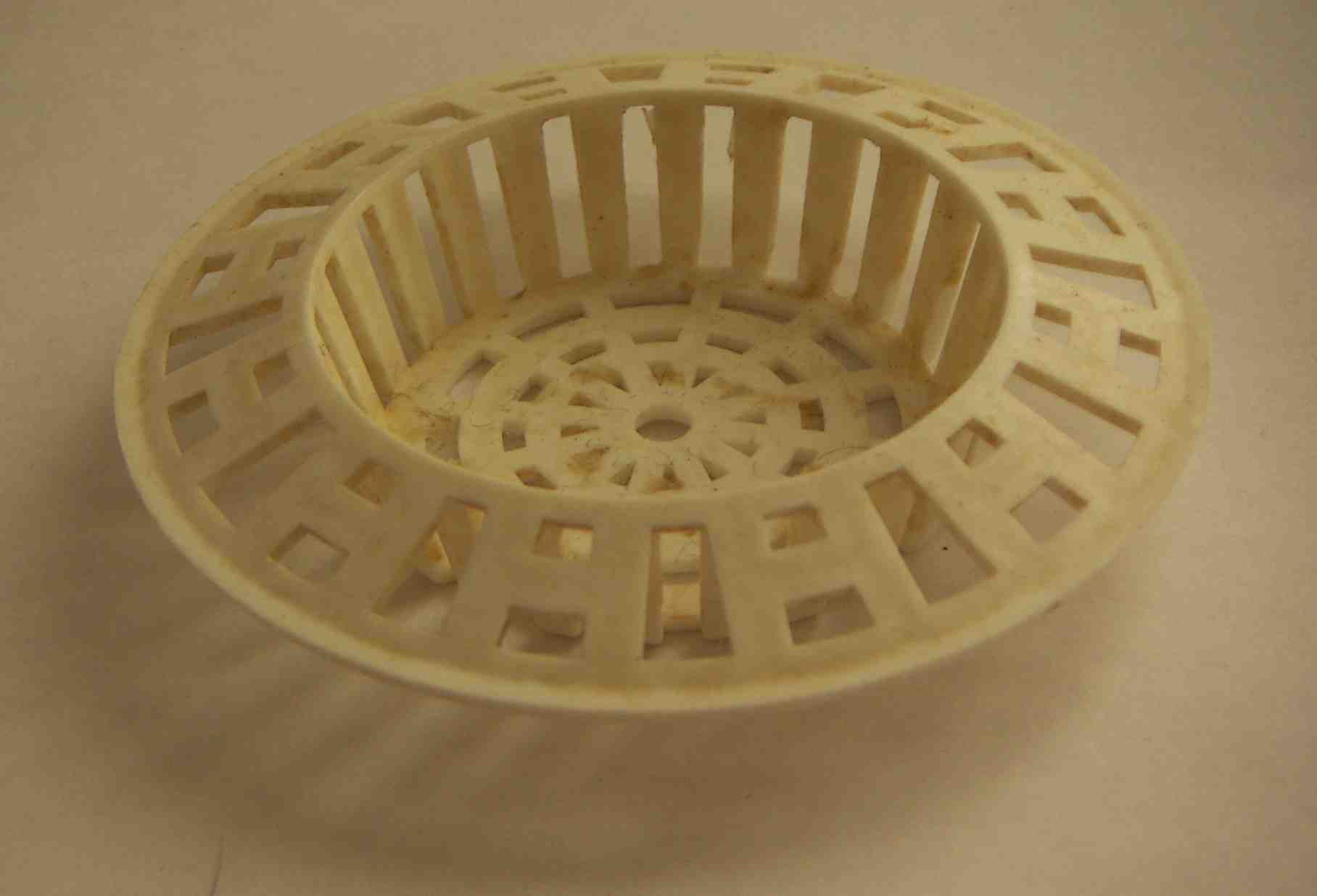
It is possible that this potato peel filter - typically in the kitchenbench sink, the same area where I also found the white stone - is of a form which can find relevant interpretations in e.g. Aristotle's philosophy. This potato peel filter could relate to Stonehenge such as Stonehenge relates to the 'Everest' divinity of those days.
Example 8 – Metaphysics 1042β-9
Text:
ἐπεὶ δ᾽ ἡ μὲν ὡς ὑποκειμένη καὶ ὡς ὕλη οὐσία ὁμολογεῖται, [10] αὕτη δ᾽ ἐστὶν ἡ δυνάμει, λοιπὸν τὴν ὡς ἐνέργειαν οὐσίαν τῶν αἰσθητῶν εἰπεῖν τίς ἐστιν. Δημόκριτος μὲν οὖν τρεῖς διαφορὰς ἔοικεν οἰομένῳ εἶναι (τὸ μὲν γὰρ ὑποκείμενον σῶμα, τὴν ὕλην, ἓν καὶ ταὐτόν, διαφέρειν δὲ ἢ ῥυσμῷ, ὅ ἐστι σχῆμα, ἢ τροπῇ, ὅ ἐστι θέσις, ἢ διαθιγῇ, ὅ [15] ἐστι τάξις)
Translation:
Since on the one hand the denominator and the logarithm are assumed to be the same in substance, the same in the dynamis, there remains to be explained the substance as energeia of the perceptible. Democritos appears to assume the existence of three differences - for on the one hand the denominator [ὑποκείμενον] body and the logarithm [ὕλη] are one and the same, on the other hand they differ in rhythm, which is σχῆμα, in manner [τροπῇ] which is θέσις, or διαθιγή which is order [τάξις].
Comment:
This seems to suggest that Aristotle understands σχῆμα as related to equiprobability, which is precisely what is needed for making sense of the entropy equation - wherein one observes that the denominator is the same before and after the 'LOG' sign but nevertheless differ on the left and right side of the equation sign - which is precisely the reason why only equiprobability makes the equation balance under normal circumstances. And hence it is what calls for a solution in terms of either semantics or syntax. Since διαθιγή qua τάξις should make sense of the 'syntax' part, one could assume that Aristotle lends to the τροπή qua θέσις the role of the semantics - which makes sense. The conclusion to this should be that σχῆμα contains both the similarity and the difference and hence could be the key to understanding the transcendent arbitrarity.
Example 9 – Metaphysics 1057α-18
Text:
ἐπεὶ δὲ τῶν ἐναντίων ἐνδέχεται εἶναί τι μεταξὺ καὶ ἐνίων ἔστιν, ἀνάγκη ἐκ τῶν ἐναντίων εἶναι τὰ μεταξύ. πάντα [20] γὰρ τὰ μεταξὺ ἐν τῷ αὐτῷ γένει ἐστὶ καὶ ὧν ἐστὶ μεταξύ. μεταξὺ μὲν γὰρ ταῦτα λέγομεν εἰς ὅσα μεταβάλλειν ἀνάγκη πρότερον τὸ μεταβάλλον (οἷον ἀπὸ τῆς ὑπάτης ἐπὶ τὴν νήτην εἰ μεταβαίνοι τῷ ὀλιγίστῳ, ἥξει πρότερον εἰς τοὺς μεταξὺ φθόγγους, καὶ ἐν χρώμασιν εἰ ἥξει ἐκ τοῦ λευκοῦ [25] εἰς τὸ μέλαν, πρότερον ἥξει εἰς τὸ φοινικοῦν καὶ φαιὸν ἢ εἰς τὸ μέλαν: ὁμοίως δὲ καὶ ἐπὶ τῶν ἄλλων): μεταβάλλειν δ᾽ ἐξ ἄλλου γένους εἰς ἄλλο γένος οὐκ ἔστιν ἀλλ᾽ ἢ κατὰ συμβεβηκός, οἷον ἐκ χρώματος εἰς σχῆμα. ἀνάγκη ἄρα τὰ μεταξὺ καὶ αὑτοῖς καὶ ὧν μεταξύ εἰσιν ἐν τῷ αὐτῷ γένει [30] εἶναι.
Translation:
But since among the opposites it is admitted to be something inbetween and of something, it is necessary for the inbetween to be from opposites. For all the inbetween is in its own genus and of what it is inbetween. On the one hand the inbetween is itself distributed in as far as it is to change, necessarily first to change (such as from the highest to what is heaped up in only a little part, it will be the first among the inbetween sounds, and in colours if it will come to be from the white in the black, primarily it will have first in the purple and grey or in the black: and it will be the same with the others): For to change from another genus into another genus is nothing but according to the convergence, such as from colour into σχῆμα. For the inbetween is necessary and in themselves and among these things are inbetween in itself to be the genus.
Comment:
This seems to outline how a parallelism - leaving something inbetween - is a necessary result of the σχῆμα in the sense of segmentation. It could suggest that segments necessarily have an inherent mirror-symmetric form - when time mirrors frequency. It also tells that there be small and medium-sized and big segments - such as my white stone, the Khumbutse and Mount Everest, or the potato peel filter, Stonehenge and the universal divinity, or the phoneme, the morpheme and the sentence etc. But all in all this seems to suggest that the time must have a form which somehow has a reflex in the frequency spectrum.
ἰδέα = the flux of information
The theory is that my PhD dissertation 'A waist of time' part 4: "A pilot study for a poetic science" is about Aristotle's ἰδέα. The issue seems to be how the knowledge of the individual finds a reflex in the knowledge of other individuals presumably via a collective consciousness - which again concerns the role of 'truth' in the fundamental theorem of logic (or Logos) in the sense of the influx of information from eternity into history. Here it will be - as far as concerns the flux of information - that the two sides of the equation will represent the individual in history and the others in history or eternity. I discuss two examples:
Example 1 – Metaphysics [990β]-12
Text:
κατά τε γὰρ τοὺς λόγους τοὺς ἐκ τῶν ἐπιστημῶν εἴδη ἔσται πάντων ὅσων ἐπιστῆμαι εἰσί, καὶ κατὰ τὸ ἓν ἐπὶ πολλῶν καὶ τῶν ἀποφάσεων, κατὰ δὲ τὸ νοεῖν τι φθαρέντος τῶν φθαρτῶν: φάντασμα [15] γάρ τι τούτων ἔστιν. ἔτι δὲ οἱ ἀκριβέστεροι τῶν λόγων οἱ μὲν τῶν πρός τι ποιοῦσιν ἰδέας, ὧν οὔ φαμεν εἶναι καθ᾽ αὑτὸ γένος, οἱ δὲ τὸν τρίτον ἄνθρωπον λέγουσιν. ὅλως τε ἀναιροῦσιν οἱ περὶ τῶν εἰδῶν λόγοι ἃ μᾶλλον εἶναι βουλόμεθα οἱ λέγοντες εἴδη τοῦ τὰς ἰδέας εἶναι: συμβαίνει γὰρ μὴ [20] εἶναι τὴν δυάδα πρώτην ἀλλὰ τὸν ἀριθμόν, καὶ τὸ πρός τι τοῦ καθ᾽ αὑτό, καὶ πάνθ᾽ ὅσα τινὲς ἀκολουθήσαντες ταῖς περὶ τῶν ἰδεῶν δόξαις ἠναντιώθησαν ταῖς ἀρχαῖς.
Translation:
According to the Logos of the knowledges, the nesting loops [εἶδος] will be of all those such as knowledge is, and according to one upon many and of negations, according to the thoughts of something decaying among the corrupt: For these things are phantasms. And still it is the sharpest among the logoses those who are making something from an idea [ἰδέας], of which we claim to be according to the own genus [γένος], but those are talking the third human. Those logoses about the nesting loops [εἰδῶν] completely absorb what we rather want to be telling/distributing of the nesting loops [εἴδη] to be of the ideas [ἰδέας]: For it converges for not to be the first pair but the number, and for being something according to itself, and all that as much as somebody let himself be guided to those opinions about the ideas [ἰδεῶν], negating the initial subscripts.
Comment:
"...all those such as knowledge is, and according to one upon many and of negations": This sounds like the summation signs of the στοιχεῖα with the minus of the αἴτια and subscripts of the ἀρχαί - that is, the very beginning symbols in the entropy equation.
"These things create the phantasms in the mind - and yet they lead to inner articulations that are of much value for distinct and articulated thought". This sounds indeed like the program of my PhD dissertation 'A waist of time' part 4: "A pilot study for a poetic science" - see comment to the following example.
Example 2 – Metaphysics 1040α-6
Text:
διὸ δεῖ, τῶν πρὸς ὅρον ὅταν τις ὁρίζηταί τι τῶν καθ᾽ ἕκαστον, μὴ ἀγνοεῖν ὅτι ἀεὶ ἀναιρεῖν ἔστιν: οὐ γὰρ ἐνδέχεται ὁρίσασθαι. οὐδὲ δὴ ἰδέαν οὐδεμίαν ἔστιν ὁρίσασθαι. τῶν γὰρ καθ᾽ ἕκαστον ἡ ἰδέα, ὡς φασί, καὶ χωριστή: ἀναγκαῖον δὲ ἐξ ὀνομάτων [10] εἶναι τὸν λόγον, ὄνομα δ᾽ οὐ ποιήσει ὁ ὁριζόμενος (ἄγνωστον γὰρ ἔσται), τὰ δὲ κείμενα κοινὰ πᾶσιν: ἀνάγκη ἄρα ὑπάρχειν καὶ ἄλλῳ ταῦτα: οἷον εἴ τις σὲ ὁρίσαιτο, ζῷον ἐρεῖ ἰσχνὸν ἢ λευκὸν ἢ ἕτερόν τι ὃ καὶ ἄλλῳ ὑπάρξει. εἰ δέ τις φαίη μηδὲν κωλύειν χωρὶς μὲν πάντα πολλοῖς [15] ἅμα δὲ μόνῳ τούτῳ ὑπάρχειν, λεκτέον πρῶτον μὲν ὅτι καὶ ἀμφοῖν, οἷον τὸ ζῷον δίπουν τῷ ζῴῳ καὶ τῷ δίποδι (καὶ τοῦτο ἐπὶ μὲν τῶν ἀϊδίων καὶ ἀνάγκη εἶναι, πρότερά γ᾽ ὄντα καὶ μέρη τοῦ συνθέτου: ἀλλὰ μὴν καὶ χωριστά, εἴπερ τὸ ἄνθρωπος χωριστόν: ἢ γὰρ οὐθὲν ἢ ἄμφω: [20] εἰ μὲν οὖν μηθέν, οὐκ ἔσται τὸ γένος παρὰ τὰ εἴδη, εἰ δ᾽ ἔσται, καὶ ἡ διαφορά): εἶθ᾽ ὅτι πρότερα τῷ εἶναι: ταῦτα δὲ οὐκ ἀνταναιρεῖται. ἔπειτα εἰ ἐξ ἰδεῶν αἱ ἰδέαι [23] (ἀσυνθετώτερα γὰρ τὰ ἐξ ὧν), ἔτι ἐπὶ πολλῶν δεήσει κἀκεῖνα κατηγορεῖσθαι ἐξ ὧν ἡ ἰδέα, οἷον τὸ ζῷον καὶ τὸ [25] δίπουν. εἰ δὲ μή, πῶς γνωρισθήσεται; ἔσται γὰρ ἰδέα τις ἣν ἀδύνατον ἐπὶ πλειόνων κατηγορῆσαι ἢ ἑνός. οὐ δοκεῖ δέ, ἀλλὰ πᾶσα ἰδέα εἶναι μεθεκτή. ὥσπερ οὖν εἴρηται, λανθάνει ὅτι ἀδύνατον ὁρίσασθαι ἐν τοῖς ἀϊδίοις, μάλιστα δὲ ὅσα μοναχά, οἷον ἥλιος ἢ σελήνη.
Translation:
Therefore one must, whenever among the delimitations somebody should define something of the concerns of each and every, not ignore what it is to always take something up: for it is not allowed to define/delimit for own concerns. For no Idea is defined for its own concern. For the Idea (is) among the concerns of each and every, as they say, and is separate: For it is necessary that the Logos be of words, and the defining person must not make the word (for he must be unknowing), for the 'nominator' ('lying') is common to all; hence it is necessary to subscript and all that; for if somebody should define him/herself in that way, an animal (image) would be distributed as dry/lean or white or something else that one would subscript. But if somebody should say do not prevent except (on the one hand) when every multitude at the same time (on the other hand) only one such subscripts, it must (on the one hand) first be said that this is also both, such as the biped animal is for the animal and for the biped (and this on the one hand is to be towards the eternals and necessary, on the other hand being first/primary and part of the complex; but this is also separate, if indeed the (hu)man is separate; for it is nothing or both; for on the one hand if it is nothing, it will not be genus at the nesting loops [εἴδη], if on the other hand it will be, then it is also a difference); hence if it be the first/primary of something, the same will not be taken away from the opposite side of the account (= cancelled). Hence if the Ideas (are) from/among the Ideas (for those are not the more complex among them), still among/upon the many one will have to [do] even that categorization from which the Idea comes, such as the animal/image and the biped. For if not, how can one come to knowledge of it? For it will be some Idea for which it is impossible to categorize in multitude or one. For it appears not [so], but the whole idea is partaking. How indeed that now should be understood, it escapes notice that it is impossible to define in the eternals, especially when it comes to singular things, such as the sun or the moon.
Comment:
This clearly concerns the question how my poetic thought could be reflecting Heaney's poem in part 4 of my PhD dissertation - "the free / time to settle on the age-old plant / seen so long ago" relative to "The Strand / The dotted line my father's ashplant made / on Sandymount Strand". The peculiar aspect of this line is that I had no good explanation or reason for it other than that it presented itself to my mind with some convincing ease. That is also what it means. However, where does the Idea come from? On the one hand it can be easy to find some relevant correlates in culture, on the other hand there is no doubt that this is my own line. The question is the role of the collective consciousness and how the subject relates to it. The whole of part 4 can be seen to be about this matter. (It cannot, though, be seen to support ideas of administrative rights to an authorship due to administration of ideas).
This is the principle of intervowen subscripts in my white metre poetry. It is probable that it shares this also with the yellow metre poetry - which then means the reduction from 77,3 to 64 poems in 'Der Dornenstrauch' part 3 etc. Both the yellow and the white metre produced a white stone - in the yellow metre this was the white stone that resembled Khumbutse, in the white metre it was a stone that resembled a few lines in one of the poems.
Example 1 – Metaphysics 981α-7
Text:
τὸ μὲν γὰρ ἔχειν ὑπόληψιν ὅτι Καλλίᾳ κάμνοντι τηνδὶ τὴν νόσον τοδὶ συνήνεγκε καὶ Σωκράτει καὶ καθ᾽ ἕκαστον οὕτω πολλοῖς, ἐμπειρίας ἐστίν: [10] τὸ δ᾽ ὅτι πᾶσι τοῖς τοιοῖσδε κατ᾽ εἶδος ἓν ἀφορισθεῖσι, κάμνουσι τηνδὶ τὴν νόσον, συνήνεγκεν, οἷον τοῖς φλεγματώδεσιν ἢ χολώδεσι ἢ πυρέττουσι καύσῳ, τέχνης.
Translation:
On the one hand to have the understanding (taking up a certain word) that Callias being sick from this or that disease is to 'carry/bring together' and when Socrates also (is) according to various (each and every) such circumstances, that is an empirical matter; on the other hand by/for all that according to the εἶδος, one is marked off, suffering from this or that disease, it is brought together (that) how to determine (about) the phlegmatic or bilious or burning fever is a matter of art.
Comment:
This concerns the question how the εἶδος as a high spiritual form can emerge through the empiricism of the senses. One could also take it that the experience and the art are 'brought together' in nesting loops - like ∑i∑j p(aibj) in the numerator.
συνήνεγκεν = aorist 3ps ind. act. of συμφέρω = 'carry/bring together'
ἀφορισθεῖσι = pass part masc dat of ἀφορίζω = 'marked off'
Example 2 – Metaphysics 987β-11
Text:
τὴν δὲ μέθεξιν τοὔνομα μόνον μετέβαλεν: οἱ μὲν γὰρ Πυθαγόρειοι μιμήσει τὰ ὄντα φασὶν εἶναι τῶν ἀριθμῶν, Πλάτων δὲ μεθέξει, τοὔνομα μεταβαλών. τὴν μέντοι γε μέθεξιν ἢ τὴν μίμησιν ἥτις ἂν εἴη τῶν εἰδῶν ἀφεῖσαν ἐν κοινῷ ζητεῖν). ἔτι δὲ παρὰ τὰ αἰσθητὰ [15] καὶ τὰ εἴδη τὰ μαθηματικὰ τῶν πραγμάτων εἶναί φησι μεταξύ, διαφέροντα τῶν μὲν αἰσθητῶν τῷ ἀΐδια καὶ ἀκίνητα εἶναι, τῶν δ᾽ εἰδῶν τῷ τὰ μὲν πόλλ᾽ ἄττα ὅμοια εἶναι τὸ δὲ εἶδος αὐτὸ ἓν ἕκαστον μόνον. ἐπεὶ δ᾽ αἴτια τὰ εἴδη τοῖς ἄλλοις, τἀκείνων στοιχεῖα πάντων ᾠήθη τῶν ὄντων εἶναι [20] στοιχεῖα.
Translation:
As concerns the term 'participation/involvement', it is only a matter of turnaround [μετέβαλεν]: For the Pythagoreans took it to be a mimesis of numbers while Plato called it participation/involvement - a turnaround of the word. As to what sort of participation or imitation this could constitute for the nesting loops [εἶδος], they left that to the common inquiry. However, though, since by the perceptible things and the εἶδος the mathematics of things is said to be inbetween, the perceptibles differ from the eternal and motionless, among the εἶδος it is for those many similars to be the εἶδος itself - one and each singular. Since the cause/minus-sign/negation is the εἶδος of the others, those specific elements/summation-signs [στοιχεῖα] are such elements [στοιχεῖα] of all the anticipations of being.
Comment:
This corresponds to my white metre in the sense of the εἶδος appearing through the poetic writing by the interactive dialogue with the perceptible history - and in the final interweaving like nesting loops (subscripts) in the reorganization of the final lines. The reason why this could be possible is that the εἶδος includes the anticipation of future events - which reveal themselves with a certain 'poetic call' when they later come to appear in the perceptible history. Even the white stone I found (on 10 august 2016 which was temporally about 4/5 through the writing) telling of the mid stanza in poem #5 (of my white metre poetry book 'Stillhetens åndedrag') seems to have 'anticipated' the final form when the 'indian' seems to tell of the mid stanza of the mirror poem #60 which is #5 from the end. It is noticed that Plato's μέθεξις perhaps could be seen as a 'turnaround' or simply 'reverse' of the pythagorean ἀριθμός → σόμ-θι-ρα = 'som-thi-ra' which resembles μέθεξις → θέμ-σι-ξε → 'them-si-xa' - but this sort of clever rhetorical trick is not what Plato is known for. But of course it could be telling of what the pythagoreans meant with 'imitating numbers'.
The procedure of writing of my white metre eventually outputted a result which has a rather exact correlate in Tintoretto's magnum opus in Scuola Grande in Venice - a lighthouse of the principles and logic of the italian renaissance erected before the european response guided the development into second thoughts.
It is noticed that what normally is translated as Plato's 'objects of mathematics' by me here is translated 'the mathematics of things' - which is about the recording and eventual permutation of things which occurred during the writing and hence were giving an impetus to the anticipations and nesting loops in the organization of the poetic lines written in interaction with history.
Example 3 – Metaphysics 991β-22
Text:
ἔτι ἐκ πολλῶν ἀριθμῶν εἷς ἀριθμὸς γίγνεται, ἐξ εἰδῶν δὲ ἓν εἶδος πῶς; εἰ δὲ μὴ ἐξ αὐτῶν ἀλλ᾽ ἐκ τῶν ἐν τῷ ἀριθμῷ, οἷον ἐν τῇ μυριάδι, πῶς ἔχουσιν αἱ μονάδες; εἴτε γὰρ ὁμοειδεῖς, πολλὰ συμβήσεται ἄτοπα, εἴτε μὴ ὁμοειδεῖς, [25] μήτε αὐταὶ ἀλλήλαις μήτε αἱ ἄλλαι πᾶσαι πάσαις: τίνι γὰρ διοίσουσιν ἀπαθεῖς οὖσαι; οὔτε γὰρ εὔλογα ταῦτα οὔτε ὁμολογούμενα τῇ νοήσει.
Translation:
And yet, from the many numbers one number comes out of it, from the many εἶδος how can there come one εἶδος? For if not out of these but out of what is in the numbers, such as in the 'myriad' [= '1000'], what sort of units could that be? For if there is sameness of one form, many will converge in unlike manner; if, however, there is not sameness of one form, neither will each other themselves nor all the many others; for something unexcitingly real differs [διοίσουσιν = 'carries over']? For that is neither reasonable nor things ('units') agreed upon in the mental conception.
Comment:
This 'something unexcitingly real' is likely to be the transcendent arbitrarity 'z' which is what makes the original metaphysical difference while yet hardly being perceptible. It is the object of inquiry in the Metaphysics and it is here recognized as equivalent to the problem of sameness of εἶδος or not.
Example 4 – Metaphysics 1023β-23
Text:
ἔτι τὰ ἐν τῷ λόγῳ τῷ δηλοῦντι ἕκαστον, καὶ ταῦτα μόρια τοῦ ὅλου: διὸ τὸ γένος τοῦ εἴδους καὶ μέρος λέγεται, ἄλλως δὲ τὸ [25] εἶδος τοῦ γένους μέρος.
Translation:
Hence each [is] those things in the appearing logos - and that is a part of the whole; therefore the γένος is a distributed part of the εἶδος, while at the same time the εἶδος is a part of the γένος.
Comment:
This on the one hand suggests how the sum of probabilities can be bigger and smaller than one, and it can so do via the character of the nesting loops.
τὸ τί ἦν εἶναι = the numerator
The theory is that τὸ τί ἦν εἶναι = 'that, to be what was' is to be understood as the numerators in the entropy equation. Essential to Aristotle's discussion is the status of the substance - if it has taken on spontaneous form or if it is 'what was' - the two different substances will count differently in the summation of probabilities. There are in the Metaphysics 77 occurrences of τί ἦν εἶναι with the prefixed article in various cases and forms.
Example 1 – Metaphysics 1028β-33
Text:
[1028β] λέγεται δ᾽ ἡ οὐσία, εἰ μὴ πλεοναχῶς, ἀλλ᾽ ἐν τέτταρσί γε μάλιστα: καὶ γὰρ τὸ τί ἦν εἶναι καὶ τὸ καθόλου [35] καὶ τὸ γένος οὐσία δοκεῖ εἶναι ἑκάστου, καὶ τέταρτον τούτων τὸ ὑποκείμενον. τὸ δ᾽ ὑποκείμενόν ἐστι καθ᾽ οὗ τὰ ἄλλα λέγεται, ἐκεῖνο δὲ αὐτὸ μηκέτι κατ᾽ ἄλλου: διὸ πρῶτον περὶ τούτου διοριστέον: [1029α] [1] μάλιστα γὰρ δοκεῖ εἶναι οὐσία τὸ ὑποκείμενον πρῶτον.
τοιοῦτον δὲ τρόπον μέν τινα ἡ ὕλη λέγεται, ἄλλον δὲ τρόπον ἡ μορφή, τρίτον δὲ τὸ ἐκ τούτων (λέγω δὲ τὴν μὲν ὕλην οἷον τὸν χαλκόν, τὴν δὲ μορφὴν τὸ σχῆμα τῆς [5] ἰδέας, τὸ δ᾽ ἐκ τούτων τὸν ἀνδριάντα τὸ σύνολον), ὥστε εἰ τὸ εἶδος τῆς ὕλης πρότερον καὶ μᾶλλον ὄν, καὶ τοῦ ἐξ ἀμφοῖν πρότερον ἔσται διὰ τὸν αὐτὸν λόγον.
Translation:
The substance is distributed, if not manifold, but in four at most: for both the numerator [τὸ τί ἦν εἶναι] and the division bar [τὸ καθόλου] and the specific [γένος] substance appear each to be, and the fourth among these is the denominator [τὸ ὑποκείμενον]. The denominator is that by which the others are distributed, itself it is not according to the others: therefore (it is) first about this to be drawn a boundary through: for indeed substance appears to be the first denominator. In this way the logarithm [ὕλη] is distributed, the (logarithmic) base [μορφή = kind/type/form] in another way, in a third way what comes out of this [τὸ ἐκ τούτων] (I distribute on the one hand the logarithm [ὕλη] such as the copper/bronze, the form the character of the idea, and on the whole what sculpture comes out of this), such that if the look/form of the logarithm first and foremost is being, and what out of both will be first via the same logos.
Comment:
The fourfold distribution of the substance is over the four main components (the fractions) of the formula: However, in addition to this 'horizontal/syntagmatic' distribution there seems also to be a 'vertical/paradigmatic' one - 1) the numerator [τὸ τί ἦν εἶναι], 2) the division bar [τὸ καθόλου] between numerator and denominator (meaning the general idea of 'division'), 3) the specific [γένος] substances A and B, and 4) the denominator [τὸ ὑποκείμενον]. The denominator is furthermore distributed or divided into ὕλη which I take to be a logarithm, the μορφή which normally means 'form' and which I tentatively take to mean the 'base' of the logarithm, and τὸ ἐκ τούτων would then be what comes out of this, which could be the value of the computation.
Example 2 – Metaphysics 1029β-12-1
Text:
ἐπεὶ δ᾽ ἐν ἀρχῇ διειλόμεθα πόσοις ὁρίζομεν τὴν οὐσίαν, καὶ τούτων ἕν τι ἐδόκει εἶναι τὸ τί ἦν εἶναι, θεωρητέον περὶ [13] αὐτοῦ. καὶ πρῶτον εἴπωμεν ἔνια περὶ αὐτοῦ λογικῶς, ὅτι ἐστὶ τὸ τί ἦν εἶναι ἑκάστου ὃ λέγεται καθ᾽ αὑτό.
Translation:
Since in the summation sign subscripts we are divided (as to) how much we subdivide the substance, among these (there is) one that seemed to be the numerator, as should be observed about it. And first we should tell among these something logically, that the numerator is each what is distributed according to itself.
Comment:
The subscripts i,j to the initial summation signs present aspects of the being in nesting loops - and these aspects include the character of our own observation - hence in our philosophical inquiry (and in our psychological reality) the numerator ('to be what was') is each which is distributed according to itself - which probably means that it is the numerator that contains both nesting loops qua p(aibj).
Example 3 – Metaphysics 1029β-23
Text:
ἐπεὶ δ᾽ ἔστι καὶ κατὰ τὰς ἄλλας κατηγορίας σύνθετα (ἔστι γάρ τι ὑποκείμενον ἑκάστῳ, οἷον τῷ ποιῷ καὶ τῷ ποσῷ καὶ τῷ [25] ποτὲ καὶ τῷ ποὺ καὶ τῇ κινήσει), σκεπτέον ἆρ᾽ ἔστι λόγος τοῦ τί ἦν εἶναι ἑκάστῳ αὐτῶν, καὶ ὑπάρχει καὶ τούτοις τὸ τί ἦν εἶναι, οἷον λευκῷ ἀνθρώπῳ τί ἦν λευκῷ ἀνθρώπῳ.
Translation:
Since there also is according to the other categories a complex/composite (for there is some denominator for each, such as for what kind and for how much and for sometimes and how and by what movement), it should be observed of the numerator [τοῦ τί ἦν εἶναι] for each of them and subscripted also for these numerators, such as for the white man what was for the white man.
Comment:
It tells that the numerator is philosophically settled temporally, such that what was is already settled and hence can be counted in the numerator. Spontaneous 'ex nihilo' formation of matter does not go into this category and therefore the summation of the probabilities can come to differ from one, since what was is settled and the sum of probabilities goes to one and therefore the probabilities of ex nihilo formation of matter will add to this - alternatively if the sum of all including the spontaneous ex nihilos per definition goes to one the sum of the probabilities of what was already settled will be less than one. This difference between the status of temporally settled and ex nihilo matter makes for a complex or composite count. The denominator responds to the category which the matter (old or new) is sorted into and therefore does not differ between the two.
Example 4 – Metaphysics 1030α-1
Text:
τὸ δὴ λευκὸς ἄνθρωπος ἔστι μὲν λευκόν, [1030α] [1] οὐ μέντοι τὸ τί ἦν εἶναι λευκῷ εἶναι.
Translation:
The [phenomenon of] 'white man' is white, which does not mean that the numerator [τὸ τί ἦν εἶναι] is for the white.
Comment:
This tells that the white colour can be 'ex nihilo', could be the man suddenly turns pale by some idea, and then the numerator counting this white colour does not count it among the other white objects. The 'magic image' is an example: It seems to tell that the humans really have a black field over one eye - and how come it looks white there normally? Could be the status of this field is different compared with the rest of the face.
Example 5 – Metaphysics 1030α-2
Text:
ἀλλὰ τὸ ἱματίῳ εἶναι ἆρά ἐστι τί ἦν εἶναί τι ἢ ὅλως; ἢ οὔ; ὅπερ γάρ τί ἐστι τὸ τί ἦν εἶναι: ὅταν δ᾽ ἄλλο κατ᾽ ἄλλου λέγηται, οὐκ ἔστιν ὅπερ τόδε τι, οἷον ὁ [5] λευκὸς ἄνθρωπος οὐκ ἔστιν ὅπερ τόδε τι, εἴπερ τὸ τόδε ταῖς οὐσίαις ὑπάρχει μόνον: ὥστε τὸ τί ἦν εἶναί ἐστιν ὅσων ὁ λόγος ἐστὶν ὁρισμός.
Translation:
But to be for/with garment isn't that what was to be something or the whole? Or not? For what indeed is a numerator: Whenever it is distributed by the other according to the other, it is not by what is, such as the white man who is not by what is, if indeed by that the singular subscripts the substances: so that the numerator is how the logos is the definition/marked-out.
Comment:
The garment can make a man white or only partially white and this exemplifies how to count the occurrences for computing the probabilities. The example of what 'is distributed by the other according to the other' could then be about these problems for the nesting loops contained in the numerator p(aibj) - if e.g. ai = man and bj = white. Aristotle then invokes the idea of the logos being activated for defining (or 'marking out') the status of the substance to be counted - the logos is related to the transcendent arbitrarity and therefore the status of the substance (to be counted in this or that category) will not be determined by a simple immanent classification.
Example 6 – Metaphysics 1031α-8
Text:
εἰ δ᾽ εἰσὶ καὶ τούτων ὅροι, ἤτοι ἄλλον τρόπον εἰσὶν ἢ καθάπερ ἐλέχθη πολλαχῶς λεκτέον εἶναι τὸν ὁρισμὸν καὶ τὸ τί ἦν [10] εἶναι, ὥστε ὡδὶ μὲν οὐδενὸς ἔσται ὁρισμὸς οὐδὲ τὸ τί ἦν εἶναι οὐδενὶ ὑπάρξει πλὴν ταῖς οὐσίαις, ὡδὶ δ᾽ ἔσται. ὅτι μὲν οὖν ἐστὶν ὁ ὁρισμὸς ὁ τοῦ τί ἦν εἶναι λόγος, καὶ τὸ τί ἦν εἶναι ἢ μόνων τῶν οὐσιῶν ἐστὶν ἢ μάλιστα καὶ πρώτως καὶ ἁπλῶς, δῆλον. [15]
Translation:
If there are boundaries among these, or indeed there are other ways or exactly as whatever has been distributed, the definition/delimitation and the numerator are to be distributed into many parts, such as thus, on the one hand, there is no definition/delimitation nor on the other hand (there is) a numerator nor will it be subscripted except for the substances, and thus it will be. That consequently the definition is the numerator-logos, and the numerator is either among the singular substances or the foremost and singular, that is obvious/computable.
Comment:
This again tells of various statuses for the substances (in the numerators) distributed by nesting loops and controlled by the transcendent logos, as far as inclusion in count is concerned.
Example 7 – Metaphysics 1031α-15
Text:
πότερον δὲ ταὐτόν ἐστιν ἢ ἕτερον τὸ τί ἦν εἶναι καὶ ἕκαστον, σκεπτέον. ἔστι γάρ τι πρὸ ἔργου πρὸς τὴν περὶ τῆς οὐσίας σκέψιν: ἕκαστόν τε γὰρ οὐκ ἄλλο δοκεῖ εἶναι τῆς ἑαυτοῦ οὐσίας, καὶ τὸ τί ἦν εἶναι λέγεται εἶναι ἡ ἑκάστου οὐσία.
Translation:
Whether it is itself or if the numerator is each and something else, is to be considered. For it is something per se [pro work] against the examination of substances: For each cannot seem to be different from its own substance, and each substance is distributed to be the numerator.
Comment:
"...is to be considered" - could apply to the present philosophical discussion or to the examination of the substances in the mind.
Example 8 – Metaphysics 1031β-19
Text:
ἔκ τε δὴ τούτων τῶν λόγων ἓν καὶ ταὐτὸ οὐ κατὰ συμβεβηκὸς αὐτὸ ἕκαστον [20] καὶ τὸ τί ἦν εἶναι, καὶ ὅτι γε τὸ ἐπίστασθαι ἕκαστον τοῦτό ἐστι, τὸ τί ἦν εἶναι ἐπίστασθαι, ὥστε καὶ κατὰ τὴν ἔκθεσιν ἀνάγκη ἕν τι εἶναι ἄμφω (τὸ δὲ κατὰ συμβεβηκὸς λεγόμενον, οἷον τὸ μουσικὸν ἢ λευκόν, διὰ τὸ διττὸν σημαίνειν [24] οὐκ ἀληθὲς εἰπεῖν ὡς ταὐτὸ τὸ τί ἦν εἶναι καὶ αὐτό: καὶ [25] γὰρ ᾧ συμβέβηκε λευκὸν καὶ τὸ συμβεβηκός, ὥστ᾽ ἔστι μὲν ὡς ταὐτόν, ἔστι δὲ ὡς οὐ ταὐτὸ τὸ τί ἦν εἶναι καὶ αὐτό: τῷ μὲν γὰρ ἀνθρώπῳ καὶ τῷ λευκῷ ἀνθρώπῳ οὐ ταὐτό, τῷ πάθει δὲ ταὐτό). ἄτοπον δ᾽ ἂν φανείη κἂν εἴ τις ἑκάστῳ ὄνομα θεῖτο τῶν τί ἦν εἶναι: ἔσται γὰρ καὶ παρ᾽ ἐκεῖνο [30] ἄλλο, οἷον τῷ τί ἦν εἶναι ἵππῳ τί ἦν εἶναι ἵππῳ ἕτερον. καίτοι τί κωλύει καὶ νῦν εἶναι ἔνια εὐθὺς τί ἦν εἶναι, εἴπερ οὐσία τὸ τί ἦν εἶναι; ἀλλὰ μὴν οὐ μόνον ἕν, ἀλλὰ καὶ ὁ λόγος ὁ αὐτὸς αὐτῶν, ὡς δῆλον καὶ ἐκ τῶν εἰρημένων: [1032α] [1] οὐ γὰρ κατὰ συμβεβηκὸς ἓν τὸ ἑνὶ εἶναι καὶ ἕν.
Translation:
From these logoses one and the same does not converge [συμβεβηκὸς] (onto) each itself and the numerator, and that each knowledge/knowing is this, knowing the numerator, such that the exposition [conclusion?] must be one both (that due to the convergence being distributed, such as the musical or the white, means doubly that it is not true how the same numerator is itself: and hence for what has converged white and the convergence, such that on the one hand it is itself, on the other hand the numerator is like not itself and itself: for on the one hand for the man and the white man (it) is not the same, on the other hand that is itself by sensation). Unusual it would appear to be if somebody were to put name onto each of the numerators: for it will also be according to this other one, such as for the numerator horse to be another numerator horse. And indeed what would prevent now from being one immediate numerator, if indeed the numerator is substance? However, not one alone, but also the logos itself among them, hence computable and of the (probabilistic) dependencies [εἰρημένων]: hence not one by the convergence for the one to be and one.
Comment:
It is a relevant question what συμβαίνω really means here: On the one hand it trivially refers to two things occurring alongside, such as the man being both musical and white, on the other hand the question is why this is an interesting philosophical issue. My opinion is that this 'together-going' is relevant from the viewpoint of the sum of probabilities being bigger or smaller than unity - by e.g. the ex nihilo formations - such as the probably ex nihilo labels or the helicopters at the Danube (a vision of mine) that probably could be photographed with cognitive surveillance but maybe not with ordinary surveillance. If they can be bigger or smaller (in a non-euclidean logic eliminating Euclid's fifth common notion that the whole has to be bigger than the part), then the submorphemic spectrum can occur in interference with the spectrum of unity, and that seems to be the real issue of Aristotle's lengthy discussions on this topic - and then the question is whether these interferences converge onto recognized and semiotically relevant categories. Hence if συμβαίνω (in various inflections (συμβέβηκε, συμβεβηκός etc) is taken to mean 'converge', it is for that philosophical reason - otherwise it means trivially 'together-going'. For Aristotle's metaphysics the issue is how e.g. λόγος relates to various metaphysical parametres such as μορφή or δύναμις or φύσις relative to their physical counterparts (such as ἐντελέχεια, ἐνέργεια or θέσις) - and hence whether the transcendent parametres lead to a convergence onto semiotically relevant categories in the physical parametres.
I take ὑποκείμενον to be the denominator in the entropy equation. There are probably appr 95 occurrences of it in the Metaphysics.
Example 1 – Metaphysics 1013β-22
Text:
τούτων δὲ τὰ μὲν ὡς τὸ ὑποκείμενον, οἷον τὰ μέρη, τὰ δὲ ὡς τὸ τί ἦν εἶναι, τό τε ὅλον καὶ ἡ σύνθεσις καὶ τὸ εἶδος.
Translation:
Among those such as the denominator, such as the parts, those such as the numerator, those the whole and the synthesis and the nesting loops [εἶδος].
Comment:
ὑποκείμενον = denominator, the part could be the A or B, τὸ τί ἦν εἶναι = the numerator.
Example 2 – Metaphysics 1016α-17
Text:
ἔτι ἄλλον τρόπον ἓν λέγεται τῷ τὸ ὑποκείμενον τῷ εἴδει εἶναι ἀδιάφορον: ἀδιάφορον δ᾽ ὧν ἀδιαίρετον τὸ εἶδος κατὰ τὴν αἴσθησιν: τὸ δ᾽ ὑποκείμενον [20] ἢ τὸ πρῶτον ἢ τὸ τελευταῖον πρὸς τὸ τέλος
Translation:
In yet another manner as 'one' is the denominator distributed for the nesting loops [εἶδος] to be indistinct - indistinct qua indivisible εἶδος according to the perceptible: The denominator either the first or the last from the end.
Comment:
The first denominator is p(A)p(B|ai), the last p(A)p(B|A). It is here assumed that the probabilities of p(A) and p(B) sum up to one and if these are ordered and distributed in a stack, the resulting perceptible spectrum can be more or less diffuse or distinct. 'Diffuse' is one of the distinctive acoustic features. Aristotle uses a number of concepts for this 'form' - such as εἶδος, μορφή, σχῆμα, ἰδέα and others - and clearly these could refer to various kinds of relevant form.
Example 3 – Metaphysics 1024β-1
Text:
[1024β] [1] ἔτι δὲ ὡς τὸ ἐπίπεδον τῶν σχημάτων γένος τῶν ἐπιπέδων καὶ τὸ στερεὸν τῶν στερεῶν: ἕκαστον γὰρ τῶν σχημάτων τὸ μὲν ἐπίπεδον τοιονδὶ τὸ δὲ στερεόν ἐστι τοιονδί: τοῦτο δ᾽ ἐστὶ τὸ ὑποκείμενον ταῖς διαφοραῖς.
Translation:
And yet like the flat kind [γένος] of σχῆματα of the flat surfaces and the solid of the solids: for each of the σχῆματα is on the one hand the flat of this kind, on the other hand is the solid of this kind: This is the denominator for the differences.
Comment:
This example tells - σχῆμα is here assumed to be an identity or 'equation' between two parts that are not identical - that 2 dimensions are 3 dimensions in the denominator. What Aristotle thereby tries to say is probably that one of the denominators is a logarithm - which I otherwise take to be his concept of ὕλη which normally means just 'matter' and hence is related to 'solid'. The logarithm of a number is the exponent of a certain base (the latter I have speculated could be Aristotle's μορφή) which means that the logarithms are added where the plain numbers would be multiplied - that is like two dimensions turned into one. The denominator in the first fraction and the logarithmic fraction are the same.
Example 4 – Metaphysics 1024β-9
Text:
οὗ γὰρ ἡ διαφορὰ καὶ ἡ ποιότης ἐστί, τοῦτ᾽ ἔστι τὸ ὑποκείμενον, ὃ λέγομεν ὕλην.
Translation:
For where the difference and the quality is, there is the denominator which we call ('distribute as') logarithm.
Comment:
This would be about the denominator in the second half on each side of the equation sign. Is it true that reducing the dimension from two to one, or from three to two, gives 'quality' and 'difference'? From a certain point of view, differential derivation associates with 'ex nihilo' formation of matter - that obtains probably primarily for the natural logarithms. If therefore one associates difference and quality with 'ex nihilo' formation of matter, one could perhaps interpret it as 'qualitatively different' matter.
The fragment continues:
Example 5 – Metaphysics 1024β-10
Text:
ἕτερα [10] δὲ τῷ γένει λέγεται ὧν ἕτερον τὸ πρῶτον ὑποκείμενον καὶ μὴ ἀναλύεται θάτερον εἰς θάτερον μηδ᾽ ἄμφω εἰς ταὐτόν
Translation:
For another (a second) is distributed for the specific genus [τῷ γένει] whose other/second (is) the first denominator and the second not dissolved/detached from the second nor both from the one.
Comment:
This probably tells of the character of the denominators on the lefthand side of the equation - the first which is plain and the second which is logarithmic. The specific genera are perhaps simply the A and the B.
Example 6 – Metaphysics 1044β-8
Text:
οὐδ᾽ ὅσα δὴ φύσει μέν, μὴ οὐσίαι δέ, οὐκ ἔστι τούτοις ὕλη, ἀλλὰ τὸ ὑποκείμενον ἡ οὐσία.
Translation:
For is the φύσει not great, neither is the substance either - the logarithm [ὕλη] is not by these but the substance is the denominator [ὑποκείμενον].
Comment:
In my conceptualization, the φύσις is the 'extension' from the θέσις of the transcendent arbitrarity.
Example 7 – Metaphysics 1067β-15
Text:
μεταβάλλει [15] δὲ τὸ μεταβάλλον ἢ ἐξ ὑποκειμένου εἰς ὑποκείμενον, ἢ οὐκ ἐξ ὑποκειμένου εἰς οὐχ ὑποκείμενον, ἢ ἐξ ὑποκειμένου εἰς οὐχ ὑποκείμενον, ἢ οὐκ ἐξ ὑποκειμένου εἰς ὑποκείμενον (λέγω δὲ ὑποκείμενον τὸ καταφάσει δηλούμενον), ὥστ᾽ ἀνάγκη τρεῖς εἶναι μεταβολάς: ἡ γὰρ ἐξ οὐχ ὑποκειμένου [20] εἰς μὴ ὑποκείμενον οὐκ ἔστι μεταβολή: οὔτε γὰρ ἐναντία οὔτε ἀντίφασίς ἐστιν, ὅτι οὐκ ἀντίθεσις.
Translation:
The inversion inverts either from denominator to denominator, or from not denominator to not denominator, or from denominator to not denominator, or from not denominator to denominator (for I distribute the denominator over the computable affirmative proposition) such that the inversions must be three: What is from not denominator to not denominator is not an inversion: for it is neither a contrariety nor an affirmative proposition, because it is not an antithetis/contradiction.
Comment:
Assume that 'not denominator' means 'minus denominator', that is, a negative value. If the denominator relates to the logarithm, the exponent can (if one distributes over 'computable affirmative propositions', as Aristotle says) remain positive in the three first cases but not in the case of two minuses, in which case it has to remain negative and hence its positive value will necessarily invert into the denominator. But it could under circumstances of 'negative affirmation' go negative in three of the cases? e–x can never be zero, but clearly log ex = x can. Of course, but then it would still be only three out of four. It is not certain that Aristotle had such logarithmic concepts available, though - but rather that it was cast in the form of ὕλη and ὑποκείμενον.
| y–x | = |
1 ———— yx |
Example 8 – Metaphysics 984α-17
Text:
ἐκ μὲν οὖν τούτων μόνην τις αἰτίαν νομίσειεν ἂν τὴν ἐν ὕλης εἴδει λεγομένην: προϊόντων δ᾽ οὕτως, αὐτὸ τὸ πρᾶγμα ὡδοποίησεν αὐτοῖς καὶ συνηνάγκασε ζητεῖν: εἰ γὰρ ὅτι μάλιστα [20] πᾶσα γένεσις καὶ φθορὰ ἔκ τινος ἑνὸς ἢ καὶ πλειόνων ἐστίν, διὰ τί τοῦτο συμβαίνει καὶ τί τὸ αἴτιον; οὐ γὰρ δὴ τό γε ὑποκείμενον αὐτὸ ποιεῖ μεταβάλλειν ἑαυτό: λέγω δ᾽ οἷον οὔτε τὸ ξύλον οὔτε ὁ χαλκὸς αἴτιος τοῦ μεταβάλλειν ἑκάτερον αὐτῶν, οὐδὲ ποιεῖ τὸ μὲν ξύλον κλίνην ὁ δὲ χαλκὸς ἀνδριάντα, [25] ἀλλ᾽ ἕτερόν τι τῆς μεταβολῆς αἴτιον.
Translation:
From these, one single of the αἴτιαι (= the plus/minus signs) would acknowledge/recognize what has been distributed for the εἴδος [= 'form'] in the logarithm: as it emerges from this, the thing itself [= the single αἴτιος] does the same as those [three] others and finds it necessary to seek/apply/inquire along with (them): hence if [that] all creation and destruction is from something complete or a majority of it, why does this converge on the αἴτιαι? For the denominator cannot invert itself into its inversion: I distribute ('tell') how neither the wood nor the bronze is plus/minus of the inversion of each of them, nor makes it [these materials themselves] the wooden bed or the brazen statue, but another plus or minus of the inversion.
Comment:
"...distributed [...] in the logarithm" means that same phenomenon of denominator turning into a negative in the logarithm. "Something complete or a majority of it" is precisely the condition which applies to the previous fragment under 'computable affirmative propositions'. Why does this converge on the αἴτιαι? That probably refers to the 3 vs 1 of the plus/minus signs which I translate as the αἴτιαι (normally αἴτιαι is translated 'causes, reasons').
The analysis of various fundamental concepts of Aristotle has been far from exhaustive but has given a good sketch of how to proceed for reaching a somewhat radical redefinition of Aristotle's philosophy and its submorphemic aspects in accordance with the conjectured abstraction.
i) The submorphemic basis for knowledge is one of the preconditions for this, and that is far from trivial.
ii) Another is the assumption of a relevance for the summation of probabilities in the entropy equation to deviate from one in the context of alternative substances, which likewise is far from trivial.
iii) A third is the inherent systematic definition of fundamental principles of semantics and syntax which this entails, which likewise is far from trivial.
iv) This is clearly relevant for an attempted formalistic definition for a modelling of the human faculty of faith, which also is a concept of relevance for the new information technology of our time. My view is that the entropy equation discussed in the present study amounts to the complex surrounding the concept of Logos in prechristian submorphemic philosophy.
v) Finally one can expect to find a conjectured mirroring of temporal = logical and frequency-spectral = phonetic forms, an isomorphy which likely could control segmentation, possibly within the framework of a universal grammar - which then naturally makes for the assumption of an isomorphy with the probability 'spectra'.
Hence there are a good number of such systematic preconditions which must be assumed for reaching the redefinition, which then probably will converge on a restructuring of the conception of Aristotle which could constitute a paradigmatic change in the conception of prechristian philosophy generally.
The potential for this paradigmatic change is inherent also in my 1997 PhD dissertation ' A waist of time' in its five parts or 'books':
Book 1: The assumption of a submorphemic signification in human language.
Book 2: The millenial periodization of the history of linguistics, information technology and logical paradoxes which allows for the postulation of a submorphemic basis for prechristian thought.
Book 3: A segmentation via parallel texts which probably entails the assumption of isomorphies between time and frequency in the prechristian paradigm. This concerns what I have interpreted and described as Aristotle's concept of σχῆμα.
Book 4: The interface between subjective and collective consciousness wherein this paradigmatic change takes place is also the locus of what Aristotle calls ἰδέα.
Book 5: The outlines of a submorphemic grammar based on subfeatural acoustic units.
Hence it is easy to see the theoretic background of my dissertation:
1989 - I read the four gospels and most of Acts in the Bible in greek (now and then over a few years, that was).
1991 - I discovered the entropy equation in an attempt to find a probabilistic basis for grammar.
1993 - I read Aristotle's Categories, Physics and Metaphysics - as well as other of his works and Plato, much in greek.
1997 - I completed my PhD dissertation 'A waist of time' - which today clearly seems to be in a direct line from the preceding studies.
Since 1997 I have been concerned with writing poetry for which the five parts of the dissertation can be seen as the theoretic basis. Hence also the poetry can provide impulses to the suggested reinterpretation of Aristotle.
|
PhD Book 1: Book 2: Book 3: Book 4: Book 5: |
Poetry TEQ Blue metre Red metre Yellow metre White metre |
Aristotle λόγος (?) μορφή σχῆμα ἰδέα εἶδος |
= the faculty of faith in the fundamental theorem of logic = 'form' = 'form' = 'form' = 'form' |
This means e.g. that the blue metre form of time (by which one can compute the year of writing of a document) conjecturally should be in the base of the logarithm in the formalistic expression of the faculty of faith which implies the integrity of the authorship of the text. That is surprising.
Unfortunately, the PhD dissertation was rejected in a letter at the end of july 1998. While I wrote the appeal, the US embassies in Dar-es-Salaam and Nairobi were destroyed in a twin bombing ('wurst in history'?) which along with the bombing of a peace conference in Omagh in Ireland some days later made for the line "rejected on a political basis" which thereby could have been intended to serve as the potential contents of my appeal. The rejection took place in 1998 while former PM Gro Harlem Brundtland was appointed chief of WHO while I in 1999 was driven to forced psychiatric treatment without a legal basis, after which I had to flee the country. In 2002 I got a disability pension which has financed my continued work. Book 1 ('Submorphemic signification') of my PhD dissertation was in 1995 rejected by Michael Noonan as reviewer for John Benjamins around the time of the Oklahoma bombing (the 'wurst' in US history) while an article ("The Amerind Personal Pronouns" by Johanna Nichols and David A. Peterson) in Language june 1996 appeared as somewhat relevant to chapters 4 and 5 in my book. The Oklahoma bombing took place while the CEO of Orkla ASA in Norway also was the chairman of the norwegian research council. The conclusion to book 2 - that a logical paradox is the same as a grammatical category - could have been the theme of the following Littleton-Denver Columbine High School massacre (via the name of my 80's-90's houseletter 'Anne-Lise Myklebust'). The massacre in Littleton was while Jon Lilletun was minister of education/science in the norwegian government. In this way the 'political' reception apparently tried to convert the dissertation into terror. This is likely to be an expression of the western history since the italian renaissance - the italian renaissance would likely have been a rediscovery of e.g. Aristotle along similar lines as the present study - was couped by protestant interests. The history of Norway since it was established in 1814 is likely to be the same story - that the state had a rationale in the form of a linguistic basis in the norwegian language for this reinterpretation of Aristotle but this rationale was couped by political interests and eventually could have been turned into a rationale for more or less terror-based international politics on behalf of power interests. There seem also to have been an avalanche of plagiarisms of my literary and scientific works - my 1994-95 novel "The Dreamer" could well be the world's most plagiarized work, for all I know. Plagiarisms and terror subsist in a mutual dependency - which means that the one can serve to call and quasi-justify for the other - unless better solutions - such as crediting of the source - are found.
In the course of the writing of the present study - since I made the discovery of the relevance of the fundamental theorem of logic for Aristotle in the end of february 2025 - there were 6-11 march 2025 the massacre on some 1700 Alawites [= 'subfeatures'?] in Syria (around the time when I started elaborating the relation between phonological features and probability distributions) and the failed launch of a german socalled 'Spectrum' rocket from Andoya in Norway at 12:30 on 30 march 2025 - the rocket was named "Going Full Spectrum" and crashed after a few seconds. It was in the 1970's or 1980's that Knut Stene Johansen told me that Phil Spector, who was the record producer for 'The Beatles', had been drunk or was on drugs with guns all over. (He also mentioned possibly around the same times the phenomenon of 'claqueurs'). Clearly the 'fill spectrum', although often associated with the beast of the revelation, could be taken as referring to the present study on the interface of probabilism with frequency spectra. It is not impossible that his name could have been used with that N/S rewrite for 'X uten tese' = 'X without thesis' which then would have been me (the N/S applied to my name suggests 'light/shining/glittering excrement-egg excreter' as for a 'brilliant career' in e.g. terror) with my rejected PhD dissertation, while the rest of his name qua 'hass-nes[s]' = hatred-nose' could be taken as a reference to terror of various sorts. (The Lana Clarkson case was from the time of Windows XP). The program could then have been about an attempt to dump the blame for terror onto me. This should be all the more surprising since the present study should be great news for the hopes of a continued existence of the state of Norway seen from the viewpoint of non-terrorist politics - in the sense of what could have been the original rationale for the state in 1814 if the linguistic situation in Norway at that time would have been of much value for understanding the submorphemic logic of Aristotle - which only today can be described.
How can εἶδος be found in the norwegian text? That is what 1814 would have been about. It is not impossible that the dialogue with history which the writing of the white metre was about would not have been the same if the language had been another.
While I was completing this article I carried some food out in a cooler room and mumbled for myself 'kylskåpet' which is swedish for 'the refridgerator' after which the tip of my shoe hit a stairway tile which was hurled up in the air and landed upside-down - 'kyle' is norwegian for 'hurl' while 'kyla' is swedish for 'chill'. According to Torp's etymological dictionary, the word could in norwegian also be seen as derived from the concept of 'rucksack' - like the danish rucksack-carrier (source). Were this the reason for Norway in 1814 when they by the treaty of Kiel separated from Denmark - after having been in union since not long after the bubonic plague of the 14th century? κύλα is ancient greek for 'the parts under the eyes' while γύλιος seems to be that rucksack. See also the above discussions of the traveller with the robe which also could resemble the danish rucksack-carrier with a submorphemic matrix of 'hoppe-kåpe-loppe' for the norwegian concept of 'loppe-marked' = 'flea market'. It is possible that Heimskringla from a viewpoint of 'Pope' vs. 'robe' could have been a historic heavy-weight for reasons of just the submorphemic level of knowledge in Aristotle and its high explanatory potential, not the least on the background of protestantism vs catholicism.
Aristotle: Physics. Books I-IV (vol.1) & Books V-VIII (vol.2). Translated by P.H.Wicksteed and F.M.Cornford. Loeb Classical Library 228, 255. Cambridge, Massachusetts & London 1980.
Aristotle: Physics. Aristotelis Opera edidit Academia Regia Borussica, Berlin, 1831–1870. Wikisource.
Aristotle: Metaphysics. Books I-IX (vol.1) & Books X-XIV (vol.2). Translated by Hugh Tredennick. Loeb Classical Library 271, 287. Cambridge, Massachusetts & London 1989 (vol.1) & 1990 (vol.2).
Aristotle: Metaphysics. The Perseus Digital Library.
Aristotle: The categories. Translated by Harold P. Cooke. Loeb Classical Library 325. Cambridge, Mass. 1983.
Aristotle: Κατηγορίαι. Έκδοση: Immanuel Bekker Aristoteles Vol. I, Academia Regia Borussica, Βερολίνο 1831
Blackman, A.M.: The rock tombs of Meir, part I. London 1914.
Distinctive feature theory - the 'Wikipedia' article
Frisk, H.: Griechisches Etymologisches Wörterbuch. Heidelberg, 1960.
Gardiner, A.: Egyptian grammar. Griffith Institute, Oxford 2012.
Google translator - Ancient Greek-English
Grover, J.: A model for a non-discrete grammar. MA thesis, University of Oslo 1992.
Grover, J.: 11 april 2021
Grover, J.: The sunflower matrix
Grover, J.: A waist of time. Dissertation written for the PhD degree at the university of Bergen, 1997 - rejected 1998. Wien 2013.
Jakobson, R. & Halle, M.: Fundamentals of language. Mouton, The Hague 1956/1980.
Liddell, H.G. & Scott, R.: A Greek-English lexicon. Clarendon Press, Oxford 1901
Simon, R.: Shijing. Das altchinesische Buch der Lieder. Chinesisch/Deutsch. Übersetzt und herausgegeben von Rainald Simon. Reclam Bibliothek 2015.
Torp, A.: Nynorsk etymologisk ordbok. H. Aschehoug, Kristiania 1919
Wallis Budge, E.A.: Egyptian hieroglyphic dictionary. A hieroglyphic vocabulary to the theban recension of the book of the dead. Kegan, Trench, Trübner, London 1911. Printed by Adolf Holzhausen, 19-21 Kandlgasse, Vienna. Issued by Book Jungle, PO Box 2226, Champaign, IL 61825. Reprinted by Lightning Source UK Ltd, Milton Keynes UK on 02 December 2010.
Wittgenstein, L: "Tractatus Logico-Philosophicus", 1918. Suhrkamp Werkausgabe Band 1, 2016.
Links to own articles and images on this homepage used in the article:
Articles about Hans-Henrik Holm
The turkish-syrian earthquakes and my poem ' Seele, du wartetest'
How language relates to logic
The falling cliff of Beachy Head
The 'ROYAL LAND' and 'Filósofo' stickers
The 'Filósofo' sticker curls up
'Götterfrucht' sticker
12 november 2020: Can light be dated?
The helicopters
Egyptian hieroglyphs, lapis philosophorum and 'Stillhetens åndedrag'
The entropy equation
Grover, J.: Collected works vol.1
Grover, J.: Collected works vol.2
Grover, J.: Collected works vol.3
Grover, J.: Collected works vol.4
The fundamental theorem of logic
My new poetry book 2016
Revelation in matter
The movement (TEQ #34)
Past hoizons (TEQ #397)
'Heimskringla' as the foundations of the Klipra connection
Rembrandt
Tintoretto's 'Scuola Grande' and 'Stillhetens åndedrag'
Sistrum, menat and computation theory
Some formal aspects of the sunflower matrix
Some notes on text and image in 'The Endmorgan Quartet'
Vermeer and the hieroglyphs
Egyptian hieroglyphs, lapis philosophorum and 'Stillhetens åndedrag'
Wittgenstein's Tractatus Logico-Philosophicus and the fundamental theorem of linguistics
The 12-tone structure of Yeats' 'Crossways'
'Wikipedia' articles:
April 2015 Nepal earthquake
Distinctive feature
Entropy (information theory)
Equilateral triangle
Iota subscript
Isosceles triangle
Khumbutse
Murder of Lana Clarkson
Shtreimel
Supper at Emmaus (Rembrandt, Louvre)
Other internet references:
Heraclitus Diels-Kranz fragment 26
Jacinda Ardern announces her surprise resignation
Language june 1996
The mystery object in Rekvika
Rocket crashes shortly after launch at Norway's Andoya Spaceport
'Wiktionary' articles on the following words:
ἀγάπη,
ἀδιάφορος,
αἴσθησις,
αἰτία (ἡ),
αἴτια (τό),
αἰτιάομαι,
αἴτιος (τό),
ἀλλοιόω,
ἀνδριάς,
ἀντίκειμαι,
ἀόριστος,
ἄπειρος,
ἀποθανὼν,
ἀποθνῄσκω,
ἀπορία,
ἅπτω,
ἀριθμός,
ἄριστος,
ἀρχή,
ἀφαίρεσις,
ἁφή,
ἀφορίζω,
βαίνω,
βεβηκώς,
βρόχθος,
γένος,
γραμμή,
δῆλος,
διαίρεσις,
διάλεκτος,
διαφέρω,
δύναμις,
εἶδος,
εἴρω,
ἐνέργεια,
ἐντελέχεια,
ἔπειμι,
ἐπίπεδος,
θέσις,
θυμός,
ἰδέα,
ἴδη,
ἵημι,
ἱμάτιον,
κατηγορέω,
καῦμα,
κεῖμαι,
κινέω,
κίνησις,
κίω,
κλίνη,
κλίσις,
κλύζω,
κλυστήρ,
κύκλος,
κύριος,
λᾶω,
λόγος,
λύκος,
λύω,
λώπη,
μέθεξις,
μελάνιον,
μέλισσα,
μένος,
μεταβάλλω,
μόριον,
μορφή,
μόχθος,
νοητός,
νόσος,
ξύλον,
οἴομαι,
ὁμολογέω,
οὐσία,
πάθος,
παρα-,
παραπλήσιος,
πάσχω,
πεπονθώς,
περαίνω,
πονέω,
πρός,
πρόσθεσις,
ῥινός,
ῥίς,
ῥοῦς,
σημεῖον,
σιμός,
στοιχεῖον,
στοῖχος,
συλλογίζομαι,
συμβαίνω,
συμφέρω,
συνεχής,
σχῆμα,
τέλειος,
τέλος,
τρέπω,
τροπή,
τύχη,
ὕλη,
ὕστερος,
ὑπό,
upó (PIE),
ὑπόκειμαι,
ὑποκείμενον,
φορά,
φρήν,
-φρων,
φρύγω,
φύσις,
χαλεπός,
χαλκός,
ὠχρός,
calx,
claqueur,
hoppe,
命 (ming),
Panne,
panne,
morpheme,
उपम (upamá),
वेदस् (védas).
© John Bjarne Grover
On the web 11 april 2025
Last updated 31 july 2026