Another 'flash of genius'
John Bjarne Grover
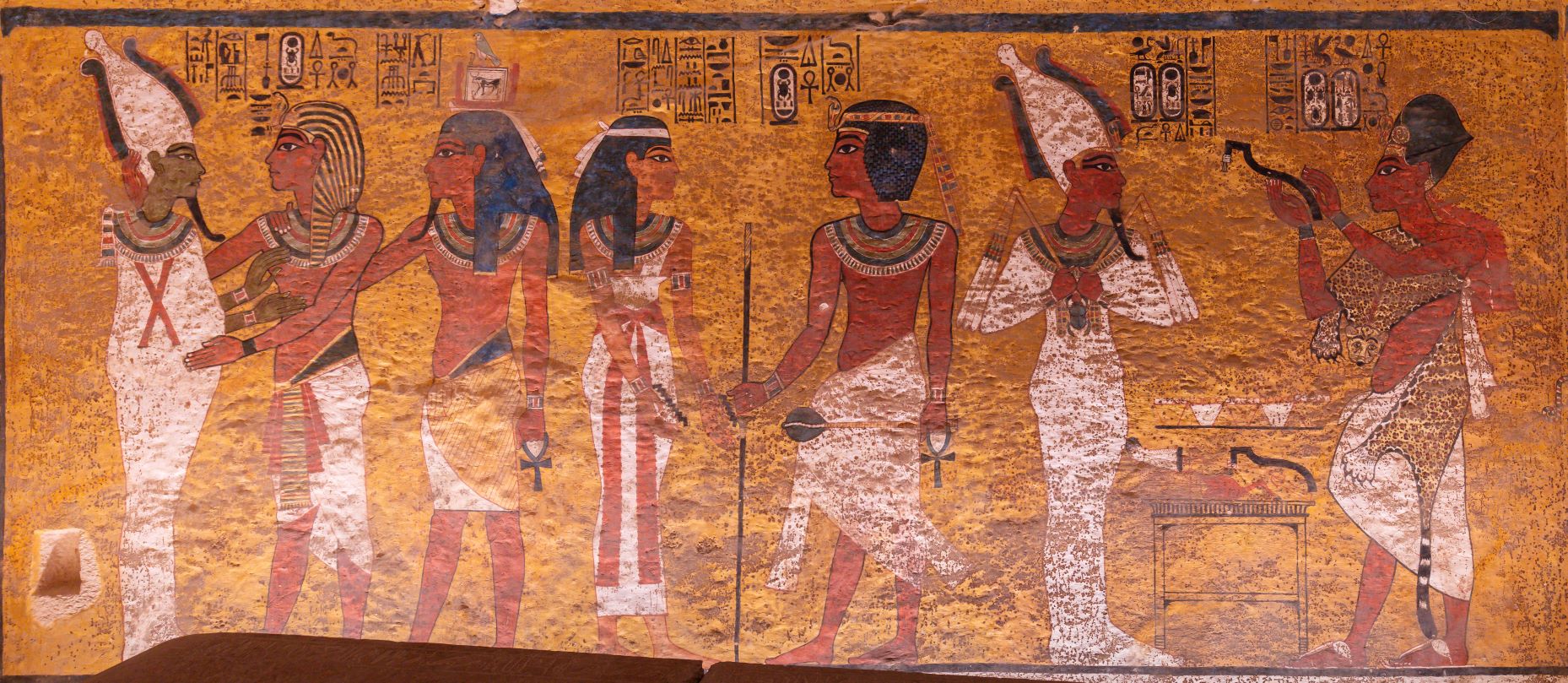
Having read Grover's article "Quantum computing" from 1999 (after having read this article), I leap to the conclusion that the uncertainty of 0 and 1 amounts to a probability for which the solution compares with the expansion and reduction of the sum of probabilities (for a 'non-euclidean' logic) and hence also the double status of Jesus Christ that he is both human and divine - a counterpoint to Judas whose squeeze-out reduced the flock of disciples to 11 and hence (1 - 1/12) = sum of probabilities = 0,91666... comes close to the Catalan number G: By a manipulation of the christian dogmas one can probably come as close as one wants to G with high precision. See Tutankhamon's 'Judas kiss' and the Catalan curve on the lower left wall (source) - told in this article.
It is because a quantum state tells that the subatomic particle can be in 2 different places at the same time that Jesus human/divine is the relevant framework of understanding. It means sum of probabilities = (1 + 1/12).
The bit-alternatives 0 and 1 with uncertainties means here the end values within which the sum of probabilities can be compressed - and correspondingly expanded.
The equation goes in balance only under the circumstances of complete equiprobability in the distribution. Assume that probabilities of a distribution are sorted (by some principle of alphabetization) and stacked in a spectrum from 0 to 1. The entropy value will be larger with uneven distribution and hence if the sum of probabilities is smaller than one, the entropy of an uneven distribution of this kind can be the same as the entropy of a distribution for which the sum of probabilities is one or larger than one and for which equiprobability obtains for all occurrences. Hence the equation (which I have postulated is the innermost abstraction of Aristotle's philosophy when conceived 'submorphemically') can go in balance even for non-equiprobable distributions - given this possibility of compression and expansion of the spectrum of probabilities. Comparing these with a non-compressed spectrum will create interferences which can resemble a phonetic-acoustic spectrum which constitutes a part of the criteria (say, stability of the real world) for the human semiotic constitution. The problem is to find the criteria for how the distributions converge on semiotically 'wellformed' categories - that is, what corresponds to 'the real world' (factually the flashing maya screen of illusion) wherein the computer does not make errors. 'Ex nihilo' phenomena tell of this - unmotivated computer glitsches could be another. If the computer can balance on the 'maya screen' of the logical equation, then it should function without error.
This means that if the problem of principled criteria for convergence in the fundamental theorem of logic which I have called for (since 2007) can be solved, then the problem of uncertainty between 0 and 1 can be converted into high exactitude. That is within the human semiotic constitution in the field between the inner and outer poetic articulations.
Those mathematicians can probably solve that problem of convergence (Aristotle's συμβαίνειν = 'symbainein') and then the problem of quantum computing is solved. And the conflict between catholicism and protestantism as well. See the difference between my translation of example 1 and the Loeb edition of the same (referred to some lines down the page) - this tells of a phenomenon of cultural or philosophical 'convergence' which makes the solution fall between two stools. The solution must be to find the convergence mathematically and not culturally/theologically.
It is self-evident that convergence is a logical phenomenon - otherwise language would not function relative to the maya of illusion. And then it should be possible to find it mathematically as well.
Source:
Delso, D.: The Tutankhamon tomb photo by Diego Delso, delso.photo, License CC BY-SA.
© John Bjarne Grover
On the web 1 july 2025
Last updated 19 september 2025