The photo
24 december 2024
John Bjarne Grover
What is a violin? What is a pianoforte?
A violin is the modern form of what the ancient egyptians called 'sistrum and menat': The sistrum is a rattle that contains 3-4 crosspins sometimes with small rattling tambourine-like cymbals - these crosspins constitute a vocalic formant type and clearly tell of the overtones and other qualities of a tone. The menat is a strap that goes over the shoulder and down on the back where it ends in some weights that rest against the back of the lungs - when the strap is pulled forth (forwards) and back again by the right hand the weights go up and down and knock on the back side of the lungs. The sistrum is held in the left hand and is the articulation of the tones on the violin - the intonation - the menat is in the right hand and is the bow that is pulled back and forth (or up and down) and clearly symbolizes the respiration. The sistrum is made up of the bones in the arm which are counterpoints to the bones in the ear - probably the 3-4 bones also tell of the 3-4 strongest formants or overtones. The violin ends in a cochlea at the one end while the violin rests under the outer ear with the eardrum in the other end. Hence a full human body semiosis is installed into the instrument.
Were it not for these 'magic' ancient egyptian apects of the violin it would probably sound like a scottish bagpipe. The birds seem to like this idea. The mystery of the human reality is how this difference can be heard also through a loudspeaker.
These aspects of the modern violin are shown on the front page of my 2015 'Der Dornenstrauch' (not 'Dornenstreich'):
This is one of the magic images. On the righthand side one sees the menat - the singer is the respiration, the horse-head (that comes running in darkness into a lightbeam) is the hair on the bow and the wolf is the symmetric and 'brain-perceptual' aspects of the violin - with two f-holes facing each other etc. There is a rotational symmetry (Venus in the marble up right, Venus in sprawl down left, mouse sleeping in the gap of the wolf up left, fleeing rat down right etc) which maybe could be the screws for tuning the strings - like the rotation of the magic images.
The left side is the sistrum (the left hand of the violin) with the three joints. One sees the amazed (and noseless) shoulder down left and the curving arm and hand. The red beak of the chinese poultry is the point of touchdown that makes the tone on the bodily assymetric instrument.
The bottle to the left is not a part of the magic image - I have added that from another 'ex nihilo'.
Now I look up the ancient egyptians for supporting this interpretation of the violin:
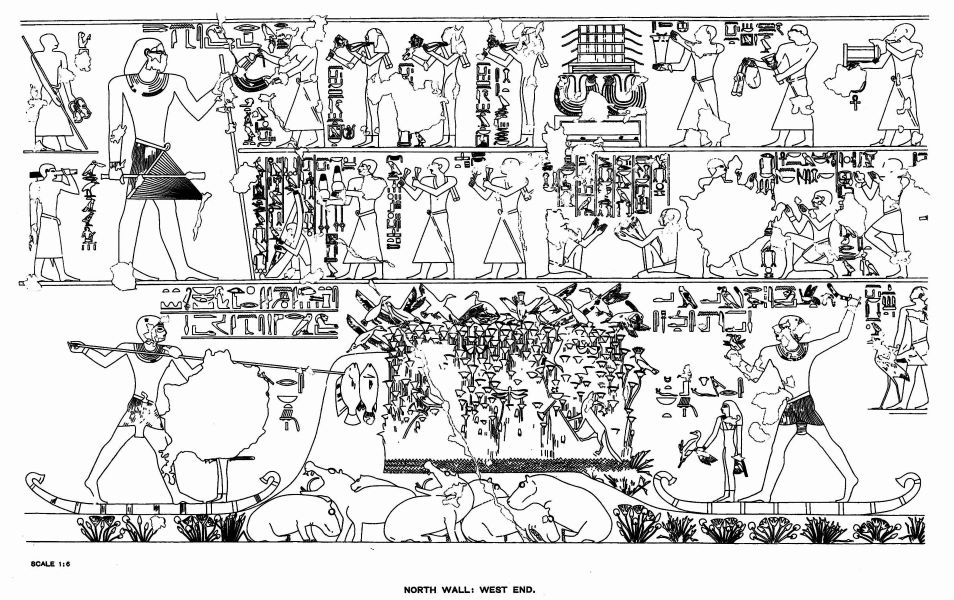
High-resolution version - source Blackman 1914.
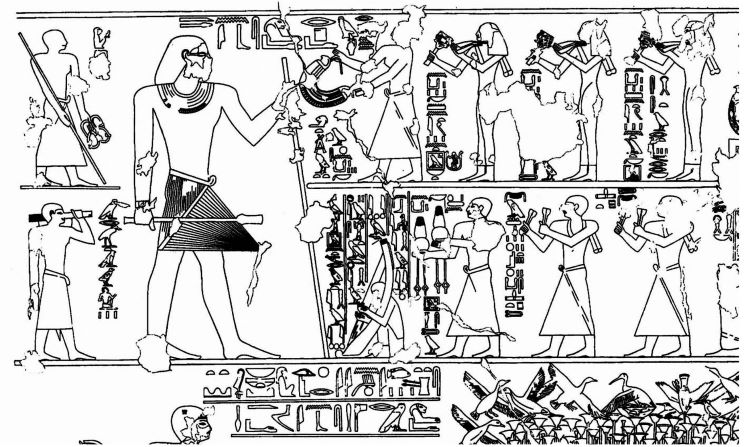
The violin (the three women with sistrum and menat) is in the upper row - see also this excerpt. But what is this? The ancient egyptians seem to have mixed up left and right arm - as if seen from the quasi-symmetric wolf. Ah, yes, that is the purpose with the curving 'sausage' held in front of the three violinists - it turns left and right around.
In the second row is an ancient egyptian pianoforte - one sees the two hands on the keys and the dampers and the frame with the strings. The front page of my 'SNEEFT COEIL', the synchronic counterpart to the diachronic 'Dornenstrauch', is this magic image (see magic images) which seems to show a girl playing the upright pianoforte to the left, leaning over for turning a page.
And in the lower row is the semiotic mystery itself - my linguistic theorem to the left (with the levitation of mystic union of the two fish into one) and my logical theorem to the right.
Double bass = historic discontinuity.
I have studied some of these aspects in my articles on egyptological matters - such as this article.
(It seems that my comment on the Catalan number may have been a blunder caused by the source photo of Tutankhamon's tomb since the 'curve' later turned out to be a shadow in a niche only - caused by the angle of the light source. Or maybe it isn't a blunder after all?).
Here is Bach's version of Cornelis Vreeswijk's 'Cecilia Lind': Bach - Cantata Nach dir, Herr, verlanget mich BWV 150 - Sato | Netherlands Bach Society. (At 8:04 "Cedern müssen von den Winden" one can hear the animals of the Nile).
And here is Bach's version of the mystic union (a panorama version, that is - Vreeswijk's 'Fredrik Åkare'?): Bach - Gloria in excelsis Deo BWV 191 - Van Veldhoven | Netherlands Bach Society.
Source:
Blackman, A.M.: "The rock tombs of Meir", part I. London 1914.
© John Bjarne Grover
On the web 24 december 2025