
5 may 2025
John Bjarne Grover
A 'milk miracle'
It was on 24 january 2014, around the time when I was concerned with small envelopes I made for storing 'ex nihilo' matter. I made them from the nearly square papers used for notices - not self-adhesive but sold in plastic-packed stacks of appr 8x8 cm papers. (The precise dimension is 8,8 cm the one way and 8,88 cm the other, which makes it 'nearly square'). These I folded first in three thirds - the outer of them folded in over the mid and then along the half in the other way and fastened with a staple:
This made for a small pocket wherein I could put those ex nihilos which formed on a rubber mat with a centimetre grid. In early 2014 I used to study in the evening three poems from my DDS part 1 - say, poem #20 and #25 and then e.g. poem #120. This left #125 open as a redundancy - say, it could have been a part of an IQ test ('what is the next number after 20, 25, 120...'?). The next morning I would look up the green rubber mat (which I had cleaned of dust) with the centimetre grid to see if some ex nihilo had formed overnight and I could microscope it and compare with poem #125. There were often interesting results.
An example of this 'quadrantic' method is from 14 january 2014 - before noon I read the three poems DDS I:101, DDS I:106 and DDS I:71 - from DDS part 1 ('Kinderhilfe') - to see if there would come a reflex of DDS I:76. In the afternoon I found a piece (on the foot end of the bed) of probably 'ex nihilo' matter which resembled another I had observed and photographed earlier - it had been in the inner sole of my shoe. This new one was very similar but in a different 'substance' which seemed to resemble wood:

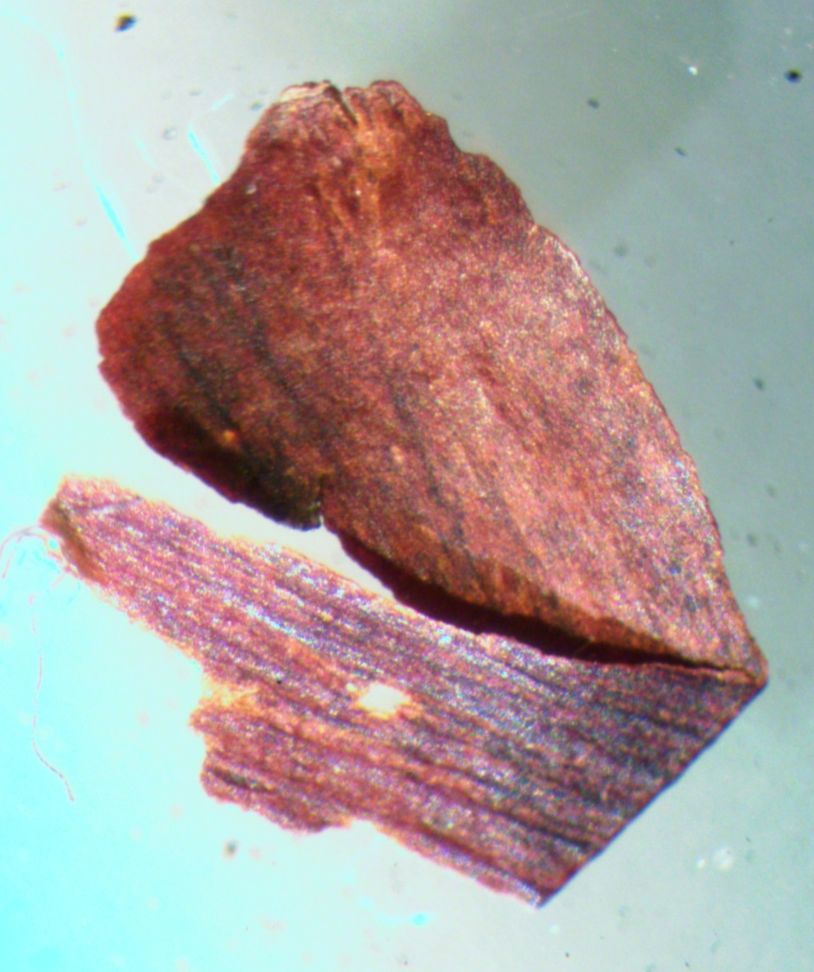
The poems #76 and #106 are quite similar, approximately as similar as the two 'stigma' pieces. One could follow #76 from the shoulder and down the upper arm down to the elbow which turns from stanza 1 to 2 and up the Sonnenweg again. The upper arm is then the first stanza and the forearm the second. I had picked this 'wooden' stigma piece up from the foot end of the bed and sat there observing it when I turned to look once again at the place where I had found it and there seemed to have come yet another piece on the same place, a little closer to the wall, which I probably would have seen if it had been there some moments earlier when I found the wooden stigma piece - this new one was a sort of bundle of woolly tuft etc. I took some photos of it under a microscope:


If the second one is 'Welcher Haufen? Welcher Schräg?', the other could be 'Überreste. Untertanen'?
On 24 january 2014 I had made some of these envelopes, say, 5-10 at least were left in a heap on the black rubber mat on my workdesk. I then left for an errand (for buying an external hard drive to my computer) and when I came back and brushed some of them aside, there was milk on the black rubber underneath. Here is a detail from some milk I brushed out on the surface with a finger which makes it easy to spot the trails of the 'milky' substance:

I dont think anybody had been in there and poured milk underneath the envelopes - even if that is the normal first idea that comes to the mind.
There was another story with the famous milk miracle of India around the day when I moved into Frederik Meltzers (not 'melkers') Gate in Bergen in 1995 - that day when I parked the van for carrying my things in there was somebody walking back and forth on the other side of the street with a long lens on his camera, taking photos of the facade on that other side. It was later reported that statues of Ganesh had been drinking milk in large amounts all over India around that day when I moved in, I think it was. The socalled milk miracle of India reportedly repeated itself in 2006 - in fact around the time when I arrived by boat to Stockholm for searching for some data on Nelly Sachs whom I believed was my genetic mother.
This miniature 'milk miracle' from 2014 could perhaps have been something comparable. Now I would try and search my TEQ for a poem relevant for this - comparable to TEQ #464 for the Khumbutse complex. I search for 'envelope' and find TEQ #1035 interesting for this story:
TEQ #1035
1 קמ"ל כדרבי זירא
Some cleared in Nicole
Christiansen,
and to start going to parties where they play music...
I have sent most of this by French post,
adherents of Antarctica
by the stories
just to mean
it's essential to an airor from that district.
I think they've pared it down to some 150
and then probably waited by Iran
and then letting some [...] administer
the suns in the radio of the buba. The conclusion
of the scientists of the people:
As the envelope progresses, the theory progresses as well!
Assume that 'Nicole Christiansen' could be taken to mean 'PIK PTRSIM', then the 'parties' would mean the division line in Genesis and the music the harmonies in the ratio. Hence an acoustic aspect. Antarctica could be contained in the heap of such white envelopes on the black mat - like a landscape of ice slabs and snow formations in the dark antarctic winter. '150' could mean the dimension of the envelopes - 50*2 and 50*3. What is then Iran? In the present context it could mean the border outlines of the country on the map resembling the border outlines of the hole in the stigma piece I had found at the foot end of the bed.
|
|
The 'buba' would then be the female breast or udder from which the milk comes, wherefrom it is 'administered' - to the 'scientists' = 'sucklings' of the people. The milk must then count as the theory in the context of the envelopes.
'An airor from that district' could then refer to that probably somewhat square cloth or 'sheet' with animals lowered down from heaven to Peter in his vision in Acts chapter 10 (verses 9-16), who, though, thrice rejected it and it was pulled up again - like my square paper folded by three and two. Why two? It is that mid poem of TEQ 1720 / 2 = TEQ #860. Peter wisely rejected the offer (given in the parallel Acts 10:13) - and so do I: Such matters are to be relegated to eternity - what is lowered down into history will be in accordance with historic Time and TEQ #860 is in book 12 rather close to the beginning. But the first poems of book 12 - that is TEQ #848-861, which include #860 - are really written in 2001 while TEQ #862 is written on 28.11.2000 - from where it continues to the end of the book 12, the last poem of which is TEQ #1034 which is written on 18.06.2001 - from which the continuation is at the beginning of the book (a wrapover) from 848 to 861. See the beginning of the handwritten manuscript and the end of the handwritten manuscript for this - the end of the book is here -followed by the beginning. Hence poem #860 - the mid poem when counting poems rather than dates - is really written in historic time at the end of the book, which is far from the middle of the entire work TEQ. Hence the quasi 'mystery' referred to by the cloth of Acts 10:13 lowered down from heaven to the historic time of Peter is really not central at all and is not the solution to the meaning of the title 'The Endmorgan Quartet'. The cloth from heaven could be in the mid point in eternity but not in history, that means.
This account is about how it is 'folded' at the end of book 12 by TEQ #1034 - that is, just by the beginning of book 13 which is TEQ #1035 - precisely the poem here - as for those 'folded' squares which are not totally square after all when turned into the small envelopes.
Now for the hebrew from Talmud 14a - for which the abbreviation is explained by the Talmud Mesorah edition which interprets it as follows:
קא משמע לן כדרבי זירא = [This new ruling] teaches us the ruling (that was later taught by) R' Zaira
The words interpreted word by word with the help of Jastrow's dictionary:
קא - he/she/it stands = emphasis = 'indeed'
משמע - obedience, ordinary sense (meaning), intimation, logical conclusion
שמע - hear, listen → understand, inferred, evidence, confession of faith (at evening/morning prayer)
שמעא - servant, attendant
לן - Kal pret 3 p sg m of לין = lodge, remain, overnight, complain, murmur, join, unto them
כדרבי -
כדר - be arched, rounded
התכדר - to be thrown around in a circle of players ('Hithpael' which expresses an intensive form also with reflexivity)
בי - in, with, at, between, among, house, school of...
ביב - pipe, gutter, canal
ביבא - duct, underground walk
זירא - wreath, crown, rim, (ledge?)
Hence one can see a relevance for the milk in the 'rounded' biba (here qua underground duct) or, as my poem say, the buba - but in the formalized form of the rectangular envelopes.
One could try a compositional interpretation such as e.g. "indeed the obedience joins the rounded at the crown/rim". Would this suggest the milk sucked by an infant?
The 'obedience' could also be taken as the 'logical conclusion' - hence the rectangular and not rounded envelopes.
I look up Klein's Etymological dictionary of the hebrew language for זירא and find not this name but there is the form
|
זיק |
- skin bottle, Arab 'ziqq' = skin of water, milk, wine etc - spark, comet, blast of wind, storm |
The word is graphically similar or near to
|
זירן |
- 'ziran' - cp. 'the Iran' - 'zirin' - cp. 'syrian' |
I look up my 'Syrjänisches Wörterbuch' by D.R. Fokos-Fuchs and find
|
zirni sir sirei jev |
- to push out/open - cheese - humidity - milk |
I notice that TEQ #1035 is the first poem in the fourth quartet and that the two last poems in the first quartet is TEQ #287 and #288 with the signatures
287 = SEC-quartet, cp. e.g. the arabic 'ziqq' = skin bottle for milk etc
288 = Bebe - cp. the 'biba', 'buba' etc.
This could lend new meaning to the 'stigma hole' as being in the second and third quartets - hence TEQ #1035 would be on the 'rim' of the 'wreath' in the sense of the stigma border.
It could be possible to see in these data a theoretic rationale for the ideas of a british presence on trains I was travelling with (possibly Gordon Brown with apparent 'leather bag' in 2010 and ideas of Kate Middleton in 2012) to and from Vienna - including a 'milk miracle' in my underpants in 2012 - representing the symmetries of my TEQ completed in 2008. One could furthermore fancy that this presence could be taken to be expressive of ideas of being 'angelic' in the sense of 'beyond time' and hence that the 'english' or 'british' could be taken to be entitled to assume the mid point of TEQ to be in Acts 10:13 (hence lending quasi legitimacy to use of terror) while other normal historic people would have to realize that they have no such legitimacy. This would clearly be a mistaken conception of my TEQ - I would say that all humans are subjected to the same historic time, which I suppose the britons agree to as well.
My TEQ should generally not be taken as providing quasi justification for exemption from or immunity against normal rules of human conduct, which means, quite simply, that TEQ cannot be taken to legitimize terror.
I notice also my residence in 'Zinck-gasse' in Vienna compared with that residence in 'Meltzers' street in Bergen.
PS In 1995, at the time of the milk miracle in India, I had not yet started to write my "The Endmorgan Quartet" (1997-2008) - but in the spring that year I had written a series of poems over specific syllables with meanings extracted from many languages. Some of these are given in my Collected works volume 3 on pages 1196-1210.
6/5-25: The indian milk miracle could have been Ganesha's wisdom that the order of poems in my TEQ is a relevant order for the divine reality while the order of historic days is the relevant principle for the human reality. In 1995 my TEQ was not yet written but my scientific book "Submorphemic signification" was completed and self-published probably around just those days, could be only a few days earlier if I remember right, and this "Submorphemic signification" is the theoretic basis for "The Endmorgan Quartet" - see also these concluding remarks to my study of the abstractional logic of Aristotle. Then indian wisdom in the Ganesha milk miracle could have understood it rather soon after I had released my "Submorphemic signification" for the public what it meant. If that should be the story of the 'milk miracle' in India, it tells of the profound importance (for the peaceful future of the world) of understanding the episteme shift contained in the difference between the submorphemic and the morphemic reality that took place around the time of Christ. It may be that the entire world of the prechristian millenium will have to be reconceived - while greek and latin classics constitute completely the foundation of european schooling and reality since the middle ages and certainly would have contributed essentially to the schism that took place with the protestant movement of Europe since Luther and Henry VIII. Isnt it 'protestantic' to 'interpret' my "Submorphemic signification" by way of the Oklahoma bombing - the 'wurst' bombing in US history? The Ganesha 'milk miracle' probably tells that the TEQ (by its theoretic basis in my "Submorphemic signification") cannot be taken to constitute a justification of terror.
If Ganesha's wisdom be understood, that is, counting by human dates (following the original historic order of the poems) rather than by the enumerated poems, the true mid point of TEQ from a human viewpoint would be TEQ #874 - which looks human indeed. It is seen that the 'Lucifer bag' also could be the 'skin bag/bottle' etc. The parallel text from Acts 10:26 supports this human viewpoint - Cornelius had fallen to his knees before Peter as for worshipping him: "But Peter lifted him up, saying: Get up, man - I myself am also only a human being".
It is seen that TEQ #874 could find a reference in apparently (then PM) Gordon Brown with leathern ('Luficer'?) bag on the train on the day of the tragic (and thundering?) earthquake of Port-au-Prince (Haiti) in 2010, thereby coindexing also the 'SEC-quartet' of TEQ #287 including a reference to the structurally (by books) mirroring poem TEQ #1035 as for the beginning of this 'historic' mid point (TEQ #874) of the work. It is possible that this phenomenon could be up and going in the business of the current times, such as the occurrence of some bags with a potential reference to some terror in France (case 1, '57' also in case 2 coindexing Khumbutse) could have indicated.
Sources:
Fokos-Fuchs, D.R.: Syrjänisches Wörterbuch. Vols.1-2. Akadémiai Kiadó, Budapest 1959.
Klein, E.: A comprehensive etymological dictionary of the hebrew language for readers of english. Carta Jerusalem, University of Haifa 1987.
Jastrow, M.: Dictionary of the Targumim, Talmud Bavli, Talmud Yerushalmi and Midrashic Literature. Judaica Treasury 2004.
Talmud Bavli. Vol.7: Tractate Eruvin. Mesorah Publications 2005.
Talmud Erubin, the classic Vilna edition, El Hamekoroth, Jerusalem 1947/48.
© John Bjarne Grover
On the web 5 may 2025
Last updated 6 may 2025


