


6 november 2024
John Bjarne Grover
Most of the article was completed on 5 november 2024 but delayed a little for not causing a stir in the US presidential election.
|
|
|
|
These occur also in my recent article on Palma il Vecchio
- see this for TEQ #601
and this for TEQ #602.
Here an interesting relation can be observed between Palma's 'Holy family with two saints' (to TEQ #602) and an excerpt from my third photo (notice Saint Francis holding a cross like a pen in his hand to the right):
|
Has the Jesus child turned around towards St.Francis?
From my article on the 23 black-and-white photos from the Danube Island I excerpt also the following photo (which looks like a jew carrying a crucified fish - a role traditionally assigned to Joseph of Arimathea) and its 'negative' version:


Interestingly, the article on Joseph of Arimathea refers to an artwork by Pietro Perugino showing this Joseph with a headgear (like a bird's nest?) quite relevant to the dress worn by Paola Priuli in Palma's portrait - cp. my TEQ #601 - is it about the meaning of their minds? These artworks are from a few years before the Madonna of Guadalupe in Mexico in 1531:
See more in the article on Palma about the images of people in the eyes of the Madonna of Guadalupe.
See also this comment of 18 september 2023.
See also this comment of 5 august 2023 - that is 15 months ago today.
Added on 6 november 2024:
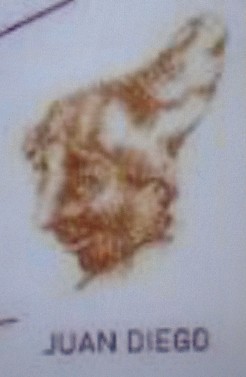
Notice how the pattern on the clothing of the man who supports Christ's body in Perugino's 'Lamentation over the dead Christ' (1485) resembles the dress of Paola Priuli in Palma's portrait (1527?) of her - and the dress of the Madonna of Guadalupe (1531) - for the latter, the headgear of Joseph of Arimathea (cp. TEQ #601) will then correspond to the lower part of the iconic revelation on the tilma of Juan Diego. In this way, Perugino's artwork tells of the divine nature of Christ and how this is present in the revelation in Guadalupe in Mexico. It is probable that most of TEQ #602 can be recognized in Perugino's artwork - in addition to TEQ #601 for the detail of the head of Joseph of Arimathea. Cp. also the detail of the headgear of Juan Diego as deciphered from the eyes of the Madonna in Guadalupe (according to the images of this website) - discussed also in this part of my article. It is noticed that the 6 characters of Palma's 'Christ and the adulteress' (as it traditionally is called) when matched against the 6 characters deciphered by Jose Tonsman from the eyes of the Madonna of Guadalupe in the lower row could be seen as having interesting counterpoints in the 6 characters in the upper and lower row of Perugino's 'Lamentation' - here in an excerpt:
|
The discussion continues under 11 november 2024
Sources:
Grover, J.: The Endmorgan Quartet #601-602, Wien 2013
Grover, J.: Palma il Vecchio and a theory of grammar
Hahn (post Lachmannum et Tischendorfium): Novum Testamentum Graece. Lipsiae 1861
Matthew 2:3: Ἀκούσας δὲ ὁ βασιλεὺς Ἡρῴδης ἐταράχθη, καὶ πᾶσα Ἱεροσόλυμα μετ’ αὐτοῦ
Paintings by Palma il Vecchio
Palma: Christ and the adulteress
https://en.wikipedia.org/wiki/Our_Lady_of_Guadalupe - The Madonna of Guadalupe
Pietro Perugino: 'Lamentation over the dead Christ'
http://www.amen-etm.org/Milagre5.htm = source of the deciphered images in the eyes of the Madonna of Guadalupe
The three photos were taken on 5 november 2024. It may have been a bird that provided the motive for the third photo, and certainly a bird for the first.
© John Bjarne Grover
On the web 6 november 2024


_-_The_Holy_Family_with_a_Female_Saint_and_Saint_Francis_of_Assisi,_ca._1520,_82.jpg)
.jpg)
#/media/File:Pietro_Perugino_cat40.jpg)