A flash of genius this morning
John Bjarne Grover
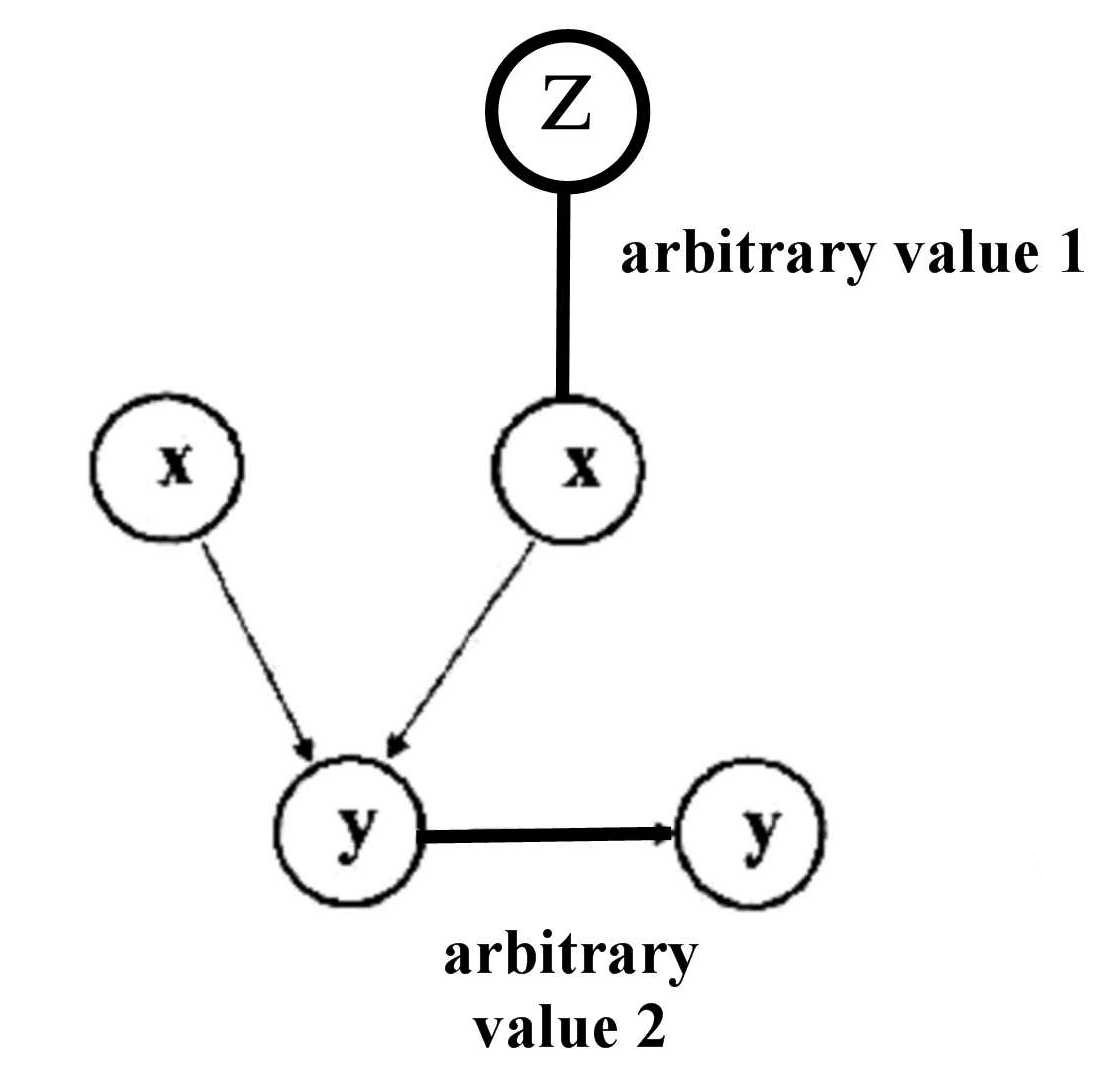
My fundamental theorem of linguistics is on the following form:
The two X's are metaphysical items which are conflated due to the limitations of the human semiotic endowment which by its limitations gives the form of the psyche. When these are conflated and thereby the difference between them is ignored, this rudeness and roughness of the human mind collapses them to one and the same and this is what gives rise to the substance, the matter of the empirical world, the lefthand Y. The righthand Y is the linguistic designation of the substance: It serves to maintain the original distinction between the two X's - that which we cannot know much about due to the averaging roughness of the mind. Hence there are two arbitrarities - the metaphysical (transcendent) and the physical (immanent), and these are in principle intended to be telling of each other - although it follows that we cannot know very much about this.
This deletion of the transcendent arbitrarity is what gives rise to the average value of numbers - also for the eventual rise of differential calculus which allows for derivation and integration.
Materialism rose as a protest against this exploitation of the contributions of the workers on level X - capitalism grabbed the transcendent profit along with the finer distinctions of human spiritualism.
Materialism tries to find a finer knowledge of (the ownership of) this transcendent arbitrarity and therefore turns the collapse around: It tells that the matter (Y) and its designation (understanding) is primary and the metaphysics arises from the conflation of the matter and its interpretation (the thing and its name/concept). It is a turnaround for trying to understand the relation between the two arbitrarities better.
This can be seen in the history of philosophy: Aristotle is the lefthand X, Plato the righthand, Hegel is the lefthand Y and Kant the righthand.
This is easily seen from studying the first line (a sort of brief 'abstract') in some of their central works:
Aristotle's 'Metaphysics' starts with the line:
πάντες ἄνθρωποι τοῦ εἰδέναι ὀρέγονται φύσει. = 'all humans seek by nature knowledge'
πάντες ἄνθρωποι = all human beings
τοῦ εἰδέναι = the knowledge (gen) - infinitive of οἶδᾰ (see the etymology suggesting 'to know' derives from 'to see')
φύσει = by/for nature (could be a dativus commodi)
There is a close affinity between to know and to see. Aristotle seems to tell that the humans extend the knowledge for or by the nature (or for the sake of or on the form of it).
Plato's 'Theatetus' starts with this scene (from this page and this):
Eucleides
Just in from the country, Terpsion, or did you come some time ago?
Terpsion
Quite a while ago; and I was looking for you in the market-place and wondering that I could not find you.
Eucleides
Well, you see, I was not in the city.
Terpsion
Where then?
Eucleides
As I was going down to the harbor I met Theaetetus being carried to Athens from the camp at Corinth.
Terpsion
Alive or dead?
Eucleides
Just barely alive; for he is suffering severely from wounds, and, worse than that, he has been taken with the sickness that has broken out in the army.
Terpsion
You mean the dysentery?
Eucleides
Yes.
The knowledge about Terpsion is not certain neither in time nor place - it is the transcendent arbitrarity called 'Theatetus'. He has been 'cut off' by the rough human mind. The following discussion (in Plato's dialogue) is indirect - notes from an earlier discussion about which one has thereby only rudimentary knowledge.
Hegel's 'Phänomenologie des Geistes':
The 'Vorrede' starts:
Eine Erklärung, wie sie einer Schrift in einer Vorrede nach der Gewohnheit vorausgeschickt wird – über den Zweck, den der Verfasser sich in ihr vorgesetzt, sowie über die Veranlassungen und das Verhältnis, worin er sie zu andern frühern oder gleichzeitigen Behandlungen desselben Gegenstandes zu stehen glaubt – scheint bei einer philosophischen Schrift nicht nur überflüssig, sondern um der Natur der Sache willen sogar unpassend und zweckwidrig zu sein.
(This could have been a comment on Plato's 'Theaetetus' - about the transcendent arbitrarity).
The 'Einleitung' starts:
Es ist eine natürliche Vorstellung, daß, eh in der Philosophie an die Sache selbst, nämlich an das wirkliche Erkennen dessen, was in Wahrheit ist, gegangen wird, es notwendig sei, vorher über das Erkennen sich zu verständigen, das als das Werkzeug, wodurch man des Absoluten sich bemächtige, oder als das Mittel, durch welches hindurch man es erblicke, betrachtet wird.
(That is to turn it around with embeddings).
The first chapter starts:
Das Wissen, welches zuerst oder unmittelbar unser Gegenstand ist, kann kein anderes sein als dasjenige, welches selbst unmittelbares Wissen, Wissen des Unmittelbaren oder Seienden ist. Wir haben uns ebenso unmittelbar oder aufnehmend zu verhalten, also nichts an ihm, wie es sich darbietet, zu verändern, und von dem Auffassen das Begreifen abzuhalten.
That is to come to the point: 'Wissen des Seienden' which could be the ontological 'Y' to the left - pointing up to the two previous ones, the metaphysicals.
Kant's 'Kritik der reinen Vernunft':
Kant as the 'Y' to the right would struggle with understanding the transcendent arbitrarity from the viewpoint of the immanent arbitrarity - going via the ontology and its sensations.
Ob die Bearbeitung der Erkenntnisse, die zum Vernunftgeschäfte gehören, den sicheren Gang einer Wissenschaft gehe oder nicht, das läßt sich bald aus dem Erfolg beurteilen.
This arbitrary knowledge (of the transcendent arbitrarity) cannot be known except through its result - what it leads to - the progress of the empirical world.
The 'Einleitung' - I. Von dem Unterschiede der reinen und empirischen Erkenntnis:
Daß alle unsere Erkenntnis mit der Erfahrung anfange, daran ist gar kein Zweifel; denn wodurch sollte das Erkenntnisvermögen sonst zur Ausübung erweckt werden, geschähe es nicht durch Gegenstände, die unsere Sinne rühren und teils von selbst Vorstellungen bewirken, teils unsere Verstandestätigkeit in Bewegung bringen, diese zu vergleichen, sie zu verknüpfen oder zu trennen, und so den rohen Stoff sinnlicher Eindrücke zu einer Erkenntnis der Gegenstände zu verarbeiten, die Erfahrung heißt? Der Zeit nach geht also keine Erkenntnis in uns vor der Erfahrung vorher, und mit dieser fängt alle an.
It means here that the transcendent arbitrarity - seen from the immanent arbitrarity of Kant - can be derived ultimately from the progress of the knowledge of the senses. This is probably the enigma he tries to solve - and the enigma will be that the immanent arbitrarity should be telling of the transcendent arbitrarity by some mystic connection which is what rescues human beings from shipwrecking on the ocean of eternity in spite of the redundancies and shortcomings of the human mind.
These four major philosophers can also be summed up as in the following scheme:
|
Adjective = A Aristotle Noun = N Hegel |
Preposition = P Plato Verb = V Kant |
I understood this in a 'flash of genius' this morning 16 november 2024 around 6-8 o'clock. What does greek or german news tell today?
Corollaries
Modern media could perhaps feel themselves to be about the erasure of the finer distinctions of platonic value of our time. That would be for preparing for a new level of information technology. But they should better shape up and learn to behave in accordance with the law. The police must arrest the criminals and put them in jail.
What I have outlined here could be more than enough as a basis for a thesis in a PhD dissertation. The administrators of the surveillance data will perhaps hurry to try and find somebody who can steal these ideas for the purpose of erasing the transcendent arbitrarity in these authentic ideas of mine. That could be under the pretext of preparing for a new level of information technology. But they should better shape up and learn to behave in accordance with the law. The police must arrest the criminals and put them in jail.
As I turned the home computer on again this morning, a surveyor who may sit somewhere watching a copy of my monitor may have felt inspired by this switch-on after two weeks absence and responded with a Windows Update message. My computer never has Windows Update so there should have been no reason for it coming by natural ways - it may have been for communicating from that transcendent arbitrarity - for swapping roles? Windows Update comes through the kitchen door and means that some surveyor can change the text you have written and there is no way for you to prevent that. That could be for preparing for a new level of information technology. But they should better shape up and learn to behave in accordance with the law. The police must arrest the criminals and put them in jail.
This is completely fundamental for the healthy development of a new level of information technology.
The new formalisms may contain some wipeout of finer distinctions that were present in the former level of technology, but the new field of knowledge will be in the form of exploration of the contents of the transcendent arbitrarity - which essentially means a mystic inquiry - and then there is nothing else which really counts than the subjective moral integrity.
The modern media may perhaps feel for being running boys for the ultimate reaction called Adolf Hitler. But then they serve only to pull the computers down into the mud - not to develop the new information technology.
This is the video which I saw on People's Daily in the second half of october 2024 and which I later (early november - just before the elections in Moldavia and USA) believed could have been a plagiarism of a fragment of a manuscript I have worked with for some years (the drafts going back to at least 2011).
The video on People's Daily could in principle have been constructed as a play on the name of 'Petter Andre Syversen' which is a name which in principle could have been constructed for being a method for seducing young females for strangulation during sexual intercourse ('embedding'). 'Szívesen' is hungarian for 'I heartily agree/welcome you'. It could have been the turnaround transform 'detter anpre szívesen' ('detter han på re' = 'he falls on his re/back' - 'rev-ben' would mean the tailbone) which could have been the form of me falling on the back and hurting the 'rand'-sinews on the lower vertebra (beyond the hip-bone). GAS-PAS-GAS seems to include the cyanide gas disaster of Bhopal just a few days after the assassination of Indira Gandhi in 1984 - Petter Andre Syversen died in a car accident in Botswana in 1986 (I have his date of death only from an 'Alex' archive on the internet) and the cyanida gas disaster in Halabja in 1988 was very similar to the one in Bhopal and rather exactly in the mirror point around the death of PAS.
'Detter anpre' = 'falls he on his re' while 'detter unpre' = ''falls she on her re'. Could be 'Petter Unpre' could mean 'John Grøver'? I recall a scene from my age 3 in Odda - I was running around with a tablespoon with butter in the mouth when the father reproached me for this and said he knew of a boy who ran around with a knife and fell on it and died therefrom. I do not remember the further circumstances of that scene.
If the GAS-PAS-GAS structure should be an 'intelligence project' organized by some western services for example for creating a 'mystic transcendent arbitrarity' out of me - a hidden, 'Deus Absconditus' (Cusanus = Devold Quisling?), mysterious presence as the origin of plagiarisms in published works - how could modern arministration be so rude, raw, cruel as to strangulate (by 'anus' power gesture of hands) young females for such purposes of being the 'transcendent' victim of erasure by raw agents?
It it easy to see the answer to this question in the form of the 'Rand' of 'Kant' as a 'V' - while Hegel has a russian 'N' in the beginning of the name. (Hence a stigmatic war with Russia had to be provoked?) Plato is a prepositional 'lato', the very transcendent Rand itself. Such cruelty and 'raw, redundant, human-mind behaviour' could find its ultimate mystery in the name of Kant seen as the answer to the enigma of how two thousand years of cultural history could seem to converge on these current days of ours.
It must be understood that the police must stop listening to such 'intelligence' gas-pas-gas and arrest such criminals and put them in jail. Should it be about some unique chance that never comes again and therefore they have to strangulate these young females? Stop listening to the gas talk and stop the crazy 'projects'.
The combination of this name (under such interpretations) with my cognitive state and intellectual work generally would not have been a suitable association. A hidden role for the name of Laura Devold could have been a purpose. I have speculated if such raw and rough 'humankind' (that is, the failure of the human mind to distinguish the two metaphysicals - compared with the raw humans who strangulate young females) could have been an 'intelligence' project for pasting that sort of primitive 'transcendent arbitrarity' onto my person - for a tragically primitive and naive idea of mystic religious inquiry.
Some 'intelligence services' may have computed that the transcendent arbitrarity (the new field of inquiry for the new information technology) we know little about but we can study this raw and rough side of the human nature by doing it (following 'Kant's 'rand'). The police must hurry up and arrest the criminals in such intelligence services and put them in jail.
The turnaround of 'p' and 'd' with this name could also have been used for lifting the authorship off me in the very inception of it (by a flash of genius) due to the illegitimate nature of such raw behaviour.
The purpose of such criminal projects could have been to try and make a bridge from Christ through the cultural history up to our time - jump your Hegel over etc - for thereby getting the divine revelation under administrative control by terror. Such naive and primitive administration must be stopped.
It is not probable that organizers of raw terror projects would have philosophized like me above, and the linguistic nucleus is mine, as far as I know. But it may well be that this historic bridge (at the Russia? with its alleged 'Fatima' origins?) is the real intention by such potential projects.
Whether this was the background of the apparent chinese plagiarism, I dont know, nor do I know how the chinese newspaper would relate to these matters.
(Nor do I know if there is such terror against young females or if it is an idea only. Nor do I know who would have been involved in such if there is any).
Sources:
Aristotle: Metaphysics. The Perseus Digital Library.
Hegel, G.W.F.: System der Wissenschaft. Erster Teil, die Phänomenologie des Geistes, Bamberg und Würzburg 1807. Marxists Internet Archive.
Kant, I.: Kritik der reinen Vernunft. The Project Gutenberg.
Plato: Theaetetus. The Perseus Digital Library.
© John Bjarne Grover
On the web 16 november 2024