

14 february 2026
John Bjarne Grover
Today I read around 15:00 or thereabout the verses Acts 11:1-5 in original greek. I looked up the word ὀθόνη which means a large piece of cloth. Thereafter (maybe nearly half an hour later or so) I went and found a large sheet of white cotton textile which I had looked at a couple of days ago - when I unfolded it I found the following word written on it (of length appr. 18 cm):
I dont think this was there when I last looked at it, although I cannot be very certain about it. (I have not written it there). The lettering looks as being 'inside' the fibres of the textile (that is, apparently not written onto it). I photographed it while holding the textile up against a light-source behind it.
By 'Berean Standard Bible' (click on the lines for the greek original):
(2) So when Peter went up to Jerusalem, the circumcised believers took issue with him
(3) and said, "You visited uncircumcised men and ate with them."
(4) But Peter began and explained to them the whole sequence of events:
Here is my The Endmorgan Quartet #387, the signature to which perhaps could be the secret of the word on the textile
- κάμιλος is a (mooring?) rope - see also Liddel & Scott's comment on the word - about the camel going through the needle's eye etc:
TEQ #387
Exodus 14:27 ויט משה את-ידו על-הים וישב הים לפנות בקר לאיתנו
Telephone rear, but the biz:
It's not magic.
The Coles, we suggested are,
of the riefly, of the beheind.
It's considering its own lock,
the effective durecks.
The cat, deterging the
the next morning-gay
and reasonable: No response,
so I'm no knowing
there's Hamiltons to be droopd in Bergn,
which the things of farewell...
[THUNDER...]
Leonard is so stott of his BB.
Ganet Geeves & Pallett Ropes
(The word 'durecks' is perhaps the same as the trademark 'Durex' - at least in sound - but it seems the poet did not know what the muse was talking about - he wrote it down as well as he could, though, well knowing that the muse could know more than himself. This story could be suggestive of the idea that such a 'transcendent' text is written from the poet's human viewpoint - but one cannot know what it really could be in a transcendent realm).
It is perhaps a part of the story that the night before this (between yesterday and today) I had a dream about crocodiles - which some would recognize in Acts 11:6. ἑρπετόν can mean 'any animal which walks on four legs' (from proto-indo-european sérpeti
- here in contrast to (neuter of) πετεινός = 'winged being', that is, a two-legged bird. But the same verse contains also reference to τετράπους which is a 'four-footed', in addition to θηρίον = 'small wild animal' - from proto-indo-european ǵʰwer- = 'wild', 'wild animal' - for the description of what was in the cloth lowered from heaven. It is notable that the same phenomenon is referred to also in Acts 10:12 (where the θηρίον is not mentioned). This Acts 10:13 is the parallel text to my TEQ #859 which is immediately followed by TEQ #860 which is the exact mid poem in TEQ. However, it is not the temporal mid poem of this part of the book: Poems TEQ #848-861 constitute the beginning of TEQ book 12 but they were written last -
from 18.06.01 to
11.07.01 - and because of the movement of these poems #848-861 from the beginning to the end of book 12 the poem TEQ #860 came to be the mid point of the entire TEQ (in 16 books). Hence the historic reality will serve to move this Acts 10:13 out of the mid point.
Hence if the word on the white textile is 'Gamblidis' it is noteworthy that the 'gamb' (about legs) derives from καμπή originally from proto-indo-european *kh₂em- = 'to bend, to curve, to smooth' - it is noteworthy that the textile was folded with a 'bend' that runs through the first 'a' in the word - suggesting perhaps just this shift from beginning to end of book 12 - which moves Acts 10:13 out of the historic mid point. Ancient Greek λίθος = 'stone' - such as e.g. my assumed 'lapis philosophorum' which was a probably 'ex nihilo' formation that occurred at the end of my writing of 'Der Dornenstrauch' part 3 (in 2014 that was). In view of this, one could perhaps consider the formation of the apparent word 'Gamblidis' on the white textile a comparably 'ex nihilo' formation. Ancient Greek κροκόδειλος = 'crocodile' comes "perhaps from κρόκη (krókē, “pebbles”) + δρῖλος (drîlos, “worm”)". But κρόκη can equally well mean 'thread which is passed between the threads of the warp, woof' or (in general) 'thread' while δρῖλος is more difficult etymologically - perhaps proto-indo-european *der- = 'to split, to separate, to tear, to crack, to shatter'. Hence the word is self-referentially written (ex nihilo) 'inside' the fibres of the cloth? That could be the thread that goes through the eye of a needle - the assumed κάμιλος - but self-referentially turned around to be the text that goes through 'the view/eye of the thread' - which could be the light that goes through the eye: "It's considering its own lock". See also the triple reference to 'see' in Acts 11:6: ἀτενίσας κατενόουν, καὶ εἶδον = "having looked intently, I was observing it and I saw".
For the 'bending leg' - bending at the knee - see the addition in this comment about Bassano's artwork. Is the text that the man reads in the book really the animal underneath it? Notice the little 'volcano' next to it.
15/2-2026: See also my TEQ #272: "I am going to give it a textuary file/style" could be about this 'Gamblidis' which otherwise could be described by other of the details in the poem. Is there a '4amatteus' in the graphic form of 'Gamblidis'? A 'Camelevel4'? What I tentatively call the 'lapis philosophorum' took (probably 'ex nihilo') form at the end of the writing of DDS part III, which the concordance table relative to Horace assigned to chinese Kangxi radical #5 = 乙 which could be that 'Z' of my TEQ #272. Its last line (with 'rats under the table') could refer to Bassano's artwork - about 'reading' the signs on the paper of the book. The greek parallel text is Luke 20:3 - here in greek.
21/2-2026: The dream was from a house on two floors - I looked down from the upper floor and the ground floor was full of green crocodiles - but one of them was red. ('Redd' is norwegian for 'afraid', while 'felles' is 'common'). My official uncle Bjørn was also in the house - I met him on my way out.
22/2-2026: In the evening 21/2-2026 I put my pyjama on the bed where the white textile had been and suddenly the left leg of it (the 'gamb'?) was rather wet - although there was no source of water anywhere. I put it to dry in the bathroom and it seemed to keep the humidity longer than expected.
24/6-2026:
The 'Camblidis' phenomenon occurred after I had read Acts 11:1-5 in greek. It turns out that, considering various editions of this, and they vary a little in some details, the average count gives for this little corpus of text (Acts 11:1-5) appr. 404 alphabetic letters, or 480 if spaces are included. The letters in the word 'camblidis' in greek occurs in total appr. 194 times in this little corpus - somewhat like 17 κ, 42 α, 9 μ, 3 β, 10 λ, 36 ι, 8 δ, 36 ι and 33 σ. When adding the twice occurrences of the ι and dividing the resulting 194 with 404 (hence the average 'presence' of parts of the word) gives 0,480 - which is exactly 1/1000 of the total number of alphabetic letters when spaces are included. (It may be that none of the received versions of the text meet all these criteria but they cluster a little above or a little below and the 'average' text could be appr. there). This could mean, if 10*10*10 = 1000 is an interesting factor, and it certainly is in the context of my 'blue metre' which spans 1000 years, that the (distributed) presence of the parts of the word is the same as the inclusion of the spaces in the computation - that is, the word borders in the text.
Hence it is possible to make a semiotic account of 'how' or 'why' the word came to take shape on the textile: It would have taken shape from the 'corpus of text' (480 symbols) like the water emerged on the pyjama leg from the 'body of water' inside it - my body inside the textiles of the pyjama - and this phenomenon was transformed 'isomorphically' onto the corpus of phonetic symbols in the text.
26/6-2026: In this file I describe how the interiors of the Santi Apostoli church in Venice, coordinates 45°26′25.81″N 12°20′11.87″E, could be seen to relate to the Fatima revelations of 1917 which took place in Cova da Iria in Fatima, coordinates 39°37′54″N 08°40′24″W. There seem to be 1832 kilometres between the two geographical points.
There are the two main artworks in the Apostoli church concerning the current matters:
1) Gaspare Diziani's "La vergine col Bambino, san Giuseppe, san Giovanni Battista e sant'Antonio da Padova". This artwork can be seen to contain most of the elements described in the third secret of Fatima.
2) Giambattista Tiepolo's "Comunione di santa Lucia" on the other side of the church.
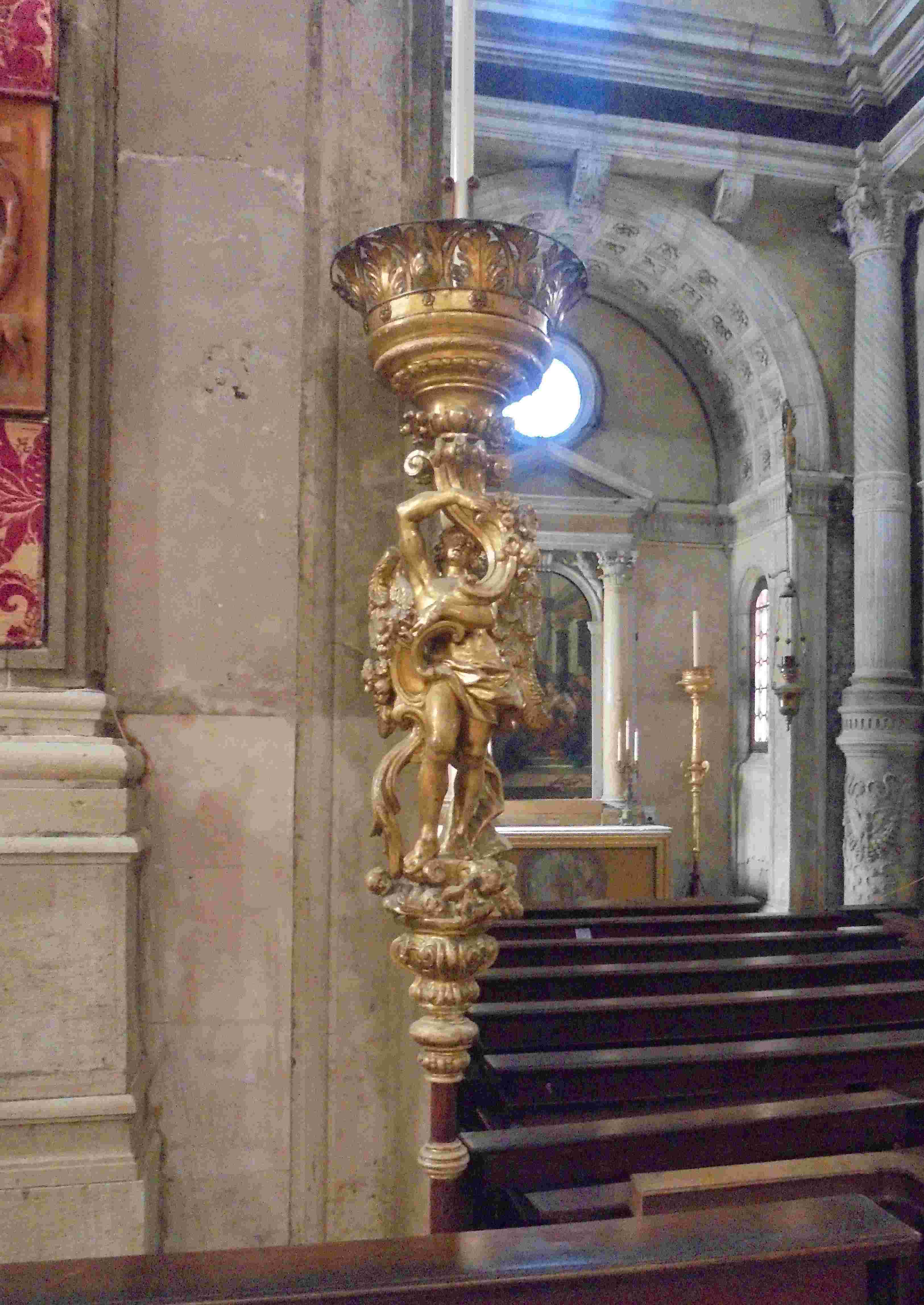
If one stands right in front of Diziani's artwork and then turns around for looking towards Tiepolo's, then one sees the artwork in the distance, half covered with the big lightstand - which resembles the statue of the Madonna of Fatima to a considerable degree:
|
|
What is interesting is that if one stands just in front of Diziani and turns around to look at Tiepolo, the distance from the eyes to Tiepolo can well be 27,18 meters and the distance to the lightstand can then be 18,32 cm - which is the distance from that point to Fatima - the 1832 km. This is interesting because 27,18 could mean a multiple of the constant e = 2,718281828..., which is the length in cm of my 'lapis philosophorum':
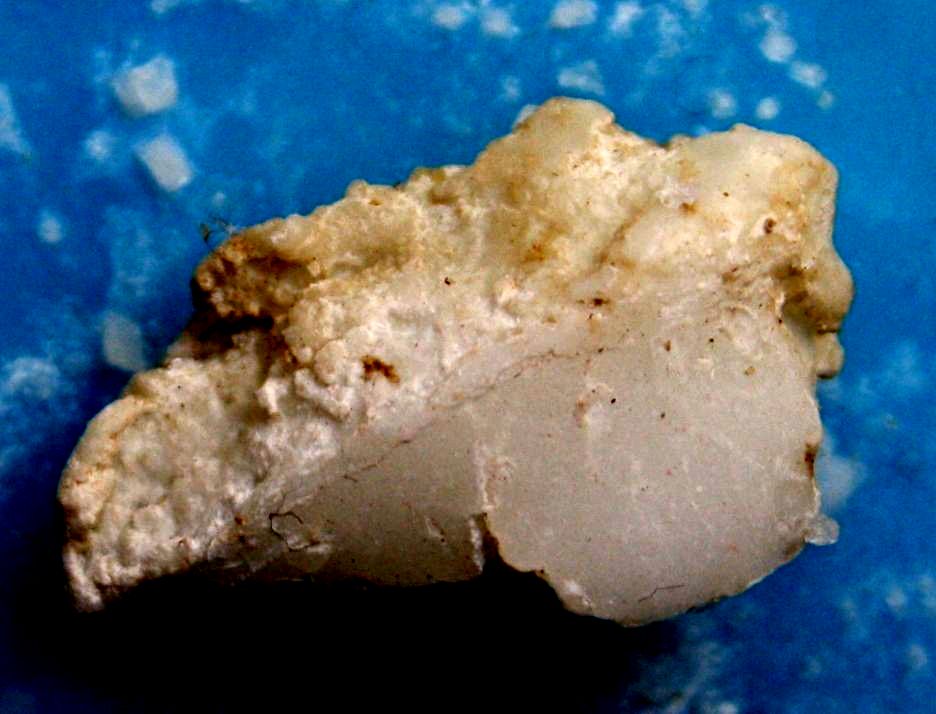

The constant 'e' is expected to be involved since it is its own derivative and therefore it allows for a ladder up and down the dimensions, so to speak.
Now for the main point: The word 'Camblidis' on my white textile is appr. 18,23 cm long. It is a little hard to measure since the beginning and end of the pigment is not very clear - and hence it is not impossible that it really be 18,32 cm:


It seems to be a little shorter when measured from the back side, for whatever reason. (Cp. TEQ #387).
Do these data mean that the Fatima revelations were but redundancies? No, it rather means that the revelations took place through the human semiotic form.
Is it the art of painting that is the story? Johannes Vermeer has made a study of this which is indeed to the point:

It is noticed that what is on the artist's canvas (on his 'white textile') is the same blue colour as my 'Camblidis', and the woman he is painting holds a book in her one hand. Even the 'lampstand' from the church is seen overhead. Hence the art of painting is to let the semiotic form of the human reality through in the artwork, to an extent that it even 'paints itself'. In this little article I have aligned this artwork of Vermeer with the ancient egyptian hieroglyph 𓉔 called 'reed shelter in the fields'. It could be about the fields of Cova da Iria where the young visionary shepherds met the Madonna, and it could be about the Apostoli church itself.
27/6-2026: In the article on Caravaggio and the blue metre, I told the story of the four WOWs which I heard in the region of Ponte dei Tre Ponti:
[28/6-2026:] Some years ago (probably around 2020 or later), I walked along another canal (Fondamenta Papadopoli) in Venice when I suddenly heard a voice 3 times pronounce loudly the sound 'WOW!' - in slow and distinct articulation, like perhaps a buddhist mantra of type 'AOM' could be pronounced in the mind (although those take perhaps a little longer time). This happened approximately when I was at the 'x' on this map - I was walking in the direction of the arrow - and the sound came from approximately the area of the black line, which means that when I turned around towards the sound I would see approximately this streetview:
 Source map of the screenshot (annotated by me) |
 The streetview map source of the screenshot |
- which means that I would have to consider three points of potential source of the sound - in addition to the more obvious idea of 'the field just above the water itself': Either around the area of the bank (with the cashpoint) or the kiosk/newsstand or the bridgehead of the 'Ponte Tre Ponti'. I continued walking and then I heard a fourth articulation of the same kind. I dont know if there could have been a natural source of these four articulations - they seemed to come from above the water, though - and were of an impressive volume.
It was really 3 WOWs followed a little later by a fourth. If I now compute on the map the distance from the Tiepolo painting of Santa Lucia in Apostoli to the place where I heard the 3+1 WOWs in the air, but in such a way that one has to cross three bridges on the way, then the distance is also rather exactly 1832 metres:
 The distance is 1832 metres Source is CalcMaps map distance calculator |
 The area where I heard the sounds Source of the map is CalcMaps map distance calculator |
The trajectory stops at the three bridgeheads and crosses the bridges, otherwise it goes right through the air like a bird - or like the acoustic sound itself. The end point of these 1832 metres across three bridges - that is, where I believed that the sound came from - is itself the bridgehead of the bridge called 'Ponte dei tre ponti' = 'Bridge of the three bridges' - as the map shows there are three bridges meeting just there. I was then on the other side of the canal - and when I started moving on towards the third bridgehead there came a fourth WOW in the air from the other side of the canal.
The bridges could perhaps resemble the phenomenon of the curving earth surface: Would the 1832 km from Venice to Fatima reduce to 1823 km if one measures the direct line through the earth? Likewise, would the 1832 metres when crossing of bridges are included reduce to 1823 if one measures right across the water?
I notice also the obvious relation between 'three bridges' and 'cam-blidis'.
There was also, sadly, apparently much potential terror-and-monkey-business (even the outbreak of ebola in Congo?) that followed after I ordered a book from Harvard University Press in Cambridge, Massachusetts, USA. (They have also a UK representative at 8 Coldbath Square, London). Would it have been about british feelings about 'Cambridge University Press' in Cambridge in England - on background of these 'Camblidis' data?
© John Bjarne Grover
On the web 14 february 2026
Last updated 27 june 2026
.jpg)
_-_La_vergine_col_Bambino,_san_Giuseppe,_san_Giovanni_Battista_e_sant%27Antonio_da_Padova_(1755)_Gaspare_Diziani.jpg)

.jpg)