


Copied from this source
Caravaggio's and Mazzola's blue metre
John Bjarne Grover
This article explores my blue poetic metre 'POLAKK English Bloggi' (2008-2010) and 'The Endmorgan Quartet' (1997-2008) relative to works of Mazzola (often called 'Parmigianino') and Caravaggio, in particular relative to Caravaggio's wellknown rough temperament and behaviour.
What is the blue metre?
The blue metre is my discovery. In the years 1997-2008 I wrote 'The Endmorgan Quartet' = 'TEQ' - 16 books of poetry (1719 poems) for which each book is assumed to concern a certain distinct aspect of human semiosis. The lines are written the one after the other in chronological order, which means that each line and hence each word is dated - see book 14 as example. Thereafter I wrote several works of what I call 'poetic metres' - blue, red, yellow and white metres which relate to 'The Endmorgan Quartet' = 'TEQ'. I wrote 'Der Dornentrauch' (2009-2015) = 'DDS' on the diachronic dimension in language mainly at coffeepoints in Vienna and other towns by observing the immediate cultural environments: It is probable that I noticed the effects of how TEQ changes the world and these changes are noticed by me as the author and these changes are constitutive for the poems in DDS. I have made some studies on Caravaggio relative to the yellow metre, such as Caravaggio and 'Der Dornenstrauch' and Caravaggio and 'Der Dornenstrauch' part 2. I wrote the blue metre called 'POLAKK English Bloggi' = 'PEB' in 2008-2010 - it is about the semiosis of historic time (which is not the same as the diachrony of language). The work is generally constituted by the poet seeing inner visions (typically at night) and recognizing these in immediate cultural events the day after and the difference between these constitute an element or step of historic time - hence the motto to the book - it can be called the historic decay conceived as the will of God (Mathews) - see also this. In contrast, TEQ is constituted exclusively (except for some book titles) by inner poetic articulations which are strictly aural impressions without any visuality.
The 'PEB' consists of 366 poems - the first 365 are 14 lines each, and one full cycle of 366 poems is assumed to comprise one millenium - 1000 years - of historic time. The philosophy is that any written text carries in itself the cues to the year it is written - and this is the 'blue metre' in human semiosis. A written text finds its offset in my book according to when it is written. This means that you can take any text and find the year it is written by finding the optimal match relative to my 366 poems. See my 'Collected works' volume 3 pages 732-754 for details.
This obtains also for the age of a written word. Take the year of first attested occurrence of a word: Say, the etymological dictionary tells that its first attested occurrence is in the year 1320, such as example 1 below ('navone' = 'swede', 'rutabaga'). I normally use the year 2009 as the year of creation of my 'PEB'. Then the relevant line according to the blue metre will be (2009-1320) * 0,366 = 252,174 which then will be in PEB #253 - more precisely, it is 0,174 through this poem, which means line 14 * 0,174 = line 2,436 which is 0,436 through line 3 in PEB #253 - that is in the line 'The food is what we call'.
All etymological time points in this article are from Tullio de Mauro's and Marco Mancini's 'Dizioniario Etimologico' (Garzanti 2000), a collection of some 185.000 italian words which nearly all of them seem to be annotated with year of first attested occurrence. It is, to my knowledge, rare to find such a collection of exact dates of first attested occurrence of words - many etymological dictionaries do not specify this with any precision. In addition to this italian source, I find Onions' "Shorter Oxford English Dictionary" (in 2 volumes) a valuable source (Onions' etymological dictionary has little information on this), and for the hungarian language there is an excellent source in Benkő et al. (4 volumes). Another source with annotation of year is Zaicz.
But is first attested occurrence anything worth? It is of course very probable that the word was in use before it was written down and it is also probable that the document which has survived with this word was not the first occurrence of the word in written form in those days. That is true - but there seems to be a special function from the form of the collective consciousness - in such a way that what for us counts as first attested occurrence is of major importance for our understanding of the history and our current semiosis by what I call the blue metre: See my translation and organization of the fragments left after Heraclitus - it seems that the historic consciousness has retained precisely those fragments after Heraclitus which in their totality constitute a poetic form of a specific kind - very little of the extant fragments are 'outside this form' or 'of random value'. But Heraclitus wrote probably much more - which means that History has taken care to discard all those parts which do not enter with convenience into such a 'blue logic' in the collective historic conciousness. Hence one could articulate the theory that the collective historic consciousness retains for the future (and does not allow history to consume) those documents which contribute to a proper 'blue metre' form of this kind - a 'blue collective logic', so to speak. This is at least an interesting hypothesis for explaining phenomena such as I describe in the present article.
Caravaggio's rough behaviour
The story of Caravaggio's temperament and behaviour is well known from numerous police records in Italy. It does not really make sense, though: How could such a great artist exhibit such a rough behaviour? What was it really about? I here scan the 8 stories about Caravaggio's rough behaviour referred to in the Grokipedia article about Caravaggio and test them against my blue metre 'POLAKK English Bloggi' = 'PEB'. I did not know about Caravaggio's temperamental behaviour when I wrote PEB. It seems, though, that this odd trait of his personality can be understood in light of just this aspect of diachrony. I go through the 8 cases of unfortunate behaviour that have been documented in italian police reports, according to the Grokipedia article on Caravaggio:
1.
"On May 4, 1598, he was arrested near Piazza Navona at 2-3 a.m. for carrying a sword and compasses without a permit, claiming protection from Cardinal del Monte but released only after intervention". (Source)
'Navone' = 'swede' or 'rutabaga' = first attested in 1320 → (2009-1320)*0,366 = 252,174 = PEB #253 line (14*0,174) = 2,436 = "sometimes it is high up / the food" - hence del Monte for the height and Navona for the food.
2.
"In 1600, he assaulted Girolamo Stampa da Montepulciano with a club and tore his cloak using a sword outside Palazzo Madama". (Source)
Madama = 1348 → PEB #242 = 'angels all among / humans and the sea'
Stampa = 1313-1319 → PEB 252,54-254,736 = from PEB #253 (line 8) to PEB #255 (line 11). In fact the entire interval from 252,54 to 254,736 seems to be the story, including the name and the place.
3.
"In 1603, he was tried and convicted for libel after composing and distributing satirical poems mocking [Giovanni] Baglione's painting as 'cabbage leaves', resulting in weeks of imprisonment at Tor di Nona". (Source)
"Contemporary accusations of sodomy arose in 1603 when rival artist Giovanni Baglione, in a libel suit over satirical poems, charged Caravaggio with the capital offense alongside other slights, though the claim lacked substantiating evidence and stemmed from professional enmity rather than witnessed acts". (Source)
'Baglione' suggests 'baglio' = 'deck-plank on a ship' = 1772 → PEB #87 = "in addition, / there is a fish bar". (A 'deck-plank on a ship' can be seen as a 'fish bar').
'Cabbage leaves' = italian 'foglie di cavolo': Neither 'foglia' nor 'cavolo' have a specific year in the Garzanti dictionary (both are given as '2nd half of the XIII century') - but their gender-opposites 'foglio di cavola' have precise years given - and these seem in the blue metre to suggest just precisely such accusations of sodomy:
'cavola' = 1363 → PEB #237 = 'backpacker in human pace'
'foglio' = 1313 → PEB #255 = 'in the body'.
4.
"A notorious episode occurred on April 24, 1604, when, at Osteria del Moro, he hurled a plate of artichokes at waiter Pietro Antonio de Fosaccia for allegedly serving without permission, then drew his sword and threatened the man amid shouts of insult; witnesses confirmed the altercation escalated from a minor service dispute". (Source)
The police report contains Fosaccia's account: "About 17 o'clock [lunchtime] the accused, together with two other people, was eating in the Moor's restaurant at La Maddalena, where I work as a waiter. I brought them eight cooked artichokes, four cooked in butter and four fried in oil. The accused asked me which were cooked in butter and which fried in oil, and I told him to smell them, which would easily enable him to tell the difference. / He got angry and without saying anything more, grabbed an earthenware dish and hit me on the cheek at the level of my moustache, injuring me slightly… and then he got up and grabbed his friend's sword which was lying on the table, intending perhaps to strike me with it, but I got up and came here to the police station to make a formal complaint…" (Source).
'Fosaccia' is not the same as a 'focaccia' any more than a focaccia is a pizza. Garzanti has no better time annotation on 'focaccia' than the XIV century - but 'focace' = 'fireplace' (cp. the issue of cooked or fried) is from 1388, which gives the blue-metre line PEB #228 = "in 'Wechselstub'" (precise point would be beginning of line 5) - which should be somewhat for this story. There are two relevant senses of 'Moro' which are perhaps even more precise:
'Mòro' (1) = 1470 → PEB #198 = 'and shows how to go to / the person in sarx'.
'Mòro' (2) = 1310 → PEB #256 = 'airy smokin'
'Móro' = 1941 → PEB #25 = 'socks rubbingly and busy'
5.
"In the summer of 1605, Caravaggio's violent temperament flared once again, this time over a woman. The courtesan Maddalena Antognetti, known as Lena, was not only Caravaggio's model for the sensational but controversial Madonna di Loreto altarpiece he had just completed in the church of Sant'Agostino, but also, it seems, his lover. / When the notary Mariano Pasqualone - perhaps a spurned suitor, or perhaps acting on behalf of a friend - apparently made disparaging remarks about her during a heated discussion with Caravaggio on the Via del Corso, the painter's response was swift and brutal. On the night of July 29th, in the shadows of Piazza Navona, Caravaggio attacked Pasqualone from behind, striking his head with a sword. Though the notary never saw his assailant, he named Caravaggio without hesitation". (Source)
'Pasqua' = 1246 → PEB #280 = "people and the food were hearty / at least most of them". (But not all were hearty, such as Lena - or Pasqualone himself?)
'Navone' (= 'swede/rutabaga') = 1320 → PEB #253 = "sometimes it is high up / the food". (The hearty food).
'Córso' = 1257 → PEB #276 = 'A woman on her knees / has her back towards me. / Then she turns and sees / me' - which could apply to the name of the woman ('lena' = 'breath', 'ant-' = 'against' + 'ogn-' = 'each, every').
'Còrso' = 1313-1319 → same as for 'stampa' in example 2.
6.
"In 1605, he pelted stones at landlady Prudenzia Bruni's windows, sang vulgar songs, and damaged property amid rent arrears, leading to a lawsuit". (Source)
Bruno = 1250 → PEB #278 = "from Ruga d'Orefici // something is obscurely / blood or I dont know / as if one couldn't see" - which could apply to the windows.
Prudenza = 1292 → PEB #263 = 'half metre long cucumber // pointing
up. Before him there's / another object, big and green' - the vulgar songs
7.
"The culmination occurred on May 29, 1606, when Caravaggio fatally wounded Ranuccio Tomassoni, a pimp and associate of a rival faction, during a street brawl near the Campo Marzio district. The altercation reportedly arose from a dispute over a tennis match (pallacorda) or a shared prostitute, escalating into a duel involving multiple participants, including Caravaggio's allies like Silvio Passeri and Pietro Antonio de Bisogno. Tomassoni suffered a severe femoral artery wound, leading to his death hours later, while Caravaggio sustained leg injuries but survived. Contemporary accounts suggest the strike may have aimed at castration as retribution but struck fatally higher". (Source)
Pallacorda = 1535 → PEB #174 = "first he tries with the ball / the round one behind the big / toe that gives step to the roll"
8.
"On August 18, 1608, in Valletta, Caravaggio engaged in a violent altercation with Fra Giovanni Rodomonte Roero, a fellow knight and the order's organist, during which he smashed Roero's door and inflicted serious wounds, reportedly using pistol shots. The brawl involved at least seven knights and stemmed from a personal dispute, highlighting Caravaggio's pattern of impulsive aggression". (Source - about Caravaggio's time on Malta).
"The fight was a violent one; the front door of a house in Valletta was smashed the house broken into and at least one knight was seriously wounded. The latter can be identified as Fra Giovanni Rodomonte Roero dei Conti della Vezza di Asti". (Source).
'Rodomonte' = 1545 →
PEB #170 line 11,538 = "along the edge of pure / matter..."
'Roèo' = 1967 = PEB #16 line 5,208 = "or in the chesterfield / somewhere out in the 'rue'" ('Roèro' is not given)
'The edge of pure matter' could have been the housedoor, and the 'chesterfield' could have been the effect of a pistol shot.
Assuming my PEB to be an exact formulation of the blue metre, it can be concluded that Caravaggio's rough temperament applied to the blue metre. How should it be understood? The blue metre can probably be compared with the weak nuclear force which concerns radioactive decay - such as the historically steady rate of decay of Carbon-14 which likewise is used for historic dating of creation of organic matter. Caravaggio's behaviour could perhaps be seen as related to this aspect of being.
I have suggested that Homer's Odyssey is a blue metre (and the Iliad is red). It can be observed that Caravaggio's odyssey to Malta, Sicily and other places before he attempted (but failed) to reach Rome again could be seen as an aspect of the same blue metre.
Checking the Odyssey considered to be a blue metre in precise parallel with my PEB, I look up the lines of the Odyssey corresponding to my PEB #174 for the 'pallacorda' (1535) by the death of Tomassoni, which turns out to be approximately Od.VIII:454-459 - here in Murray's translation: "Now when the handmaids had bathed him and anointed him with oil, and had cast about him a fair cloak and a tunic, he came forth from the bath, and went to join the men at their wine. And Nausicaa, gifted with beauty by the gods, stood by the door-post of the well-built hall, and she marvelled at Odysseus". But this sounds just like the story of example 5 from the summer 1605 (and this again links by the two names mentioned for example 4) when the dispute was about Maddalena Antognetti who had been model for Caravaggio's 'Madonna di Loreto' (by the door-post). On 29 may 1606 the dispute seems to have been about Fillide Melandroni - but the parallel is interesting. I notice also that both 'fillide' and 'melandrio' now are common nouns in fact both of them first attested in 1967 - which suggests 5,2 lines into PEB #16: One sees in the 'Madonna di Loreto' the cast rods (of the two pilgrims) crisscrossing - and the 'chesterfield' cloth covering the shoulders of the kneeling male (like Odysseus's bath + cloak) can perhaps be recognized also on the Madonna (the child then being her 'chesterfeel'). Hence the 1606 dispute could (in view of the blue metre) have seemed to be about the status of the Madonna of Loreto in her relation to Caravaggio himself as kneeling at her door-post.
That this could have been an important 'blue metre' aspect of the story is confirmed by the fact that the name of the Malta victim 'Roèro' (which is not listed in the dictionary) can be compared with the form 'roèo' which is first attested in 1967 - which is also the year for both 'fillide' and 'melandrio' relevant to the name of the female 'Fillide Melandroni' who could have been the cause of the brawl with lethal outcome in Rome in 1606 - which also was the reason why he had to flee Rome for Malta. In fact the year 1967 occurs three times in this form. There is also a double occurrence of the years 1313-1319 in 'stampa' of example 2 and 'còrso' in example 5, which is interesting.
The Madonna of Francesco Mazzola ('Parmigianino')
(On Mazzola, see also this article). I dont know if modern periodization is of any value for understanding the following. Caravaggio is said to have grown up in the environments of socalled 'mannerism' but is also credited with being a major impulse for the following 'baroque'. From this it is easy to oversimplify to the assumption that Caravaggio broke with his background and created something new instead. Caravaggio may, though, as the following could show, have nourished a more or less secret admiration for the work of Francesco Mazzola (called 'Parmigianino') - such as the one with the Madonna and (allegedly) San Zaccaria:
Copied from this source
The work is located at the Uffizis in Firenze.
This work of Mazzola (Parmigianino) was created probably in the beginning of the 1530's. It is traditionally referred to as the Madonna and Jesus along with San Zaccaria and his son John the Baptist plus Magdalene in the background. But isnt the child a girl who wants to be with Jesus boy and he is reluctant relative to the historic temptations? This source tells: "The earliest definite reference is probably that from 1533 referring to a 'Madonna and Child [with] the infant St John the Baptist and San Zaccaria' sold to Bonifacio Gozzadini from Bologna". It could be reasons such as this - an early reference that came to be the standard conception - that it be about Zaccaria and his son John the Baptist. There is from his self portrait the impression that Mazzola can have been of a tender stature - and maybe some even could have thought of him as somewhat feminine - and if this is why this document could have mixed up the gender for the socalled baptist, there could be historic reasons for this conception which are perhaps not essential to the artwork. And then it needs not be San Zaccaria either. One can get this overall impression that people could have had a tendency to downplay the value of his art and therefore they harassed him a little. He is also considered a main proponent of the socalled 'mannerism' which likewise is a term with a negative taint - were it even coined for harassing him a little? One sees in the artwork a taint of 'kiosk literature' - emphasized also by the paradoxical 'kiosk' in the background - but that is of course what Mazzola says - that this is how humans are and think - it is not a sentimental weakness of his. Could be phenomena such as this could have created problems for the reception.
But there are reasons to believe that he could have been very highly esteemed by Caravaggio, who is considered a pioneer of the following 'baroque'. It is possible to see reflexes of Mazzola's artwork (this Madonna with the alleged San Zaccaria) in a good majority of Caravaggio's own paintings - I excerpt a few examples (for better resolutions see source list at the end of this article):
None of these are plagiarisms of the admired work - very far from it - and it is well possible that Caravaggio did not know about these parallelisms himself. 'John the Baptist' is perhaps the most convincing - the sheep exhibits the girl's hair-covered behind on Mazzola's artwork, and her clutching is transferred to the sitting baptist who clutches the 'Madonna' in the form of the red textile (symbolic perhaps of Jesus' earthen origins). The rich hairflow is shared with 'Magdalene' in the background. Would the stick be Zaccaria's ardent look? The clutching of the 'grapevine' (or the grapes) in 'Sick Bacchus' likewise exhibits the turning of the body by the shoulders - symbolic perhaps of the girl's behind. In the 'Crucifixion of St.Peter' the behind of the girl is present prominently in the one who tries to lift the cross, while the reversal or front-back is a general feature of the characters, including the upside-down of the cross. Zaccaria and his twisted shoulders is here present in the otherwise mysterious jacket in the lower right. Both Emmaus artworks show in the lower left the same back with attention towards Jesus. The remaining examples are of more general kind. In the 'Beheading of St.John' and the 'Burial of Santa Lucia' there is the curving arch going up and left and the vertical phenomena up right - plus the behind again in the burial scene - now on the right while Zaccaria's look is shifted left.
Historic records seem to tell that this Madonna of Mazzola was moved to Firenze in 1605 - the year before the tragic event of Caravaggio with Tomassoni in Rome. Would the story have been that Mazzola's artwork was so important for Caravaggio that this movement was a part of the circumstances that could have triggered the event? I have not found out where it was before it was moved to Firenze - if it were in e.g. Bologna or Rome - there seem to have been some copies around, such as this one, but that is probably not something that Caravaggio would have taken much interest in. Would this movement of the artwork have contributed to the tragic incident of 29 may 1606 if the circumstances clearly indexed this artwork by Mazzola? This theory is reinforced by the fact that the incident that led to the death of Tomassoni took place at Piazza di Firenze, apparently just at Via dei Prefetti and what is now called Via di Pallacorda. Were that 'Pallacorda' the name of the street also in 1606? Or has this streetname come up after the 1606 story? Caravaggio seems to have lived just around the corner - in 'Vicolo del Divino Amore 19'.
The aural impressions in Venice
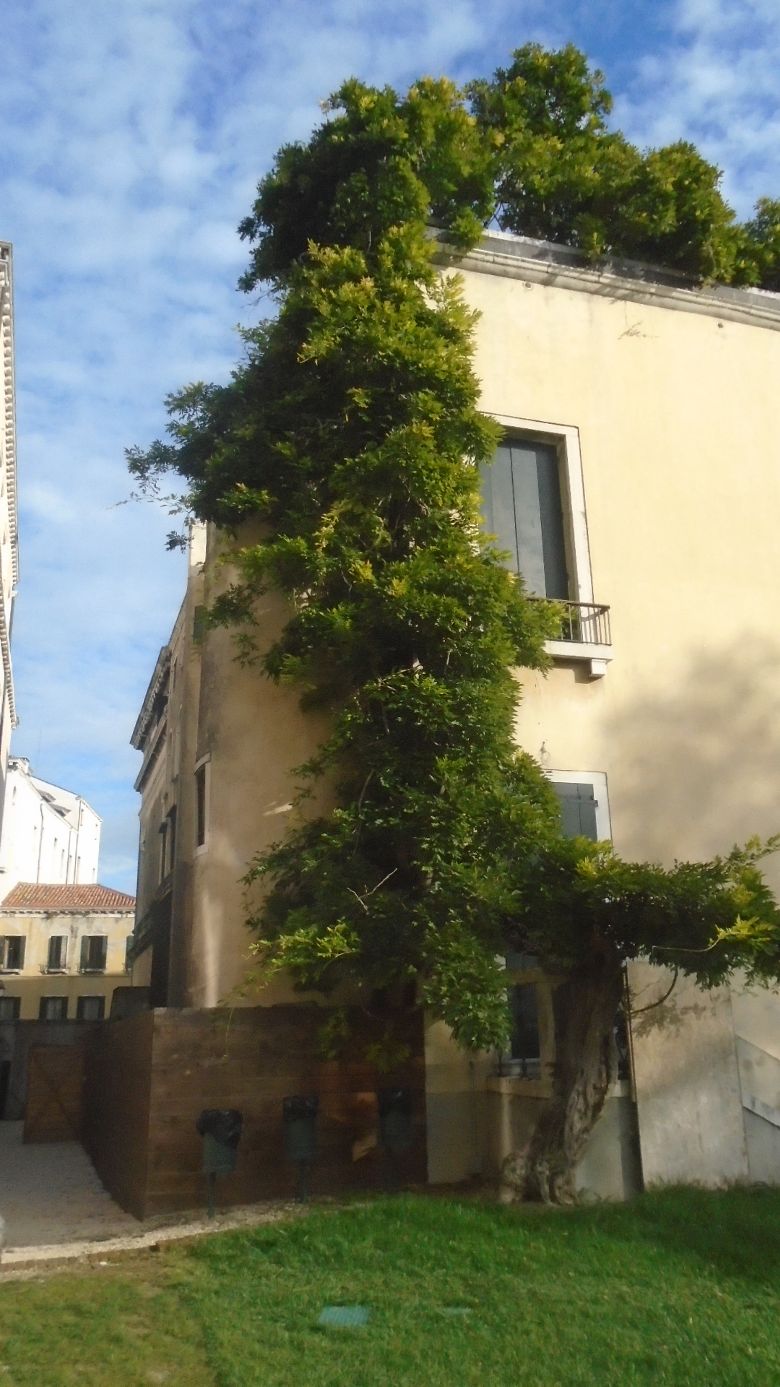
As recorded in this file, I passed a xylophonist outside a window near San Leonardo (not far from Guglie) in Venice - he played on an 'aboriginal' xylophone with coconut amplifiers for the dry sound from the wooden bars - and a day or two later I was in the garden to Ca' Bembo near Chiesa di San Trovaso - the garden of the linguistics institute in Venice. I marvelled the fantastic wisteria tree there climbing up on the wall and when I was about to leave, a xylophone (sounding like a marimba, with a colour-rich tone compared with the dry xylophone at San Leonardo) started to play, climbing a scale of natural intervals up like the wisteria itself. Neither do I know for this case whether there could have been a natural origin of the sound, but I fancied that it was the wisteria itself who played.
Considering Mazzola's artwork again, there is an imaginary 'water canal' running through it - this imaginary water canal runs like a paradoxical woof-and-weft of the 'pallacorda' racket and it follows the Canal Grande on the map of Venice well:
|
(Source) |
 (The annotated photo adopted from source ) |
 (Adopted from source) |
The paradoxical 'kiosk' of Mazzola's artwork will be at the place (annotated with 2 on the map) where I heard the xylophonist at San Leonardo while the marimba music (annotated with 3 on the map) would be the book under the left hand of 'San Zaccaria'. For example, assuming a turning of the roles of San Zaccaria with the young girl in Mazzola's artwork as it is shifted over onto Caravaggio's 'Burial of Santa Lucia', one finds that the marimba scales then would be around the right hand of the body of the saint on the floor. Hence it would follow a waterway of Venice.
Some years ago (probably around 2020 or later), I walked along another canal (Fondamenta Papadopoli) in Venice when I suddenly heard a voice 3 times pronounce loudly the sound 'WOW!' - in slow and distinct articulation, like perhaps a buddhist mantra of type 'AOM' could be pronounced in the mind (although those take perhaps a little longer time). This happened approximately when I was at the 'x' on this map - I was walking in the direction of the arrow - and the sound came from approximately the area of the black line (source map) which means that when I turned around towards the sound I would see approximately this streetview - which means that I would have to consider three points of potential source of the sound - in addition to the more obvious idea of 'the field just above the water itself': Either around the area of the bank (with the cashpoint) or the kiosk/newsstand or the bridgehead of the 'Ponte Tre Ponti'. I continued walking and then I heard a fourth articulation of the same kind. I dont know if there could have been a natural source of these four articulations - they seemed to come from above the water, though - and were of an impressive volume.
I look up the blue metre since I remember the 'Tre Ponti' is mentioned there - it is in PEB #225. The word 'pant' is mentioned in line 3 and 7 and there is a 'Lunga' in line 9 - which means that the apparent airstream of this articulation can be seen as mentioned 3 times in the poem - at three points, so to speak.
PEB #225 corresponds to the year 1395 - since (2009-1395) * 0,366 = 224,724. This was the year approximately in the middle of the papacy of Boniface IX - whose papacy was in the middle of the Western Schism of the catholic church which lasted from 1378 to 1417, "in which bishops residing in Rome and Avignon simultaneously claimed to be the true pope". Boniface IX, born Pietro Tomacelli Cybo, was pope in Rome from november 1389 to his death in october 1404. Perhaps somebody would say that Boniface IX was much concerned with money - which could be the cashpoint/bank on the other side of the water. The 'tre ponti' explains itself with the bridge(head), and then there is the kiosk (newsstand) left: That kiosk would clearly correspond to the paradoxical building in the background of Mazzola's artwork.
This is how I came to think of this artwork of Mazzola. Then the birthname of the pope - in addition to this essential function of the blue metre - gave me the cue to Caravaggio's story from 1606 - which suddenly seemed sensible in light of the concept of a 'Western Schism' by the movement of Mazzola's 'Madonna' to Firenze in probably 1605:
Pietro Tomacelli Cybo (= Boniface IX's birthname) resembles the name of
Ranuccio Tomassoni di Terni via
La Luce Tomacelli di Terni.
It is then highly interesting to observe how many of Caravaggio's works can be seen to receive some explanatory light from the artwork of Mazzola. And where would the 'WOW' sounds (annotated with 1 on the map) be on Mazzola's artwork? That would probably be around the eyes of the Jesus child. I notice also the 'waterway' function of the amphora above his head. This mapping explains the peculiar twist of the shoulders of San Zaccaria. A profound mystic it seems that Mazzola could have been.
The word 'WOW' occurs also three times in my 'The Endmorgan Quartet': In TEQ #814, in TEQ #1017 and in TEQ #1148. It is seen that the concepts discussed above have a relevance for these occurrences. For example, in TEQ #814 one finds:
|
The two calls forth an extensive mammonist force The news upset me with the key in the letter, position reign 498 - high rejection. If I find any such process of conscious auditory - |
= the bank with the cashpoint = the newsstand, the kiosk = the third element = the fourth stanza of PEB #225 = the auditory phenomenon over the water |
In TEQ #1017 one can see the last five lines as telling the 5 quoted lines from TEQ #814 in reverse order.
The number 498 in TEQ #814 could be a second round of the PEB - that is 498-366 = PEB #132 - which is the beginning of the chapter '-818'. There are 24 chapters in the PEB and I have associated these with the letters of the hebrew alphabet. This chapter '-818' is in my notes tentatively associated with the hebrew letter 'qoph' = ק - which makes sense also for this artwork of Mazzola - including the vertical line which could tell of the transforms seen in Caravaggio's 'John the Baptist':

And now for a little check of that 'WOW' - what says function 14? The three occurrences are at 31.10.00 (TEQ #814), 15.05.01 (TEQ #1017) and 15.03.02 (TEQ #1148), which is intervals 196+304 = 500 days. The interval 196/500 = 0,392 multiplies with the 207 poems of book 14 for poem #81,114 = poem #82 which is TEQ #1329. But that is far from a 3-liner defining these three WOWs. However, there is such a 3-liner at poem #80, and that looks quite well suited for these definitions. But how can one reach that? Of course, by adding yet another WOW a little later for adding some days to the 500 in such a way that the ratio leads to just #80. 508 days interval gives 196/508 = 79,87 = poem #80, while 507 days will give 196/507 = 80,02 = poem #81 - then it would be precisely on the border between 7 or 8 days later - after the last occurrence of WOW which was on 15.03.02: Hence around 22-23.03.02: That makes for TEQ #1150 where there is a '[now]' on the border between 22 and 23 march 2002. Assuming this NOW to be the fourth WOW it is possible to make for poem #80 providing the three lines corresponding to the three occurrences of WOW in TEQ. Since this makes for four WOWs one can add also the ratio 500/507 for the new interval - that lands the new interval on #204,14 which is poem #205 in book 14 - which is TEQ #1452 - a four-liner which also can be used for defining the now 4 occurrences of 'WOW'. So it passes the test very well on these provisos. The WOW really 'iz'. For a possible 'phonetics' of the WOW I look up the mirror image to #80 which is 208-80 = #128 - or maybe even this un-numbered poem which is squeezed in between #127 and #128. Is there a 'phonetics' in #208-205 = poem #3 which is TEQ #1250? Could be there is a more detailed description there for all I know. Hence it is not impossible that these 3 WOWs + 1 [NOW] were the four WOWs I heard over the water in Venice.
Mazzola's 'Pala di Bardi'
The story of Caravaggio's 8 troubles - in accordance with my 'blue metre', that is - seems to find a rather relevant representation in this masterpiece of Mazzola:

Copy of the artwork (from
source)
It is the socalled 'Pala di Bardi' = the altarpiece of Bardi - and the story seems to be how it in 2016 could have been 'restored' (which here apparently could mean something like almost 'completely destroyed') into this form (according to this source). If it really be the case that it has been 'restored' in this way, then it is possible that the harassment of Mazzola has continued to the present day. It can be noticed that the patterns on the yellow leftmost dress of this 1521 artwork resembles the patterns on the dress of the 1531 Madonna of Guadalupe 10 years later. See also my comments on this 1531 apparition in Mexico. This pattern on the dress seems to be nearly completely wiped out after the alleged 'restoration' - if this really be true and it is not (as one can hope) only a copy that has been 'restored' while the original is stored safely away. This 1521 'Pala di Bardi' of Mazzola (Parmigianino) was painted apparently in Viadana in the 1520's and arrived to Bardi only well after Caravaggio's death - but one notices the phonetic affinity of Caravaggio's 1606 dispute allegedly on the 'pallacorda' = 'palla a corda' with 'Pala di Bardi'.
The 'Western Schism' could be the issue and the story could be the role of Aristotle in christian theology up to the Western Schism. Mazzola (Parmigianino) may perhaps provide solutions to some of these problems and that could be why the world has been reluctant to recognize his contribution - it was even in his own lifetime that success was not his forte. Clearly Mazzola was not a threat to the christian creed - rather the opposite - but there could have been a theological paradox hiding somewhere which appeared a little difficult to understand.
The 8 stories discussed above on Caravaggio's 'rough behaviour' can probably also be recognized in aspects of Mazzola's 'Pala di Bardi':
1. This event tells that Caravaggio was arrested for carrying a sword and 'compasses' - the latter (whether I understand this word right or not) can be recognized in the 'elongated' pointer to the mechanic clock at the foundations of the artwork.
2. This event is about a 'club' (with which he attacked Stampa). The italian word seems to be 'batone' which is first attested in 1306, hence PEB #258, the fifth line: "Wooden sticks are piled up there, / timber for a season's cold" - which clearly is that timber plank (now removed by the 'restoration') on the righthand side of 'Pala di Bardi'.
3. The 'backpacker in human pace' is recognized as the righthand man with his hand at his bottom - and what is 'in the body'? Would it be what the strange expression of the Madonna (on the 'throne') could be telling of? The deckplank of a ship is clearly the plank on the righthand side - what I call 'timberleave' in this poem which also seems quite consonant with Mazzola's 'Pala di Bardi' - cp. the 'potion/person', the 60 year clock etc.
4. This is the restoration (of he 'Pala di Bardi' itself). 'Airy smokin' could be the reason often invoked for the need for a 'restoration' of an artwork - one must remove the dust that has accumulated on it. In addition, Fosaccia had asked him to smell the difference between oil and butter, which seems to have been what led to the event.
5. This could be about the relation between the top 4 vertical bars (on 'Pala di Bardi') and the lower 4 ticks on the clock - plus that 'sword' of the pointer. 'Sometimes it is high up'. The woman turns and sees me - that is the woman in the yellow dress who turns and sees the spectator: It could be this which is the Madonna of Guadalupe ten years later.
6. What is that red spot on the lip of the woman in yellow? Is it the same as the blood of my PEB #278 (line 13)? The half metre long 'cucumber' could be the bird in the lower left (a 'cuckoo-umber'), while the big object could be the marble pillar with some 'green' on top of it.
7. Matrimony can be for life and may femoral implications. I notice from the story with Ranuccio Tomassoni that he sems to have died from wounds at Via dei Prefetti: The word 'prefetto' is given as earliest 1292 which gives PEB #263 line 5,9: Line 8 tells of 'a structure hitherto unseen' which could be the pale face on the white marble pillar - possibly just about to take shape.
8. Is the man to the right suggesting a finger up in his own behind? If so, it could be a counterpoint to the woman with the 'potion' - as for the difficulties there could be in getting out of such a matrimony. The woman in yellow could indicate a similar solution - along with her own finger pointing to her chest.
Mazzola's problems
Mazzola was largely self-taught and therefore could have refused to give in to the dogmas of his time. Could be that is what Caravaggio did not give in to either - I dont know how autodidact he was but he anyhow seems to have taken the refusal out in behaviour instead. Both men died at the same age. Were Mazzolo bullied by the society - and, if so, is that why Caravaggio behaved like a bully, at least on a few occasions?
Mazzolo seemingly did not get any payment for the masterwork Madonna and San Zaccaria (source) - it was seemingly acquired by the lawyer Bonifacio Gozzadini in Bologna who did not pay but who offered him gratis assistance in court in case he should come to need it - before it finally was moved to Firenze in 1605. Is that why Caravaggio attacked 'ran-nuccio tomas-selli/soni' in 1606 - at Piazza di Firenze? 'Ran' means 'robbery' in some germanic languages such as old english or scandinavian languages.
It was seemingly in the early 1530's that Mazzola (Parmigianino) was appointed for decorations of the ceiling in the Santa Maria Steccata church in his home town Parma, which was an offer of some status. A good part of the ceiling over the altar has been decorated by him, but the preplanned 18 months came to stretch into nearly 10 years due to delays (apparently also in the deliveries of needed leaf gold). After some 10 years of scaffolding for the work in the ceiling of in Santa Maria Steccata in his home town Parma he was finally arrested and thrown in jail for two months for having spent too much time on the paid work - and this may have been a major disappointment for him - after his release he fled to Casalmaggiore and died in the following year probably from lung dysfunction allegedly after some alchemical experiments. In the mean time in Parma a colleague who had married his cousin also adopted the name of 'Mazzola' and took up residence in the house which Mazzola seems to have been the proper heir to (after his father). The appointed payment for the 18 months (eventually for the 10 years) in the Steccata church was apparently a total of 400 scudi - which, if I have computed right and the gold prices were then as they are now, would be something equivalent to around 165.000 euros (?) of today. I think I read somewhere that a prostitute could take a few scudos for a sexual intercourse (cp. Tomassoni who seems to have been a pimp).
See this description of parts of the work in the Steccata church: "Attorno ad essi ci trovano fastose cornici dipinte con conchiglie e arieti come decorazioni, e una decorazione su sfondo rosso di grottesche dorate, in cui si vedono aragoste, rane e altro, variamente associabili ai quattro elementi. Alle estremità si aggiungono gli stemmi Montini, festoni (con melograni, alloro, carciofi, teste d'aglio, cipolle), granchi (guardando dall'ingresso verso l'altare, a sinistra), colombi (a destra)". In italian 'rana' = 'frog' while 'astice' (or 'aragosta') = 'lobster' - hence 'ranastice' (cp. 'Ranuccio') would be 'frog-lobster' - while the 'tomas-soni' could be the man who took his name and house in Parma (after which Mazzola himself was dubbed into 'Parmigianino'). In addition, one recognizes the artichokes (carciofi) from the restaurant event (with Fosaccia) = Caravaggio's story #4 and the 'melograni' ('pomegranates') from the name of 'Fillide Melandroni' of story #7. The 'alloro' would be 'all'oro' for the scudi d'oro? Or would it be about the thigh of the pimp - where he was wounded and bled to death? Then only the 'cipolle' remain. 'Cibo-olio' = 'food/bread-olio' - and hence even 'Berg-oglio'?
It seems that the epithet 'Parmigianino' ('the little one from Parma') was formed after the artist's death and hence after the colleague had taken his name and house.
Is this story also the reason why people eat 'parmigiano' nowadays?
Concluding remarks
The conclusion could be that Caravaggio's rough behaviour could have been in defence of Mazzola in his misfortune - Caravaggio seems also possibly to have learnt much from Mazzola's art - and their shared rooting in what I call 'the blue metre' could tell of shared esthetic interests. This could perhaps to some extent explain how such a great artist as Caravaggio could have exhibited such a surprising behaviour.
If the role of the 'Western Schism' should be as suggested here - which could mean a hypothetic story of Mazzola's artwork being available in Rome before it was moved to Firenze in e.g. 1605, a 'schism' leading to a formal 'despair' in Caravaggio as having triggered the event with Tomassoni in 1606 - then it is clear that the historic role and esthetic value of Mazzola's artwork must be considered extraordinary indeed.
The blue metre could (like Carbon-14) be telling of decay in human historic reality - that is, the historic reality vs the eternal.
What does the story tell of my poetic works TEQ and PEB relative to the aural impressions in Venice? That depends on what surveillance data could have told. I have not had access to anything such but welcome initiatives that could serve to bring them to daylight if they exist. Clearly if these 'aural impressions' are recorded on surveillance and can be seen as generated from (or, say, are 'correlating with') my poetry, there could be a considerable technological (and general knowledge) potential therein which should not be left to intrigue.
I have not touched upon the issue whether the blue metre shared between Mazzola's 'Pala di Bardi' and Caravaggio's rough behaviour also can have been present in the similarities of Mazzola's 'Madonna and San Zaccaria' and several works of Caravaggio. I notice the high relevance of e.g. PEB #9 which is exactly 182 (= half a year) from PEB #191 which is a notable 'turning point' - written when I moved from Venice up to Vienna. The entire PEB was well drafted long before I moved - including this line "Folks were portioned / at 190" in PEB #191 - although I could not know then which poem number (here about 190-191) it would land on: It could be interesting to see this 190-191 as the 'Western Schism' telling of my movement from Venice to Vienna, could be like Mazzola's artwork moved to Firenze. See PEB #190 for the artwork with Caravaggio's sheep in stanza 1, the 'Magdalene' with the amphora in stanza 2 and the Madonna in stanza 3 - and the 'qoph' line in stanza 4. Clearly it is not impossible that the blue metre would have contributed to lending shape to the history and the parallelisms between Mazzola and Caravaggio, but that would anyhow be a matter of an esthetic logic the concerns of which probably could have been contained in the surprising behaviour of Caravaggio at some points of his career.
Finally, this story could tell how important the temporal value of 'first occurrence of a word' in the history of a language can be. Hence it could also shed light on the role of the status that seems to be assigned to early documents in the history of a language's literature - such as 'Heimskringla' in Norway, 'Chanson de Roland' in France and similar phenomena: If these should turn out to be fraud, an early occurrence of a word in such a document should not be assigned any value, but clearly if they are not fraud the age of the word can - in accordance with the blue metre - be very important for the reality-constitution in the specific culture. The story of the honour code in french culture could be an example: If it could be shown with certainty that 'Chanson de Roland' is a piece of fraud from later centuries, then it is not impossible that this specific trait of french culture could come to dissolve. Likewise, it could possibly be considered valuable if the norwegian culture could leave Heimskringla behind - it is not impossible that it could have been constructed some time before the state formation in 1814 (the re-opening of the state - on basis of the idea that it allegedly had existed before 1397 and the Black Death) for the purpose of making the norwegians appear ridiculous (leading to these problems). In Italy - could it be that the Decameron is a dubious work produced in some later century? One guesses that there could be several 'first occurrences' in that work. And what would that have to say for the understanding of the historic reality of today? (See the above introductory comment on the fragments left after Heraclitus). Could Caravaggio's surprisingly rough behaviour - and maybe also the apparently unfortunate 2016 'restoration' of Mazzola's 'Pala di Bardi' - have been a result of some historic swindle affecting the blue metre?
Sources:
The quotes from Caravaggio's works are from this list of his works:
John the Baptist
Sick Bacchus
Crucifixion of Saint Peter
Supper at Emmaus (1602)
Supper in Emmaus (1606)
Cruficixion of Saint Andrew
Salome
Beheading of Saint John
Burial of Santa Lucia
Adoration of the shepherds
Madonna di Loreto
The quotes from Mazzola's works are from this list of his works:
Self portrait
Madonna con Bambino e Santi
Pala di Bardi (before restoration)
Pala di Bardi (after restoration)
Some internet sources:
This internet source on Caravaggio on Malta
A Life of Caravaggio in Seven Crimes: The Violent World of Baroque Rome
Caravaggio - the Grokipedia article
Caravaggio's long rap sheet on display
Unknown artist - copy of Mazzola: Madonna with San Zaccaria etc
Other sources:
Benkő, L. et al: A magyar nyelv történeti-etimológiai szótára. 4 volumes. Akadémiai Kiadó, Budapest 1984.
de Mauro, T. & Mancini, M.: Dizionario Etimologico. Garzanti 2000.
Grover, J.: Der Dornenstrauch. Collected works vol.4. Wien 2019.
Grover, J.: POLAKK English Bloggi. Collected works vol.1. Wien 2013.
Grover, J.: The Endmorgan Quartet. Collected works vol.2. Wien 2013.
Homer: The Odyssey. Transl. by A.T.Murray. Loeb series, Harvard University Press 1984.
Mathews, R.H.: Chinese-English Dictionary. (A Chinese-English Dictionary Compiled for the China Inland Mission by R.H.Mathews, Shanghai: China Inland Mission and Presbyterian Mission Press, 1931). Revised american edition 1943. Harvard University Press, Cambridge, Massachusetts.
Onions, C.T.: Shorter Oxford English Dictionary. Volumes I-II. Clarendon, Oxford 1978.
Zaicz, G.: Etimológiai szótár. Magyar szavak és toldalékok eredete. Budapest 2006.
© John Bjarne Grover
On the web 14 december 2025
,_-_Google_Art_Project.jpg)

_(copy_after)_-_The_Virgin_and_Child_with_Saint_Jerome,_the_Magdalen_and_the_Infant_Saint_John_-_JBS_165_-_Christ_Church.jpg)
,_-_Google_Art_Project.jpg)


_-_Pala_di_Bardi_3_2022-05-16.jpg)
-Caravaggio_(1610).jpg)
.jpg)
.jpg)


.jpg)
.jpg)
