15 september 2024
John Bjarne Grover
Nesting and context are two chapters in my SNEEFT COEIL.
Nesting: "Klein ist die Welt" (32 poems)
Context: "Ich ginge aus zu Breleon" (32 poems)
On 13 september 2024 I took three photos that made sense for poem #25 in the chapter on nesting:
Yesterday I photographed the interior to the left and today I went out for a walk and photographed the two exteriors to the right - which clearly make sense for the poem #25 in the chapter on context:
|
That this is context appears from the explanatory value of the righthand context in the following poem #26.
(This translation is in fact not so bad).
16 september 2024:
The elements noticed above seem to apply also for an ancient egyptian relief from the temple of Abydos - wherein one can notice also elements from this theory of relevant grammar:

The photo is from Breasted 1964 - illustration #204
The central part of the illustration shows the following detail:
This exhibits a remarkable presence of an apparent perspective effect - as if the horizontal division line between the stones constitute a distant strand with a scene beyond a bay - people gathering around a pillar at which bottom two characters face each other like a left- and right-hand pair of parentheses - this is seen also as mirrored in the water between that distant strand and the characters in the foreground whereby the light seems to be bent into a related but different scene - now it looks like two lions bound back-to-back at a pillar - like left- and right-hand parentheses having swapped order (say, due to the bending spectral light in the water) - and between these lion-backs there would be a diffuse/compact frequency spectral feature, as suggests my article on these matters. The resulting format would be somewhat like this - by the conventions adopted in the article:
On both sides of the lower two 'lions' bound back-to-back to a pillar ('D') there is (to the right and left of this) the symbolism (at 'G') resembling the miraculous medal (source) - but here it looks more like a combined sistrum and menat which by this article is suggested to amount to a theoretic equivalence to a Turing machine. The pillar of the parentheses rises up into what could resemble a formant structure - hence the Vocalism with its suggested high/non-high paradox - and on top what could be a 'neural fissure' (cp. the head-gear of the two divines), or, maybe better, the equivalence to a mid point - here for a Consonantism. Hence the pillar can be seen to tell (top-down) of the features C-onsonantal, V-ocalic, G-rave, D-iffuse/compact.
This means that if the resulting format in the detail on the middle should count as an 'unrestricted grammar' (I am not sure if it would or under what conditions), it is classified as 'not nesting' in this overview (62 MB) - and hence what is inside this mid fragment of the image does not have to interfere with the assumed nesting in the above interpretation. However, it is seen that what is adjacent to and beyond this fragment in the full image contains elements of the above 'context' symbolism:
Among the two tall characters to the left, the outermost divine character is a bird-head (more of it seen in this photo found under this link at "Details der Westwand der Kapelle: Links die Götter Harendotes und Isis - rechts der kniende Ramses I. vor Wennefer und der Göttin Isis") - and hence the two divine characters to the left can resemble my water bottle and 'papyrus' scroll. The presentation of Ramses to the divine character contains a 'papyrus' which could resemble the umbrella - and the two remaining elements to the right could be the equivalence to the hat on the ground. Is it 'Götter-Frucht' he is presenting - see also this comment - possibly with 'Filósofo' and 'Royal Land' to the right?
Alternatively, a modern eye can see a water surface before the distant 'strand'-scene in which case it could be recognized as not a non-nesting 'unrestricted grammar' but as a 'contect-sensitive' - which here is classified as both 'nesting' and 'context' - when including the water theme (the heavy rain distorting the view) of the 'nesting' above - but in those ancient egyptian times perspectival variation of size was apparently not normal and it would probably be considered abnormal to interpret smaller graphic size of a character as implying longer distance to the object - and therefore ideas of a water surface could be alien to an ancient egyptian but not to a modern eye.
The divine headgear shows (a far as I can count) the hair in twice 25 striations (the lower brim and the inner 'crest') plus 9 horizontally on the top = 34, while the human Ramses has appr. 42,666 striations in his hear.
See also the number 34 for 'Horemheb' etc. 34 * 0,75 = 25,5 - and 0,75 * 0,75 = 0,5625 - the ratio between the red and green distances - the green is appr. 0,5625 times the red (although the resolution of the photo is not optimal for this mesurement).
The two examples of yesterday (15 september) can count as an explanation to how my yellow metre books ('Der Dornenstrauch', 'SNEEFT COEIL') can be based on outer poetic articulations that relate to the inner poetic articulations in my 'The Endmorgan Quartet' - here by the poems of SNEEFT COEIL. It is not a matter of political power, of course - it is a matter of esthetic logic. Those who feel that this logic can be challenged and hijacked for power purposes make a very big error - not the least since such esthetic logic certainly will come to form the basis for the new computer functionality - and attempts to challenge and pirate this logic leads only to a slowdown in the development of it.
The illustration in Breasted's 1964 book seems to be from Metropolitan Museum in New York - the possibly more recent photo quoted above is of a poorer quality - see e.g. the hair - is that only a photographic issue or has the artifact been worn down? If it has been deliberately worn down, would that have been for hiding away the evidential value which could bring the development of the computer knowledge on a better track? See e.g. comparable problems with the 2016 restoration of Francesco Mazzola 'Parmigianino's artwork - see the painting before 'restoration' and after 'restoration' - mentioned towards the end of this file - or this 'restoration' of an artwork of Giusto de' Menabuoi referred to in this file - the discussion towards the end shows how essential just those details of the artwork could be for reaching the new level of knowledge which could be of such importance for the development of the computer. It is of course possible that a 'natural reaction' against this new knowledge - intuited on a subconscious level - could have been a driving force in such apparently tragic stories. (I dont know why the article by Park put me in such a low mood. Would it have been because e.g. the reference to 'Longhi, Delaney and Roberts' could have invoked associations to the idea of an organ missing from the body - cp. the apparent removal of the 'cortex' around the two saints?) However, it is of course also possible that the reasons could be less subconscious and more quasi-political. I hope Tiepolo's 'Education of the virgin' (source) is safe and not sent to restoration. I tried to find it in Venice - it has high explanatory value for my book title 'SNEEFT COEIL' ('What does it mean?') - but the church where it is stored is apparently permanently closed.
These are aspects which probably can be of much importance for the development of a new computer epistemology - and they appear as interesting by their esthetic value - and show thereby the importance of esthetic logic for the new knowledge.
Humans live in a redundant and limited world. That is the fact of esthetic logic.
18 september 2024:
The three ex nihilo labels
An overview of the glyphs for the three stickers - ROYAL LAND, Filosofo and Götter-Frucht.
I take the three columns of signs on top right of the main relief to be telling of these three apparently ex nihilo stickers - that is the theory I test in the following - and it seems to be well confirmed. I discuss them in turn. The resources and knowledge available to me are limited, though: I have searched in Gardiner and Wallis Budge.
Column 1 from the right = ROYAL LAND

Explanation:
Desert hare + 2 wavy water lines = 'wn' = 'to be'
Spadelooking heart+windpipe = 'good' in various forms
Gardiner A41 = 'king' - with brim and neckpiece, A40 = 'seated god'
The glyph in this case is certainly A40 and not A41 - but the clue to the story, as I take it, is that the human mind is limited and therefore take these to be 'one and the same' - hence the 2 'holy/metaphysical glyphs' collapse into 1 ontology
The sum of this is 'to be a good king/seated-god' = (ontologically) ROYAL
The following signs tell
Gardiner Aa13/15 = (2 ribs of oryx?) - phon. 'im'
Gardiner U6/7 = hoe, to hack up - phon. 'mr'
Gardiner D21 = mouth = phon. 'r' - example 'ret' = 'everybody'
RETI = 'the 2 leaves of a door', but the glyphs show 3 such leaves ('trinitarian' door?)
Loaf+viper = 'tf' = that (yonder) = dem.pron. single fem. ('that side')
Box + viper = 'pf' = single masc.
SUM for the latter part:
Phonologically 'im-mr-ret(i)-tf/pf' → 'arets' = hebr. ארץ for 'LAND' - originally apparently 'to stamp/press together'. Hebrew is related to egyptian.
Semantically 'furrows of everybody in trinitarian doors of/for that yonder'
= burial tomb mystery of furrows like the hair of Ramses and Isis for 'everybody' by burial in 'LAND' transforms into descension from heaven in pyramidal form onto LAND = 'trinitarian mystery' = 'when 3 and only 3 can be the same across different realities'
Transcendent arbitrarity = the difference between A40 'seated god' and A41 'king' = brim, neckpiece - here from Gardiner:

= the modern political mystery (as I have guessed) of early infant head opening with removal of piece of occipital lobe for eyes under brim, plus slanting 'beard' (erection). This seems to get its explanation in the form of 'transcendent arbitrarity' - out of reach for distinctions in the human reality but evidently detectable in the form of this political 'mystery': That could explain its prominence in the political reality - although it is noticed that it apparently correlates with power interests that could be out for retaining negation in logic.
Column 2 from the right - assumed to be the 'Filósofo' label in diagonal types:


Reading these top down:
1)
Wavy water line = 'n' = 'water', 'in', 'to' = Gardiner N35
Wickerwork basket = 'nb' = 'every', 'all' = Gardiner V30
wick of twisted flax = 'h' = Gardiner V28
Circular cartouche (or 'pupil'?) = 'sh' = Gardiner V9/D12(?)
2)
Folded cloth = 's' (same as 'bolt' spanning border) = Gardiner S29
Loaf, bread (rising dough?) = Gardiner X3(2)
Loaf, bread = 't' = Gardiner X1
Stool of reed matting = 'p' = Gardiner A3
3)
Jar with handles = 'i' (?) = Gardiner W23
Vertical stroke = '1'
Wavy water line = 'n' = 'water', 'in', 'to' = Gardiner N35
Tentative interpretation:
1) 'in every thread (of neural network?)' united in cartouche
2) diagonal crossing border/confinement and 'rise like a dough'
3) container makes unity out of it all
Is this a definition of a philosopher? The ex nihilo piece I call 'the philosopher' - discussed in this file (under e.g. 'Palma and Fatima') exhibits clear similarities with the glyphs in question:
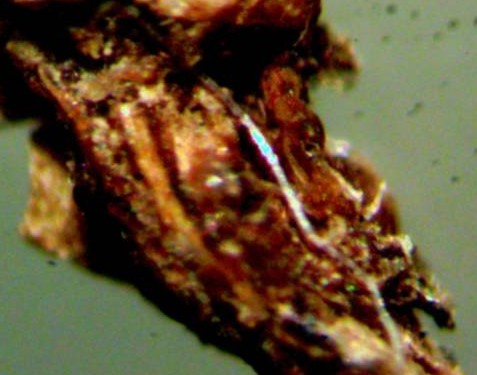

One sees the two 'wicks of twisted flax' very clearly - the Möbius-like forms - and the folded cloth in the 'J' shape (the glyphs have the circle between the two twisted flaxes) as well as the vertical stroke. Could be most of the elements in the glyph series can be spotted - here are outlined the two 'twisted flax' and the jar with handle:


In addition, it is possible that some phonological motivation could be spotted - in the 'Filz/felt' of the first part, the 's-t-p' in the second and the 'yin' in the latter - 'felt-stp-yin' = 'philosopher'? This interpretation is arguably more doubtful, but the diagonal typography could perhaps find some rationale in the transgressing bolt = folded cloth. Wallis Budge gives for 'threshold' = 'sati' the following glyphs:

which could be spotted in the duck-like the leaf in the first photo above.
Column 3 from the right - the 'Götterfrucht' sticker:

The three bowls in a row seem to be used for making a phrase-final 'nw' - hence one can assume that the signs are divided in two phrases - the upper and lower. The owl and the complex sign underneath can be recognized from the theme in the main relief in terms of the divine standing next to the consonant-vocalic structure, reaching a hand towards it:


The structure which goes up and 'through' on the glyph could have its counterpount in the lifted arm of the divine - for the effect found in the presentation of Ramses - the apparent 'papyrus' tube and tract (like a grammophone). One can guess that this served to forward divine messages - that the papyrus could 'talk' with divine messages through the 'hiero-glyphs' - that is, from the divine standing next to the phonological structure composed of 'Consonantal-Vocalic' above and 'Grave-Diffuse' below. The 'strand'-scene is here formalized into three horizontal strokes and five vertical - as for the 5 pieces of 'fruits' held in the hands of Ramses. The owl - is that the divine - or even the 'bird-head' standing next to her?
In sum, this seems to provide for the 'Götter-Frucht' sticker.
I refer also to the article on Palma with the following illustration:


which perhaps can be recognized in the lower 3 x 5 grid on the glyph. I could not find the second topmost glyph (under the eye) in Gardiner but one can guess that it is about the 3+5 = 8 features of some kind.
I have counted 9 occurrences of this 'Götter-Frucht' sticker - most of them probably occurring ex nihilo on my hands but one on a textile bag and maybe one or two or even more may have been on oranges bought in the shop.

On the wavy water glyph underneath there are 10 top angles and 11 under.
I could not find any glyphs for 'glue' or 'sticky' but I found in Gardiner a form for 'attach' (40 MB):

Since this contains both the 'comb' (here with only 7 pins, though, not 8) and the wavy line underneath, it can be assumed that this part of the column of glyphs account for the sticky character of the back side. Could be the number of occurrences vary.
Notice also the 6th column counted from the right:

This contains the same desert hare, double wave-forms plus seated god (or king) and the spadelooking heart+windpipe as the rightmost column - that is for the ROYAL LAND - only the signs and their order are mirrored. On top of the column, though, there are three vertical-shaped signs - which perhaps could associate with the extra three signs on the 'attach' form. The leftmost of them looks, by the way, in its lower part like my orange peeler.
20 september 2024:
I had planned to go for a trip to Szolnok but the floodings of central Europe made me postpone it for a day or two. I arrived to find the way down to the old shed completely overgrown with a wildernis from an old apple tree that had fallen, from bamboos, Don Juan roses and grapevines, and I had to cut my way through it. When I finally could reach the old wooden shed (in which I had put in a new floor of planks some years ago) and opened it for getting the wheelbarrow out, I found a bird's egg in it. It appeared at first a mystery since the egg was big - 5,5 * 4 cm - and it was late september. A hen could not have reached the only possible opening for a bird nearly 3 metres up on the wall, and there was no other opening for a big enough bird.

It may have been a big owl perhaps? Some of them hatch in the late summer or autumn.
Or was it the philosopher's egg?
Before I opened the door, the poem 'Åsbrun' of Hans-Henrik Holm came to my mind - the one I translated for this article:
Beaming
Screening little bosom swarm
wonders rising brittle, warm.
Round the log in younger threshold
sunshine beamed in harder glow
as I little was in measure.
I looked higher up than now.
None among the farming fountains
sembled big or dangerous.
In the pass between the mountains
angels watched the angelus.
'Angelus' is the catholic celebration of the incarnation of Christ - here the moment when the divine spirit took hold in the historic flesh of human reality.
Maybe this could solve the translational problem with the 'farming fountains' - since there is no mention of 'fountains' in the poem - there is only mention of the younger people (older than the poet, though) springing from the surrounding farms - and hence the translation could go
None among the farming peoples
sembled big or dangerous.
In the pass between the nipples
angels watched the angelus.
However, there is no mention of nipples - only mountains - in the poem. I dont know how that looks inside an egg, though. And the poem starts with a bosom so the idea is not very farfetched, as is seen also from my own poem TEQ #248:

See also the parallel text from Luke 21:23 the first part.
References:
Breasted, J.H.: Geschichte Ægyptens. Deutsch von prof.dr.Hermann Ranke. Deutsche Buch-Gemeinschaft, Berlin, Darmstadt, Wien 1964. (The original 'A history of Egypt' is apparently from around 1905 but the illustrations may perhaps be in the german edition only - there appeared earlier editions of the german edition in 1954 and 1957 and maybe a first edition before that).
Gardiner, A.: Egyptian grammar. Oxford 2001. (40 MB)
Grover, J.B.: Giusto de' Menabuoi. 2024.
Grover, J.B.: Palma il Vecchio and a theory of grammar. 2024.
Grover, J.B.: Parmigianino. 2024.
Park, H.M.: From Polyptych to Easel Painting: A Panel from A Dismembered Altarpiece by Giusto De' Menabuoi
Wallis Budge, E.A.: Egyptian hieroglyphic dictionary. A hieroglyphic vocabulary to the theban recension of the book of the dead. Kegan, Trench, Trübner, London 1911. Printed by Adolf Holzhausen, 19-21 Kandlgasse, Vienna. Issued by Book Jungle, PO Box 2226, Champaign, IL 61825. Reprinted by Lightning Source UK Ltd, Milton Keynes UK on 02 December 2010.
© John Bjarne Grover
On the web 15 september 2024
Last updated 20 september 2024




_-_Pala_di_Bardi_3_2022-05-16.jpg)




