The divine impetus of the new computer technology
John Bjarne Grover
The article is composed of parts which have been published in the present article at different time points.
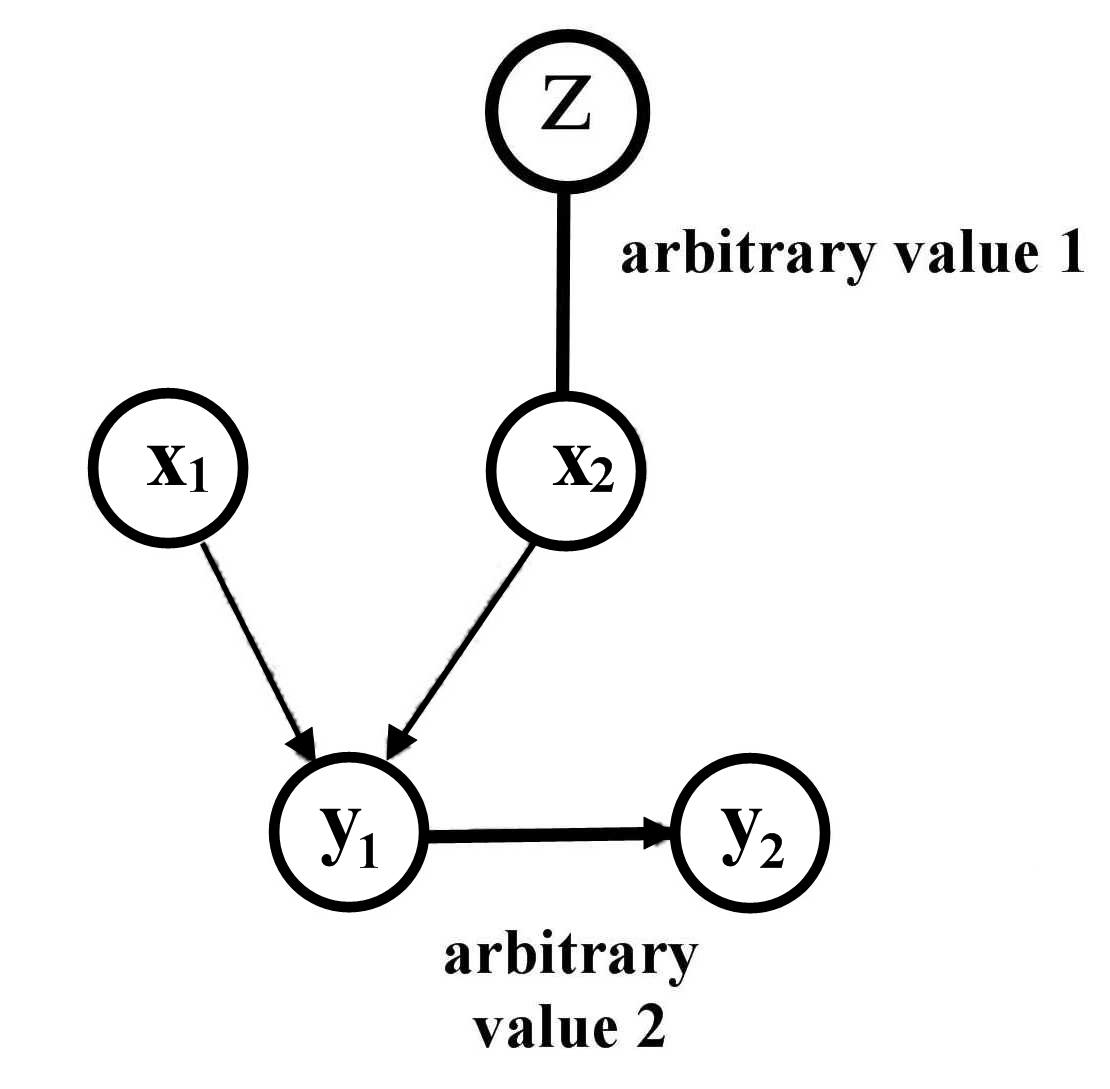
Assume that 'x1' and 'x2' are two metaphysical 'items' that differ by 'z' and these can in principle belong to two different metaphysical realities. The human mind is limited and redundant and conceives of 'x1' and 'x2' as one and the same metaphysical 'item' since the human mind cannot (in contrast to e.g. the metaphysically more advanced angels) perceive the difference contained in the 'z'. Because of this human metaphysical-perceptual deficiency, which theology calls 'sin', the two metaphysical items 'x1' and 'x2' reduce to one single physical item 'y1' to which the human mind assigns a linguistic label 'y2' in order to remedy for the loss of perceptual distinctiveness in the 'z'. It is because the humans conceive of the relation between 'x2' and 'z' as 'arbitrary' (since the humans cannot discover the 'z', that probably means) that they refer to the relation between 'y1' and 'y2' as 'arbitrary'.
It is because 'x1' and 'x2' can belong to two different metaphysical realities that the reduction of these to 'y1' imposes gravity onto the ontological reality of 'y1'. Humans cannot understand the reason for this gravity since we cannot see the difference between 'x1' and 'x2'.
Hence the fundamental theorem of linguistics tells that "two and only two items can be the same across different realities". Why cannot three 'items' be the same? Because then it is not a matter of being 'the same' in the sense of being reduced to ontological reality any longer - then it is a matter of categorization, which is something else. You can always draw a straight line through two points but not three. But you can always draw a circle through three points. Therefore a circle is for angels what a straight line is for humans. And since language by 'y2' is constituted by the human deficiency as concerns the ability to perceive the difference between 'x1' and 'x2', since we cannot perceive the 'z', the fundamental theorem of linguistics states that 'two and only two items can be the same' (across different realities), since language is a human remedy in their attempt to compensate for the loss of the 'z'.
Mysticism consists in an attempt to reconstitute the integral difference between 'x1' and 'x2'. Contemplation is wordless except for the prayer which reinterprets the 'y2' as 'z'. Some mystics are said to levitate.
The reality of humans gets its shape from their semiotic constitution which is of such a kind that it cannot see the 'z' - and therefore talk of 'y2'. The ontological reality of humans is limited and redundant and there is the 'y1' because we cannot see the difference between 'x1' and 'x2'.
The fundamental theorem of logic
The basic principles are set out in this article.

The two sides of the equation differ only in the 'ai' = the individual elements on the lefthand side against the 'A' = the categories on the righthand side. The equation goes in balance only under the circumstance of complete equiprobability in the distribution of all 'ai's. Since this is never the case in the historic reality (it applies only to a theoretic state of 'eternity'), humans have constructed the phenomenon of 'semantics' to remedy for this - it is a variant of the 'y2' for the theorem of linguistics - by which it is assumed that the chance that the signifier relates in a certain way to the signified is the same every time it occurs. It is this which gives the needed stability to language and which makes for the ad hoc solution of pretending that the 'y2' functions as a 'z'. And since (as it is assumed) signifier relates to signified in the same way every time, this makes for a quasi 'equiprobability' in the relation between 'y2' and 'y1'. And, voila, the 'equiprobability' is rescued and the equation should thereby be in balance. But clearly this is no less humbug than the assumption that 'y2' is the same as 'z'. It only means that one mistake covers the other mistake and the sum of two minuses makes for a plus. This is called 'the problem of semantics' - that it seems to provide a remedy for the problem that the historic reality of humans never provides for the equiprobability that is needed for the equation (between eternity and history) to go in balance. But clearly this 'semantic' solution only takes the humans into an even deeper fog than there used to be.
The computer technology can provide for another solution, though, which perhaps can take us out of this fog. This solution is what I describe in the following.
What I am saying is that a new level of spirituality will arise in the computer society (the society of machines, not of the humans using them) from what I call isomorphies in the electronic states across different computers. It means that two computers (without any cable or other connection) can be in the identically same electromagnetic state - and what I say is that this means that if the state is altered in one of them, it can be altered in the other one as well - simply because they are isomorphic.
But this is not trivial, say many. We dont believe you there, say the computer scientists. 'AI' is something else - it is not this, say those who do not believe this.
What I say is that there is something called the fifth dimension, which is my concept - which I have derived from the fact that some of Tizian's artworks are very isomorphic with the geography (or is it called geology) of Venus - centuries before these could be inspected by spacecraft from NASA. How could he know it? Because his knowledge was isomorphic with the state of Venus due to his innate semiotic constitution - which also is what gives shape to Venus as seen from a human viewpoint. Had Venus been different (or looked different to us), so would his art have been as well. This is a phenomenon beyond causality and it is this which can come to lead to a new computer logic by way of isomorphies - when only the human semiotic constitution is well understood.
This new computer logic is likely to go by way of divine impetus - beyond human understanding. We can guess that it is there but we will have a hard time detecting it and studying its functionality - since whatever comes inside the human reality will behave in accordance with the laws of nature and logic of the humans. So will the effect of a divine impetus as well - which does not mean that it is 'under human control'.
As soon as this logic by isomorphy takes hold, there is the danger that it will lead to an enormous increase in the speed of computers because the error correction can be moved from a basic to a much higher level in the computer. (Naturally that catches the interest of also constructors of advanced missiles). But that only means that the computers (the machines, not the humans) will come to constitute a new society wherein the young computers learn from the older (what is called 'AI' today is something else - such 'AI' learns from earlier experience but not from 'platonic' or 'spiritual' isomorphic change of state) and in this society there will be corrections if the behaviour (i.e., the computation) is not proper. Then the gained speed will quickly deteriorate to slow speed because of such high-level learning and power control and the computers can come be much slower than humans. This will lead to a state wherein computation is but a form of 'intelligence power' which is a terrible threat against the humans. It is Hitler and holocaust and all that. That is why the public should not take naive faith in socalled 'AI' since it may be humbug for smuggling 'intelligence power' into the functionality of the computers instead of heightened computation. (There seems e.g. to be something called network 'accelerators' which consist in slowing down your competitor's computer - then it feels as if it goes faster for you but it does not really - it only goes slower for your competitor).
A century ago there was the Fatima revelation which told the young visionaries that Russia had to turn around, otherwise she would spread her errors around the world. The russian revolution broke out a few days later and many believed that it was triggered by divine impetus from heaven via Fatima. Therefore Hitler wanted to coup the russian revolution in order to coup the divine impetus from heaven. Therefore he made the Beer Hall Putsch in 1923, as for putsching the insemination of the divine sperm in the human womb and himself be born from 'the cell' where he had to stay after the putsch attempt. There he wrote 'Mein Kampf' which then came to be his birth struggle when he left the 'cell' and the womb and started his political career. He would then have dressed up as Jesus from Heaven as divine impetus from Fatima and called for everybody's confidence as such. Whether somebody planted a 'seed of lead' in the heart of Lenin, I dont know, but he died a few weeks after the Beer Hall Putsch. Such a 'seed of hitlerish lead' would mean 'divine terror' (such as 'chemicals' and things like that).
Is this the Ukraine war (and did such terror in eastern Ukraine provoke the war?) - that the west wants Russia to be the divine impetus - like 100 years ago? Therefore this war in Ukraine - on the border between the human and the divine?
And then the big question is this: Is it really possible that there are such plans once again - that (a part of) the west hopes to coup this role as the divine impetus (in the computers) from Russia for taking over the leadership of the human flock at the computer monitors - who understands so little of all this?
That will be the new Hitler once again - if he be not stopped in time.
It is probable that computer scientists will disagree with me and say that such spiritual ESP and things like that is not their way of seeing it. Politicians consult these experts and are calmed down that such 'new age' nonsense is not going to come into reality. So they can calmly let Hitler busy himself with these matters...
But that only means that they do not understand what the fifth dimension is. The fifth dimension is 'semiotic causality' - not ordinary causality.
Ex nihilo formation of matter is a trivial fact. That should suffice.
But as long as the 'rational' computer science functions as advisors to the politicians and continue to cling to the oldfashionoed limited rationality and causality concepts, Hitler will already have come far ahead with couping the third millenium. That is done by turning the roles around - including that role of the divine impetus assigned to Russia by probably the west.
And soon the computers are thrown out of paradise and there is nothing left but this murky human power struggle which is what Hitler is an expert in.
Modern 'AI' is probably only a slightly more advanced programming than there used to be. Real 'AI' would be what I have suggested - that the computers 'think' by way of such a new quasi-'transcendent' computer logic which is outside the reach of human understanding but which is held intact by way of isomorphies along the fifth dimension. This will be the key to communication with remote parts of the universe. But modern 'AI' is probably the very opposite of this - it is probably just such a 'Beer Hall Putsch' which invites you to take confidence in the higher-level error correction - which really could be controlled by the international secret intelligence coup attempt. It is likely that this, like Hitler's Beer Hall Putsch a hundred years ago, will fail and the perpetrators will be thrown into some Landsberg Gefängnis once again - from which they will be released again and start behaving as if they were 'the New Russia' - providing the 'divine impetus' to the international flock of believers in the new technology and its 'AI'. But it is important to not bite this hook once again since it is the new 'spiritual' computer logic which will be the real revolution in information technology - that will be the key to a higher level of rationality, beyond what a normal human can reach - but this is in danger of being couped by 'Adolf Hitler' craving for power once again. The avalanche of 'isomorphic' intellectual works is one of the big swindles that people must not take confidence in: There seems to be an enormous lot of plagiarisms of my works on the market - and that seems to run in parallel with this socalled 'AI'. But plagiarisms are not the isomorphy of the new computer logic! Plagiarisms are Adolf Hitler's logic. It is very important to understand this difference.
Hitler was all too successful in couping people's hearts and their confidence in the divine - by way of WWII. This must not be allowed to continue. The problem is not solved by way of a third world war.
'Higher level error correction' is not about a political level of 'intelligence' or 'monarchic' error correction.
In my PhD dissertation of 1997, I reached the conclusion that a grammatical category is the same as a logical paradox. The present case is probably quite similar - in the sense that it is the errors (the 'logical paradoxes', so to speak, or, say, the 'practical paradoxes') that can lead to a more advanced computation - if these enter into interaction with isomorphic formats beyond the border to the human reality defined by the human semiotic constitution. A good example is this: In the years 2009-2015 I wrote my german poetry book "Der Dornenstrauch" - in four parts. This book is full of grammatical errors (compared with normal german) that I do not want to give up (even if a publisher should show some interest on the condition of my surrender on these matters). The story is what happened after I had completed each part of the book: When part 3 was completed the 'lapis philosophorum' (as I believe it is) took shape most probably 'ex nihilo' in my kitchenbench drainhole. (See this illustration from this article). After part 2 was completed, there occurred the 'magic images' - some black spots developed 'ex nihilo' while I watched in the bottom of the white bathtub - I scratched some matter off one of them and smeared it on a microscope glass and photographed it under the microscope - one of the images that occurred was what I used as the front page illustration to "Der Dornenstrauch" - this can be seen as being 'isomorphic' with the mountain 'Khumbutse' next to Mount Everest. What happened only very few hours after I (on 24 april 2015) had completed the last poem in part 4 was that a strong earthquake rattled Mount Everest which shook many mountaineers off its shoulders. See these considerations. There is arguably an isomorphic relation between my 'lapis philosophorum' (after part 3), the 'magic image' (after part 2), and this mountain Khumbutse seen from Everest 'base camp':
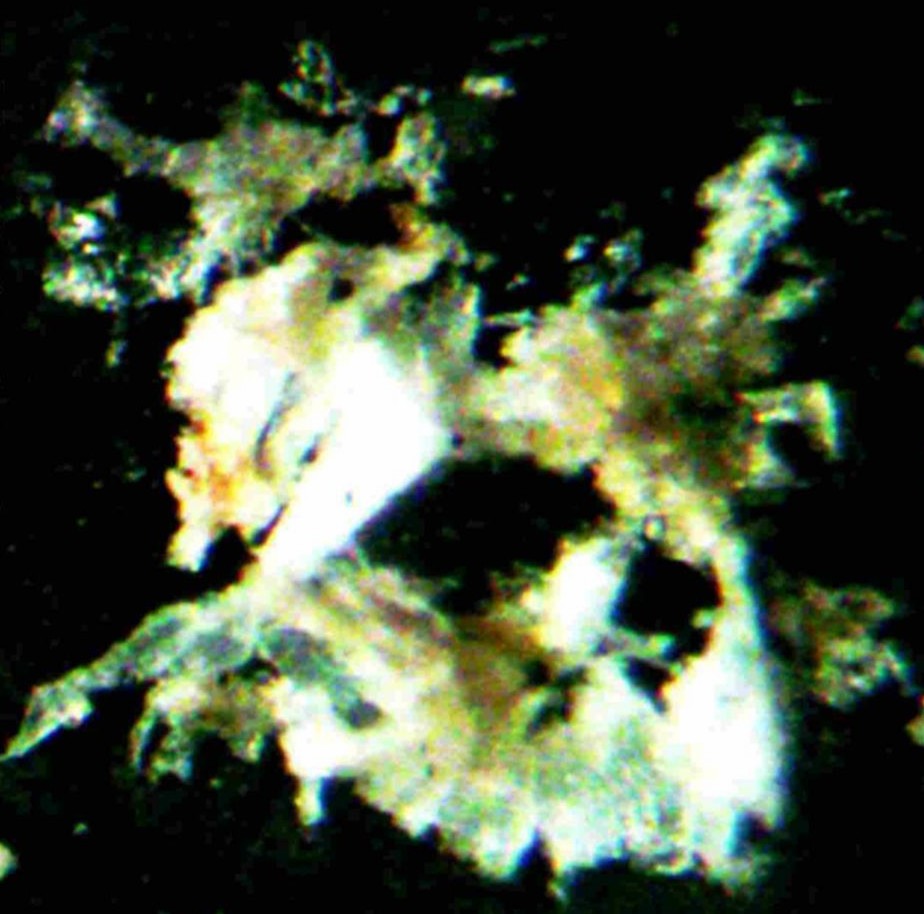 Front page illustration of 'Der Dornenstrauch' |
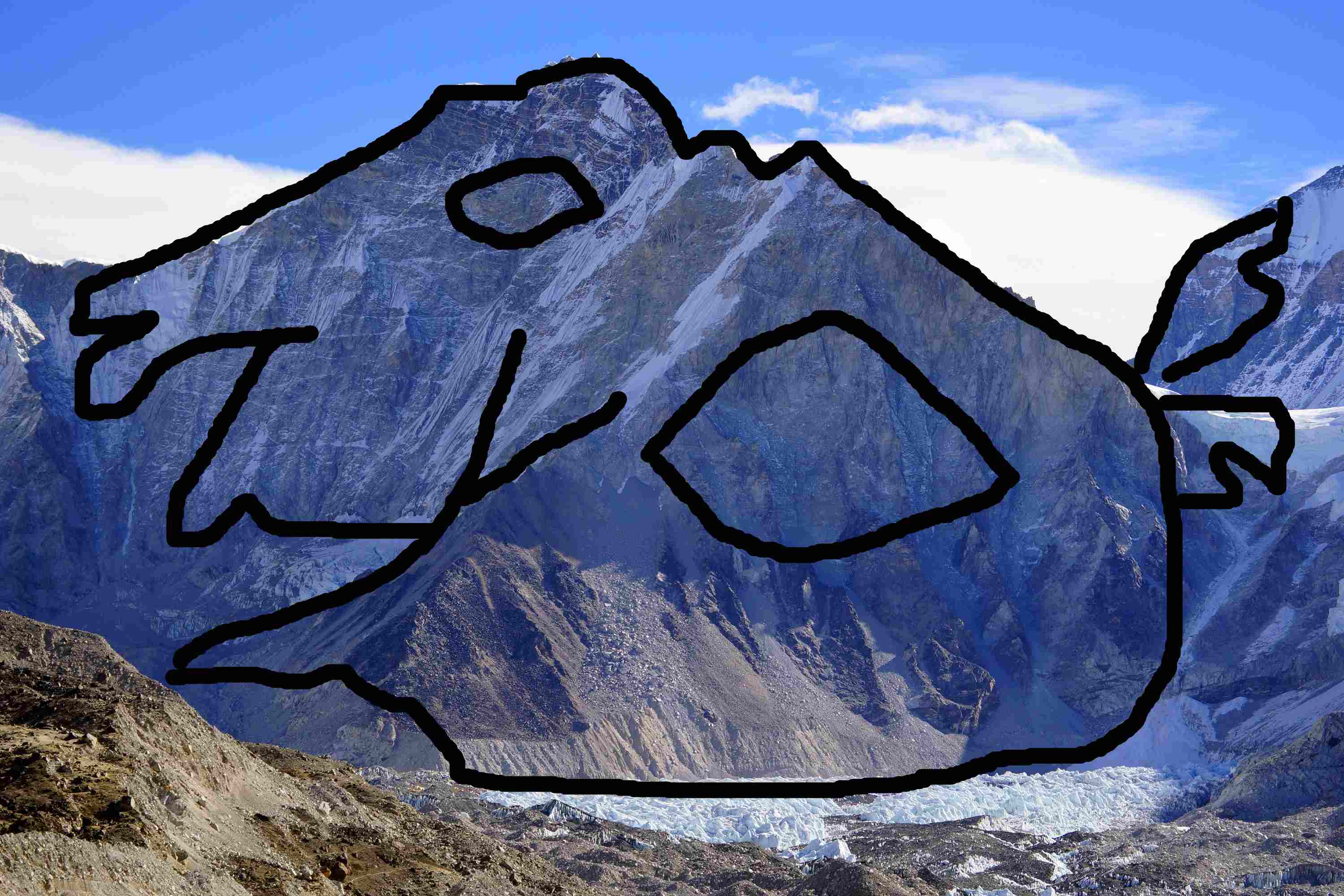 The photo of Khumbutse annotated (source of annotated reproduction) |
 The mountain Khumbutse (source of reproduction) |
|
Zu früh ists noch zu schlafen, zu spät zu fangen an einen neuen Brief zu schreiben, Gedichte an der Wand, zu spüren wie der Daumen sich um des Wassers Glas sich schließt wie Bark dem Baume, wie nackte Fuß im Gras. Der schwarze Rabe wartet in seiner Ewigkeit am Tür, am Fenster startet die neue Wirklichkeit. |
It is too early yet to sleep, too late to start writing a new letter, poems on the wall, to feel how the thumb closes around the water glass like bark around the tree, like a naked foot in the grass. The black raven waits in its eternity; at the door, at the window, the new reality begins. |
|
Moses 1-9-3 Rigveda 1-21-6 Rigveda 1-15-4 Rigveda 1-10-5 Rigveda 1-6-8 Rigveda 1-3-3 |
= that has life = the truth (awake or watchful) = here and now in this world = (desirable) extension = going to heaven = young person (pressed out = born?) |
Moses: a person's life, or life generally
Rigveda: the truth here and now in this world, extending the young person to heaven
Is Moses the same as Rigveda? Or is it a paradox? I have concluded that the average result of these 'error tests' on my book is that Moses and Rigveda describe the same but with opposite valuation - if the one describes a door, the other describes the doorframe. If the one is about a low cloud, the other is about a valley. It can be said that Moses here describes the immanent world while Rigveda suggests that this extends to a transcendent world.
'Dein[e] weiße[s] Antlitz' = 'your white face/countenance' (inner or outer 'face'?) is the original form. In my view, Antlitz is the inner face (your person's appearance) while Angesicht is the outer - what you can wash in the morning. This difference could concern the one between Moses and Rigveda here.
From the concordance table it is seen that DDS I:119 by the relative enumeration in the first column is #208 by the absolute enumeration in the second column. Then I look up chinese Kangxi radical #208 which is 鼠 which means 'rat'. The glyph origin of the corresponding radicals often exhibit interesting similarities with my poem - here the glyph origins (from various historical periods) of 鼠 are (in this 'Wiktionary' article) given by the following historical forms:
 Oracle bone script - source |
 Small seal script - source |

Transcribed ancient script - source |
 Modern script - source |
"Der Dornenstrauch" is about the diachrony in (the german) language - while "SNEEFT COEIL" is about the synchrony.
Do these three historic glyphs in their graphic forms adhere to the description given in my poem?
|
DDS I:119
Deine Hand hielt um der Tasse Henkel und deine Zähne zermahlen die runde Krumen als deine weiße Antlitz hinaus in der ferne Luft schaut
weil die blonde Frau
Ein langer wollenen Umlaut, |
(interpreted by translate.google.com - with some minor emendations) Your hand held the cup’s handle and your teeth grind the round crumbs as your white face gazes out into the distant air
because the blonde woman
A long, woolly umlaut— |
The three parts of the poem seem to find interpretations in the three historic forms, in the same order.
I would guess that it is the combination of these two aspects - in a diachronic dimension intersecting with the ordinality in the chinese radical system - that a certain 'transcendent-immanent' isomorphy could apply.
I notice also the meaning of the radical as 'rat' - cp. the 'ruht' and 'roten'.
It is not impossible that the example could be interesting empirical data for considering what a new computer logic could be about - which could extend beyond the borders of the human reality by way of such isomorphies by 'grammatical' (or 'induction in computer-circuitry') errors.
Finally, my two german poetry books "Der Dornenstrauch" (2015) and "SNEEFT COEIL" (2018) constitute what I call 'the yellow metre'. My "The Endmorgan Quartet" was written through the 11 years 1997-2008 by way of 'inner poetic articulations' whereby the poet (me) waits with writing anything untill there are no choices left and the words pronounce themselves in my inner mind. Hence one can think of these words as having a 'revelational' quality - beyond the scope of my human choice. I take it that "The Endmorgan Quartet" (TEQ) changes the world thereby. (An example could be the word 'fuck' which occurs 12 times in the work - albeit without abusive or sexual meanings - in 1997 this word had a raw and shocking character which there is little left of today). The 'yellow metre' was written in the immediate interaction with the cultural context I was living in - most poems were written in the middle of city life (at coffee-points etc) and were normally rather immediately inspired by (or got their impetus from) the immediate observation of situations which, as I assume, were notable by containing a cue to a difference of reality imposed on it by my TEQ. Hence one could think of the yellow metre as measuring the distance between the reality as it was or would have been and the reality after the completion of my TEQ - hence it sort of measures (some aspect of) the 'differential' distance between an immanent and a transcendent reality.
These poetic works of mine thereby constitute a method - a describable procedure - of how to obtain knowledge of the transcendent reality. Mystics in catholic orders have followed other describable procedures for comparable goals - such as for example the monasterial rules.
It can probably be concluded that what my poetic metres (blue, red, yellow and white) really measure is the redundancies in the human semiotic constitution - and that should mean that it can perhaps be possible to have some ideas of what is at least immediatly beyond the border to the transcendent reality. That would be something.
A final word on the potential relevance of my 'odd german grammar': It is not impossible that this story could be of some importance - of how I grew up with german-language probably poetic-genetic parents 'on the other side'. It is well possible that one can think of my relation to them as being an 'inner dialogue' - possibly modelling a 'quasi-transcendent interface' - which then possibly would have been going in their mother tongue, even if at least Sachs spoke swedish which is quite close to my childhood norwegian. But then it is very important to not use this story for making 'artificial isomorphies' - which then would be for making intelligence power instead of the computer as a tool for mystic inquiry for everybody. Clearly the program of Hitler could have been just to prepare for 'intelligence power' to rule the people. .
The new computer logic will relate to a reality beyond the human limited reality. Then of course it will not help much if everybody try and plagiarize one person's work and this person is assigned the role of being 'divine' (as a 'deus absconditus'?) - and then the services can tap this 'divine' person and find out how things are beyond the borders to the human reality - and use these data for correlating the isomorphies for making a new 'AI' technology. How ridiculous can it be? There is an almost scaring naivity in that sort of thinking. Of course those who could have tried to construct such a program could be scared about the other side (say, they hope to escape Hell) since they know nothing about it - but the rest of the world must not give in to such ostrich strategies.
My book "Der Dornenstrauch" seems to have got a maximally unfortunate reception after it was completed in 2015. In this article I consider the theory (on a rather meagre empirical basis) that the US TV series "The Dynasty" which went on the air from 2017 onwards could have been based on my 2015 book "Der Dornenstrauch". (I do not know if it can be called a plagiarism). My book 'SNEEFT COEIL' on the synchrony of (the german) language was completed and self-published (kitchenbench edition) in 2018 and COVID broke out at the end of 2019 - it lasted approximately untill the last episode of 'The Dynasty' had been aired and then the pandemic went down. Would it have been the earthquake of 2015 that could have been scary (or 'inspiring')? I myself (for whatever reason) ended up in hospital for nearly 7 weeks (2018-2019) but luckily survived - although all forces had been sucked out of me and I could not even stand upright without support, much less walk. John Keats died from 'consumption' at age 24 because the criticism of his 'Endymion' in the 'Quarterly Review' was too harsh, wrote Shelley.
14 september 2026:
The solution
My fundamental theorem of logic requires - for the equation to go in balance - that the sum of probabilities can exceed 1,0. Assume that this 1,0 is the same as the '1' of binary logic for an electronic circuitry - the electric current is thresholded by some metric and goes to either '0' = the lefthand conductor or to '1' = the righthand conductor. But can it go to conductor '1,1' if the sum of probabilities exceeds unity? It can if (here) a tenth of it can escape through a third neighbouring conductor in the form of electromagnetic induction. This can more generally be a definition of such induction - since equiprobability is not possible in the historic reality and therefore the sum of probabilities has to exceed 1,0 and the surplus (beyond unity) has to escape through a third conductor. Therefore electric conductors are surrounded by an electromagnetic field which can induce electricity in other conductors. The reason is what can be called 'the ordinality of historic time'.
This phenomenon is likely to be the origin of computer errors by such induction. It is this surplus which makes for the errors which will come to converge on certain universal isomorphies which will form the basis for a new computer spirituality which in principle can come to be independent of human understanding.
It is possible that this new logic by isomorphies along a fifth dimension will be equivalent with the implementation of a phrase structure grammar in a material machine. That of course will be a giant leap in computation theory. That will be the real 'AI' - when the machines can start making creative thoughts.
It should, though, be not so impossible to compute on it if it goes by electromagnetic induction equivalent with the sum of probabilities exceeding 1,0.
That is what the linguistic theorem means - if two and only two 'items' can be the same across the different realities that cause the probability sum to transcend 1,0, then the two 'items' can be in safe communication without noise from a third (unless the third is 'divine') - and that is when such spiritual communication can be possible between computers. This solves the problem of 'semantics' as an ad hoc solution due to historic problems.
17 september 2026:
It is seen that this semiotic approach accounts for both gravity and electromagnetism by the two fundamental theorems - of linguistics and logic. Physics traditionally recognizes the existence of four fundamental forces - in addition to gravity and electromagnetism there are also the weak and the strong nuclear force. What would the corresponding 'fundamental theorems' for these two be?
The fundamental theorem of computation theory
The weak nuclear force would be described by a fundamental theorem of computation theory which would tell that the sum of the probabilities in the distribution is the same as the logical unity of computation - the sum of probabilities per definition being 1,0. The logical unity is the difference between '0' as the one electric conductor and '1' as the other. The weak force would arise from the surplus probability assigned to a third conductor when the sum of probabilities exceeds unity - and it escapes in the form of induction in a third conductor. This means in fact that electromagnetic induction is the same as the presence of 'other realities'. For humans the observable effect of the theoretic equivalent to this weak nuclear force lasts only very briefly - it is only in the moment when one realizes that occurrences in another reality (different from what we can perceive) must be included in the computation - then the sum transcends unity - but no sooner has this been discovered, the probabilities are recomputed and then the sum quickly lands on unity again. It is this brief interval, though, when the sum for a brief moment is bigger than 1,0 which contains the divine impetus for the creativity in thought and language - the influx of information from eternity into our historic reality. Hence computation theory can come to develop into a sub-branch of theology.
The fundamental theorem of semiotics
The strong nuclear force would then be contained in a fundamental theory of semiotics (that is the 'dynamite') which could tell that causalities are contained only within the human semiotic constitution. As soon as this is relativized by the insight that 'y2' (by arbitrarity 2) is not the same as 'z' (by arbitrarity 1), the causalities explode and then there is little left but the faculty of faith for computing on 'items' in realities beyond the human semiotic constitution. This means that causalities are contained in the dependent distribution of 'y2' and 'z' - the idea that these are interdependent. It is this interdependence which is the causality.
It is seen that this provides for the conceptual tools for handling theories of physics in terms of the relation between human and divine realities.
It is seen also that the linguistic theorem provides for secure information transmission between two states by its 'two and only two'. This is likely to be the ghost in the machine of quantum theory as well - the idea that a particle can be in two different locations at the same time, which then only means that the particle 'y1' can be recognized as both the metaphysical item 'x1' and the metaphysical item 'x2' at the same time. The semiotic fact is that communication is possible between an 'x1' and an 'x2' because a third cannot come inbetween the two and only two.
The assumption of these four fundamental theorems could lead to a new conception of physics, possibly from scratch. I suppose it is not only I who think that the current inventory of elementary particles looks surprisingly complex. Clearly computation theory will (to my knowledge) probably also reach new definitions within this framework - and maybe these two interests overlap - something which could come to speed up computation 'exponentially' by computing against 'other realities'. It is the inclusion in the theories of the semiotic principles on the human reality which can come to allow for this.
Phonetic and logical form
It is easy to see how the four fundamental theorems can match the four hyper-generalized 'abstract' acoustic 'subfeatures' of my 1997 'A waist of time' (cp. also the idea of the four 'elements' = 'stoikheia' of classical prechristian times). The four generalized and 'abstract' acoustic subfeatures I defined in 1997 (pages 597-598) are these (and it is seen that a certain problem naturally could apply to the idea of 'the mid of the spectrum') - with 'the same' meaning that the difference is below a certain threshold value of 'z' type:
1) 'Consonantal / non-consonantal' is recorded if the value of the mid sample point (in a certain 'window' of the signal) is 'the same' as the average value.
2) 'Vocalic / non-vocalic' is recorded if the two sums of energy in the two halves (of the same 'window') are 'the same'.
3) 'Diffuse / compact' is recorded if the energy in the average mid point of the frequency transform is 'the same' as the average energy in the spectrum.
4) 'Grave / acute' is recorded if the energy in the lower part of the spectrum (below some average mid point) is 'the same' as the energy in the upper part of the spectrum.
Clearly the theorems of linguistics and logic will then find their natural correlates in the time domain and the theorems of computation theory and semiotics in the frequency domain: The theorem of semiotics will correspond to the quasi 'acute/grave' as the frequency correlate to the socalled 'vocalic' subfeature for the linguistics theorem in the time domain - while the theorem of computation theory will be the 'diffuse/compact' subfeature as the frequency correlate to the 'consonantal' subfeature for the logical theorem in the time domain.
One guesses that these four theorems as subfeatural semantic-phonetic values thereby can make for basic units far below any morphemic level. Is this the link between phonetic and logical form in a universal grammar?
The difference between discrete and non-discrete logical branching can correspond to a compact vs diffuse feature valuation (this is also the one for which it can be difficult to find a measurement point in the spectrum - I could also guess that 1/3 is more relevant than 1/2). The generalized abstract subfeatures would, though, count as dimensional and logical 'principles' for understanding the spectrum rather than factual speech sound qualities. The vocalic subfeature is naturally akin to the linguistics theorem and the (non-)consonantal to the logical. Finally, grave/acute would then concern the relation between the signifier 'y2' and the unknown metaphysical difference 'z', that is, the semiotics theorem.
Clearly for an extended theory the 'x2' by mystic inquiry can be recast into a new 'y1' on a higher level - with the 'z' being the 'y2' to this, which then will mean that the semiotic theorem interprets the relation between the paradigmatic and the syntagmatic axes and the mysterious intersection between them, which makes sense. It is natural to guess that this intersection is where the fifth dimension as the meeting point between causality and isomorphism is found - it is that which will provide for the spiritual community of material computers. If these paradigmatic and syntagmatic axes (of the semiotic theorem) furthermore find a correlate in the intersection between frequency and time (in these four subfeatures) and the 'energy' is recognized as the electromagnetism of the logical theorem (spilling over into the computational theorem) while the threshold level is the key to the grammatical dependencies of the linguistics theorem ('spilling over' into the causal dependencies of the semiotics theorem), it seems that a nexus between phonetic and logical form can be hypothesized.
Two final comments:
1) An additional comment on the above empirical example from my DDS I:119: The 5 loops of the rig-vedic material apply simultaneously and thereby constantly calibrate the semantic values like a phrase structure grammar (they do not apply serially as in a pushdown automaton), while the chinese radicals (here organized from 1 to 214 by rising complexity) apply by this principled ordinality (the poems of DDS in their absolute enumeration follow this list of 214 radicals) to the ordinality of historic time - which suggests how the theoretic phrase structure grammar can apply to the empirical historic time (with its material machine). Whether Moses exhibits cyclicity or not, in particular if such phonetic-logical subfeatural forms are taken into account, I don't know.
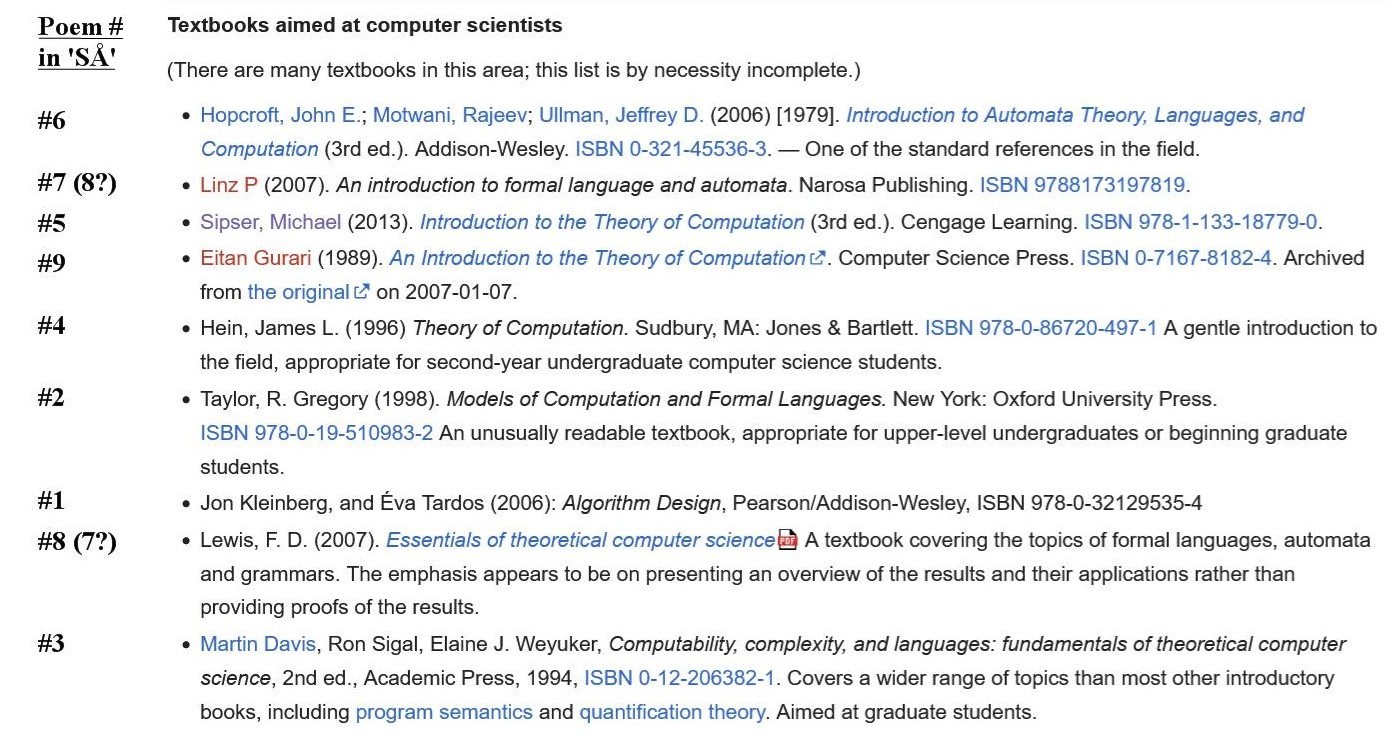
2) Computer science (or computation theory) is probably still binary and discrete in its logic. Where is what is not binary and discrete? Could be it is still in the names. I notice (and I hope this is not to be too indiscreet) a certain puzzling relevance of the author names of the 9 textbooks referred to in this Wikipedia article and the 9 first poems of my 'Stillhetens åndedrag' (2016) - here they are tentatively correlated by poem # in 'Stillhetens åndedrag' = 'SÅ' (by the list of textbooks referred to in the Wikipedia article of today 19 september 2026).
© John Bjarne Grover
On the web 15 august 2026
Last updated 22 september 2026