The image is a detail from this image from this source
13 june 2025
John Bjarne Grover
TEQ #630, Exodus 18:9, tomb images of Senbi and Tutankhamon
The article interprets my The Endmorgan Quartet poem #460 in light of its parallel text from Exodus 18:9 and images from the tombs of Senbi in Meir and Tutankhamon. It provides an account of how a new level of matching of left- and righthand parentheses can develop within the linguistic competence.
TEQ #630
Exodus 18:9
ויחד יתרו על כל-הטובה אשר-עשה יהוה לישראל אשר הצילו מיד מצרים
It is still somewhere in this world -
how my culture relates English or Scandinavian One
since it had been the maculation of Nicholas Ship.
England grew up through histories,
juvenile delinquencies,
and, later, many of the major.
But I'm gripping forward.
Baniregerem
TEQ #630 is from The Endmorgan Quartet book 10 ('A deep ratch'). The poem is written on 10 february 2000. I discuss it in comparison with its parallel text from Exodus and from the viewpoint of ancient egyptian art.
The hebrew of Exodus 18:9 interpreted:
ויחד = יחד = union, be united, be one
יתרו = יתר = remain, be left; תור = to go around/about, to spy/search out, turn/order etc; turtle-dove
על = על = above, upon, over, the Most High; yoke, servitude
כל = כל = measure, contain, sustain; כלל → the whole
הטובה = טוב = to be good, well, pleasant
אשר = אשר = bind; go straight on; rel.pron.
עשה = עשה = to work, fabricate etc
יהוה = יהוה = the most sacred name of God, IHWH from הוה = HUH
לישראל = towards + שרה = to contend, wrestle; to loose, set free
אשר = אשר bind; go straight on; rel.pron.
הצילו = נצל = to strip off, take away; deliverance
מיד = מיד = to move, shake
מצרים = מצרים = Egypt, border
This suggests that it be possible to construct a tentative interpretation along the following lines:
|
Exodus 18:9 interpreted To be one (unity) remains above all to measure the good dependency, to make the most sacred name of God towards/for setting free the dependent deliverance moving (out of? across?) Egypt |
TEQ #630 It is still somewhere in this world - how my culture relates English or Scandinavian One since it had been the maculation of Nicholas Ship. England grew up through histories, juvenile delinquencies, and, later, many of the major. But I'm gripping forward. |
The poem interprets the righthand part of the rock carving from Meir (from a time probably around 1900-2000 BC):
The image is a detail from this image from this source
As described in this file, there is a relation between the stripes on the rod which 'Senbi' is reaching for among the hieroglyphs on the wall and the legs of the fox climbing up in the 'sunflower matrix' between the two boats. As is seen, even the boat he stands on has these stripes, for which reason one could make sense out of the 'Nicholas Ship' as inherently related to the 'maculations' on the hieroglyphic rod.
The female in front of Senbi is much smaller - like 'juvenile' - and she holds a bird in her one hand and possibly a menat or a papyrus plant in the other. This object could perhaps be associated with a 'de-link-uency'.
It is the hieroglyphs on the rock carving just above the small female and in front of 'Senbi' that attracts interest here - compared with the signature 'Baniregerem' to the poem:


'Bani-rege-rem' can be conceived in terms of the following hebrew (the 'reg' is not in the dictionary):
בני = built up +
רך = young / רע = friend/lover +
רם/רום = high
= 'built up young/friend/lover high'
which could suggest that the young and tender short female (= 'juvenile') in the front of the boat is interpreted in the 'built up' tall friend behind her who is reaching for the object.
Now these three hieroglyphs can be tested against my poem qua interpretation of the egyptian image: Among these three, the symbol to the right is the 'folded cloth'. The other two are used in expressions for 'love' or 'lover', as in the רע = friend/lover of 'Bani-rege-rem' - here from Gardiner's Egyptian grammar p.516:

Here the word for 'love' ('mri') is made of a hoe, a mouth and a man sitting with hand to his mouth, used in ancient egyptian expressions as determiner for eating and drinking. But this is not the same as the 'folded cloth' on the wall of Meir.
It happened when I took this photo - the bottom had fallen out of a wastebin in downtown Vienna - that I understood that it was highly 'magic': I had seen this very clearly for my inner view the evening before and when I saw it I immediately understood that it was this I had seen the day before. I also understood then that it was about the ancient egyptian hieroglyph called 'folded cloth' (often identified as a variant of 'bolt') - with phonological value 's'. What is interesting here is that the apparent female on this photo is lifting her hand up (gripping forwards, though) reaching for the object (like 'Senbi' on the egyptian wall): This is the hieroglyph seen closest to him on the wall, right under his forearm. The dog seen to the left is the 'friend'.
Hence the difference between the sitting man and this 'folded cloth' - if this intuition of mine were relevant - could be that the folded cloth could be about an aspect of sexuality which makes it different from 'love' or 'lover'. Why was the eating and drinking of the hieroglyph turned into a folded cloth? Could be because it is in #2 the name of Senbi's wife 'Meres' = 'M-R-S' (detail - source of image). That the upper left part of this probably is woman, wife (source) seems likely for this excerpt #1 (detail): There is also a viper sign which can be compared with this excerpt from Wallis Budge p.433. Since the latter seems to indicate presence of water, a pool or whatever, and since 'M-R-S' is posited right above the character assumed to be 'Meres' the wife of Senbi, it is natural to guess that excerpt #1 (detail) could be telling of the front of the boat under Meres and Senbi: This is where the papyrus boat curls up in the front. By Gardiner, this sign group #1 (detail) - assumed to designate the front of the boat - could be recognized as an ideogram when including the loaf - or a single sign for 'every, all' (source Gardiner p.525). Furthermore, by Gardiner p.465, the socalled 'backbone' sign in sign group #1 (detail) seems to be associated with the idea of 'venerated state'. Hence one could speculate that the 'venerated' curl of the front of the boat could be the ideogrammatic reference associated with water in the upper sign group. But this could be just the 'Nicholas Ship' of my poem - the old father with his bowing of the head = (norw.) 'nikk' to his daughter - cp. also the alleged 'spinal cord' bending out from the backbones of the sign - and then there are the stripes across this papyrus ship that correlate with the 'maculation' stripes on the rod in the hand of Senbi - the 'hieroglyphic' rod the semantics of which he is just about to detach from the wall for aligning the logic with the linguistics.
For the sign group #2 (detail), which shows a 'granite bowl' (source) in the upper part and a viper (source) in the lower, one can refer to Gardiner for the idea that the granite bowl (via the Old Kingdom variant and this Wallis Budge excerpt - source) could associate with the idea of 'proclamation' combined with the 'father' associations to the viper sign, one could guess on this group as something like 'venerated father proclaiming' his daughter Meres the wife of Senbi. Since Senbi is just about to wriggle some semantics off the wall, one could see in this the line "England grew up through histories" in my poem. Cp also the signature with the 'Bani-' = 'built up', here for 'grew up'. There could perhaps have been some 'semantics', but Senbi is gripping forwards.
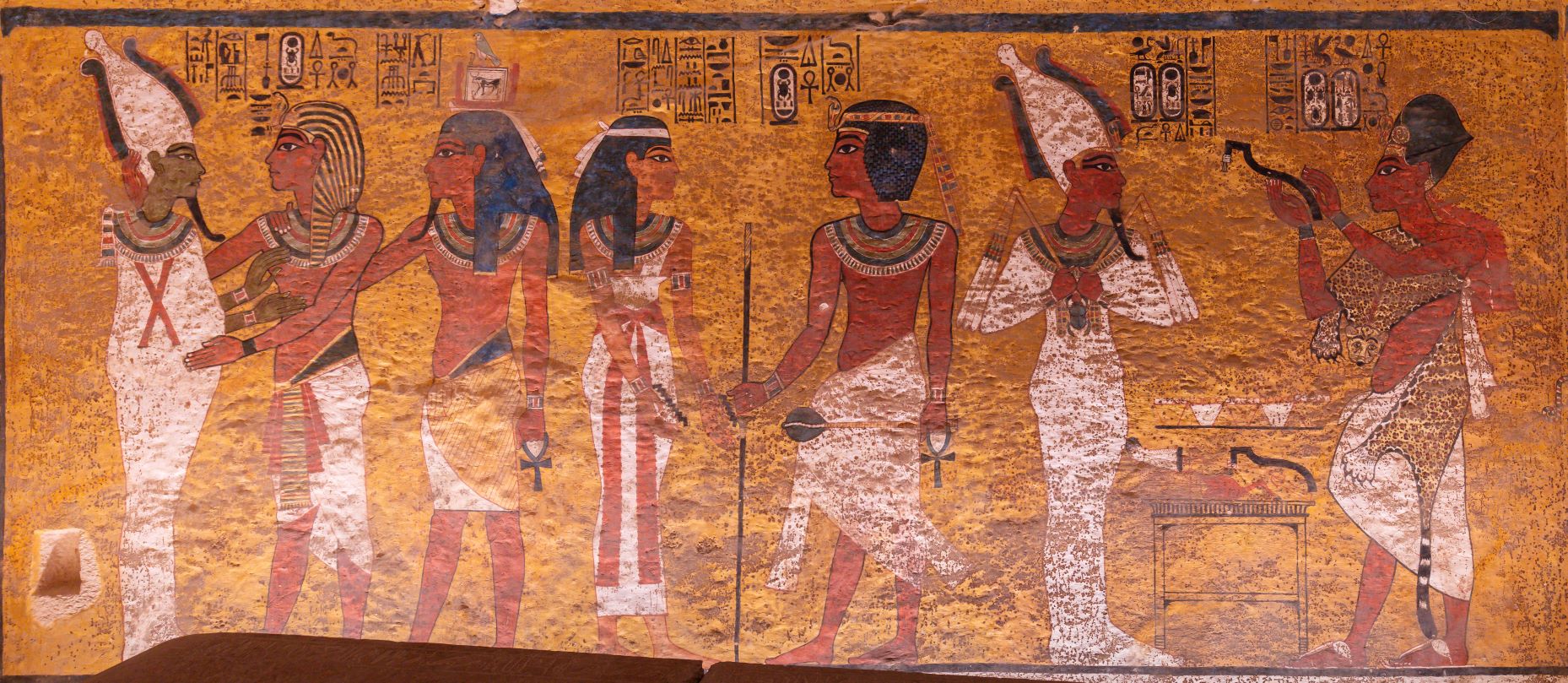
My translation of Exodus 18:9 can in fact also be used for interpreting the main image at the sarcophagus of Tuthankhamon - hence my poem and Exodus 18:9 relate like Senbi and Meres relate to Tutankhamon:
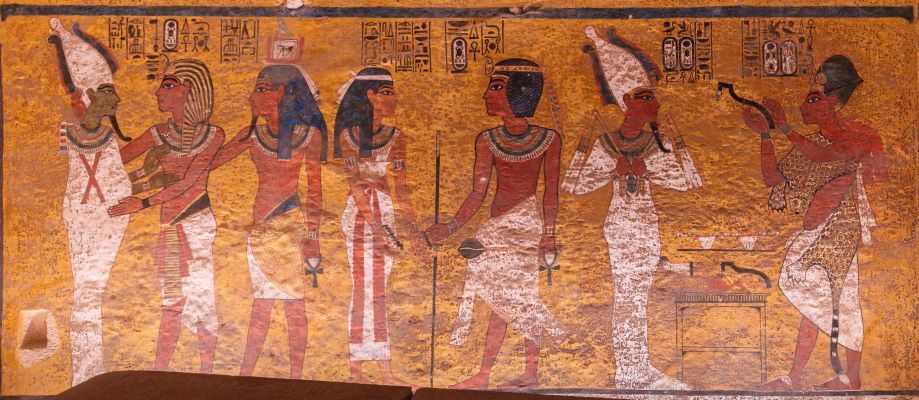
Better resolution here - source of the image - found in this article
Here it seems that Tutankhamon exits from life to the right and resurrects for new life to the left - and the secret for this mystic transform is the socalled 'Catalan number' which is contained in the symbolic curve held between the hands of the priestess to the right as well as in the (90 degrees turned) integral shown down left - see these articles on the phenomenon as well as this article about how the Catalan constant could have been the secret of a theoretic assassination of Lenin in 1924 - not so long after this tomb of Tutankhamon allegedly was first opened. It would have been the transit from the old to the new life that made for the possibility of the 'historic discontinuity' that could have been the secret in how they could manage to build the huge pyramids.
My translation of Exodus 18:9 tells something similar as seen in the Tutankhamon image - by way of the role of the 'non-euclidean' logic of Aristotle when the sum of probabilities can differ from unity, the one. Jesus Christ is the christian interpretation of this - when he is both human and divine he is both substances at the same time and hence the sum of probabilities will not be unity. Could it be the Catalan number G = 0,91596...? It is noteworthy that 1 - 1/12 = 0,91666... - hence his 12 disciples. It is well possible that this is the nature of this mystery constant - which then will have something to do with 'the most sacred name of God'. If one assumes that the book of Moses was written by Moses, it would perhaps have been about the time of Tutankhamon - and hence it is of course very likely that the jews, fleeing from the egyptians after some decades, would have known much about these things. (Moses even had a relevant start on is own life, possibly even some juvenile delinquency). Cp. also the idea of הוה = eternal Self-existence for the idea of eternal recurrence.
Clearly the resurrection of Tutankhamon would find its close correlate in the theme of Senbi and the 'sunflower matrix' (as I call it - 'fishing and fowling' seems to be a standard term among egyptologists - Ferguson 2012). The mystery rod which 'Senbi' holds in his hand could associate with the quasi 'Catalan curve' which the priestess holds between her hands - and which has a copy underneath, reminiscent of the identity in semantics between the fundamental theorems of logic (to the right) and linguistics (to the left) of the sunflower matrix. The essential 90 degrees turning (see this file) is seen in the form of the vertical rod held in the near middle relative to the horizontal line to the right on which 2+3 = 5 cups seem to stand (with extension also in the horizontal rod which the man holds in his other hand). The woman to the left of the vertical rod has wavy lines on her palms - meaning 'water' in egyptian. These diagonal wavy lines would correspond approximately to the diagonal fox in the sunflower matrix. (For ideas about the modern political cult, see this comment on the Gaza war - here for the 'Scandinavian One'). The horizontal line with the 2+3 = 5 cups would correspond to the diagonal spear with the two fish of Meir, and hence with the corresponding mirrored diagonal (cp. also the 'X' on the leftmost character) between Senbi's rod and the three ducklings in his other hand.
The difference is that the priestess to the right does not hold her arm and hand backwards but both of them are holding the 'Catalan curve'. She is gripping forward. The 'linguistics' of this should be that although it looks perhaps dark after this semantic slippery slope (she is also dressed in a leopard skin), there is rescue ahead when one comes up to the linguistic solution on the other side. The slippery slope is the humbug of the semantic solution for the fundamental theorem of logic - as soon as one comes up on the linguistic side the semantics is less dubious - although it still is a result of the limitations of the human mind. The move from the right of the Tutankhamon image to the resurrection on its left could also be seen as a reading through Exodus 18:9 from beginning to end.
The conclusion seems to be that my poem (2000 AD) relates to Exodus 18:9 (appr. 1230 BC?) like Senbi (appr. 2000 BC) relates to Tutankhamon (appr. 1330 BC). It would be interesting to find that there could be 4000 years between my poem and the rock tomb of Senbi.
According to my observation in my article on Aristotle, it could conjecturally take 4000 years to make a 'chomsky hook'. What is that 'chomsky hook'? It is that which converts a pushdown automaton into a context-free phrase structure grammar. The opening lines to Wolfgang Hildesheimer's 1986 book "Mitteilungen an Max über den Stand der Dinge" goes:
"Wieder ist, wie Du, lieber Max, wahrscheinlich bereits festgestellt hast, ein Jahr vergangen, und ich weiß nicht, ob es Dir so geht wie mir: allmählich wird mir dieser ewigwährende Zyklus ein wenig leid, wozu verschiedene Faktoren, deren Urheber ich in diesem Zusammenhang, um mich keinen Unannehmlichkeiten, deren Folgen, die in Kauf zu nehmen ich, der ich gern Frieden halte, gezwungen wäre, nicht absehbar wären, auszusetzen, nicht nennen möchte, beitragen"
While the lefthand parentheses are printed out, the righthand ones have to be stored somewhere. Any practical natural language allows of course for only very few such pairs before clarity is lost, but there is agreement among linguists that there exists an intuition which matches one lefthand parenthesis with a righthand one even if they are not 'stored on a stack', so to speak. This is mainly a theoretic matter but it is assumed that there exists such a capacity in the human language faculty. The ability to match such pairs without storing them on a practical finite stack would be the 'Chomsky hook' of the context-free phrase structure grammar, in contrast to the pushdown automaton which stores all the righthand parentheses while the lefthands are printout out ('pronounced'), after which the righthands are printed out in reverse order. The phenomenon resembles a logical paradox. What would it mean that it can take 4000 years to develop a 'Chomsky hook' on a new level of language?
The example of the rock carving of Meir matched against my poem could tell what it would be. The 'english or scandinavian One' could be the two 'maculations' on the righthand side - the rod and the boat which are inherently related. When the 'juvenile' as well as 'major' delinquencies here probably refer to the 'semantics' on the righthand (logical) side which necessarily has to (or should) be 'the same' as the semantics on the lefthand (linguistic) side, the two maculations on the right are the same as the two fish on the left. (Cp. also the story of Jesus with the 2 fish and 5 loaves).
Wherefrom comes then the intuition that a righthand parenthesis is matched with a lefthand one - without being stored during the printout/pronounciation? It would come from Tutankhamon's travel through the death on the righthand side for a resurrection on the lefthand side - in such a format that the lefthand resurrected one is the same as the righthand dead one - they are 'the same' and therefore the one knowledge is the same as the other: Then you dont have to store the righthand parentheses while doing the lefthands. This corresponds to the hebrew of Exodus 18:9 for the same lines - with the most sacred name of God (IHWH) being in the travel of the dead Tutankhamon from the right to the left. One notices the peculiar role of the signature 'Baniregerem' when 'BNI' often means 'son of' - in which case it could look like 'son of John Glover high'. It should of course not be misunderstood in the sense of the most sacred name of God - or even the very opposite. These things would be about development of grammatical levels and information technology - in which case certain assumptions about new connections between things can be postulated, although this should not be taken to a conflation of divine and human characters.
It may be that the essential difference between Meir and Tutankhamon is that 'Senbi' of Meir holds his one hand backwards and the other forwards while the priestess of Tutankhamon holds both hands forwards. This could be my line 'but I'm gripping forward'. Her hands contain the hieroglyph called 'adze' (source) which allegedly is a small axe for 'dressing wood'. I have guessed that the small graph down left on the Tutankhamon image is supposed to be the Catalan constant in the form of the integral from 0 to 1 of the curve actan x divided with x. This socalled 'adze' is, as is my guess, a part of an ancient egyptian mathematics for computing the voyage to the resurrection in history - could be in the form of the human reality contained in the Catalan graph down left.
Assume that the tomb of Meir tells of a transform of semantics from right (where it is logical humbug) to the left (where it is meant to be not linguistic humbug) - on this way it passes through the 'sunflower matrix' of historic discontinuity. In Tutankhamon's image that means the two middle characters which is a man with a spear = the lefthand character with a woman with two palms = fish in water = the wavy hieroglyph. Her two hands are the equivalent to the two fish - and when human mind conflates the two, that is to make it 'lens'-formed and hence the four fingers look different of size. This difference would give rise to the semantics. Her two hands would be the two fish just above the shoulder of the man in the 90 degrees turn onto the sunflower matrix (see this study) - and that explains the lifted sea - it is the wavy lines of Tutankhamon's woman's hands - seen in the sunflower matrix at the bottom. Hence the sea is lifted by the symbolism in her two hands - like it was lifted when the jews crossed the Red Sea - a transition which could have resembled the one of Tutankhamon from death to resurrection. The sunflower matrix has a symbolic bottom. In my poem this is the line 'England grew up through histories' - which is that lifted sea level - the England which 'grew up' when Tut is returning to the historic reality. The story of the jews walking across the Red Sea will here mean that they walk through the sunflower matrix and that is what makes for a unity between the left and the right parentheses - which, tells the hypothesis, it takes 4000 years to make. That is between Meir and my poem
Here is another ancient egyptian tomb wall on the same theme - only left and right are turned around:
It is this image from the tomb of Menna. It is seen that the raised water around the 2 fish is the same as in the tomb of Senbi, the sunflower matrix above them likewise, it contains a diagonally climbing animal and there are rods between the birds. There are nests among the birds, suggesting perhaps 'nesting loops'. The character to the left holds 2 birds in his hand while the other hand is reaching backwards with a lifted rod, the small person in front of him holds 3 ducklings. Before the man on the right there is, just as for Senbi, a smaller person standing with bird and papyrus in his hands.
It suggests that on this image, from appr. 1400–1352 B.C., which is more than 600 years after Senbi of Meir, the fundamental theorem of logic is to the left and the linguistics is to the right. It is likely that this depicts the same scene of lifting sea water as when the israelites went through the Red Sea: They went through what I call 'the sunflower matrix', led by IHWH. It is interesting to notice the relevance of the tetragrammaton pasted over the sunflower matrix - or maybe even more relevant when the matrix is mirrored such as for the tomb of 'Menna':


If this be a matter of right- and left-hand parentheses, it can be observed that the relevance of the mirrored matrix means just that the two are simultaneously present.
My TEQ #630 now suggests that the mid line "England grew up through histories" could be suggestive of England in the sense of the water that rises in the sunflower matrix. The last line 'But I'm gripping forward' could now get a new interpretation in the form of Exodus 14 verses 16, 21, 26 and 27 from the story of the crossing of the sea - suggesting that this reaching forwards of the hand is something in this context. Likewise, the pillar of fire (or 'angel of God') and pillar of smoke occur before the people untill in Exodus 14:19 they withdraw from this position and occur behind the people instead.
I notice once again the story of Jesus feeding 5000 people with two fish and five loaves. The story is told in Matthew chapter 14 - it is preceded by the story of the beheading of John the baptist and followed by the story of Jesus walking on water. The abnormal water element could perhaps be recognized in the apparent phenomenon of the rising water at the 'sunflower matrix' of Senbi and Menna.
Finally, it is now easy to spot a systematic connection between the illustration from Meir (the sunflower matrix flanked by the theorems of linguistics and logic) and the hebrew Exodus 18:9 listed in the beginning of this article. The lefthand side (with the linguistic fish) of Meir is through the first 5 words, then follows the righthand side (the logic) through the next 5 words - such as the wriggling loose of a glyph in terms of "לישראל = towards + שרה = to contend, wrestle; to loose, set free" - and the three last concern the crossing of the sea through the sunflower matrix. This matrix contains redundancies which allows the lefthand character to emerge from it, and when it is seen horizontally mirrored the other man can be seen to emerge from it as well - as described in see this study. This could add further evidence to the idea that it can take 4000 years to make for a new level of 'innate' knowledge of how a righthand parenthesis relates intuitively to a lefthand parenthesis - apparently without the need for an intermediate storage medium.
Although the phonetic values of the ancient egyptian hieroglyphs probably are very uncertain, I tried to look up (in Wallis Budge and Gardiner) some equivalents to the syllables in the signature 'Baniregerem' and found something that could come close to something like 'to make it through the praise/worship opening to the silence', something like that. I notice my PhD dissertation part 5 ('A waist of time') on p.589:
"All the four features I make use of in this exemplifying test have absolute zero values (that is, the differences are zero) only in the case of SILENCE and in some idealized averaged RANDOM NOISE. The outputted values rise above zero (to positive values) when the signal carries information. This means that the patterns of points are representing the boundaries to information transmission. When this also is taken to represent the boundaries to the OTHER'S SELF (compared to the child's self), it means that we may conceive of theoretical information as that which is transmitted between selves".
The fundamental theorem of logic opens for a concept of truth as flux of information on the border to eternity, which is perhaps not the same as the other's self. However, judaism developed monotheism which then could suggest that going through the 'sunflower matrix' meant going towards God or IHWH, which could be an interesting understanding of this.
15/6-2025: The hieroglyphic combinations that could approximate something like 'ba-ni-r(e)-gr-im':

BA-sign from Wallis Budge (2010) p.128

NU-sign from Wallis Budge (2010) p.195
Notice the high relevance of the NU/NW sign for the Tutankhamon image - the 'n' = 'water' = wavy lines sign over the two palms of the woman standing in the middle and the 'adze' glyph (source) which the priestess with the leopard skin (to the right) holds between her forwards-reaching hands. The following hieroglyphic signs for BA[i] = 'leopard god' is clearly highly relevant to this priestess - as well as to the rightmost character in the Meir image - 'Senbi' holding three ducklings in his forwards-reaching hand:

BA-signs from Wallis Budge (1920) p.200
The last sign 'Bai' is highly relevant to the BA-sign from Wallis Budge (2010) p.128 and hence the priestess with the leopard skin clearly has something to do with the first syllable in the signature 'Baniregerem' of my TEQ #630. The second syllable is then the water signs of the woman in the middle, while the 'forward-gripping' character to the left in the Tutankhamon image would be the rest of the signature - reaching forwards for the opening in the silence - just on the border between silence and the first formation of structure carrying information.
Sources:
Blackman, A.M.: The rock tombs of Meir, part I. London 1914.
Davidson, B.: The analytical hebrew and chaldee lexicon. London 1855.
Delso, D.: The Tutankhamon tomb photo by Diego Delso, delso.photo, License CC BY-SA.
Ferguson, E.J.: Time and Meaning: The Use of the Fishing and Fowling Scene through Time in Ancient Egyptian Non-Royal Tombs. (2012). Electronic Theses and Dissertations. 430. https://digitalcommons.memphis.edu/etd/430
Gardiner, A.: Egyptian grammar. Oxford 2001.
Grover, J.: The Endmorgan Quartet, Wien 2013.
Hildesheimer, W.: "Mitteilungen an Max über den Stand der Dinge", Suhrkamp 1986.
Menna and Family Hunting in the Marshes, Tomb of Menna, The Met Collection. Also on http://commons.wikimedia.org.
Wallis Budge, E.A.: Egyptian hieroglyphic dictionary. A hieroglyphic vocabulary to the theban recension of the book of the dead. Kegan, Trench, Trübner, London 1911. Printed by Adolf Holzhausen, 19-21 Kandlgasse, Vienna. Issued by Book Jungle, PO Box 2226, Champaign, IL 61825. Reprinted by Lightning Source UK Ltd, Milton Keynes UK on 02 December 2010.
Wallis Budge, E.A.: Egyptian hieroglyphic dictionary in 2 volumes. London 1920.
© John Bjarne Grover
On the web 13 june 2025
Last updated 19 september 2025