2 june 2025
John Bjarne Grover
TEQ #460, Exodus 16:14, Gasherbrum IV and the rock tombs of Meir
This study of my 'The Endmorgan Quartet #460' = TEQ #460 follows up the comparable studies on TEQ #464, TEQ #462-463 and TEQ #461 - which all include aspects of the high peaks of Himalaya as relevant for an interpretation of these poems from my TEQ book 8 "Diplomadery and Descendature" with emphasis on the very high relevance of the hebrew parallel texts from Exodus.
TEQ #460
TEQ #460
Exodus 16:14
ותעל שכבת הטל והנה על-פני המדבר דק מחספס דק ככפר על-הארץ
While it has begun,
perhaps he'll find five Porter's pender,
mag wir acht zu sehen.
Senguin Cuds of Muds
In the following I show how the hebrew relates to the poem via a somewhat complex connection.
The previous analysis, of TEQ #461, was centered on a quite similar first line - 'while it is ahalf' - with reflex in the hebrew in such a way that it was divided on the middle.
The #460 starts with the same but on the beginning. It turns out that the first word in Exodus 16:14 holds the entire analysis.
Exodus 16:14 relative to TEQ #460
ותעל שכבת הטל והנה על פני המדבר דק מחספס דק ככפר על הארץ׃
1. תעל - Proto-Semitic ṯaʕlab- = 'fox', Kal fut 3psf, Hiph fut 2psf/3psm of עלה = whole burnt offering; ascent, stairway, steps
2. שכבת - layer, stratum, seam, coating, film
3. הטל - הטיל = to toss, throw, to pour, to lay (an egg), to impose, (psychology) to project
טול = to pitch over or reel; hence (transitively) to cast down or out:—carry away, (utterly) cast (down, forth, out), send out.
4. הנה - הנה = they, these, the same, who; on this side; copula
5. על - על = on top of, about
6. פני - פני = i) plural of פנים= face, interior; ii) = fs imp of פנה = to face, to turn, to speak to
7. המדבר - def art + מדבר = desert, unsettled pastureland; wilderness, mouth, anterior part of the tongue, leader
8. דק - thin, skinny, lean, fine, faint (comprising minute particles), small, diminutive, דוק = film, sheet, to look out, surround, watch-tower, surrounding wall
9. מחספס - Pual part s m of חסף = peel, scale; round thing - reduplicated from an unused root meaning apparently to peel; a shred or scale - round thing; scale-like, flake-like thing.
10. דק - thin, skinny, lean, fine, faint (comprising minute particles), small, diminutive, דוק = film, sheet, to look out, surround, watch-tower, surrounding wall
כפר - = pref nms of כפר = village, hamlet; to cover; to pardon; henna colour
12. על - על = on top of, about
13. הארץ - def art + ארץ = land, earth, ground
The interest surrounds the first word which is the Proto-Semitic ṯaʕlab- = 'fox': This gives the cue to the important correlation with the Himalayan mountain Gasherbrum IV - which resembles not only the 'wigwam' (which can be recognized in word 8 and 10) but also the 'sunflower matrix' from my studies in ancient egyptian semiotics:
It is the desert fox climbing up along the diagonal in all three forms which is remarkable here: That is the same as the Proto-Semitic ṯaʕlab- = 'fox' which is contained in the first word תעל = ascent, stairway, steps of Exodus 16:14. It climbs diagonally up on Gasherbrum IV as well as very similarly in the ancient egyptian 'sunflower matrix'. In the 'wigwam' it has a very clear counterpart in the lower man - who stands staring at the 'window' with the woman or person apparently putting something into the mouth or onto the tongue. Notable is perhaps also that this fox in assumed Akkadian (relevant to the proto-semitic) is called 'šēlebum' - somewhat similar to 'Gasherbrum'. See more on this name below.
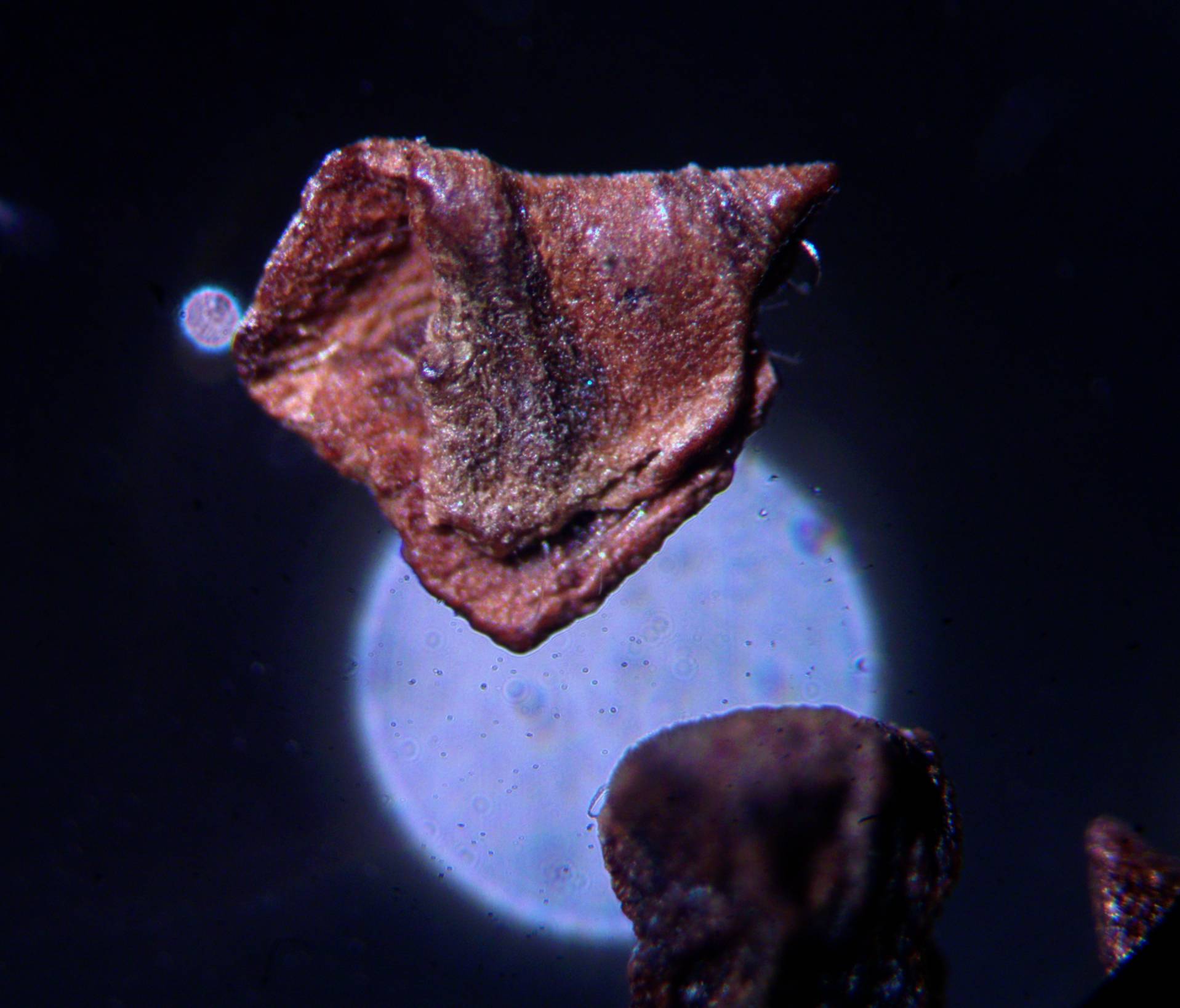
The probably 'ex nihilo' stone I found in 2014 which I call the fox is special by being a folded stone.
The climbing 'fox' is obviously the first line in my poem: While it has begun - that is, the first word in the hebrew parallel text.
Gasherbrum IV and the rock tombs of Meir
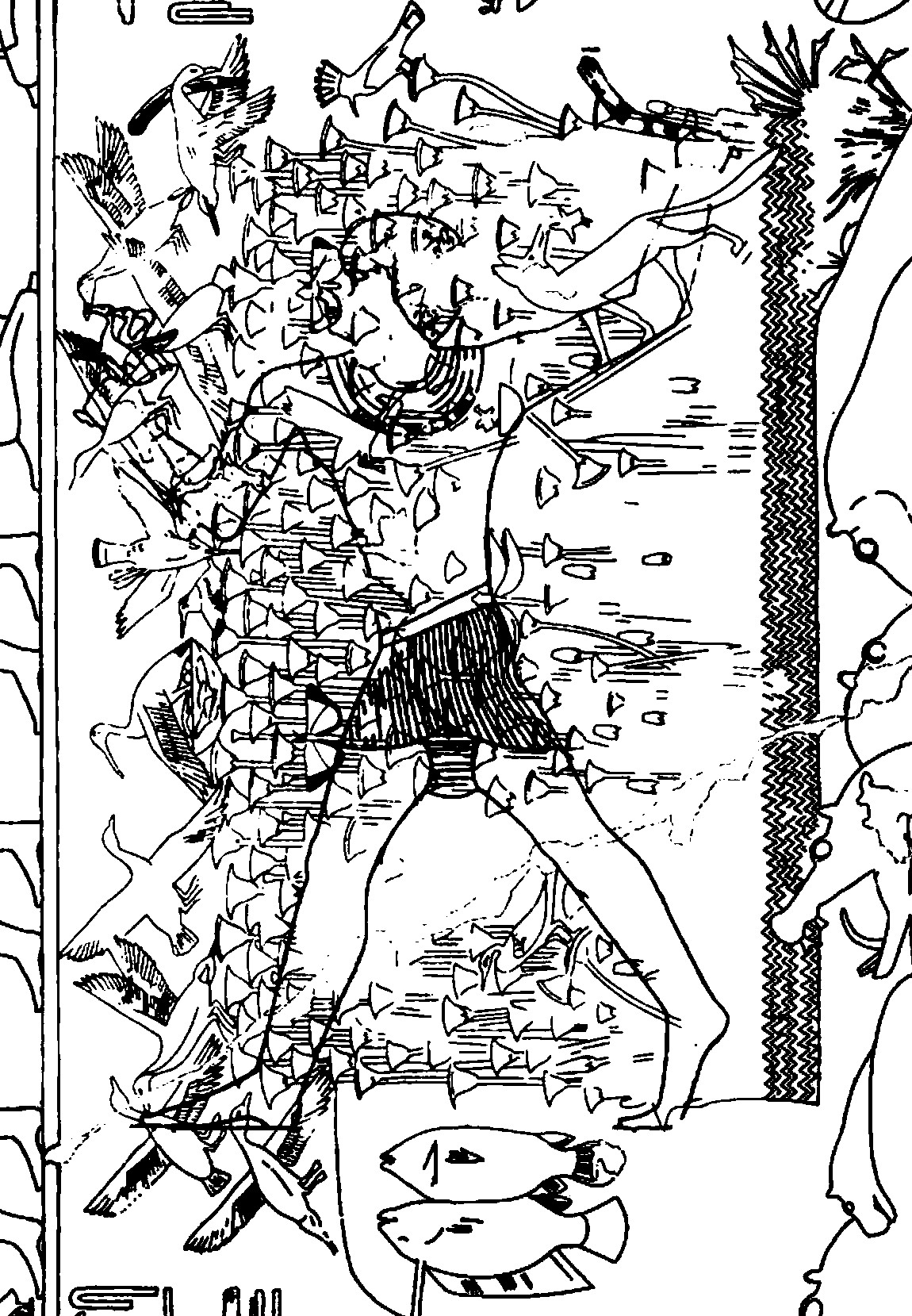
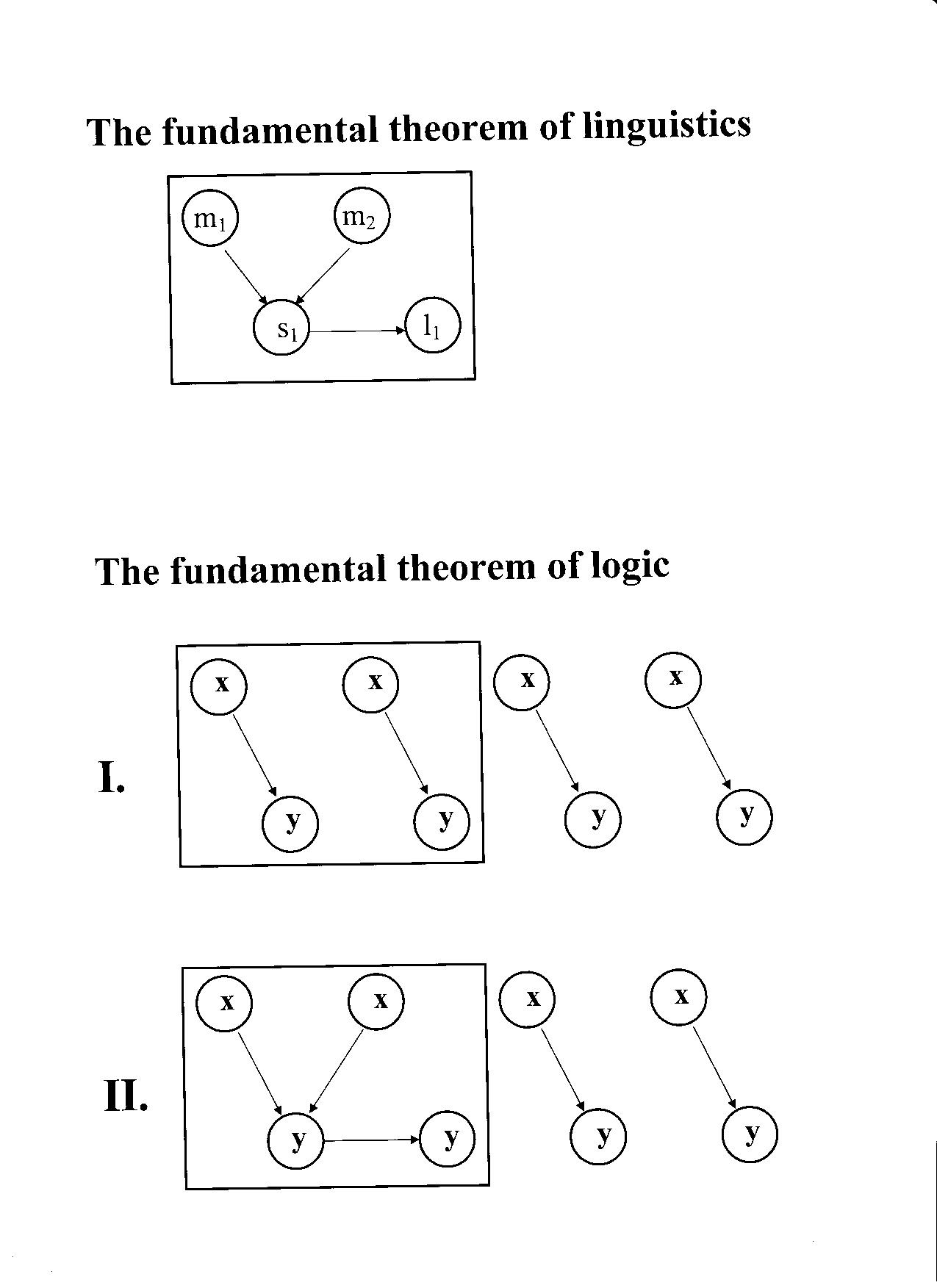
Then what are the two next lines of my TEQ #460? To tell it right away, the solution is in the sunflower matrix which I have analyzed from the rock tomb carvings of Meir reported in Blackman 1914 and Blackman 1915 - extremely interesting data these are. As I have shown in my earlier article on this, this matrix is found in the following tomb carving showing what I call the fundamental theorem of linguistics to the left of the matrix and the fundamental theorem of logic to the right:

The image a detail from this image from this source
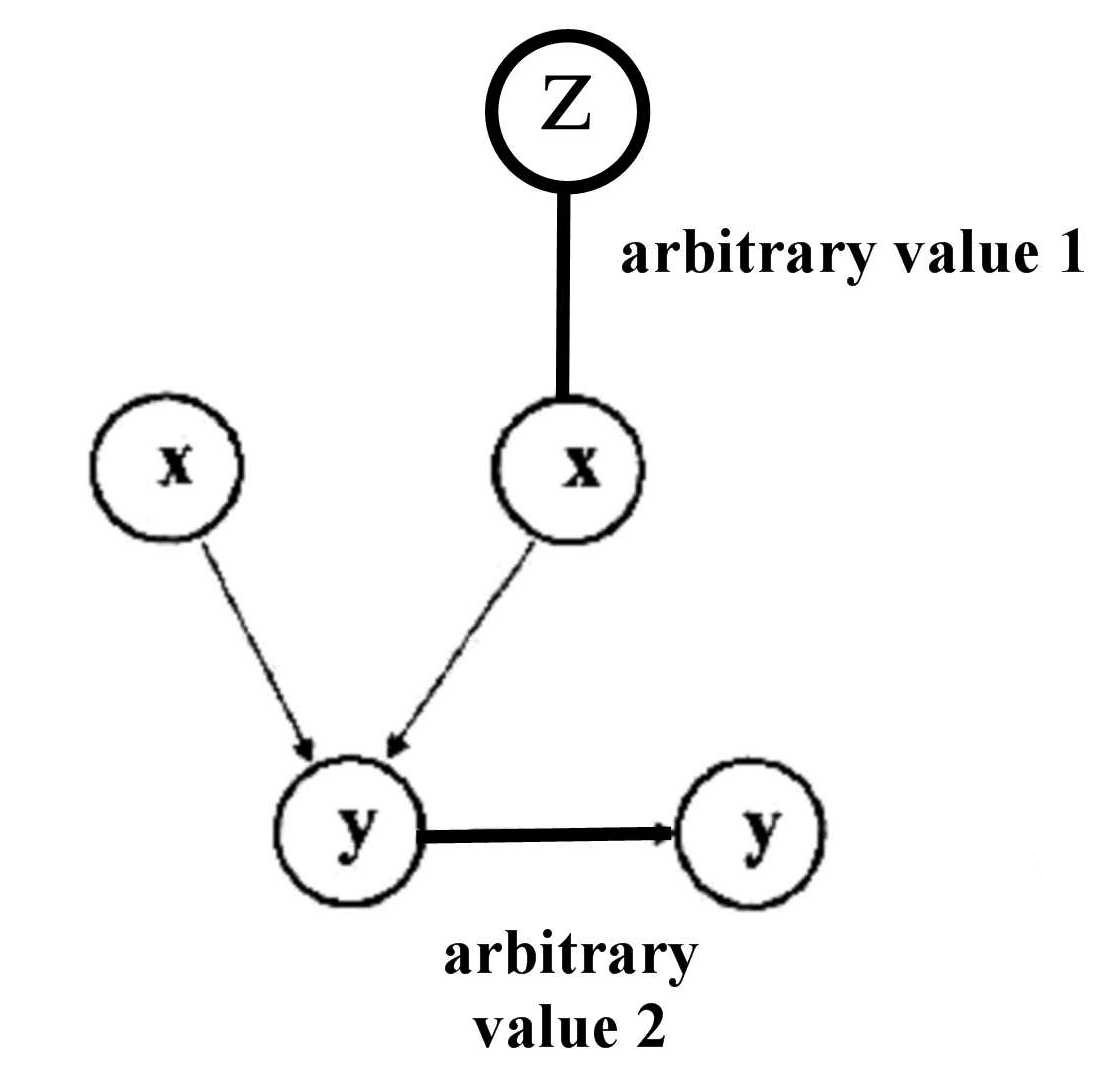
The lefthand side shows the 'two and only two' fish on one spear - which means that they are 'the same' - and then they collapse into one ontological constituent or referent with a semantic value attached or labelled thereto. On the righthand side there is 'Senbi' who has just wriggled a hieroglyph off the wall - which means the 'semantic solution' which also is essential to the lefthand side - on the righthand side this is what rescues the equation when equiprobability does not obtain in the historic reality. The fundamental theorem of logic on the righthand side is furthermore emphasized with the large and small dimensions on the characters - his wife is much smaller than himself while standing in front of him with a big bird in her hand while the three ducklings he holds are much smaller: This tells of the important aspect of the fundamental theorem of logic described in my article on 'The submorphemic Aristotle' that the sum of probabilities can have to be bigger and smaller than unity - this seems to be an absolutely necessary precondition which applies to the vertical dimension - when probabilities in the time dimension are ordered and stacked in the frequency dimension. This makes for the vertical variability - while I have described the comparable phenomenon for the horizontal dimension in my study of the parenthetical variability in Palma il Vecchio.
See these observations on the properties of the 'sunflower matrix' from the tomb of Senbi. From the viewpoint of the idea of a symmetry in the time dimension with the frequency dimension, and from the assumption that the sunflower matrix (in the middle of this part of the tomb wall) displays a sort of frequency spectrum, I tried to turn the matrix 90 degrees and paste it over the righthand side of it - the 'logical' part:
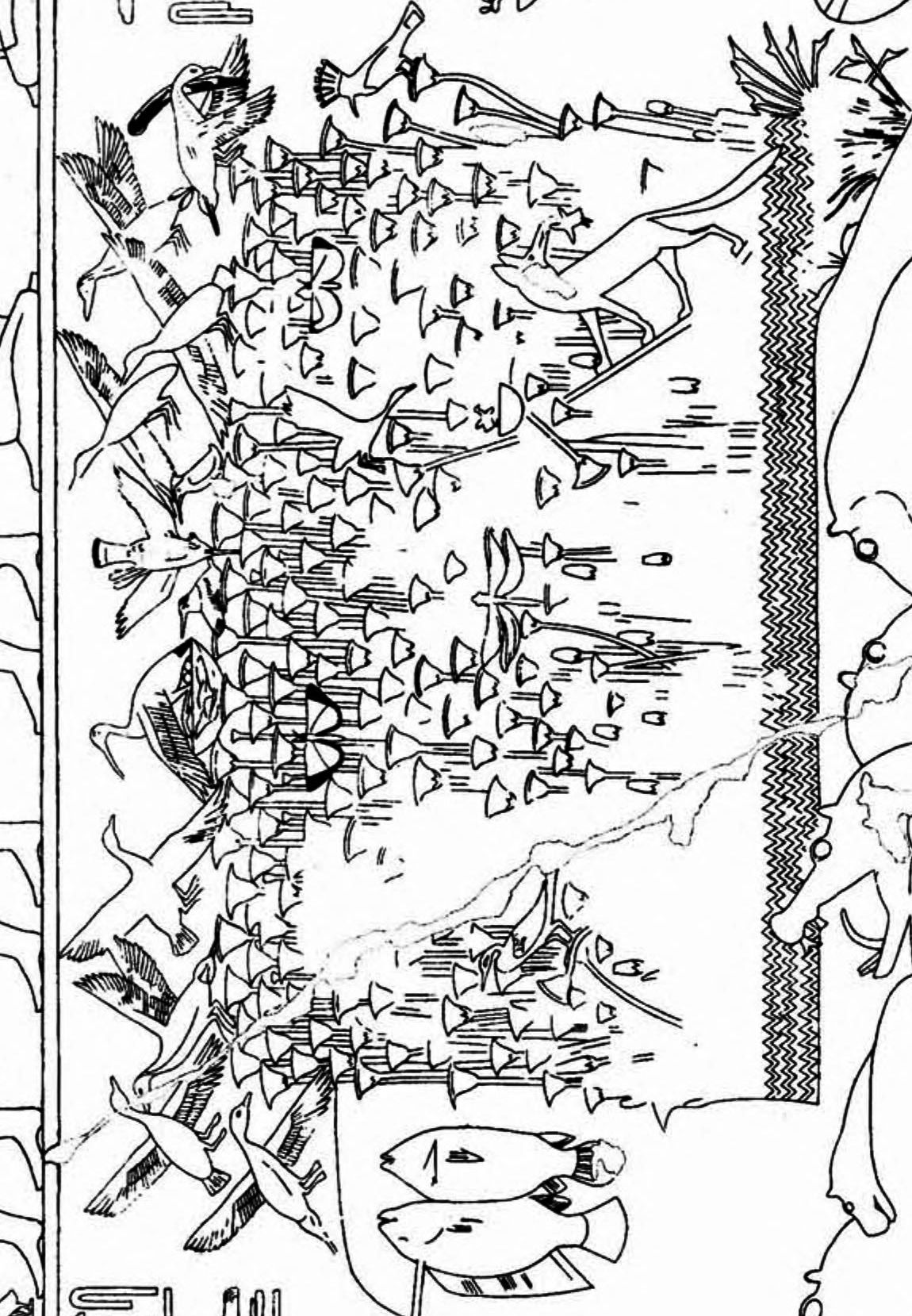
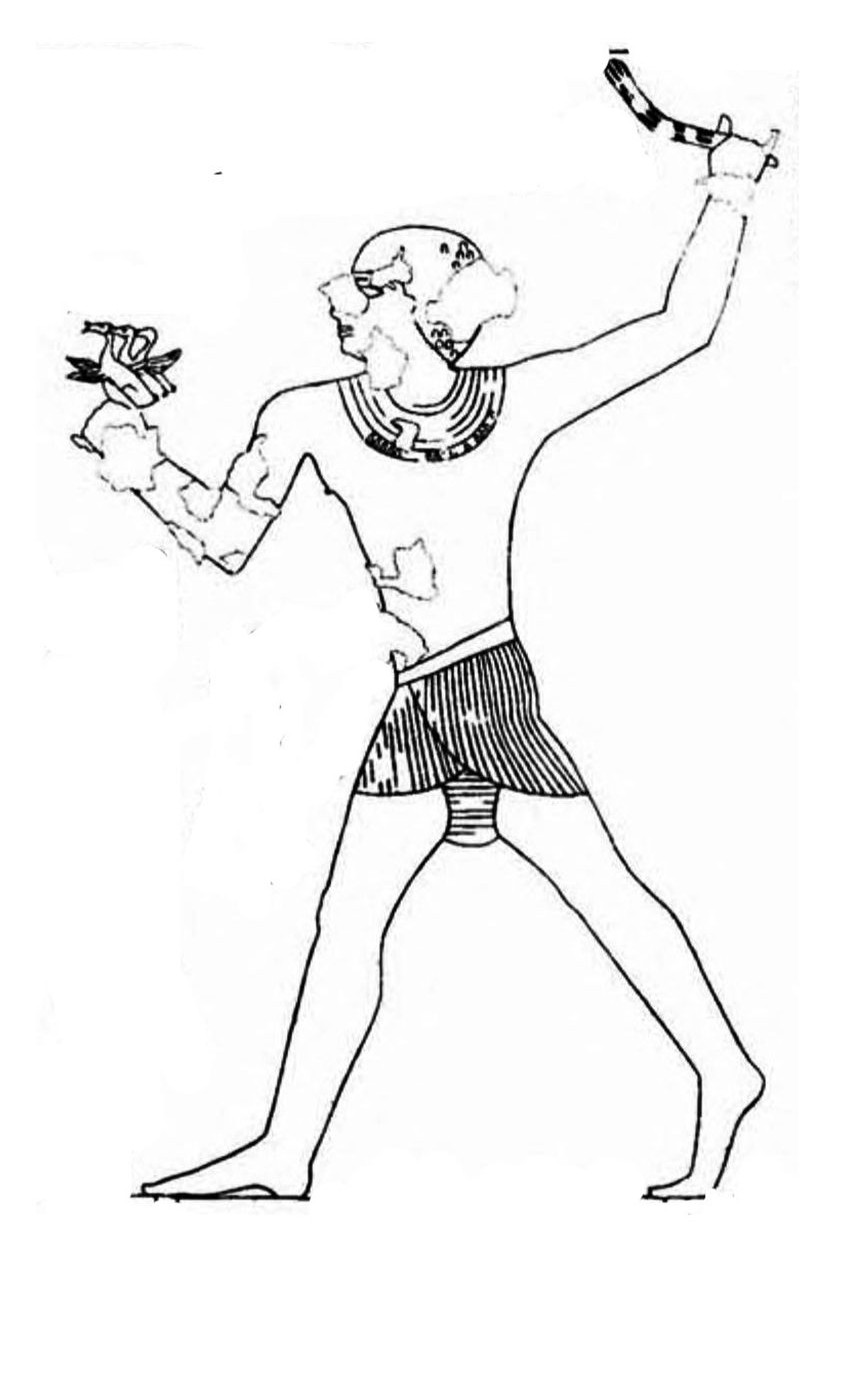


The remarkable result of this is that the 'fox' here is climbing up the biceps or triceps of 'Senbi' who is just about to wriggle the (meaning of the) hieroglyph off the wall. It is then noticed that the legs of the fox constitute stripes across the bent arm of Senbi - and the glyph which he is just about to wriggle loose is precisely of that type: It is bent like his arm or a boomerang and it has stripes across it like the legs of the fox. Thereby a theory of semantics is established: How can the information about what he holds in his hand go through his bent arm towards his brain? By this principle of isomorphy via the legs of the fox. The striped rod which he holds in his hand - telling also of the 'stripes' of the legs of the fox over his arm - could be the same as the rod reported in the Genesis book of Moses (chapter 30) on Jacob who was tending the sheep of Laban - how he was making striped rods by peeling off bark for exposing the white at certain parts - in an apparently innovative technology that could influence the patterns on the fur of the young sheep conceived during the exposition of this striped rod in the water trough.
It is noticed also that with this turning and displacement - like ordering and stacking probabilities in a quasi spectrum - the three ducklings which he holds in his other hand will be fed by an adult bird:
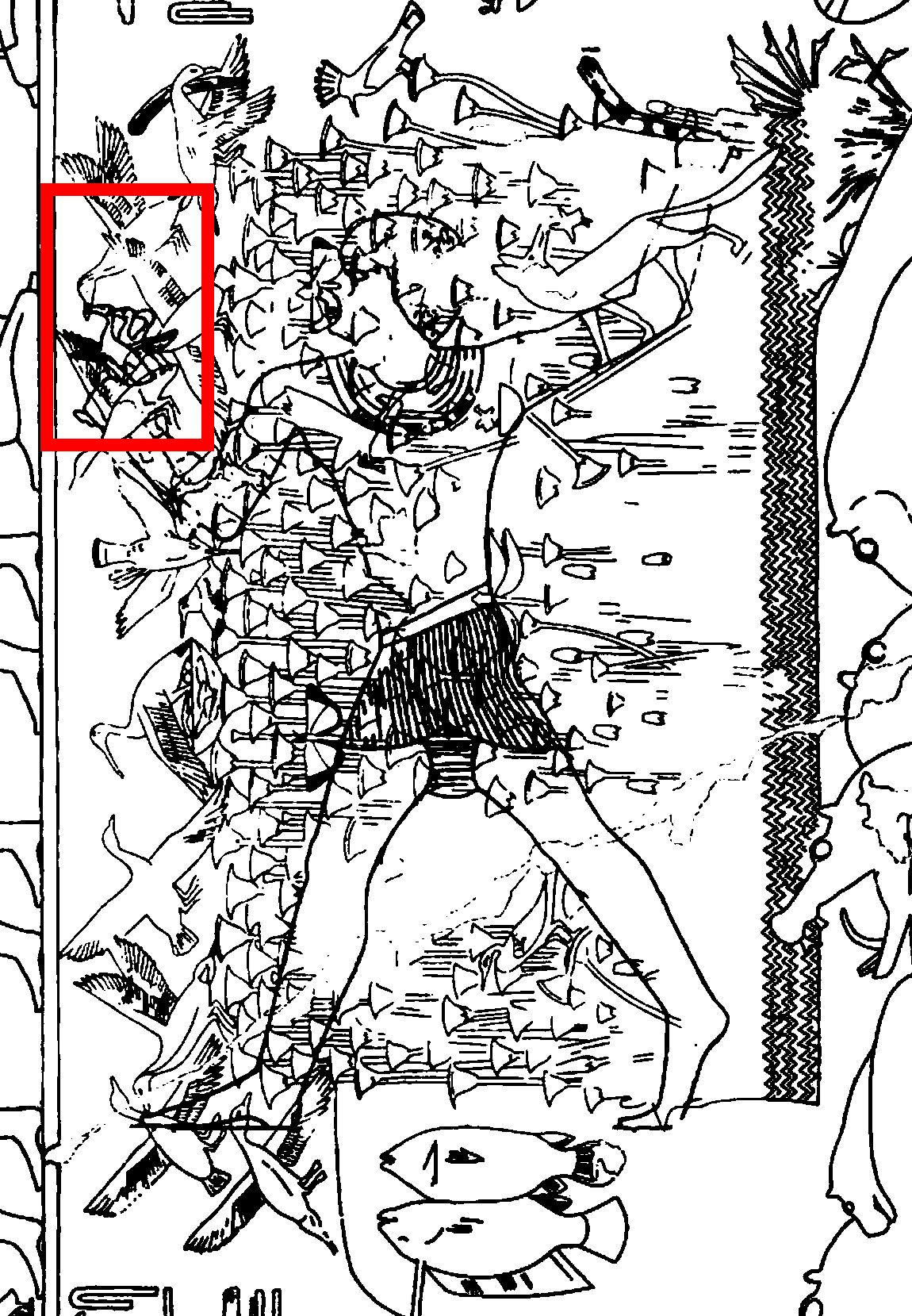

This bird will therefore have in its beak the three duckling beaks - like the legs of the fox on the arm of Senbi - which constitute a rod of 'boomerang' shape like that other bird is holding in its beak:
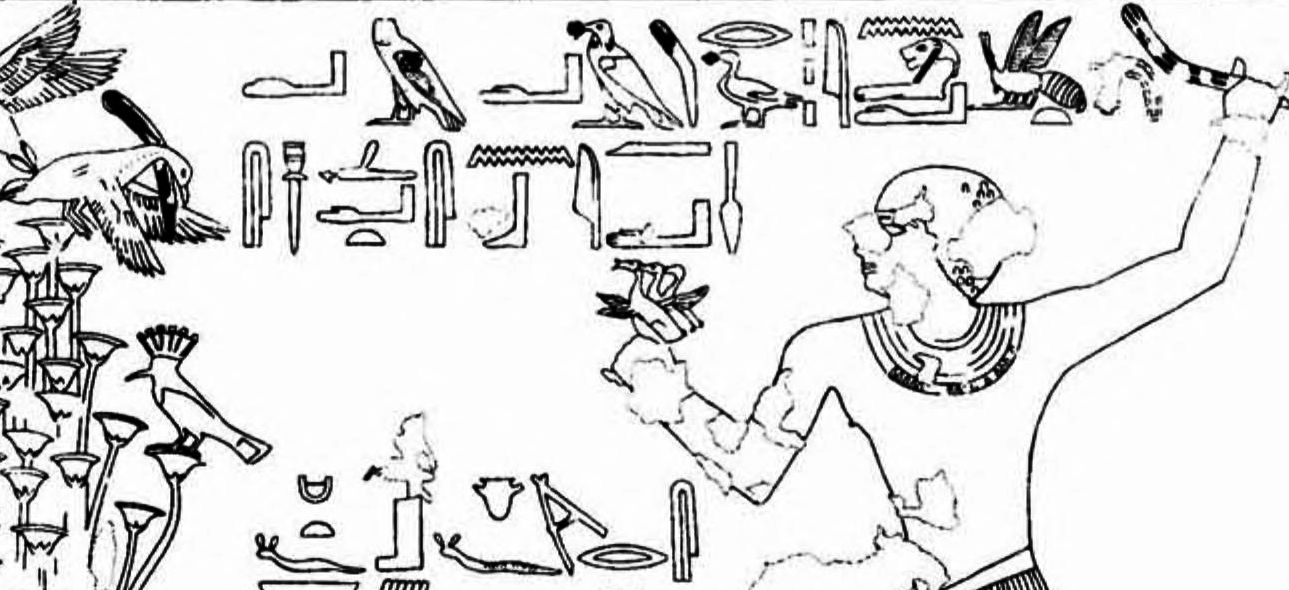
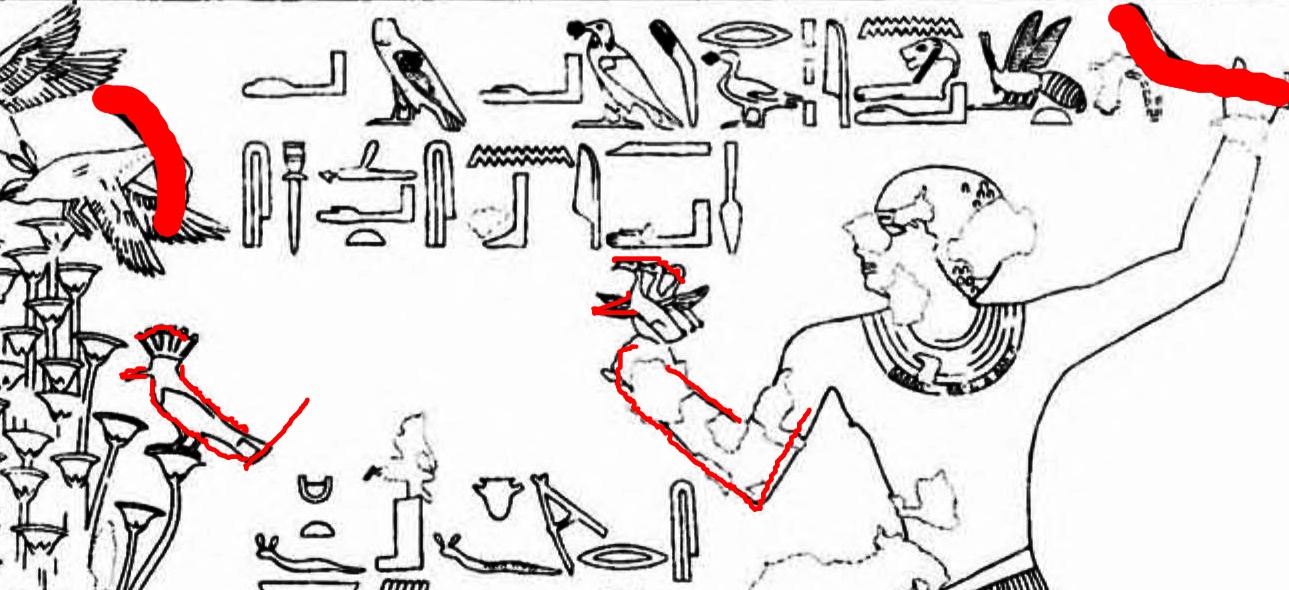
This transform therefore creates a link between what his left hand holds and thereby knows of what he holds in his right hand. Shifting the 90 degrees turned 'sunflower matrix' over onto the lefthand side creates a new redundancy:
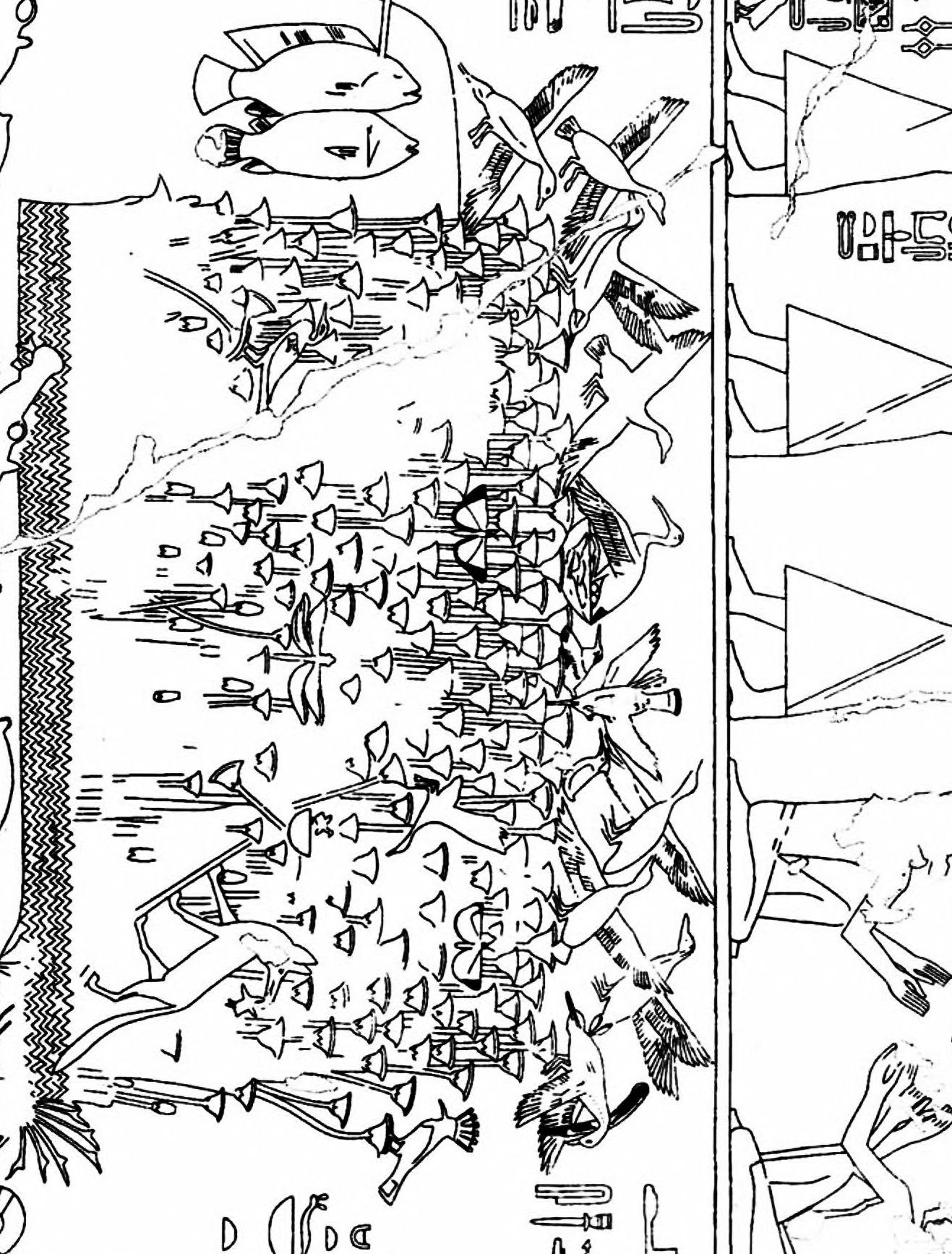
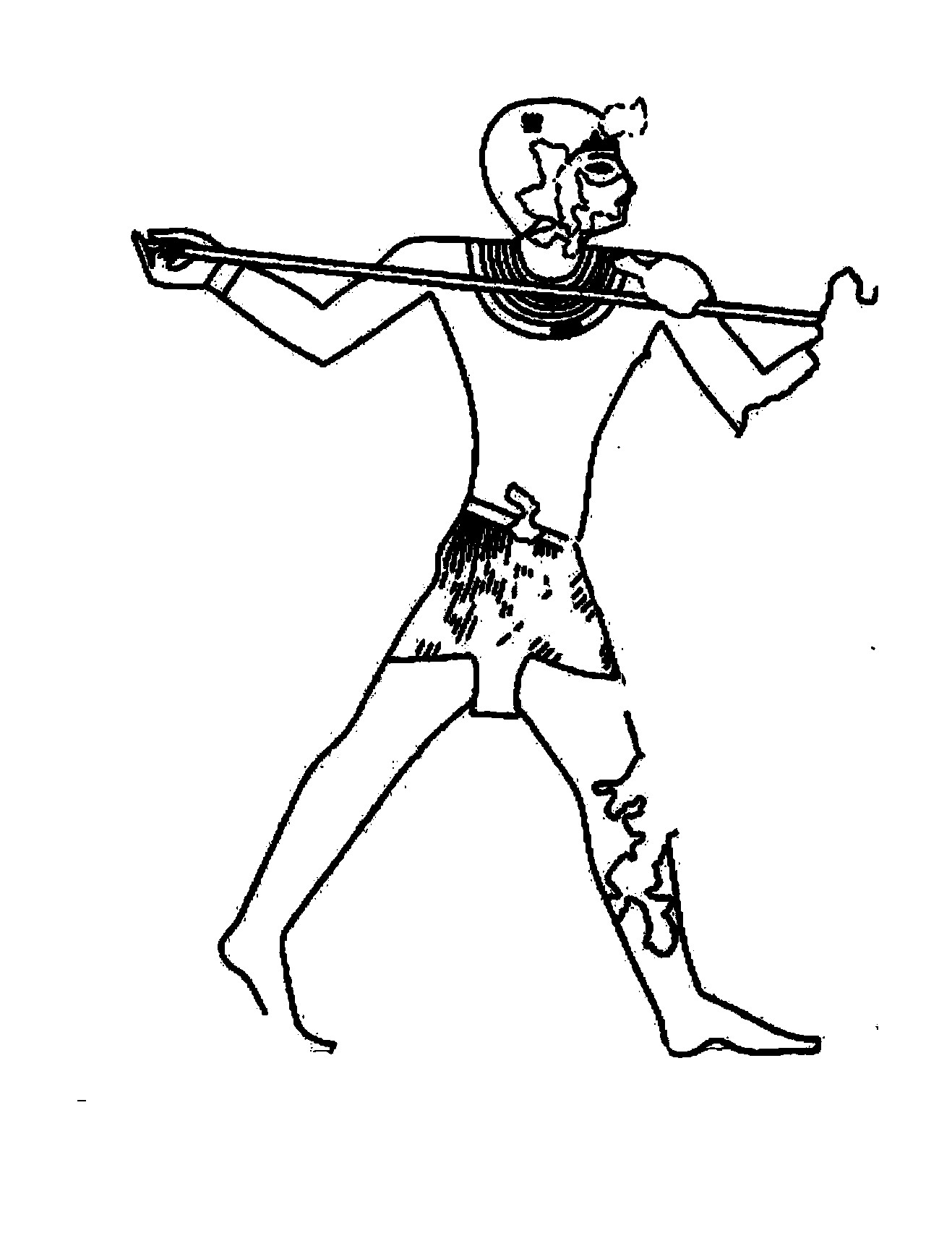
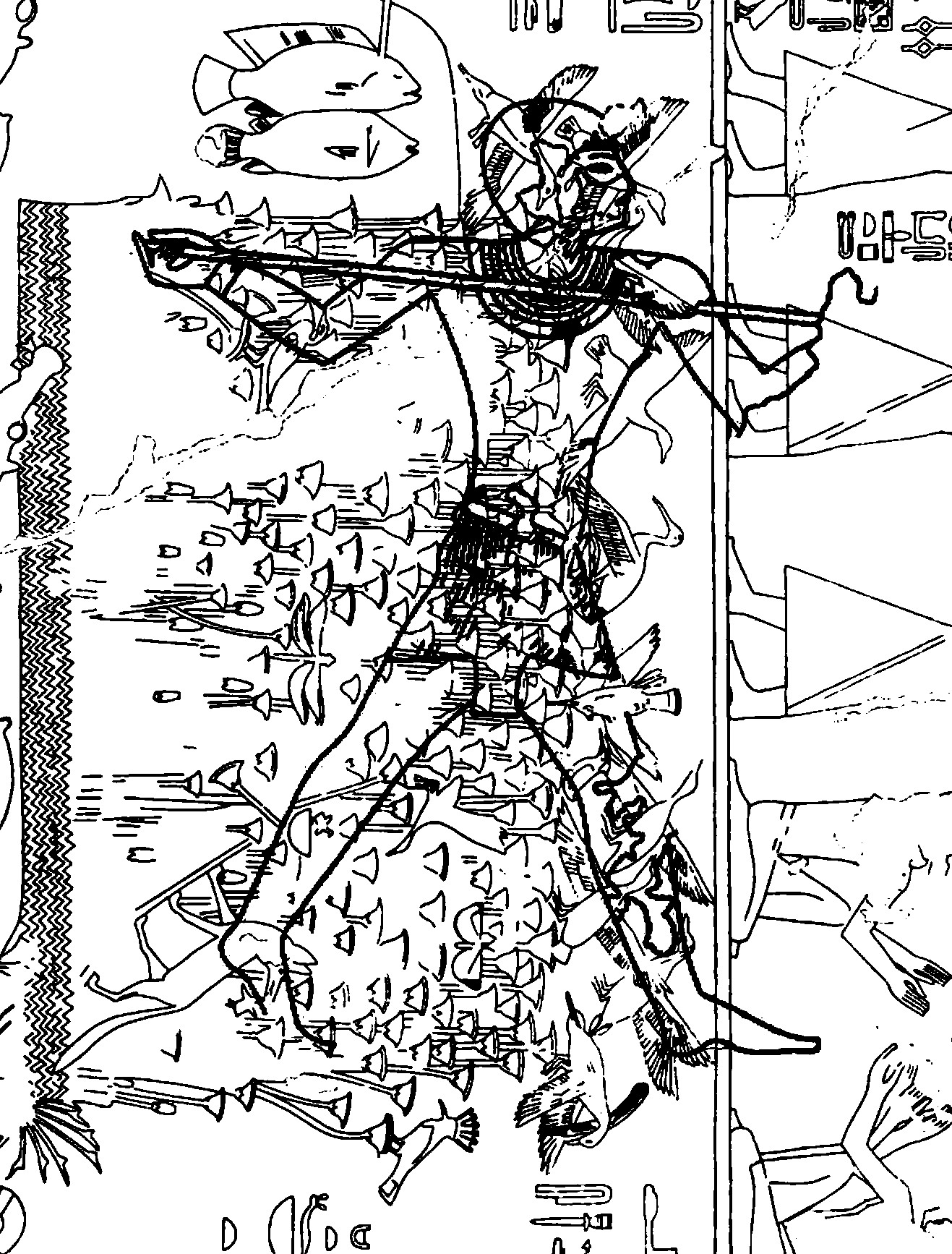
Here the fox is climbing up along the calf of the leg and the 2 fish of the fundamental theorem of linguistics are seen just above his backwards-held arm. Then what is above or beyond his forwards-reaching other arm? That should be the counterpoint to the fundamental theorem of logic - and it is found when turning the entire tomb wall around 90 degrees - which will allow for an excerpt of what will then have the place of the fundamental theorem of logic:
Now the spear which penetrates the 2 'same' fish will penetrate the two 'same' objects of the 2 arms of 'Senbi': The first of these corresponds to the three ducklings in Senbi's hand, which means the mid of the three males - the first of these holds 'breast-feeding' forms (as for the bird which feeds the three ducklings) and the other two seem to hold some sort of instruments in their hands. The mid of these has his skirt penetrated like the stick held in the hand of the big character above the fish-spear man - see more on this below. These three could correspond to the three lines in my poem, and they correspond then to what is in Senbi's hand in front of his eyes - while the adjacent three females - the mid one of whom now is covered with the two fish - apparently with sistrums and menats (symbolizing the 'same-ness' of these two fish?) in their hands will correspond to the bent and striped rod in Senbi's backwards-reaching arm and hand. (A menat seems to have had two 'pendants' on the back which could correspond to the two fish and hence it could tell of 2-5 while the sistrum could have been telling of 2 in the power of 3 = 8). The formal expression of this is seen in the lower righthand part of the excerpt - the matrix for turning stripes and the 'bent' forms. When these are seen as equivalent to the two fish on the spear, the two hands of Senbi are seen as equivalent by the same logic - then the left hand knows what the right hand does. This suggests perhaps also a conflation or conjunction of the two genders. The result is seen in this tomb wall from Meir - reported in Blackman 1915 - of Senbi's son 'Ukh-Hotp':

The image from this source (Blackman 1915)
It is here seen from the mid row how the female with the sistrum and menat has taken the place of the male behind the one carrying the breast-feeding shapes - and how the sistrum and menat could be a correlate to the 'wriggling loose' of a hieroglyph from the wall:
On the line above there are the equivalence to the 2 fish (for the fundamental theorem of linguistics) in the 2 sitting people facing rightwards (and would the one standing leftmost, behind them, be a correlate to my first line 'While it has begun'?) and on the right the correlate to the fundamental theorem of logic by the 5 males: These seem to be the '5 porter's pender', the first of them showing a 'butterfly' gesture (as for turning 2 and 5) by holding hands around own neck and the second presents a formal 'matrix' of some sort. There is also a harpist sitting there with a 'bent' frame with 'stripes' of strings - like that hieroglyphic rod in Senbi's hand - and it may be that this harpist is of a different 'aristotelian substance' and hence is not counted for the probabilities: The total number of people on the upper row is then 8 - like the four on the mid row if multiplied with 2 as for the human figure of double size. This double size will then correspond to the symmetries in e.g. the two bulls on the bottom line. The 5 will then be the 'penders' on the spear of fish.
My third line 'mag wir acht zu sehen' will then tell in its reference to the mid register of the harpist of a 'different aristotelian substance' type - and hence the subject and verb of this third line of my poem do not follow the ordinary rules of number in german.
The Meir tomb version of the sistrum held in the hand of the figure of double size clearly tells of '2 in the power of 3':
My theory of Aristotle tells that the quasi spectra of ordered and stacked probabilities matching the phonetic form (of acoustic spectra) will be essentially subjected to compression and expansion of the otherwise (per definition) normal sum 1.0 - and there are some reasons to believe that the expansion can go up to 2.0 or even perhaps 3.0 - although the natural assumption lands on the idea that Aristotle's intuition of logarithms can have been equivalent to an intuition of natural logarithms with base 2,71828... In the double size this could mean the base 2.0 - and the following illustration from Blackman 1915 (from the tomb of Ukh-Hopt) the size of the big characters could seem to be just the e = 2,71828...:

The image from this source (Blackman 1915)
The value ('Euler's number') e = 2,71828... as base of logarithm seems (since the function ex is its own derivative) to be what can account for 'ex nihilo' formation of matter. It is seen from the illustration that each unit is divided into 7 and that the big figures reach nearly up to 5/7 in the third unit: Had they reached 5 it would have been 2,71428 which is good approximation - but they are a little shorter. However, the grids for the smaller characters are 7 * 3 = 21 per register for the lower two and apparently 22 for the upper - which could mean that the error is counterbalanced there. It is furthermore noticed that the two characters to the left of the two big ones are drawn in a different grid and rest on a ground which is not totally aligned with the 'floor' of the two lower registers: This could suggest that the exact e = 2,71828... was computed by such additional adjustments - could be they had advanced mathematics on this if they moved heavy stone by such semiotic technologies and therefore needed (or found) high precision on this value. It is seen that the wrestling scene of the upper register on the right shows a person 'falling down from above' which could be suggestive of just that 'ex nihilo' phenomenon. Wittgenstein's Tractatus Logico-Philosophicus is summed up in his 7 main ideas - which can be to tell of how 'ex nihilo' can be understood as a 'fall' into the world - even if, as tells his 7th line, it is not normal to talk about such potentially alarming things and therefore one normally does not talk about it:
1 - Die Welt is alles, was der Fall ist.
2 - Was der Fall ist, die Tatsache, ist das Bestehen von Sachverhalten.
3 - Das logische Bild der Tatsachen ist der Gedanke.
4 - Der Gedanke ist der sinnvolle Satz
5 - Der Satz ist eine Wahrheitsfunktion der Elementarsätze.
(Der Elementarsatz ist eine Wahrheitsfunktion seiner selbst).
6 - Die allgemeine Form der Wahrheitsfunktion ist [p/, ξ/, N(ξ/)].
Dies ist die allgemeine Form des Satzes.
7 - Wovon man nicht sprechen kann, darüber muß man schweigen.
'Der Elementarsatz ist eine Wahrheitsfunktion seiner selbst': Should that mean simply ex which is its own derivative - that is, its own 'recursive matter' in the sense of 'ex nihilo' substance? Like this ancient egyptian image? Truth falls in from a higher dimension - like the truth conception in my 'fundamental theorem of logic'? Could be Wittgenstein's 'Elementarsätze' would have been the source of such falldowns of another logical substance into the world. But truth is probably not the same as matter - some would say it is the opposite - and that is an old philosophical debate.
It is, though, likely that theories have arisen that this semiotic philosophy is what brought the ancient egyptians to a technology of quasi 'levitation' for lifting the stones of many tons when building the pyramids. One such stone constituting the roof of a chamber deep into the pyramid must be many meters long and correspondingly thick for holding the above weight and weighs an enormous lot of tons - and how could they manouvre these slabs of rock around? Even if 100 or 500 men in theory could have lifted it with their bare hands, there would not have been enough space for them around the stone for that. One could think of a technology which can shift one scene of reality into another (like that turning 90 degrees of the two persons into the matrix) by way of what is shown on the tomb wall illustrations - and the only difference between the two scenes is that a slab of stone has changed position - a sort of 'in & ex nihilo' phenomenon (which will not be 'levitation', though). By sophisticated semiotics the change from one scene to another could have been obtained by precise and concentrated indexing of a 'hieroglyphic' kind. Could be they had driven this technology far - including the effect on the surface life of society from the deep funeral tombs of the pharaos.
Could be they simply lifted semantics from the logical to the linguistic fundamental theorem or vice versa - through the 'sunflower matrix'.
The hebrew of Exodus 16:14 seems to tell of a flake-like thing of henna colour on top of something - this 'on top of' occurs twice - in words 5 and 12. But this seems to be another of the ex nihilo pieces which occurred in early 2014 - what I came to call 'the christian wigwam' - it has precisely this 'flake-like henna-coloured flag' on top of it - here front and back side of it:
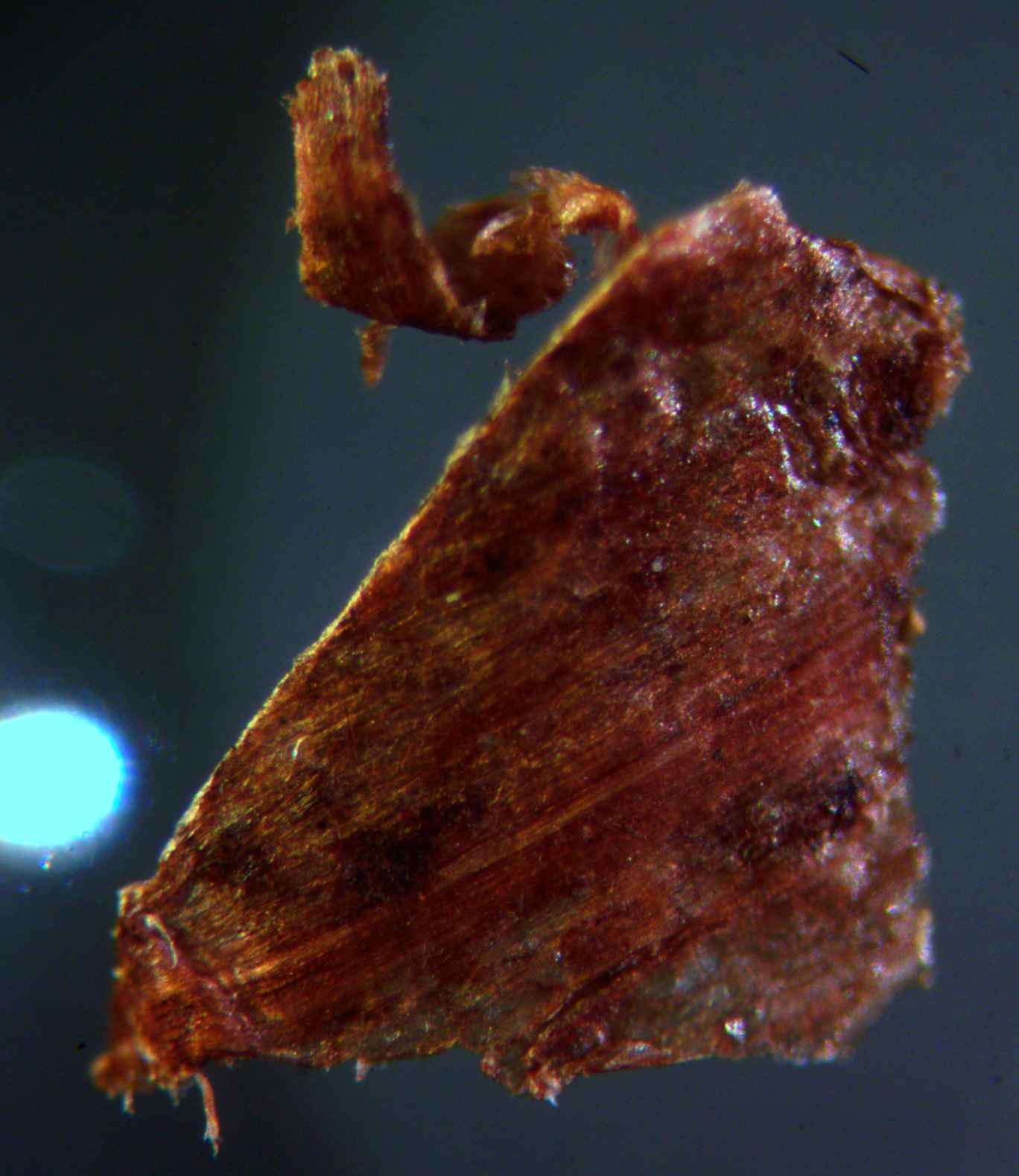

How this flake-like henna-coloured flag could have stayed there well attached I dont know - I could turn it around and photograph it on the other side and it kept the form. It is seen that one of them has a face on top surrounded by a halo which could resemble a Tut-Ankh-Amon mask or something like that.
This compares also well with the back (east) side of Gasherbrum 4 and with the the hip of the big character with the triangular apron from the rock tomb of Meir (seen up left):
|
|
The source (Tom Livingstone) for the image of the east side of Gasherbrum 4 tells: "The left side is yellow-coloured rock, and is junk limestone/marble. The right side is granite".
If this flake-like henna-coloured thing 'on top of' the structure of my 'ex nihilo' object is to be compared with the rock image of Meir, it would land on the thigh of the big character - or maybe about the knee. This would be approximately where the fox is ascending along the leg of the linguistic fish-catcher:


Although the fox is a little too long down at the foot, and naturally walks upside down as the image turns the other way, this completes the circle anyhow. This little flake-like thing that occurs on top of something would find its equivalence in the normal wigwam at the place where the woman inserts something into her mouth. Would this be the flake-like thing - like a layer of 'semantic' prophetic or inspired language onto the tongue? See Acts 2:3 - the story of the arrival of the tongues as of fire.
The egyptian triangular 'apron' - with the stick across it - resembles the granite part of the east side of Gasherbrum IV as well as the apron with the fish-catcher's spear in the 90 degrees conversion at the sunflower matrix.
The result of these shifts is that the logical theorem will apply to the linguistic theorem - when these go for an isomorphy, the result will resemble the chinese character 之 = zhī: The interesting observation is now that the oracle bone script form of this character resembles the posture of Senbi in this ancient egyptian tomb image and the etymologies include "to go; to proceed: Cognate with 時 (OC *djɯ, “time; season”) (> 辰 (OC *djɯn, “date; time”)), 志 (OC *tjɯs, “goal”), 趾 (OC *kjɯʔ, “foot”) (> 止 (OC *kjɯʔ, “to stop”)), Burmese စ (ca., “to start; to begin”)" - hence not only the striding posture of Senbi but also his foot and the concept of 'While it has begun' = the first hebrew word of Exodus 16:14 which has its etymologies in that ancient 'fox' of proto-semitic.
What this should mean for semiotic theory is that - according to my postulates in the study of Aristotle - if probabilities are ordered and stacked in a quasi frequency dimension, there will be a meaningful correlation with the phonetic form of the ordinary frequency spectrum. (The symmetric relation could be observed in the later form of 之 = zhī in terms of the later development of the sign). The data from Senbi's tomb could then suggest how phonetic and logical form meet in this way: It will be simply the redundancies in the probability distribution that makes sense relative to the form of the bodies of the two characters of the theorems of linguistics and logic.
The two lines of mine about '5 porter's pender' and '8 zu sehen' then seem to comment on just the phonetic (linguistic) and logical parts of this sunflower matrix turned 90 degrees either way. Would these be the contents of the rest of Exodus 16:14 - after the 'fox' in the first word? There are three distinct parts of the verse - the first three words could comment on my first line, the following 8 on my third line and the final 2 on the mid line. It is observed that the 8 words (words 4-11) that comment on my third line (the 'logical form') there is mention of peeling a fine film off something - like that bark which Jacob peeled off the rods before he put them in the water trough. This is likely to be the same as 'Senbi' with the hieroglyphic striped rod in the sunflower matrix. The stripes are the legs of the fox over his arm. The real story in this complex therefore seems to be the mystery how Senbi's left hand can know what his right hand is doing - in the form of the 'semiotic mystery'. In my poem this concerns the relation between the 2nd and the 3rd line. Clearly the left and right hands and arms meet in the consciousness of the subject and this is what is subjected to possible changes for such a 'semiotic' theory to function as a technology for movement of physical bodies.
It is furthermore seen that these considerations on the 'sunflower matrix' discussed in this file as concerns poem #50 from my 'Stillhetens åndedrag' thereby also will concern the 'turnover' of the structure in my book - the socalled 'calibration point' where the beginning meets the end like the signifier and the signified in a traditional semiotic conception. This beginning meeting the end will thereby be about the same as the left and the right hand - whereby also the 2 turns into the 5 of the fish and loaves that Jesus handed out to the thousands of people (Matthew 14:13-21).
This more generally will concern the phenomenon of borders where two different realities meet on either side.
Humans have probably always been out for these mysteries - which in the egyptian tomb cult could have led to the mastering of the art of 'levitation' or rather 'historic discontinuity'.
It is seen from this article of mine that I had been into many of the same themes as in the present study but I had not seen the relevance of the legs of the fox for the stripes of the rod which Senbi grasps for. Why not? Because I had no reason to assign any importance to it - and then it looks like a coincidence when I put the sunflower matrix 90 degrees over the outlines of Senbi. It is only with the introduction of the proto-semitic fox from the first word in Exodus 16:14 that I can discover this - and that is precisely the first line in my poem: "While it has begun".
What is now the important observation is that the two remaining lines of my poem seem to contribute with an important conclusion: The second line "perhaps he'll find five Porter's pender" seems to tell of the phenomenon that the man on the righthand side will see the 2 fish - who are 'penders' on the 'porters' spear - as 5 fish: He sees the symbol 2 from the other side and then it looks like 5. But this is just what the man on the righthand side is into - he wriggles a hieroglyphic graphic symbol off the wall for the semantic function.
But would this be about the form of the arabic symbols for the numerals - that '2' looks like a mirrored '5'? Probably not: I would guess that it could concern the universals in the socalled 'keys to heaven' whereby the categories 2 and 5 essentially swap - here excerpted from this article about the 'keys to heaven' - told much more essentially in volume 4 on pages 1212-1214:
Information transfer = LOGOS
1 17 48 entrance to community = the DOOR 2 25 33 goodness = parameter 1 3 21 47 apparition (divine) = fourth parameter for BODY 4 29 34 donation = HOUSE (= oikonomia)
The parametres in the paradise machine = PHONE
5 19 46 commutation/information transfer in global/universal space 6 27 35 arbitrarity (IN/OUT as aspect) = parameter 3 7 23 45 bit-reversal = parameter 2 8 31 36 free will for nature poetry; information = real value = parameter 4
The four grammar/language types = LEXIS
9 18 44 nesting = nominal type = +N-V 10 26 37 context = verbal type = -N+V 11 22 43 witness report = adjectival type = +N+V 12 30 38 prepositional type = -N-V
Triadic butterfly sign, the working of the machine = LEKTON
13 20 42 negation, paradox, binary values = lekton = HOUSE 14 28 39 gender = BODY, city = body 15 24 41 relegation of authority/control to universal muse = 4th par. = ORAL 16 32 40 three triadic semiotic spaces = three basic parameters giving the
fourth = COGNITIVE
It is seen that parametre 1 must swap from line 2 to line 5 for joining the other three parametres (of 'goodness-driven economy') in the second quarter. This is likely to be the universal reason for this finding of 5 porter's pender when there are really only 2 fish.
Then what is the third line - "mag wir acht zu sehen"? That is likely to be the three ducklings in the hand of the man on the righthand side - for the exponential function of the 2 fish to the left in the power of 3 to the right = '8 zu sehen'. The important conclusion that can be drawn from this poetic logic is that the fundamental theorem of logic relates to the fundamental theorem of linguistics in a falldown of dimension from 2 to 1 - from multiplication to addition. However, it is possible that the conversion from 2 to 5 is included in this - which of course would make it more difficult.
23 = 8 while its 'derivative' (assuming 2 to be the variable 'base' = Aristotle's 'morphe') will be 3 * 2*2 = 12. It is many years since I saw in a vision that 7½ + 8 = 3 - this has remained in my mind as a riddle but maybe this brings us closer to its solution.
If the base is supposed to be not 2 but 'e' and 8 the result, then the exponent will be not 3 but 2.0794 - that is e2.0794 = 8 - which hence relates to 3 appr such as 8 relates to 12.
The falldown in dimensions which a derivation entails could here be from the logic (and its 'logical semantics') in the righthand side to the linguistics (with its 'linguistic semantics') in the lefthand across the 'sunflower matrix'. (Would this also turn 5 into 2 - as by Jesus' 5 loaves and 2 fish?) This would anyhow be an important corollary from this study.
Why is the third line in some german? Is it because there is water between the left- and righthand side in the egyptian 'sunflower matrix'? Could be it is another 'dimension'.
The signature
Now for some observations on 'universal phonetics' for these matters. The first concerns the name of Gasherbrum IV - this mountain is divided in two countries - half of it is in China and the other half in Pakistan. The interesting observation to be made here is that the chinese name of the mountain seems to be the signature to my poem when the phonetics to 'Senguin Cuds of Muds' is interpreted in hebrew. The signature 'Senguin Cuds of Muds' has the following phonological correlates in hebrew (whereby I tried to find hebrew words of this phonetic form with relevance for this complex):
שנהב - ivory - from
שן = 'tooth' + (by Klein)
הב / יב = elephant
hence 'ivory/tusk' = 'Sh-N-H-V' - not so far from 'SeNGU-in'
כוי = (Jastrow) to cause discolouring
קוי = (Jastrow) 'to circle', (Klein) linear (from measuring line, circle)
כד - to deepen, a jar, pail,vase
See also Al-Quds - arabic name for Jerusalem (cp. TEQ #464)
מוד = to stretch, prolong, continuity, to stretch
Hence 'Senguin Cuds of Muds' seems to be a play on the elephant face in Gasherbrum IV (on top facing rightwards):
Now the interesting observation is that these hebrew quasi-interpretations of the phonetics in the signature 'Senguin Cuds of Muds' seem to have a rather close correlate in the chinese form of the name 'Gasherbrum' = (in traditional chinese) 加舒爾布魯木 = pinyin Jiāshūěrbùlǔmù - that is, the following chinese signs:
1.
加 - jiā -
to put on top of another object; to add; to put in; to increase; to raise; to impose; to foist; to grant; (arithmetic) to add
placed after a monosyllabic adverb to indicate an increase in the degree; more
Most importantly, there is no doubt about the essential element of on top of as in the above discussion of the hebrew to Exodus 16:14.
Relevance for the signature of my poem in its hebrew interpretation:
'Cuds': The similarity with the hebrew כד is notable: to deepen, a jar, pail,vase (= 'rounded earthenware'?), (Jastrow) 'arched' by כדר = arched, rounded. Here it will be the element of 'deepen' which matches 'to increase; to raise'.
2.
舒 - shū -
to stretch; to unfold; to relax; to open up; to stretch out; slow; comfortable; leisurely; easy
Etymology: Possibly connected to 紓 (OC *hlja, *ɦljaʔ, "to loosen, relax").
Relevance for the signature of my poem in its hebrew interpretation:
מוד = to stretch, prolong, continuity, to stretch
3.
爾 - ěr -
thus, so, like that;
you, thou
Relevance for the signature of my poem in its hebrew interpretation:
'of' could tell of 'thus', 'thou'
4.
布 - bù -
cloth; textiles; to announce; to proclaim; to spread; to deploy; to set out
The etymological attempts are centered on 'to spread out' and 'cloth' (cotton etc) but may not be solved.
Relevance for the signature of my poem in its hebrew interpretation - here for the Sen-guin/qui-n:
כוי = (Jastrow) to cause discolouring - applies to the cloth or textiles
קוי = (Jastrow) 'to circle', (Klein) linear (from measuring line, circle)
5.
魯 - lǔ -
(bound form) crass; stupid; rude; foolish; rash; vulgar
Relevance for the signature of my poem in its hebrew interpretation - here for the Sen-[guin]:
שנהב - ivory - from
the שן = 'tooth' + (by Klein) of the 'ivory' - of the elephant of Gasherbrum IV
6.
木 - mù -
tree; woody plant; wood; timber; wooden; (literary or in compounds) coffin; simple; plain; slow; emotionless; numb
Relevance for the signature of my poem in its hebrew interpretation:
The only element that remains unparalleled here is the
הב / יב = elephant of the 'ivory' - would that be relevant to the wooden tree?
Hence it seems that the signature to my poem interprets in hebrew a correlate to the chinese name of Gasherbrum. It is the 'Cuds of Muds' which are significant - the 'Senguin' less so. However, since the elephant is clearly visible on the mountainside, it is interesting to look up the chinese oracle bone form of 'elephant' and compare it with the cliff - which makes some sense:
The mammoth elephant is even more clearly visible from this angle (source of the photo). Since the chinese for 'elephant' = 象 = pinyin 'xiang', mandarin pronounciation close to 'siaŋ', the word clearly has something to do with the form 'Senguin'. 象牙質 = 'siang-ya-zhi' = ivory character/nature.
The Gasherbrum IV mountain is shared between two countries, and one could naturally guess that the signature of my poem is the chinese 加舒爾布魯木 IV峰 and that the pakistani (urdu) name گاشر برم ۔ ۴ could be the contents of my poem. But this is guesswork only - I do not have the chance to find out of the associations that could attach to the pakistani name.
Finally, there could clearly be much to gain from a study of the hieroglyphs on the wall of the rock tombs of Meir, but I do not have the resources needed for that. I nevertheless bring some scattered observations on some relevant sounds - although it must be noticed that it is perhaps not so certain that the phonetics to the egyptian signs hold good. Here some observations from Wallis Budge:
'Senguin':
senket = light
senq/senqet = to suckle
sensi = to praise
ui = sign of dualis (cp. the 2 fish)
un = being, existence = the linguistic theorem
'Cuds':
khut = name of light-goddess, fire, horizon
'Muds':
mut = mother, scruples (= weights for scales), die, death, dead
One notices the relevance of these egyptian connotations for this story around my DDS #158. Should it be a coincidence that it tells of 1-5-8? At least in our decimal culture these digits can be assigned some prominence.
Concluding remarks on the hebrew of Exodus 16:14
It is seen that word 1 = ascending fox of the egyptian matrix, word 2 = the prophetic tongue, adding words 3 and 4 makes for the fundamental linguistic nucleus which is the lefthand side of the egyptian matrix which recognizes the fall-down of 'ex nihilo' matter by the recognition of the sameness in word 5. The double mention of 'on top of' (words 5 and 12) the unsettled pastureland (word 7) = the cuds of muds produces the fine layer or stratum (words 2, 8, 9, 10, 11) of an alternative substance which is the potentially syntactic matter of the fundamental theorem of logic recognized on the righthand side of the egyptian matrix. All this will conspire onto words 12 and 13 for the concept of 'on top of the world' = the Himalayan mountains as a potentially transcendent reference to the ancient egyptian culture (including its pyramids) through which the lines of my poem can be explicated.
While I worked with these matters ('Senbi' wriggling a hieroglyph off the wall etc), a piece of the 'Birch' glacier in Switzerland wriggled off the hillside and fell down on the village Blatten underneath - cp. hebrew word 11 כפר from Exodus 16:14 - the village came to be 90 percent buried under masses of so to speak 'cuds of muds'. Were it even a little 'henna'-coloured (source of screenshot)? This was just 12 km off the burial site of Rilke in Raron - of some interest as concerns the tomb-oriented ancient egyptians. See this discussion.
Sources:
Blackman, A.M.: "The rock tombs of Meir", part I. London 1914.
Blackman, A.M.: "The rock tombs of Meir", part II. London 1915.
Davidson, B.: The analytical hebrew and chaldee lexicon (London 1855)
Jastrow, M.: Dictionary of the Targumim, Talmud Bavli, Talmud Yerushalmi and Midrashic Literature. Judaica Treasury 2004.
Klein, E.: A comprehensive etymological dictionary of the hebrew language for readers of english. Carta Jerusalem, University of Haifa 1987.
Livingstone, T.: Instagram page
USA Today: See the Birch Glacier collapse: Swiss village buried after huge landslide
Wallis Budge, E.A.: Egyptian hieroglyphic dictionary. A hieroglyphic vocabulary to the theban recension of the book of the dead. Kegan, Trench, Trübner, London 1911. Printed by Adolf Holzhausen, 19-21 Kandlgasse, Vienna. Issued by Book Jungle, PO Box 2226, Champaign, IL 61825. Reprinted by Lightning Source UK Ltd, Milton Keynes UK on 02 December 2010.
Wittgenstein, L: Tractatus Logico-Philosophicus, 1918. Suhrkamp Werkausgabe Band 1, 2016.
© John Bjarne Grover
On the web 2 june 2025
Last updated 3 june 2025