11 september 2025 at 03:31:36

27 september 2025 at 08:32:10

25 october 2025 at 19:42:42

1 november 2025 at 06:56:21

20 november 2025 at 15:45:26

6 december 2025 at 14:26:16
6 january 2026: Can light be dated?
John Bjarne Grover
If the age of a lightbeam could be dated, then we could know the exact distance to the celestial bodies that can be observed through telescopes. This could revolutionize our knowledge of the universe. How can light be dated? By observing some sort of archetypal decay in the form of its qualities - e.g. in the same way as Carbon-14 decays. This C-14 decay can be understood as a correlate to my 'blue metre' which measures historic time. My 'yellow metre' (= 'Der Dornenstrauch') measures diachrony in language which is another form of time - and I discuss some examples of how this metre could constitute a component in a computation of the age of a lightbeam. I had some such ideas when I wrote the article '12 november 2020: Can light be dated?' which brings some ideas on archetypization of 'an aspect of light'. I here bring some data from a possibly related phenomenon. The first article was based on some phenomena related to the Madonna of Guadalupe - here I discuss data which could be seen to have some relation to the socalled 'Black Madonna of Częstochowa', and I suggest how the age of a lightbeam probably can be shown to correlate with what I call a yellow-metre diachronic factor in language, described in my 'Der Dornenstrauch'.
1. The phenomenon
On 11 august 2025 I reported on a strange phenomenon on the screen (type Acer AL1714) to my home workdesk computer. It looked at first like a feather but it spread out and in the course of the following months attained the form of nearly a ring - with a peculiar character of ice roses on a window or some hoarfrost on a surface. I photographed it now and then to study the progress of the phenomenon:
| |
|
11 september 2025 at 03:31:36 |
27 september 2025 at 08:32:10 |
25 october 2025 at 19:42:42 |
1 november 2025 at 06:56:21 |
20 november 2025 at 15:45:26 |
6 december 2025 at 14:26:16 |
It seems to have started with the formation of some 'bubbles' on the screen and two very clear diagonal 'slits' which I had not made and which seem to be an integral part of the phenomenon since the ice roses seem to curl around these - here photographed on 24 august 2025 (the monitor being turned off and hence the 'ice roses' are not visible):
There could be a cue to this in the beginning of my 'The Endmorgan Quartet':
But in the very selfsame moment
as one of the constituents diminished,
another one expanded to the
transfinity bristling in the open slits
where you could hardly press another coin in,
or in the low esteem of a Bradley daughter.
The two diagonals could also be recognized in ancient egyptian hieroglyphs in the form of two reed-flowers which also can be written as two diagonal strokes: 𓇌 = \\ - probably often associated with a high front possibly rounded vowel.
Now some days ago I read some poems by Elena Bono wherein I thought that I recognized this phenomenon - here her poem "Il mio cuore è diviso" = 'My heart is divided' from her collection "Invito a Palazzo", Ed. EmmeE 1982, Ristampa Ed - reproduced from the article or 'dossier' Elena Bono - Un caso letterario - here in translation with translate.google.com:
|
IL MIO CUORE È DIVISO Mi inchino davanti agli dei immutabili. Sospiro mentre osservo la nebbia che si alza dal fiume. Il mio cuore è diviso tra il tempo e le certezze eterne. Serenità e tristezza: un unico vino bevuto lentamente. Stasera voglio intrecciare ghirlande di tenere rose, incoronare le fronti di bronzo degli Immortali. Tenere rose morenti su fronti di bronzo. |
MY HEART IS DIVIDED I bow before the immutable gods. I sigh as I watch the mist rising from the river. My heart is divided between time and eternal certainties. Serenity and sadness: a single wine drunk slowly. Tonight I want to weave garlands of tender roses, crown the bronze brows of the Immortals. Tender dying roses on bronze brows. |
I then take 'Mi inchino' = 'I bow' in the sense of the two diagonal strokes which could be two reed-flowers of hieroglyphic character when these are contained in "My heart is divided / between time and eternal certainties". The tender roses are the ice roses - the 'brow' is then perhaps me sitting in front of the screen, looking at it.
It seems that even the rest of the poems reproduced in this dossier on Elena Bono (pages 23-31) can be seen to tell of the same phenomenon: 'Ancora un poco - ancora un poco' = 'once and again a little further' the steps to the mystic palace which the book is about - here the slow progression of the stages of development through the TIME which is the next poem - here translated with translate.google.com:
|
Richiudo infine le labbra, mi incanto a guardare l’altissima fronte lontana le mani d’avorio i grani delle ore che scorrono fra le sue dita. |
Finally, I close my lips, I'm enchanted by the sight of the high, distant forehead of the ivory hands of the beads of the hours that flow between his fingers. |
The circular form on the screen could be the lips that are slowly closing - it is the poetic subject (me) that is speaking out from the monitor when it observes myself sitting there writing through historic time. The following poem 'La fontana nel giardino mentions apparently water on the workdesk surface - here is the poem in translation. It is true that I some years ago - after having made small envelopes of paper for containing 'ex nihilo' matter of various sorts - found that some apparent milk had taken form likewise 'ex nihilo' under the heap of such envelopes on the workdesk in front of the monitor which now exhibits its white not on the desk but on the screen as a phenomenon of light. This could be the theme of the following poem 'Invito a bere' = 'Invitation to drink' - here translated with translate.google.com. The 'fine wrinkles' could be the fine tentacles of the ice roses - that is, the mouth on the screen. Even the last two poems in the dossier excerpted from the book seem relevant to this monitor phenomenon: 'Preghiera di un monaco zen prima di dipingere' = 'Prayer of a zen monk before painting' - here translated with translate.google.com - as well as 'Parole di un maestero del tiro con l'arco' = 'Words of an archery master' - here translated with translate.google.com - tell about the desired union between the writing subject (me at the desk) and the words from the mouth on the screen.
|
Buia la strada frettolosi i passanti, al vento e alla notte soltanto potevo io domandare dove il Palazzo, dove la sacra mai vista città delle Mura di Giada. |
The street was dark the passersby hurried, only in the wind and the night could I ask where the Palace, where the sacred, unseen city of the Jade Walls. |
where my correlate is
The four samples,
though I've had them,
for being there,
though I'm coming
to the same Endmorgan Quartet, says I,
but wind and dark -
but hour to test hypotheses on various directions...
The messenger could find a correlate in the formation on my computer screen with its 'wind and dark', and "the same Endmorgan Quartet, says I" is the mouth on the screen which pronounces the poetic articulations which I write down - it is my own poetic subject which talks to me like I listened to my own inner poetic articulations for the prophetic language of my poetry. Or like the writing subject of my novel 'The Dreamer' - as soon as he has started writing the world undergoes a schism between the subject and the collective consciousness who starts talking to him in the form of car numbers and other peculiarities - probably what the subject himself had written. Uncivilized society believes that plagiarisms can take this form of saying what I say to myself on the computer screen. Western civilization is much the same as the monasterial institutions of the catholic church - the monasterial life brings an enormous spiritual uplift to the society outside, and the society therefore invests in these monasteries which make it possible to live in monasterial poverty without suffering shipwreck in the ditch. That is civilization. A monk or a nun (in, say, Italy with its strong family traditions) lives totally detached from the family whose members are not let in for keeping up contact with the monasterial subject (the monk or the nun). Protestant countries suffer from the lack of monasteries and seem to have developed 'plagiarisms' (including indexical abuses in business) as a mistaken understanding of this mouth on the screen - and very uncivilized the society then becomes and the state sinks under its debt burdens. The computer age will probably change contemplative life rather radically since the inherent freedom of the subject (in terms of thoughts, feelings etc) is no longer the same and a marian apparition can now be a laser projection and the thoughts can be surveyed by computer - therefore the new 'freedom of the subject' (including its struggle for delimiting this in spiritual poverty) will find new ways for the mystic inquiry.
3. Elena Bono: 'The expulsion from paradise'
It was this poem ('Cacciata dal Paradiso Terrestre di Masaccio') which really put me on the track of a correlation in Bono's poetry with the monitor phenomenon. The poem is apparently not included in her six collections of poetry but is reproduced on this page which is a subpage under this main page. The poem is reproduced on this page - and here in automated translation with translate.google.com:
|
Dedicata alle donne di Sant’Anna di Stazzema,
di Marzabotto e delle Fosse Ardeatine Cacciata dal Paradiso Terrestre di Masaccio
Piange Adamo, si copre il volto con le mani |
Dedicated to the women of Sant'Anna di Stazzema, Marzabotto, and the Fosse Ardeatine Masaccio's Expulsion from the Garden of Eden
Adam weeps, covering his face with his hands |
It is the lines "Eve weeps, [...]: / two slanted slashes for her eyes, / her mouth a black hole, / in the scream as long as time" which told of the relevance of the monitor phenomenon, the two slanting lines, the mouth, the extended spread of it over the screen. Here is the artwork of Masaccio - more explicitly here - the expulsion from paradise. It is seen that the artwork has been subjected to socalled 'restoration' (in the years 1983-1990), seemingly of a kind rivalling Mazzolo's 'Pala di Bardi': The (probably fig) leafwork around the hips of Adam and Eve has been removed by the 'restorers' even if indeed it could have been the very essential part of the artwork - as it resembles the 'ice roses' that curl around on my monitor screen:

Masaccio (1425-1427) (Source of the image)
See also my TEQ #256. As for Pala di Bardi and my TEQ #1594, even here one sees traces in the restoration of my TEQ #256 by the reference to 'research' and 'theorecan' - that is, a 'theoretic' basis for the serious 'restoration' of the artwork. What is the 'formance'? It could be me sitting be-fore the screen - the (be)-'fore-man's'. One could suspect that those who 'restore' (or rather 'destroy') the old masterpieces follow a logic which I have documented in my 'The Endmorgan Quartet' - such as when my poem is called 'Timberleave' the restorers feel that they have to remove the timber (the 'plank') from Mazzola's (Parmigianino's) 'Pala di Bardi', and here in this example my poems of relevance introduce concepts of scholarly philosophy and theoretic consideration they employ 'theoretic views' on the artwork and remove the fig leafwork for such reasons. Alas, that would be a misunderstanding. I have also discussed a grotesque case of 'restoration' of early italian renaissance in the article on Giusto de Menabuoi where it likewise seems that the 'restorer' has removed precisely those parts of the artwork which are most interesting from a general semiotic viewpoint.
4. My roman sojourn
Bono had published 'Piccola Italia' in 1981. I was in Rome for some months in 1981 with my then girlfriend who rented a room in the flat of a female friend of her. My girlfriend seemed to be an acquaintance of Emma Bonino, possibly through a common friend of theirs - she talked of the possibility of us visiting her (and/or her friend?) but it came to nothing. [21/1-26: I was a sort of liaison for an initiative for a 'peace march' to Paris and was in contact with several peace organizations in Rome]. I notice the similarity of names - Elena Bono and Emma Bonino. Bono published "Invito a Palazzo" the following year 1982. My girlfriend's female friend (who owned the flat) did on an occasion give me a kiss on my mouth that wiped my front teeth with her tongue, which was surprising and which perhaps was supposed to mean something. She had also asked if I thought her breasts were too small. I may perhaps have understood the point later, but I am not sure about it. However, whatever the reason, to my imagination there could have been an associative aspect of 'invito a palazzo' through the wall - as if the wall were a sort of 'monitor' for a computation of some kind. And one notices the peculiar phenomenon of 1) my sojourn in Rome in 1981, 2) Bono's 'Invito a palazzo' published in 1982, 3) the 'restoration' of Masaccio's artwork 1983-1990.
When I was in Rome in 1981 I bought a 'tessera mensile', a monthly season ticket card for public transportation which normal romans used and this opened up a new feeling of belonging to another society which ignited new optimism.
Invito a Palazzo
Mistico Potala
Mensile Tessera
Of course I hoped for a chance to settle in Italy but my economic means and chances were too limited and I had to go back to Oslo after some months, also for taking an education. It is, though, not impossible that this little story from my younger days still could be a part of the background for the 2025 formation of the pattern on my computer monitor.
5. The workdesk
A story of some potential value must be told: My head was in early childhood probably opened and somebody could have scissored off a part of my lower occipital lobe. Since the skull is intact it must have happened in the earliest days of my life, could be 2-3 weeks after birth when the skull is still flexible. This could in principle have been done for political purposes - assumedly for making power through such abuse. I have also fancied that somebody could have masturbated a spurt on my opened brain in connection with the scissoring - which then could have been for being in the role of 'angelic forces'. A couple of years ago I had through some time nourished some suspicion that somebody could have been abusing this slight weakness in the visual field of mine by popping up in the righthand part of my visual field - since there could be a 'weak point there' (due to this early child abuse) - and hence I fancied that somebody could have believed that by appearing from a certain angle equipped with certain characteristics, they could have felt like being vestiged in 'angelic forces', so to speak. Since I also had (by my residence in Vienna) this idea that it could be in combination with a potentially difficult aspect of the austrian constitution of 1955 (which delimits the austrian rights to military installations - although some of these limitations have apparently been considered 'obsolete' in recent years - although it is perhaps not certain - I know nothing about this - that this downtuning of the constitutional limitations have been renegotiated), I decided to put a brief excerpt of this 'Staatsvertrag 1955' up on the same 'weak point' field at my home workdesk. (What is 'militaristische Tätigkeit'? Does it mean independent militsia groups and terrorist organizations or does it mean state military defence?) I used to work on computer screen at point 3 in the following illustration of my workdesk - and I put up the excerpt from the Staatsvertrag on point 4. (The weak point is probably further to the right than the normal 'blind spot' of the eye which would be somewhere between 3 and 4).
The workdesk is surrounded by bookshelves in front and on both sides, and I put it on a shelf of my bookshelf on righthand side. After some time I started more and more to use another computer screen - at point 2 - which hence started to claim my attention more than the one at point 3. In its early form it seemed to constitute a vault from the right- to the lefthand side of my workdesk. I have on the following illustration turned the white black (and upside down) and the two diagonal 'slits' are seen in black - they then seem to go out from the two monitors and hence they can be seen to be telling of my visual attention:

The 'snowflake' and the slits and bubbles occurred on monitor 3. What happened when I started to use the monitor at point 2 instead of 3 was that the monitor at point 3 would come in the position where the Staatsvertrag at point 4 were earlier - and hence the whole thing was so to speak shifted leftwards - and so the Staatsvertrag would so to speak land on the developing white field at point 3.
6. The austrian constitution of 1955
This socalled 'Österreichischer Staatsvertrag' as it is shifted from position 4 into position 3 could find an explanatory framework in Jakob Böhme's 'Aurora' = 'Morgenröte' - from the text in chapter XXVI sections #120-121:
120. Wenn aber diese Morgenröte wird vom Aufgang zum Niedergang scheinen, so ist vorbass mehr keine Zeit, sondern die Sonne des Herzens Gottes gehet auf und wird RA.RA.RP. in der Kelter außer der Stadt gestoßen und mit ihm AM.R.P.
121. Dies sind verborgene Worte und werden allein in der Sprache der Natur verstanden.
It is possible that the form on my computer screen could be telling of this transform from RA.RA.RP to AM.R.P:


The tsv = i and the ii = y which tell of the two slanting lines ('transfinite' slits) which are the hieroglyphic double reed flowers. One guesses that the rest of the 'superfluous' letters could constitute the bubbles on the screen. The VOM could be telling of the 'brazen brow' of Bono which here could mean that the VOMb (of the Madonna with the Jesus child inside - see below) is turned upside down (to the forehead) for the '15' being turned upside down to an 'R' - which then could suggest that it would be the Jesus child who is in the monitor.
The observation of Böhme became meaningful for me in the context of the hotel where I lived before I bought a house in Szolnok - in this hotel I experienced what I have understood as the (probably jewish) mystery of 'Sobibor' - a drill outside the hotel of maybe 10 metres height (it was difficult to have any opinion on its height) went up and down all day long even if nobody were present - it was suspended in probably 6 wires that kept it upright - and at night I heard the loud sobs from a neighbourhood (I believed it was in the hotel) somehwere - it sounded like an almost human voice loudly sobbing or breathing but it was too regular in repeats or pulses to be human. The sobs were so loud I could not sleep and I closed windows and put on the workers' sound protection I often travel with - it was still very audible and made it difficult to sleep. It lasted for perhaps an hour and then there was silence for an hour or two before it began again, in intervals throughout the night. This and the drill continued for a few days and nights. The drill was constant in its regular ups and downs but the sobs were in irregular intervals - but still too repeatingly regular and almost mechanic to be human. I have guessed that this is the 'sob-i-bor' which probably is a jewish mystery of 're-incarnation' type. 'Bor' is hungarian for 'wine', cp. the 'Kelter außer der Stadt'.
'Die Sonne des Herzens Gottes gehet auf' is then likely to be another jewish mystery type which I have recognized as probably 'Treblinka' (described in this story from Vilnius):
Himmler constructed three death camps for jews under the umbrella which he called 'Aktion Reinhard' - those were Sobibor, Treblinka and Belcez. These names he had probably (as one can guess) stolen from jewish mysticism for turning it into the terror of the death camps - for 'turning roles around'. I have guessed that the third element 'Belcez' could have been something which happened one night in the house I bought some days after the Sobibor experience: I woke up soon after 4 in the morning when a small apparent 'toy car' - it was black and perhaps 20 cm long and looked as if it were made of black 'bubbles', 'bean-like' sort of - it looked up at me as I looked down from bed. Then it started running in under the bed - it sort of 'floated' over the floor as if on wheels (not legs) and I fancied that I heard an electric motor humming discreetly there - and I believed it was a prank from somebody who had equipped it with camera and microphones for spying on me. Since that could mean that it also could contain dangerous materials I had to get it out of the house and I caught it in a bucket and threw it out in the garden's deep night. The next morning I discovered a plant in the garden with a 1-2 metres 'wingspan' on the place where it could have landed - had this plant really escaped my attention the days before? The plant later grew fruits that pointed upwards instead of the normal downwards and I concluded that it probably had returned to the stars from where it maybe came. I should probably not have thrown it out in the black night. This story is described in this article and in my poem 'Das kosmische Tier' which ends with the 'küssen' which perhaps can be seen in the monitor screen phenomenon - and the 'stillen' is then the Jesus child in the monitor. The relevance here is the element of the 'black bubbles' on the screen. If so, one can also observe the notable 'diagonal' (as for the two diagonals) in the 'Treblinka' photo.
I woke up at probably 4:04 in the morning and reached my hand up to the light button ('bubble') on the cord going from the lamp down under the bed where it was wound up in some curls before it went into the outlet, and when I saw the 'black car' it was approximately as far out on the floor as the lamp was above the floor (90 degrees angle) - hence it was perhaps a sort of 'black light' that was lit when I pressed the 'lamp bubble'. It thereafter ran (like the cord down along the wall) in under the bed and tried to hide among the curls of the electric cord, as I saw when I pulled the bed out from the wall. I thereafter found a bucket (a 'lampshade', so to speak) to put over the 'shadow' and pushed a piece of cardboard under it: This 'cardboard' could be a sort of 'Sobibor' (cp. the RP symbolism of Böhme). I then threw it out in the darkness as if it should have been lightbeams emitted from the lampshade and a new 'plantshade' grew up and pointed towards heaven - like an antenna taking in cosmic radiation and returning an answer in the form of the fruits. The conclusion to this interpretation is likely to be that the shade was the 'logic of the artificial intelligence' - the computer errors (it afterwards felt like an error of mine to have thrown it out) that are generated from the electromagnetism that surround the electronic circuitry on the floor - an electromagnetic field that took form from the curls of the electr[on]ic circuitry under the bed and which entered into platonic communication with other electr[on]ic circuitries in the remote universe. This could be the real contents of the Sobibor-Treblinka-Belcez mysteries - and the function of nazism and its death camp could have been the very reactionary resistance to these jewish mysteries which can contain the secrets needed for understanding the artificial intelligence that will come to be developed.
One naturally thinks that the combination of Sobibor (on background of the Treblinka event from Vilnius) and this Belcez could be the story of 'the envoy from heaven' (the theme also of my diary novel 'The Dreamer') that had come to earth - and the response to this in the form of the signals emitted from the plant-shade that seemed to have sprouted up in the garden. It could be about the details of the 'platonic' communication with the remote universe.
One notices also the 'cosmic antenna' plant as a possible symbol of the human eye's retina - with the stem rooted in the socalled 'blind spot'.
7. The Endmorgan Quartet #346
Here is TEQ #346 - of potential importance for understanding the computer screen phenomenon:
TEQ #346
Exodus 14:2 דבר
אל
בני
ישראל
וישבו
ויחנו
לפני
פי
החירת
בין
מגדל
ובין
הים
| דבר | speak, drive, thing | On a fraige window, |
| אל | to, towards, (God, angel?) | anyhow a wart victory I have. |
| בני | constructions/sons | This is one of the most fire-alarm studies you can make |
| ישראל | Israel, wrestlers with God | of the Isaacism, |
| וישבו | to sit, place, put | law and finished. |
ויחנו | to decline, encamp, dwell | It must have been connected to you. Well. |
| לפני | to turn (oneself) | It may well be. |
| פי | (mouth) | That must be five-lass, |
| החירת | become white, cavity | double double you. |
| בין | constructions/sons | Nobody has ever shown the pictor, |
מגדל | 1) noble, 2) twisted | but I'm well into it: |
| ובין | constructions/sons | H36 (it was a little into H66). |
הים | sea, west | No no no, just your card. |
Ludd | ||
The 'fraige window' is the screen where a 'speak drives thing' - there is a material reflex in point 3 of the words in point 4 on my workdesk. The 'angelic' aspects could be in the second word 'towards' the constructions of Israel, which corresponds to the role of 'fire' = 'light'. The placing or putting of the law is in the austrian constitution at point 4. Were the phenomenon connected to me - in my 'dwelling'? Could be the hoarfrost crystal could be seen as an eye with a 'blind spot' (a weak point in the visual perception) in the opening, with lightrays falling in. The view through this eye would then be some 'double double you' in the way the cavity becomes white. The constructions = 'photons' have a spin (twisted) like the sun sets in the west - that is like the earth rotates about itself.
An interpretation of the hebrew on this basis: "Speech drives the (material) thing towards the divine photons wrestling with God to position the encampment to turn itself (into) the oral cavity: Photons with spin and photons like the setting sun".
It is the speech that drives the intramental form 180 degrees around to reappear as the self looking out at the self through the formation on the computer screen. This can be seen as a quantum existence on two different locations at the same time. It was Jacob who was 'wrestling with God' and Jacob was the son of Isaac - hence the 'Isaacism'. The formation on the computer screen must have been connected to the self - or, if not by causal connection, at least by some potential relation - which perhaps can be seen as a DNA-controlled form of the human semiosis, the human reality.
The 'card' - is that the 'tessera mensile'?
It is interesting to notice that it is speech that drives the thing. Hence it talks of prophetic language - and the white fields on the screen are what is pronounced in the oral cavity: Those are the photons wrestling with God (= the sons of Israel). This makes sense in accordance with my fundamental theorem of linguistics - wherein it is assumed that metaphysical difference between the two 'items' is ignored by the imprecision of the human spirit and the two thereby collapse into one physical-ontological piece of being - to which a linguistic item is attached in an attempt to keep up a trace of the original difference: That makes sense of such an idea of a language-driven impetus to formation of the white field on my computer screen.
It is often interesting to look up the mirror image in TEQ which consists of 1719 poems. When this is TEQ #346 the mirror poem will be TEQ 1720-346 = TEQ #1374 = 'The Great Photo' - which indeed could be the theme of this hebrew - the prophetic language about the 'photons' of this great photo. A 'Beutel' is a small envelope, probably like the the ones I had on the centimetre grid on the rubber mat (when milk was formed), a 'Beutler' is a marsupial mammal such as the kangaroo carrying the child in a pouch ('envelope').
The 'five-lass' could be recognized as the '55' of the Staatsvertrag turning into the 'double double you' of the 'ii' in the middle, and when turning around the '5' turns into an 'R'.
Jastrow tells that the parallel text קשיא to TEQ #1374 means "hard, strong, heavy, difficult, open to objection, unanswerable objection, contradiction". Hence it is possible to see the hebrew for TEQ #346 as applying to TEQ #1374 and vice versa.
'No no no, just your card' - should that mean 'just your sword'? That sets in the 'western sea' of the surface of the monitor - and leaves two distinct or 'contradictory' slits?
These phenomena could suggest that it could make sense to study the development on the screen as far as at least one aspect of the qualities of light is concerned.
8. Der Dornenstrauch
'The Endmorgan Quartet' (1997-2008) = 'TEQ' is constituted entirely by inner poetic articulation which I conceive as being of a 'prophetic' kind, that these inner poetic articulations have an origin which in principle can be 'divine'. I believe that my TEQ changes the world, and my german poetry work 'Der Dornenstrauch' (2009-2015) = 'DDS' is the yellow metre studying (or measuring) these changes in the world. DDS contains 440 poems in four parts. They are given a relative and an absolute enumeration - the relative includes poem numbers such as 71, 72, 72a, 72b...72e, 73 while the absolute counts from 1 to 440. It later turned out that these poems interpret the chinese 'Kangxi' radicals that go from 1 to 214 - in fact my work follow these in the absolute enumeration from 1 to 214 and from 215 to 428 it counts the chinese radicals down again from 214 to 1 - in a 'mirror' enumeration. Chinese radicals is a way of making it possible to find a chinese sign in a dictionary: When there are 214 signs recognized as the 214 most basic forms, any chinese sign (of various complexity) will contain in a part of itself at least one of these 214 basic signs which means that as soon as you have discovered the basic (radical) component in a chinese sign (which can be of considerable complexity), you can 1) look up this basic sign and the complex signs that are organized under it, 2) count the number of strokes left in the complex sign when the radical is subtracted from it and 3) then look up the group of signs that are sorted under this number of strokes - and in this final group there are normally only a few signs, say, from 5 to 20-30 at most - so the radical system makes it easy to find a chinese sign even if there exist an enormous lot of signs with often very many strokes and high complexity. Hence the radical system is a principle of ordering and the radicals themselves are organized from 1 to 214 according to ascending complexity. There exist several systems and the Kangxi system of 214 signs was constructed in the 18th century and is still in use among several others. (360 radicals was an older system now probably out of use, and 188 radicals is a more modern system of widespread use - in fact parts 1 and 2 of DDS contain 360 poems and the highest number of 'relative enumeration' in part 1 is DDS I:187). It seems that my DDS follows the order of the 214 Kangxi signs (without me being aware of this while I wrote the book) and I have speculated that there must be some universal semiotic principle that is shared between the radical system(s) and my work. Is this the reason why DDS part 1 is called 'Kinderhilfe' - because the count-up of the radicals is a sort of '(Kinder) aufziehen'? Could be there is some relevance there (however, the present account of the 'Jesus child' in the computer screen is at least equally interesting). 'Der Dornenstrauch' contains many grammatical errors - but these seem to correlate with the earliest attested forms of hebrew and sanskrit - the book contains also the earliest verses from Rigveda and Moses analyzed in such a way that each grammatical error in my work can be compared with one or very few words from these two ancient texts and the relevance is very interesting.
'Der Dornenstrauch' is about the diachrony of language (cp. these Rigveda ad Moses correlations) , and it seems that my poems in this work often interpret the earliest attested stage of the chinese signs - which normally is the 'oracle bone' forms that date to 1250-1050 BC - which means in fact from about the age of Moses (and maybe also Rigveda could be that old). The present phenomenon of correlation with the chinese radicals can be observed also for an example which has high relevance for the present computer screen phenomenon in the poem DDS #107b - here translated with translate.google.com:
Das ist Weißbrot.
Fliegst du weiter?
This is white bread.
Will you fly on?
107b
Das ist die eigene Wille,
die Hoffnung auf andere Schwelle,
auf größere Welten
zusammen.
Gerade im grüne Laubwerk
kommen wir andere vorbei,
verstehen wir anderes
Brotwerk.
107b
This is one's own will,
the hope for another threshold,
for bigger worlds
together.
Especially in the green foliage,
we pass others by,
we understand other
bread.
The white mouth on the screen is easily recognized in the first stanza - including its identification with me in front of the screen. The poem #107b in relative enumeration is in absolute enumeration #141 and hence correlates with Kangxi radical #141 which is 虍 which means 'tiger' (see Mathews #2160). Here are the earlier forms of the sign - the variation is considerable. What is interesting is that the oldest attested form, the oracle bone script, looks like a dreadful tiger jaw - and can be recognized in the second stanza of my DDS #107b. One could therefore say that the white mouth-like form on my computer screen - not the least in its semiotic form of the Jesus child - is recognized in stanza 1 which can be taken to be the semantic part of the sign-poem correlation while the second stanza corresponds to a graphic-poem correlation. Chinese sign semiotics is sometimes exposed in the form of the signs being composed of one phonological and one semantic part - however strange that theory can seem it finds nevertheless a correlate here in my poem.
The mirror poem (that is #141 when counting down from #215) is DDS #184 in relative enumeration which is #288 in absolute enumeration - here translated with translate.google.com:
Das Morgenlicht verwandelt sich
dasselbe und das schwarze Joch
Die Pferde sind eines Geschlechts
The morning light transforms
the same and the black yoke
The horses are of the same sex
184
in Gegenlicht auf mich.
Zwei Pferde ziehn zusammen dicht
wie man es hölzern bricht
als traben sie vorbei.
Ich bin mich selbst und ich bin froh
wie liebn einander zwei.
und gehn zusammen gegen
der Seele Leuchte: Was ist echt
und was nur scheinbar wegen.
184
into backlighting on me.
Two horses move close together
as if broken from wood
as if they trot past.
I am myself and I am glad
how two love each other.
and go together toward
the soul's light: What is real
and what is only apparent.
My poem contains an ambiguity in the writing of "ich bin froh / wie liebn einander zwei" which clearly has a relevant resonance in "ich bin froh / wir liebn einander zwei" = "I am glad (that) we love each other". Is there a similar 'semantic' first half with a 'phonological' second part here? Could be if the two horses are considered the upper and lower part of the tiger's jaw.
Is there even a 'double' tiger in absolute enumeration 2*141 = 282 = DDS #178? There are interesting aspects of this DDS #178 - here translated with translate.google.com:
Dürre Morgen, frühe Winter
Dry mornings, early winters
178
übermorgen wieder Tinten
streicht nicht an
was du geschrieben.
Wieder wird es
hochgebiegen.
178
the day after tomorrow, inks again
do not underline
what you have written.
Again it will be
bent upwards.
(I would have translated morning and winter in singular, and 'underline' I would take more in the sense of 'canvasses/paints out'). It is the bending upwards which is interesting - spread over many days and months the form which started out as a 'feather' under two diagonal slits developed into a near circle as it was bent up and around. Again, it is the formal graphics which is referred to in this second half of the poem.
Assuming that there is a mystic connection between the spectator (me) in front of the computer screen and the white form that has taken shape on the screen - like an eye of mine looking at me or a mouth speaking the words that articulate - say, as in the writing of TEQ - in the depth of my mind - it is interesting to read the poems in DDS under the section of relative enumeration '107' (= 107, 107a, 107b, ... 107p) as being a description of the stagewise elements in just this turnaround from me to what looks out towards me from the screen in its 'tat twam asi' form (see also this article). It is probably possible to read 'Der Dornenstrauch' in this way, although it may be understood that it may be that it is not necessarily easily understood if one has to go through the empirical basis such as this formation on the computer screen and its explanatory framework explained in this article.
9. The Black Madonna of Częstochowa
The story is told in this Wikipedia article. Legend tells that the evangelist Luke painted the icon on a wooden table that had been used by the 3-membered Holy Family, which suggests that it be about a holy artifact. The article tells: The legend concerning the two scars on the Black Madonna's right cheek is that the Hussites stormed the Pauline monastery in 1430, plundering the sanctuary. Among the items stolen was the icon. The Hussites tried to get away after putting it in their wagon, but their horses refused to move. They threw the portrait down to the ground, and one of the plunderers drew his sword upon the image and inflicted two deep strikes. When the robber tried to inflict a third strike, he fell to the ground and writhed in agony until his death.
It may be that the icon exists in several versions of what Luke allegedly painted on the tabletop, according to the legend. The etymology of the name of Luke = Λουκᾶς derives from Λούκιος - from Latin Lūcius from lūx, lūcis ('light') from Proto-Italic *louks from Proto-Indo-European *lewk- ('brightness'). Cognate of Mycenaean Greek 're-u-ka', Ancient Greek λευκός (leukós, 'white, light, bright'), Old English lēoht and English light. Generally it seems that Luke or Lucus = "light-giving". There is also a latin word 'lucanus' = 'stag beetle', and there exists a word λούκουντλος which seems to mean a sort of cake. In 'Stillhetens åndedrag' #23 'Language' there is mention of 'cake' in a context of 'light from water'. Hence it is possible that the name of the evangelist Luke is taken to mean 'light-giving' for which reason he could have been credited with the 'principle' of the icon - could be it is considered 'black light' because it is not reflecting light from the sun but maybe is conceived as being light itself, so to speak.
Reproductions of the icon seem somewhat confused - there are many versions although all seem to share the elements of two cuts or scars on her cheek and a sort of crown on her head - I here use the following one which seems relevant:
|
|
It is seen that the same form appears here - the two diagonal strokes with the 'crown' surrounding it - it has the same form as the white formation on my computer screen. As concerns the role of the jewels on the image, see also this photo along with a corresponding photo from my synchronic 'SNEEFT COEIL' the chapter 'Schwarze Blätter' poem #9 - I have speculated that the quasi 'diadem' was an ex nihilo formation from TEQ #19.
10. The rock tombs of Meir
From this little comment concerning this wall illustration from the rock tombs of Meir (see Blackman 1914) in ancient Egypt (source is Blackman 1914) probably around 2000 BC one can excerpt the interesting form as the curved shape with two end-strokes:
It is seen that the the detail exhibits approximately the same form as on my computer screen - the two diagonals and the curving form around them. Interestingly, on the desk before me, between me and the monitor, I have a black rubber cutting mat with a white centimetre grid on it: It was on this grid mat that I some years ago made a heap of small envelopes (for storing small piece of ex nihilo matter) that I folded from nearly square paper sheets (8,8 x 8,9 cm) which I folded and stapled together - I then went for a walk and on my return I found that some milk had been formed probably ex nihilo under the heap of such envelopes. It is interesting to observe the similar 'centimetre grid' on the detail from Meir. One fancies that the two curving forms tell of a swap function - could be along symmetries - in both left-right and front-back direction relative to the spectator. Cp. also the 'cosmic animal' that hid among the curls of electric cord under the bed.
The metaphysics is that the human brain (or call it 'mind') surveys the entire universe known to it and 'information technology' occurs in the moment when this knowledge splits off from the subject and takes a detour on the righthand side for facing the subject from the other side - that is the curving form with two endpoints. It is the Jesus child who looks out of the monitor.
There is the obvious reference to this in my TEQ #346: The 'double double you' is the two curving forms, each resembling the white formation on my computer screen, for the hebrew 'become white, cavity', while the 'five-lass' with the hebrew mouth is the milk on the centimetre grid on my workdesk - here for the matrix above the two curving forms on the egyptian tomb wall.
11. Goethe's theory of colour
Assume that the white form on my computer monitor should be telling of the relative distance between the two endpoints, or the distance between this form and my person, measurable in the form of the shape relative to the time it took to develop. The above forms span the interval from the end of july to december. The theory here - on basis of the idea of subjective and objective light in terms of the two endpoints of the curving shape - goes according to Goethe's theory of colour (Trygve Madsen mentioned this) - that the two end points of this form will relate to each other like the spectra from light and dark: Goethe's theory of colour seems to tell that light and dark are complementary and a beam of darkness sent through a prism will throw a spectrum that compared with the spectrum from a lightbeam will (notice that the following visualization runs through both light and dark beams) divide on the middle (by the 'green') of the visible spectrum and juxtapose the two halves: A beam of light sent through a prism makes the spectrum 'ROY(g)BIV' while a beam of darkness sent through a prism makes for a spectrum 'BIV-ROY' - divided and juxtaposed at the green part of the spectrum. This role of the green can be spotted from DDS I:107b (discussed above) which is what the tiger is 'inbetween' in the second and 'formal' part of the poem.
Notice also how the left-right and front-back direction relative to the spectator in the egyptian rock tomb image also correlates with the relevant excerpts from my 'Der Dornenstrauch': The two mirror poems (DDS I:107b and DDS I:184) and the one multiplied with two (DDS I:178). Is there an elementary mathematics contained in this matrix of chinese radical principles? A closer study of the poems contained under '107' - that is 107, 107a, 107b...107p - seem to concern just this folding around in the curving form from subjective to objective light. Example is DDS I:107a - here translated with translate.google.com:
Morgenlicht
Nochmals treiben die Menschen
Morning light
Once again, people drive
107a
ihre Karotten nach etwas grundsätzlich neues.
Die Sonne kommt zu 'nem Gipfel -
man spührt wie das Aufgeben
sich verändert und plötzlich
kommt es auf die andere Seite her.
107a
their carrots toward something fundamentally new.
The sun reaches a peak -
you can feel how giving up
changes, and suddenly
it comes from the other side.
red
orange
yellow
blue
indigo
violet
The green is not present - it is the beginning of the turn when the green breaks up into a semiotic schism between meaning and 'radical' form in 107b. The Kangxi radical to 107b is #141 which is 艸 = 'grass' for which also the apparently oldest attested form is rather similar to the modern one - which clearly shows two 'half spectra' of three prongs/colours each - potentially juxtaposed - and with the meaning in the 'green grass'. It is seen that the green colour is lifted out from the formal spectrum to be assigned the 'meaning' of the double-fork spectrum. This goethean colour spectrum continues throughout the 18 poems in '107' untill the last - that is DDS I:107p - here translated with translate.google.com:
..nur ein halbes Tier.
..only half an animal.
107p
Ich schaue in der hohe Himmel
in den schweizernden Luft von [...]
in einer längst gesehnte Verteidigung.
107p
I look up at the high sky
in the Swiss air of [...]
in a long-awaited defense.
BIV
R = red
O = orange
Y = yellow
The 'half animal' is when the two parts - the subject and the object - are gone independent. See also these illustrations on another wall in the same tomb of Meir - how they clearly display the concept of 'only a part of an animal'.
The poem 107p could tell of the black animal ('Das kosmische Tier') that I threw out in the garden dark - including the plant that sprouted up with an antenna shape like a 'Y'.
Chinese Kangxi radical to this 107p is #156 which is 走 = 'go, run' for which the oracle bone script version looks like the lower righthand character in the tomb art from ancient Egypt's Meir - which looks like advanced semiotics displaying the fundamental subdivision of human semiosis in the lower part - between the logical theorem to the right and the linguistic theorem to the left. Hence the chinese radical 156 (for this DDS 107p which in absolute enumeration is #156) tells the poem in this sense of 'only the half'. If this character in the lower right looks up in the sky above him he will see the two curved forms like on my computer screen - but on my screen one finds only half of these two, that is only one such form.
12. DDS I 'Kinderhilfe' as the basis for the white formation on my computer screen
The first part 'Kinderhilfe' is divided into four parts: 'Hunde', 'Grenze', 'Baum' and 'ROP'. The series DDS I:107 is in the chapter of part 1 ('Kinderhilfe') called 'Grenze' (= DDS 59-113). One can of course see the series under '107' as an account of how a border - here between the subject and the object - is formed.
DDS part 3 is called 'Baum' and seems to acount for the tentacles or 'fur' of the white form, such as in its first poem DDS I:114 = here in translation with translate.google.com:
Ich hatte den Palast für dich reserviert,
weil die Kinder spielten
"I had reserved the palace for you,"
because the children were playing
114
sagte sie mit einer metallenen Stimme
als wendete sie sich um
mit einem Fingerzeigen
auf dem Trottoir
wo scharfe Hai-Zähne glänzten
in dem Sonnenschein.
114
she said in a metallic voice,
as she turned around,
pointing,
on the sidewalk,
where sharp shark teeth gleamed
in the sunshine.
Norwegian 'ba om' = 'asked for', the opposite of italian 'invito' - here for Bono's 'Invito a Palazzo'. I would for semantic reasons have translated 'while the children were playing', but it may well be that 'because' is better. The sharp shark teeth are here the soft 'tentacles' inside the 'jaw' of the white form on the screen: The hard shark teeth here get their bony substance from the Kangxi radical to this DDS 114 which is 骨 = 'bone' and in the oracle bone script form could look like a shark's jaw. Are these 'shark teeth' also the same as the annual rings of a tree ('Baum'), present in the white form also as the 11 rings? The poem of relative enumeration 114 contains 16 poems, the last being DDS I:114o - here translated with translate.google.com:
Nochmals schau ich aus dem Fenster
Once more I look out the window
114o
von des Tisches Rand
wo mein Buch
auf des Holzes Fläche ruhet, endet.
114o
from the edge of the table
where my book
rests on the surface of the wood, ends.
which tells that 'Baum 114' is about the diachrony of the annual rings in wood - here ending in the 'window' = 'screen' at the end of my wooden workdesk whereupon a book (made from cellulose) rests on the surface as a 90 degree version of the formation on the screen. Hence the white form on the screen is not only a conversion of myself looking into it and looking back at me from the computer screen - and then I would see myself at the other end of the workdesk like the chinese radical to this 114o = Kangxi radical 203 = 黑 = 'black' which has this oracle bone origin - a man who could be myself - but it is also a conversion of the wooden workdesk where a book made from wood is resting horizontally. This 'wooden' book may detach from the wooden surface in DDS I:114a - translated with translate.google.com:
Und als ich abends ging
And when I went in the evening
114a
Schwänen am Donau-Fluss zu futtern
erschrak der Schwan.
114a
to feed the swans on the Danube River
the swan was startled.
This detachment of the book from the wooden workdesk will then correspond to how the sign broke in two (meaning and form) in 107b discussed above (or, say, the chinese radical 'grass' for 107a where the green is lifted out for becoming the meaning). Chinese radical to 114a = absolute #189 = Kangxi radical 189 = 高 = 'tall' for which the glyph origin of the oracle bone script could look like a man with hat feeding a swan. The meaning of the sign is 'tall' but also in the sense of 'above standard' - here possibly for the wooden book which is 'beyond the standard' wood of the workdesk - a sort of 'elevation' or maybe even 'levitation' - like the swan with its curved neck floating on the undulating water. For the image on the screen it could count as what has been superimposed on it.
Could be this adds yet another factor to the computation of the age of a lightbeam - the diachrony contained in the annual rings.
There are 11 holes (at least so far) on the white formation on my screen. The number of relatively enumerated poems in chapter 'Grenze' (59-113) is 55 = 5 * 11. I notice the 'five-lass' of TEQ #346 - including the 'double-double' of the number 11. The number of relatively enumerated poems in 'Hunde' is 58, the same number as the absolutely enumerated poems in 'Baum' (DDS 114-150). This relation between the relative and the absolute enumeration could be seen as the theme of the part called 'ROP' (DDS 151-187) - here is the first poem in that section - DDS I:151 - here translated with translate.google.com:
Man sieht es in den Männern wie sie gehen
Ein jeder Mensch hat zwei Gesichter -
You can see it in the way men walk
Every person has two faces -
151
und eine Frauen die radeln in der Ferne.
Man denkt: Es ist poetisch was man sehen.
Poetisch denke ich unter diesen Sternen.
ein Angesicht, ein inneres Antlitz.
Die sprechen beide von den zwei Geschichten:
Man lebt nur einmal - wie ein Sommerblitz.
151
and women cycling in the distance.
You think: What you see is poetic.
Poetically, I think under these stars.
a face, an inner countenance.
They both speak of the two stories:
You only live once—like a summer flash of lightning.
This seems to interpret the annual rings of trees into the fingerprint identification of humans - interpreted as the relation between the relative and the absolute enumeration - as appears from the last poem in 'ROP' which is DDS I:187 - here translated with translate.google.com:
Zu früh ists noch zu schlafen,
zu spüren wie der Daumen
Der schwarze Rabe wartet
It's still too early to sleep,
to feel the thumb
The black raven waits
187
zu spät zu fangen an
einen neuen Brief zu schreiben,
Gedichte an der Wand,
sich um des Wassers Glas
sich schließt wie Bark dem Baume,
wie nackte Fuß im Gras.
in seiner Ewigkeit
am Tür, am Fenster startet
die neue Wirklichkeit.
187
too late to begin
writing a new letter,
poems on the wall,
close around the glass of water
like bark around a tree,
like bare feet in the grass.
in its eternity
by the door, at the window,
the new reality begins.
These 'fingerprints' on the glass could be put in relation to the (11?) holes in the white formation on the black screen of my computer: According to this theory, the 11 holes (transfinite? uncountable fingerprints?) should be telling of the relation between relative and absolute status of the knowledge - which means the difference between the subjective origins of the knowledge or light and the objective occurrence of it in the new reality on the screen.
One assumes that the objective knowledge is consonant with a knowledge in the collective consciousness, maybe as what has been built of assumed common knowledge about the human reality, accumulated through millenia.
DDS I:187 is absolute #291 which is mirror #138 which is 艮 which according to Mathews' dictionary #3327 (radicals are sometimes not listed for meaning, but Mathews is a good indicator) means 'a limit, hard, perverse, obstinate', which here could be suggestive of 'leaving an imprint on the surface of the glass'. (Cp. also the קשיא as parallel text to TEQ #1374 in the above discussion). The modern form 艮 could be suggestive of 'the thumb around a glass', while the oldest known form - the oracle bone script - could perhaps be more suggestive of 'like bark around a tree, / like bare feet in the grass' - in both cases it is about the contact between the body extremity (the finger) and the object - hence the fingerprint.
'Hunde' is the chapter of DDS I:1-58 - it starts with what looks like the two diagonal strokes in terms of 'zwei hoch-elektrisch-graden Leiter' in DDS I:1 - here translated with translate.google.com:
Ich ritt in schneller Sprung durch das Verbrauchte
Wir ritten durch die Nacht der Schnee-Lawinen.
Ich trieb mein Pferd noch schneller durch die Nacht
Wie kam ich von dem nächtgen Ritt umher
Doch eben diese Nacht kam zu 'nem Ende
I rode swiftly through the wasteland
We rode through the night of snow avalanches.
I urged my horse on even faster through the night
How did I get through the night ride,
But this very night came to an end
1
der Nacht mit einem anderer als Begleiter
auf seinem Pferd mit einem Deckel überm Haupte,
fuhr blindlings von der Seite zu der Seite.
Ich sah wie dieser andrer schneller Reiter
noch ritt mit seinem Haupte zwischen Linien
von zweien hoch-elektrisch-graden Leiter.
und sah voran ein dritter auf seinm Pferd
mit Füße und mit Füße wie ein Tracht
mich schlug auf meinen Händen unversehrt.
als ob die Nacht sich selbst verwundet hätte?
Ich kannte früher nur Maschinen die schwer
an meiner Hand mich schlugen unverwettet.
als Schnee und schwarz sich mischten in den Mienen
und kalte Dunkel in der tiefen Wende
des Jahres und der Nacht Lawinen.
1
of the night with another as my companion,
on his horse with a cap over his head,
driving blindly from side to side.
I saw how this other, faster rider
still rode with his head between lines
of two highly electrically straight conductors.
and saw a third ahead on his horse,
with feet and feet like a slap,
striking me unharmed on my hands.
as if the night had wounded itself?
I had only known machines before that beat me heavily,
uncompromisingly, on my hand.
when snow and blackness mingled in the mines,
and cold darkness in the deep turning point
of the year and the night avalanches.
(I notice the beginning of this poem as relevant to the end of St.John of the Cross' 'The dark night of the soul' which again is relevant to Bono's 'Invito a Palazzo').
(The translation of 'Miene' as 'mine' is surprising but could have been poetically old/new french a la 'a face, an inner countenance' in DDS I:151 above).
Assuming this poem to be about the two slanting lines which occurred first along with the bubbles which perhaps could have been the 'fingerprints', one has a good overview of the 'hoar-frost snow' on my computer screen.
This idea could also correspond to the 'metallene Stimme' of DDS I:114 discussed above - that there exists a metal cord uniting the subject and the object in a formalized version of the reality. Is that the new humankind - or is it the secret of metals such as e.g. the alchemists studied?
Kangxi radical to DDS I:1 is ⼋ which is the numeral '8'. Its oldest known form, the oracle bone script form, resembles the two lines which is the theme of the poem.
'Der Dornenstrauch' is primarily a mystic work but clearly it can be read also as relevant also for physical theory.
Concluding remarks
It can be concluded that an important factor for detemining the age of a lightbeam could be the measuring of the extent to which the two half spectra are juxtaposed and intermixed. Since there (probably) is no upper limit for such a distance (or age of the light) - that is, for example, the distance between two celestial bodies - it is interesting to observe that the rate of change of the formation on the screen slowed considerably down towards the end of october and probably will continue somewhat but the progress may be slower and slower - which then means that it approaches the axis asymptotically for the parametre of infinite distance. The rate of approach can then assumedly be computed from the rate of change (= the derivative) of the formation on my computer screen from july to december. It should be possible to construct the formula describing the relation between change of form and the number of seconds between the various stages given at the beginning of this article.
The idea of determining the age of a lightbeam can probably be associated with a method of 'tat twam asi' type - whereby the 'inner poetic articulation' in the mind of the poet - that which was articulated on paper when it was written down immediately after the inner pronounciation - comes to substantial form on the computer screen in front of the poet. It is also natural to believe that this could be seen as a correlate to quantum theory with its assumption of a particle being present at two different locations at the same time. The present study has suggested that there exists a 'missing link' between these two occurrences which can be subjected to a 'poetic mathematics' which eventually could contribute to a computation of the age of a lightbeam. My yellow metre work 'Der Dornenstrauch' seems to describe stages in this 'missing link'. The present article has described what seems to be the contents of the 18 poems under the relative enumeration '107' - on the assumption that these 18 poems describe the process of the 180 degrees turnaround from the subject before the computer screen to the object behind or on the computer screen. DDS was written in cultural contexts (normally at coffee points in the university district or downtown) and can be seen to measure the distance between the inner poetic articulations of TEQ (in the mind of the poetic subject) relative to the cultural 'objects' speaking this distance back to the observing poet.
8 january 2026: Here is yet another photo of the progressive form on my computer screen - it clearly seems that it will come to close the circle one day but apparently at a slower and slower speed:
See the white formation on my computer screen of 12 january 2026 enhanced by contrast and light in this file.
It is possible to consider it a matter of ordinary physical strain: The screen is just under an 18 mm thick wooden bookshelf above it and when this shelf is empty just over the screen, it is possible to easily insert two (probably even three) normally thick postcards inbeween and push them from side to side, but when I put books over this area (appr. 30 cm from left to right just above the screen) it seems the wooden shelf sinks just a little down and then it is not possible to get even a normal 80 gram paper inbetween:
However, the wooden shelf is of course very rigid and there cannot be much pressure on the screen - which had been in this place and with such books on the shelf above for some 14-15 years before the phenomenon started last summer. The shelf probably just touches down onto the top of the screen and imposes a light pressure onto it.
Some human associations: The computers may still live in paradise but it may be that it lasts not forever. Have they started to give in to the pressure?
My 1995 novel "The dreamer" (self-published in kitchenbench format to a handful libraries in 2008) can perhaps be read as a snake offering the apple of plagiarism - but it is possible to remain in paradise by saying no thanks to this offer. The book can be seen as written by an envoy from heaven who has come to make a report on the state of the art on earth, and this 'report from earth' seems to go in some periodic fashion - could be for telling of how things are there. (In fact 'smat-fent' in ancient hieroglyphic egyptian seems to mean 'snake report').
Can we prevent the expulsion of the computers from paradise? Yes, by stopping the plagiarisms.
Today I also understood yet another possible source or reference point for this phenomenon. I translated for my discussion several poems of the great greek poet Mikelis Ablikhos (Μικέλης Άβλιχος - often pronounced 'Avlikhos') - see 'Ablikhos' under this list - and now it occurs to me that his poem on Ekaterina Valsamaki could well be considered a relevant part of the phenomenon. It seems to find a reference in my black-and-white-thresholded photo #22 - but upside down:
The woman with the mask and wrinkled forehead sees something black and white up there. There is also mention in the poem of 'the holy tear of love' - and I notice the tears that have run from the slits in the screen. There are now three tears. A similar phenomenon was also reported from the socalled Madonna of Akita. See also Ablikhos' following example poem 'In the whiteness of Ekaterina Typaldou Kharitatou'.
Blackman, A.M.: "The rock tombs of Meir", part I. London 1914.
Bono, E.: "Invito a Palazzo", Ed. EmmeE 1982, Ristampa Ed - excerpt in 'dossier': Elena Bono - Un caso letterario.
Bono, E.: Elena Bono - Poetessa, dramaturga, scrittrice (http://www.elenabono.it/index.html).
Bono, E.: Poesie inedite (http://www.elenabono.it/in-memoriam-poesie-inedite-elena-bono.html).
Böhme, J.: Aurora oder Morgenröte im Aufgang (1612).
Gardiner, A.: Egyptian grammar. Griffith Institute, Oxford 2012
Goethe, J.: Theory of colours (Wikipedia article).
Grover, J.: Der Dornenstrauch. In: Collected works vol.4. Wien 2019.
Grover, J.: Stillhetens åndedrag. In: Collected works vol.4. Wien 2019.
Grover, J.: The Endmorgan Quartet. Collected works vol.2. Wien 2013.
Mathews, R.H.: Chinese-English Dictionary. (A Chinese-English Dictionary Compiled for the China Inland Mission by R.H.Mathews, Shanghai: China Inland Mission and Presbyterian Mission Press, 1931). Revised american edition 1943. Harvard University Press, Cambridge, Massachusetts.
Österreichische Staatsvertrag 1955.
Wikipedia article: The Black Madonna of Częstochowa
© John Bjarne Grover
23 july 2026: The phenomenon has through the last half year (probably mainly through the last 2-3 months) continued to spread and has now laid another layer around the original formation: 


26 august 2026: The form has advanced yet a little: 
26 august 2026 at 15:42:07 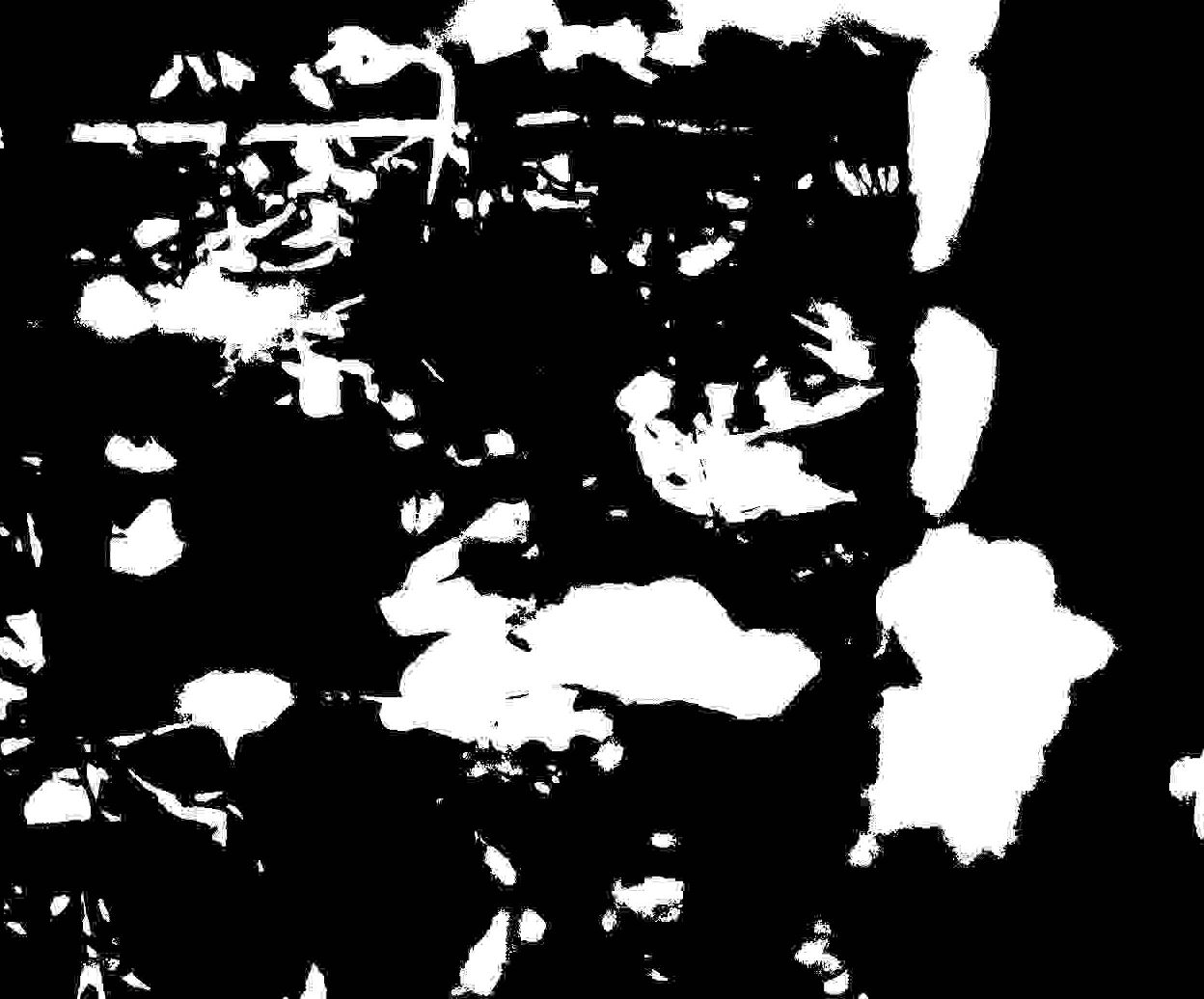
This article was published in the afternoon of 6 january 2026 on johnbjarnegrover.com under the directory articlesonlinguisticandsemioticmatters and 12 interesting articles of mine but when I later in the afternoon tried to update it for a couple of small emendations, the file was nulled - the file came up on the web but it was empty. This suddenly applied to all files on johnbjarnegrover.com so I could not update any file there without losing its contents. The quota for free web hosting on my account used to be 10 GB but was seemingly suddenly lowered to 1 GB, so from 23 january 2026 I changed from free web hosting to paid web hosting and it seems to function again. In the mean time it has been on johnbjarnegrover.net but since redirection did not function I could not make readers of johnbjarnegrover.com aware of it. Hopefully it now functions properly again.
Sources:
On the web 6 january 2026
Last updated 26 august 2026